

You may be reading this because worry has stopped feeling like “just stress”. You might be lying awake replaying conversations, scanning your body for signs that something is wrong, missing deadlines because your mind won't settle, or feeling exhausted by the effort of holding everything together. Some people arrive at this point convinced they have an anxiety disorder. Others wonder whether anxiety is only part of the picture, and whether ADHD, Autism, burnout, or longstanding personality patterns may also be involved.
That uncertainty is often the hardest part.
A careful anxiety disorder assessment is designed to reduce that uncertainty. It isn't an exam you pass or fail. It's a structured clinical process that helps a psychiatrist work out what symptoms you're experiencing, what may be driving them, how much they're affecting daily life, and what kind of support fits. In practice, that matters because many adults don't present in neat categories. Restlessness may be anxiety, ADHD, or both. Social avoidance may reflect social anxiety, Autism-related overwhelm, or painful past experiences. A specialist needs to untangle the threads, not guess.
In consultant-led adult services, that broader view matters even more. Work led by experienced consultant psychiatrists with expertise in neurodevelopmental conditions, personality disorder, and general adult mental health, including Dr Sai Achuthan, is often most useful when symptoms overlap and the underlying question is not merely “Do I have anxiety?” but “What is the most accurate explanation for what I'm living with?”
The First Step Towards Calmer Waters
A common story goes like this. Someone books an appointment after months of putting it off. They've told themselves they're overreacting, or that everyone feels like this. Yet they're checking emails repeatedly, struggling to switch off, dreading phone calls, and feeling tense even during ordinary tasks like shopping or commuting. Friends may say, “You need to relax,” but that advice rarely helps when your nervous system feels stuck on high alert.
A proper anxiety disorder assessment proves useful. It gives shape to what has felt chaotic. Instead of trying to self-diagnose from scattered symptoms, you sit down with a clinician who knows what to ask, what to rule out, and how to connect the details into a coherent picture.
That need is growing. In England, the prevalence of Generalised Anxiety Disorder among 16 to 24-year-olds increased from 1.1% in 2000 to 7.6% in 2023/24, and 18.3% of adults showed symptoms likely to benefit from clinical intervention, according to the NHS adult mental health and wellbeing survey for 2023/24.
A diagnosis starts with listening. The checklist matters, but your story matters just as much.
Many people worry that an assessment will reduce them to a label. In good psychiatric practice, the opposite is true. The point is to understand how anxiety shows up in your life. Do you avoid meetings because you fear embarrassment? Do you feel keyed up all day with no obvious trigger? Have concentration problems been present since childhood, suggesting ADHD rather than anxiety alone? These are different questions, and they lead to different recommendations.
What patients often get wrong
People often assume that seeking an assessment means they're committing to medication, or that they'll be judged for “not coping”. Neither assumption is right. Assessment comes first. Treatment decisions come later, once the picture is clearer.
Others fear they won't explain themselves well enough. That's exactly why structured psychiatric assessment exists. Your job isn't to present a perfect case. Your job is to describe what life has been like. The clinician's job is to make sense of it.
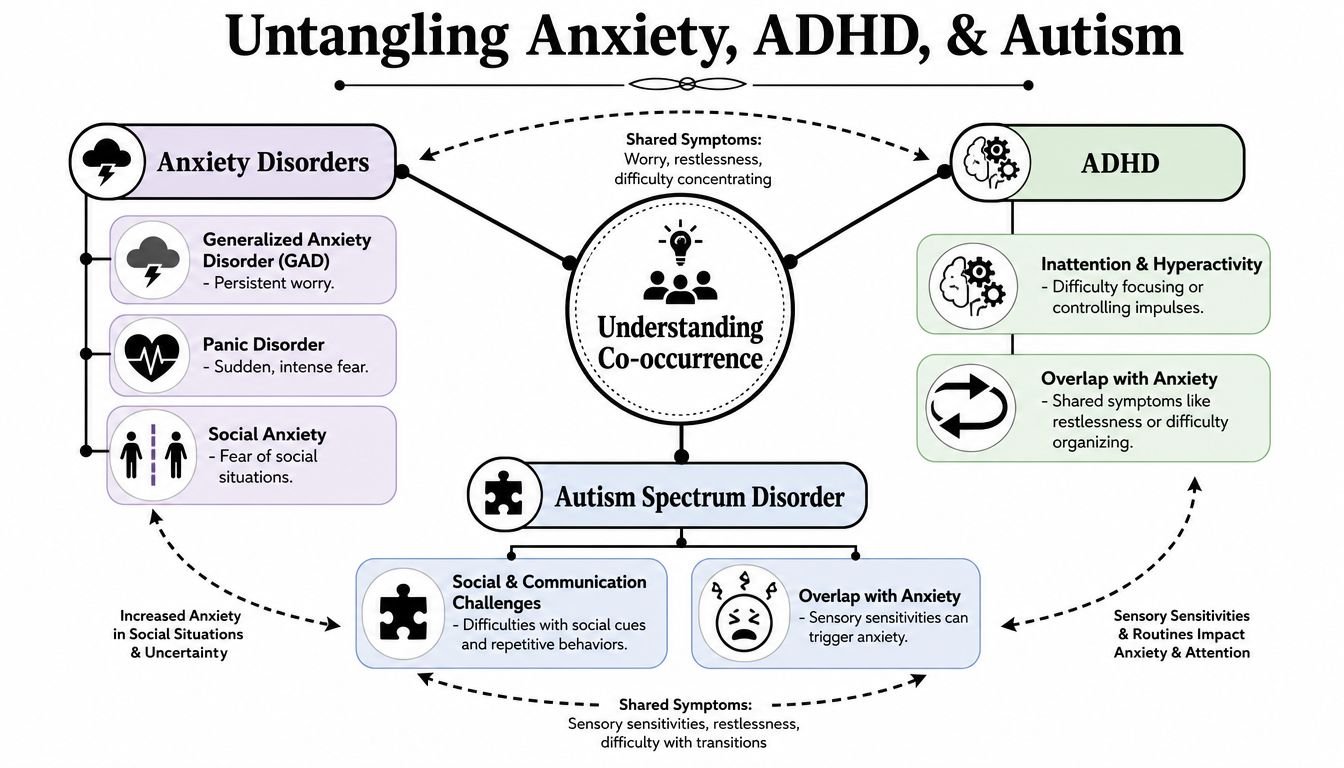
Untangling Anxiety ADHD and Autism
Anxiety is a real condition in its own right, but it also overlaps with other conditions so often that a superficial assessment can miss the mark. That's particularly important for adults who've spent years wondering whether they're anxious, neurodivergent, both, or neither.
When symptoms look similar
Think of symptoms as dashboard warning lights. A racing heart, poor concentration, irritability, avoidance, and sleep disruption can all signal anxiety. But the same “warning lights” can appear when someone with ADHD is overwhelmed by disorganisation and missed deadlines, or when an autistic adult is exhausted by sensory overload and social uncertainty.
Three common anxiety presentations often come up in clinic:
- Generalised Anxiety Disorder involves persistent, hard-to-control worry across several areas of life.
- Panic disorder usually centres on sudden surges of fear with intense physical symptoms.
- Social anxiety tends to focus on fear of scrutiny, embarrassment, or negative judgement.
Those categories are helpful, but only if they're used carefully. For example, an autistic person may avoid social events not because they fear judgement in the classic social anxiety sense, but because the noise, unpredictability, and demand to read social cues are overwhelming. An adult with ADHD may look “anxious” because they're constantly firefighting, forgetting, arriving late, and anticipating criticism.
Why differential diagnosis matters
As of December 2023, 172,022 people in England had an open referral for suspected autism, and estimates suggest up to 1.2 million autistic people and 2.2 million people with ADHD in England remain undiagnosed or waiting for assessment, as discussed in the BMJ report on neurodevelopmental assessment demand. That diagnostic gap matters because untreated neurodevelopmental conditions often show up in adulthood as anxiety, burnout, low self-esteem, or relationship strain.
Practical rule: If anxiety only explains part of the picture, the assessment should keep going.
A specialist psychiatrist will usually ask questions that go beyond current worry. Were there childhood signs of inattention, impulsivity, sensory sensitivity, rigid routines, or social communication differences? Do anxious episodes appear after sensory overload, change, or organisational failure? Are there repetitive relationship patterns that suggest personality factors rather than anxiety alone? Those distinctions shape the final diagnosis.
For some readers, this overlap becomes especially visible in relationships. Social uncertainty, rejection sensitivity, and sensory needs can complicate intimacy and connection, which is why practical communities focused on autism and dating can be useful alongside formal assessment.
Genetic and family patterns can also add context. If anxiety seems to run through generations, or if ADHD and Autism traits cluster in relatives, it can help to read a broader discussion of the anxiety disorder genetic picture before your appointment.
What a Gold Standard Assessment Involves
A high-quality anxiety disorder assessment isn't a quick chat followed by a label. It combines structured questioning, clinical judgment, and a careful review of how symptoms affect life. That's the standard patients should expect.
More than a symptom count
According to NICE guideline CG113 on generalised anxiety disorder and panic disorder, assessment must consider distress and functional impairment across social and occupational life, not just symptom totals, and diagnosis typically requires significant impact over at least six months. That point is easy to miss. Two people can report similar worries, but only one may meet the threshold for a disorder if the symptoms are persistent and disruptive.
A strong assessment usually explores:
- Current symptoms such as worry, panic, avoidance, physical tension, sleep problems, and concentration difficulties.
- Duration and pattern including whether symptoms are constant, episodic, linked to triggers, or present since childhood.
- Functional impact at work, university, home, and in relationships.
- Risk and safety including self-harm thoughts, substance use, and periods of crisis.
- Comorbidity such as depression, ADHD, Autism, trauma-related symptoms, or personality difficulties.
The role of questionnaires
Questionnaires can be helpful, but they don't diagnose by themselves. They support the clinical interview. A psychiatrist may use structured screening forms before the appointment so that the session can focus on detail and interpretation rather than basic data collection.
Collateral information can also help, especially when someone struggles to describe longstanding patterns. Input from a partner, parent, or someone who knew you earlier in life may clarify whether attention difficulties, rigidity, sensory issues, or social communication differences predated the anxiety.
The best assessments don't ask only “What symptoms do you have?” They ask “What do these symptoms mean in the context of your life?”
Signs of a robust service
If you're comparing providers, it helps to know what good practice looks like. A robust service should offer more than a short screening call and a generic summary letter. It should produce a reasoned formulation that explains why one diagnosis fits better than another, or why more than one diagnosis may apply.
Useful preparation often starts with knowing the kind of history a psychiatrist will take. This overview of mental health assessment questions gives a realistic sense of what clinicians usually explore.
A gold standard assessment should also leave room for uncertainty. Sometimes the correct answer isn't “You definitely have X.” Sometimes it is “You have clinically significant anxiety, but we also need to consider ADHD,” or “Your symptoms are real, but they may be better explained by autistic overwhelm and chronic stress.” That honesty is part of good medicine.
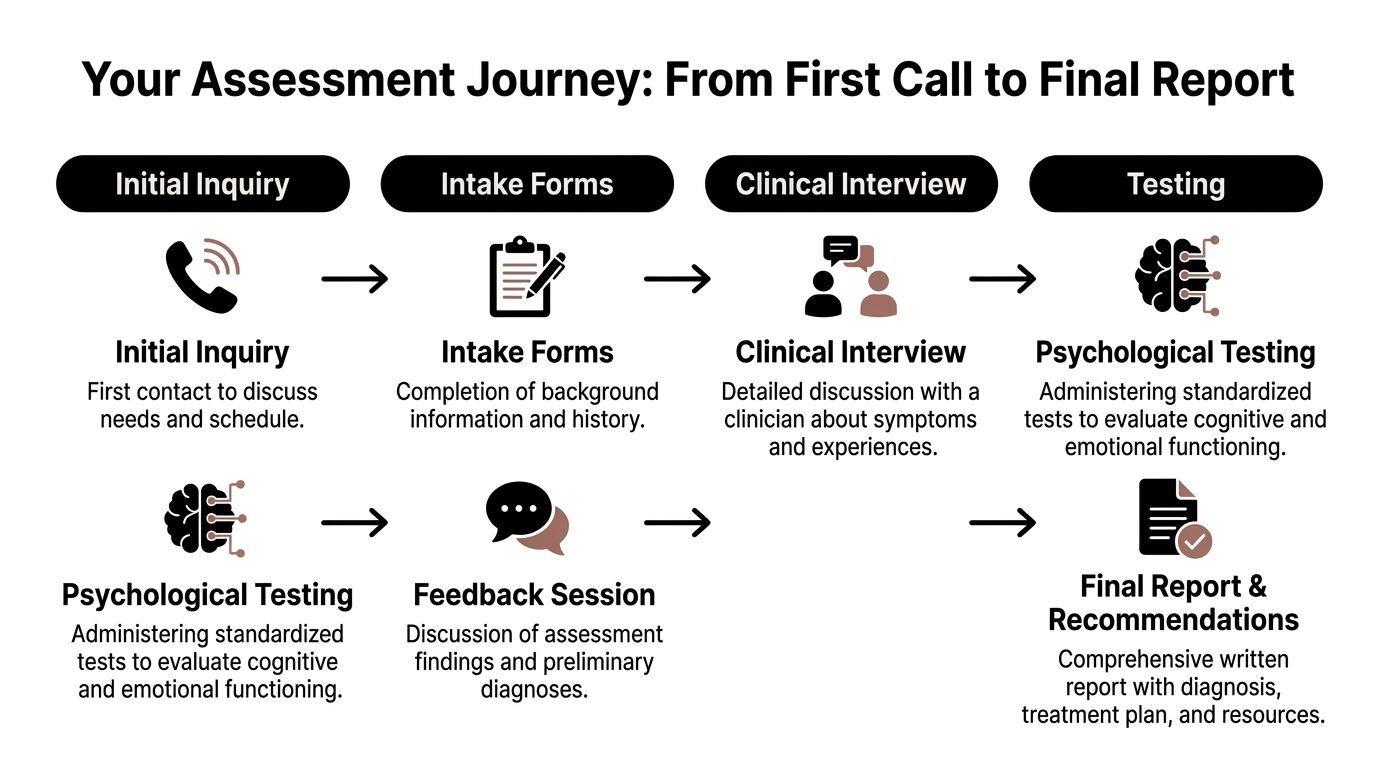
Your Assessment Journey From First Call to Final Report
Knowing what to expect tends to lessen anxiety. A well-run assessment pathway should feel organised, predictable, and respectful of your time.
The first contact
The process often starts with an enquiry call or booking form. This stage is simple. You outline what concerns you most, whether that's anxiety, panic, social difficulties, concentration problems, suspected ADHD, suspected Autism, or a mixture of several issues.
At this point, a good service should help you work out what kind of appointment fits. Some people need a focused mental health assessment. Others need a broader neurodevelopmental and psychiatric review because the symptoms don't sit neatly in one box.
One consultant-led option in the UK is Insight Diagnostics Global, which offers online and face-to-face adult assessments with psychiatrists on the GMC Specialist Register, with assessments usually scheduled within seven working days and reports completed within five working days thereafter.
Forms before the appointment
Pre-assessment forms are there to save time, not create bureaucracy. You may be asked about your background, current symptoms, medical history, medications, education, work, relationships, and previous mental health treatment.
A common tool at this stage is the GAD-7. It's a seven-item screening questionnaire used widely in UK primary care. A score of 10 or more is an important cut-point for moderate anxiety and signals the need for further clinical evaluation, as outlined in the CORC guide to the GAD-7.
The clinical interview
This is the heart of the assessment. The psychiatrist asks detailed questions, but the conversation shouldn't feel like an interrogation. You'll usually discuss when symptoms began, what triggers them, what makes them worse, how they affect daily functioning, and whether there were earlier signs of ADHD or Autism traits.
Expect practical questions, such as:
- What does a difficult day look like?
- What do you avoid, and why?
- Have these patterns been present since childhood, or did they emerge later?
- How are work, study, sleep, finances, and relationships affected?
If the psychiatrist has expertise in neurodevelopmental conditions and personality disorder, they'll also look at the broader pattern. Emotional dysregulation, chronic interpersonal stress, sensory sensitivity, and executive function problems can all colour how anxiety presents.
Try not to rehearse a “perfect” explanation before the appointment. Real answers are usually more useful than polished ones.
After the interview
After the assessment, the psychiatrist reviews the information and decides whether the evidence supports an anxiety disorder, another diagnosis, overlapping diagnoses, or a need for further evaluation. You may have a feedback discussion before the written report arrives.
That final report should give you more than a label. It should explain the reasoning. If anxiety is present alongside ADHD or Autism, the report should say how those conditions interact and what support is likely to help most.
Understanding Timelines Costs and Your Diagnostic Report
Practical questions matter. People usually want to know how long the process takes, what they'll receive at the end, and how private routes compare with NHS pathways.
Public and private routes feel very different
For autism and ADHD in England, waits can be long. Under the NHS Right to Choose pathway, new autism referrals were listed at 40 to 50 weeks as of June 26, 2026, while ADHD medication initiation wait times were 25 to 40 weeks, according to ProblemShared's Right to Choose waiting time information. That doesn't mean public care lacks quality. It means many patients face long periods of uncertainty before they receive answers.
Private assessment often appeals to people who need clarity sooner, want flexibility around work or study, or need documentation for treatment planning, workplace adjustments, university support, or shared decision-making with their GP.
What you should receive
A proper diagnostic report should be readable, specific, and clinically useful. It usually includes the referral reason, relevant history, presenting symptoms, mental state findings, diagnostic opinion, and individualized recommendations.
The most useful reports also include a formulation. That means an explanation of how your symptoms fit together. For example, a formulation might show that chronic anxiety has developed on top of untreated ADHD, or that autistic sensory overload is driving avoidance that could be mistaken for social anxiety.
| Service Component | Description |
|---|---|
| Example Private Assessment Package | Initial triage, pre-assessment forms, consultant psychiatric interview, diagnostic formulation, written report, and recommendations for treatment or further support |
Costs in context
Costs vary by provider and by the scope of assessment. Neurodevelopmental pathways are often priced separately from general mental health assessments. For context, NHS England's guide price for an Adult Face-to-Face Autism Assessment is £1,150, and for a Combined Adult ADHD/Autism Assessment it is £1,300, as set out in the NHS England payment guidance for ADHD and autism services.
That figure doesn't tell you what any individual private clinic will charge, and it shouldn't be used as a shortcut for judging quality. What matters more is whether the service includes a specialist interview, careful differential diagnosis, a robust report, and clear next-step advice.
How to Choose the Right Assessment Provider
Choosing a provider isn't only about speed. It's about whether the assessment will stand up clinically and help you move forward.
Check the clinical basics
Start with regulation and credentials. For adult psychiatric assessment in the UK, you should look for a service regulated by the CQC and clinicians who are on the GMC Specialist Register. Those details won't tell you everything, but they're an important starting point.
Then look at scope. If your symptoms may involve anxiety, ADHD, Autism, trauma, or personality factors, the provider should be able to assess overlap rather than forcing you into a narrow pathway. Specialist consultant experience is vital for such assessments. In more complex cases, a psychiatrist with experience across neurodevelopmental conditions, personality disorder, and general adult mental health, such as Dr Sai Achuthan, is often well placed to consider the full picture rather than one symptom cluster in isolation.
Ask direct questions before booking
A reputable provider should answer clear questions without being defensive. Useful questions include:
- Who will assess me. Ask whether you'll see a consultant psychiatrist and whether they routinely assess co-occurring ADHD, Autism, and anxiety.
- What does the report contain. You want more than a short confirmation note.
- Will functioning be assessed. A diagnosis should connect symptoms to real-world impact.
- What happens if the picture is mixed. Good clinicians don't pretend every case is straightforward.
If you're trying to work out whether psychiatric input is the right starting point, this guide on how to see a psychiatrist can help clarify the route.
If a service promises certainty after a very brief interaction, be cautious. Complex presentations often need careful, not fast, thinking.
Look for communication, not just credentials
The provider's style matters. Patients often remember whether they felt heard more vividly than they remember the exact questionnaire used. You want a service that explains the process, tells you what the forms are for, and gives you a report written in plain language.
A short explainer can help you judge that tone before you book:
One final point is non-negotiable. Assessment services like these are not crisis services. If you're at immediate risk, call 999. If you need urgent support but it isn't an emergency, contact NHS 111.
Turning Your Diagnosis Into Your Next Steps
A diagnosis can feel heavy at first, especially if you've been struggling for a long time. But in clinical practice, the most helpful diagnoses usually bring relief. They replace confusion with a map. They help explain why certain situations drain you, why previous coping strategies haven't worked, and what kind of support makes sense now.
That support won't look the same for everyone. One person may need anxiety-focused therapy. Another may need ADHD treatment because disorganisation and emotional overload are driving the anxiety. Someone else may need Autism-informed adjustments, better sensory management, and a clearer understanding of their social needs. Sometimes the biggest outcome is self-understanding.
That wider perspective matters in life transitions too. If anxiety appears around pregnancy or early parenthood, targeted support can be especially helpful, and resources such as these expert tips for postpartum anxiety may offer a useful starting point alongside formal clinical care.
The aim of an anxiety disorder assessment isn't to put you in a box. It's to help you stop guessing and start choosing your next steps with better information.
If you want a consultant-led adult assessment that considers anxiety alongside ADHD, Autism, and related mental health concerns, Insight Diagnostics Global offers online and face-to-face evaluations, structured reports, and follow-up options. It isn't a crisis service, but it can be a practical next step when you need diagnostic clarity and a treatment plan grounded in careful psychiatric assessment.