

You’ve probably done what many people do. You searched for an AQ-50 test, answered a long set of questions online, and ended up staring at a number that feels important but strangely unclear.
That number can stir up a lot. Relief. Doubt. Worry. Curiosity. For some people it fits years of feeling different. For others it raises new questions about autism, ADHD, anxiety, low mood, burnout, or social overwhelm. If that’s where you are, the most helpful place to start is simple: an AQ-50 score is not a diagnosis. It’s a screening result, and screening tools are meant to guide the next step, not settle the whole question.
In everyday clinical practice, careful psychological assessment is essential. Adults often arrive with overlapping concerns. Some are wondering about autism for the first time. Some already suspect ADHD. Some are dealing with anxiety, depression, or longstanding relationship difficulties that make self-report questionnaires harder to interpret. A thoughtful clinician looks at the whole person, not just one score.
That’s particularly important in the UK, where people are often trying to make sense of the AQ-50 while also navigating NHS referrals, Right to Choose, private options, and long waits. Leading with extensive experience, top, leading Consultant Psychiatrists in neurodevelopmental and personality disorder work, including Dr Sai Achuthan, this broader clinical lens matters because the right answer often comes from understanding how different conditions can look similar on the surface.
You Have an AQ 50 Score What Now
You finish the questionnaire. The page refreshes. There’s your result.
Maybe it’s higher than you expected, and you feel a jolt of recognition. Maybe it’s lower, and you wonder whether you answered “wrong”. Maybe you’re now replaying old school reports, work struggles, sensory experiences, friendships, and the effort it takes to get through ordinary days.

The first thing I’d want a patient to hear is this: your score is information, not a verdict. It doesn’t tell you who you are. It doesn’t cancel your experience if the number seems low. And it doesn’t confirm autism on its own if the number seems high.
What people usually feel after seeing the score
A score often lands in one of these ways:
- Recognition: “This explains a lot.”
- Uncertainty: “I’m not sure whether this fits me.”
- Second-guessing: “Did my anxiety affect my answers?”
- Urgency: “I need to get assessed properly.”
- Confusion about overlap: “Is this autism, ADHD, both, or something else?”
All of those reactions are reasonable.
A screening score is best used as a starting point for a careful conversation, especially when ADHD or mental health symptoms are also present.
What to do before you react too quickly
Pause before turning the result into a label. Ask yourself:
- What made me take the AQ-50 in the first place? Was it lifelong social difficulty, sensory sensitivity, rigidity, burnout, concentration problems, or a pattern someone else noticed?
- What else is going on right now? Anxiety, depression, exhaustion, trauma history, loneliness, and ADHD traits can all shape how you answer self-report questions.
- What am I hoping the result will help me do? Seek diagnosis, understand yourself better, ask for support at work or university, or make sense of a long history of struggling.
A calmer way to read the result
Think of the AQ-50 as similar to a smoke alarm. If it goes off, you shouldn’t ignore it. But the alarm itself doesn’t tell you exactly what caused the smoke, how serious the problem is, or what needs fixing. You still need proper assessment.
That’s why the most useful next step isn’t to keep retaking online tests. It’s to build a fuller picture of your difficulties, strengths, history, and current mental health before deciding on referral or assessment.
What Is the Autism Spectrum Quotient 50 Test
You might be sitting at your kitchen table in Manchester, Glasgow, or London, looking at an AQ-50 result and wondering what this questionnaire measured. That question matters, especially in the UK, where a screening result can shape whether you speak to your GP, use NHS Right to Choose, or look at a private assessment.
The AQ-50, or Autism Spectrum Quotient 50 Test, is a 50-question self-report screening tool used to spot patterns of autistic traits in adults. In UK practice, it is commonly used as an early screening step for adults who do not have moderate or severe learning disabilities and want to know whether a full autism assessment is worth pursuing.
The key point is simple. The AQ-50 helps identify whether further assessment may be appropriate. It does not confirm or rule out a diagnosis by itself.
What the questionnaire is actually looking at
The AQ-50 asks about everyday experiences that often come up in autism, such as social interaction, routine, communication, and detail focus. Rather than asking one big question, it samples traits across five areas so clinicians can get a rough sketch of your profile.
| Subscale | What it explores in plain language |
|---|---|
| Social skills | Whether social situations feel natural, confusing, tiring, or hard to read |
| Attention switching | How easily you shift plans, tasks, or ways of thinking |
| Attention to detail | Whether you notice small changes, patterns, or specifics strongly |
| Imagination | How you approach hypothetical situations and social imagination |
| Communication | Whether communication feels direct, literal, effortful, or easy to misread |
A rough sketch is the right comparison here. The AQ-50 works like an outline drawing, not a finished portrait. It can point to a pattern, but it cannot show the full person, their history, or why those traits are there.
That matters because adults often present in ways online checklists miss. Someone may look organised at work but be exhausted by social interaction. Someone else may seem chatty and still struggle with reciprocity, literal interpretation, or sensory overload. Many people have spent years masking, especially women and people who were never picked up in childhood.
Why it is still used in real clinical pathways
Clinicians use the AQ-50 because it gives structure to an initial conversation. If you are starting an NHS referral discussion with your GP, exploring a Right to Choose provider, or considering private assessment, a tool like this can help explain why autism is being considered.
It is also practical when there are overlapping concerns. A person may report lifelong social confusion, intense interests, difficulty switching tasks, and sensory stress. The same person might also have ADHD, anxiety, or both. In real UK assessment pathways, that overlap is common, and it is one reason a brief questionnaire can only ever be the opening step.
If you have already come across other screeners, the Sachs Center RAADS-R explanation is a useful example of how different autism questionnaires aim to flag traits rather than make a diagnosis.
What the AQ-50 leaves out
The AQ-50 cannot examine your childhood development in detail. It cannot judge how much masking is affecting your answers. It cannot reliably separate autism from ADHD, anxiety, trauma, depression, or personality factors when those are part of the picture.
That is why two people with similar answers may need very different follow-up. One may be autistic. One may have ADHD with social anxiety. One may have both, which is common enough that a careful clinician will usually ask about concentration, impulsivity, restlessness, worry, panic, and burnout rather than treating autism as the only possibility.
Used well, the AQ-50 is a useful starting tool in the UK system. Used on its own, it is too blunt to answer the question many individuals have, which is what explains their lifelong pattern and what kind of support will help.
How AQ 50 Scoring and Cutoffs Work
The scoring itself is more straightforward than people expect. The difficult part is interpreting the result correctly.
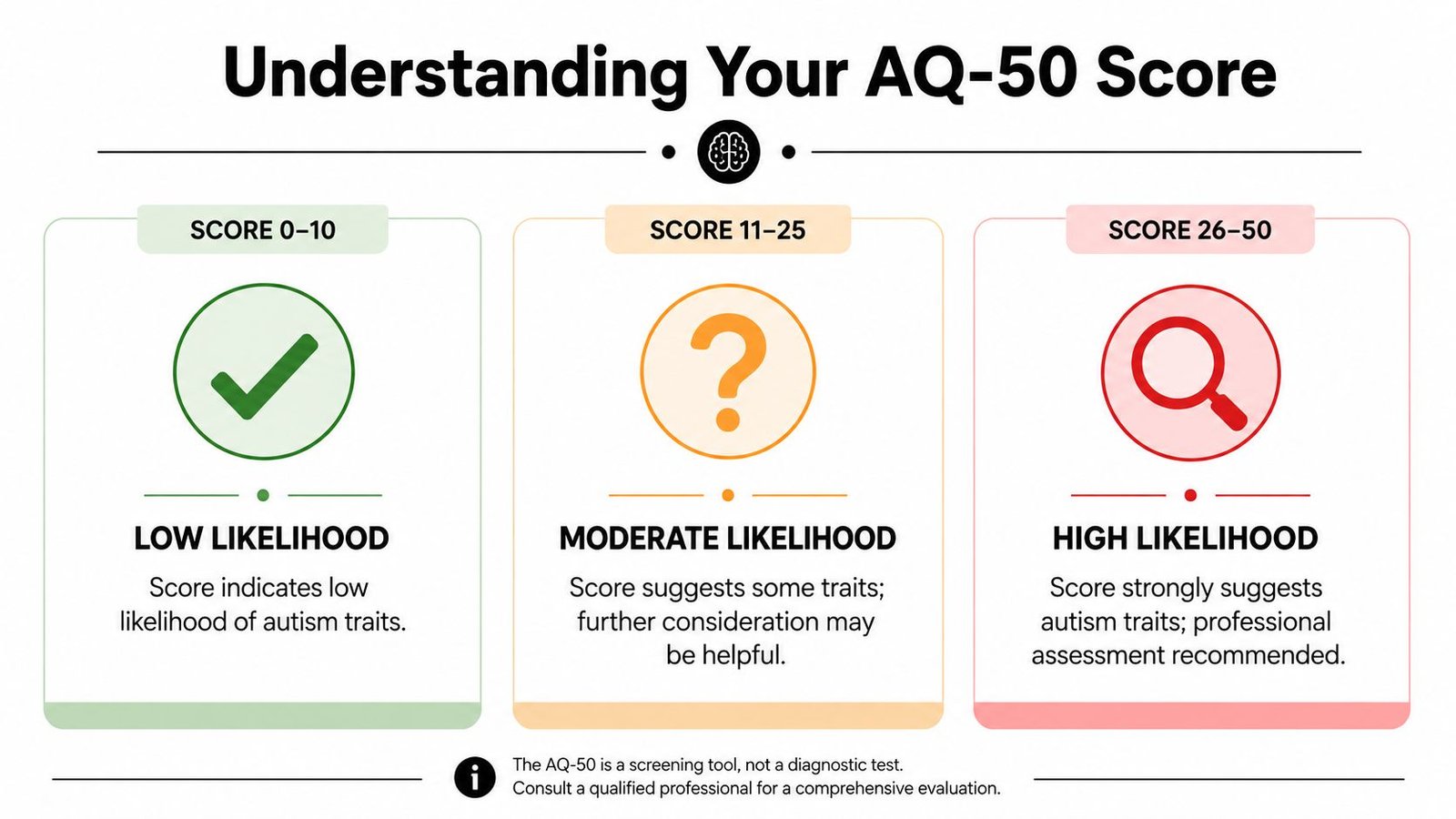
In UK settings, the validated cut-off is 26 or above, and scores below 26 can help rule out ASD with high specificity, while scores at or above 26 suggest significant autistic traits and the need for further evaluation, according to this AQ-50 validation paper in a UK context.
What your number actually means
An AQ-50 score is not a percentage of how autistic you are. It’s a tally of responses associated with autistic traits.
That means a score doesn’t measure identity or severity in a simple linear way. Two people can have the same total and still have very different profiles. One might score highly because of social communication and rigidity. Another might score highly because of detail focus and difficulty switching attention.
A practical way to think about cutoffs
This is the mistake many people make: they treat the cutoff like an exam pass mark. That isn’t how it works.
A better comparison is blood pressure screening. If a reading is above a certain threshold, a clinician doesn’t say, “That single reading proves the whole diagnosis forever.” They say, “This needs proper follow-up in context.”
Here’s a simple guide to the broad score bands shown in the graphic:
- Low range: Fewer autistic traits were picked up by the questionnaire.
- Middle range: Some traits are present, but interpretation needs care.
- Higher range: Autistic traits are more strongly indicated, and professional assessment is worth considering.
Why cutoffs can still feel confusing
Different online sites sometimes present AQ-50 scoring as if the threshold answers everything. It doesn’t. One reason is that autism screening tools don’t all work in exactly the same way. If you’re comparing questionnaires, this plain-language Sachs Center RAADS-R explanation is useful because it shows how screening scores can point towards further assessment without acting as a diagnosis by themselves.
A high AQ-50 score means “look closer”. It doesn’t mean “case closed”.
How to use the result wisely
If your score is 26 or above, the most sensible interpretation is that further assessment may be appropriate.
If your score is below that, don’t assume your experience is invalid. Some people under-report traits, answer too strictly in ways the questionnaire doesn’t capture well, or struggle to translate lifelong coping patterns into tick-box answers. A score is one piece of evidence. It is never the entire clinical picture.
The Important Limitations of the AQ 50
You finish the AQ-50, see a score that feels high, and your mind jumps straight to one question. “Does this mean I’m autistic?” In clinic, this is one of the most common moments of confusion, especially for adults in the UK who are trying to decide whether to speak to a GP, use Right to Choose, or pay for a private assessment.
The AQ-50 can be a useful starting point. It is only a starting point.
A UK referral study found that the questionnaire did not separate autistic and non-autistic adults cleanly enough to be used on its own, even at higher cutoffs, which is why clinicians treat it as one clue rather than a verdict in this UK study on AQ performance in adult autism referrals.
Why self-report has blind spots
The AQ-50 relies on your own reading of your behaviour, your history, and your internal experience. That sounds straightforward, but it often is not.
Many adults have spent years masking, copying other people, or explaining away their difficulties as shyness, stress, sensitivity, or “just being awkward.” Others have the opposite problem. A period of burnout, anxiety, low mood, or isolation can make every social interaction feel harder, so answers become coloured by current distress rather than lifelong pattern.
That is why a questionnaire works a bit like a snapshot taken in one kind of lighting. You can learn something from it, but you cannot see the whole person from one image.
Co-occurring conditions can blur the picture
Online AQ-50 explainers often skip over the hardest part of real assessment. Traits can overlap.
Anxiety can look like social avoidance. Depression can reduce motivation, expression, and connection. Trauma can affect trust, sensory responses, and relationships. ADHD can bring impulsive comments, missed social cues, poor concentration, restlessness, and difficulty shifting attention. On paper, some of those experiences can look similar. In real life, the reasons behind them matter.
If both autism and ADHD are possible, the job is not to pick whichever label appears first. The job is to work out whether one explains the picture best, whether both are present, or whether another mental health condition is shaping the pattern more strongly.
This matters in the UK because many adults reach autism services with years of unanswered questions and more than one possible explanation. That is one reason NHS and private clinicians should ask about attention, mood, anxiety, trauma history, and day-to-day functioning, not just autism traits.
What the AQ-50 cannot show
The questionnaire cannot do several parts of the job that a proper assessment needs to do:
- Track your developmental history. Autism diagnosis depends on patterns across childhood and adult life, not only how things feel this month.
- Test context. Difficulties may show up at work but not with close friends, or in noisy places but not quiet ones.
- Sort overlap carefully. The form cannot reliably separate autism from ADHD, anxiety disorders, depression, trauma effects, or personality factors.
- Notice masking. Some adults answer in ways that reflect how they have learned to cope, not how hard those situations are.
- Describe support needs. A score does not tell a clinician what help you need at home, at work, or in education.
Why this matters for UK assessment routes
If you are thinking about Right to Choose or a private assessment, the AQ-50 can help you decide whether it is reasonable to ask for a referral. It should not be used to rule yourself in or rule yourself out.
A high score may support the case for asking for a full autism assessment. A lower score does not automatically close the door, especially if your history strongly suggests autistic traits, masking, or overlap with ADHD or anxiety. Clinicians who assess adults well do not just count ticks on a form. They look for the pattern underneath them.
A better question is, “Does this result fit my longer story, and does that story deserve specialist assessment?” That is the question that leads to useful next steps.
From Screening Tool to Full Diagnostic Assessment
You finish the AQ-50, see a score that seems to explain a lot, and feel two things at once. Relief, because there may be a reason life has felt harder than it looks from the outside. Uncertainty, because a score is only the start of the story.
A diagnostic assessment adds the missing pieces. It looks at how your traits developed over time, how they show up across daily life, and whether autism is the best explanation, or only part of it. In UK practice, that matters a great deal because the route you choose, NHS, Right to Choose, or private, should lead to an assessment that is careful enough to sort overlap properly.
The AQ-50 is a bit like a waiting-room blood pressure check. It can show that something deserves closer attention. It cannot explain the whole picture by itself.
What a detailed assessment usually includes
A thorough adult assessment often brings several strands together:
| Part of assessment | Why it matters |
|---|---|
| Clinical interview | Explores your current difficulties, coping style, relationships, work or study life, and sensory or social patterns |
| Developmental history | Looks for traits across childhood and adolescence, not just adult stress |
| Collateral information | Family input or old reports can help clarify lifelong patterns |
| Structured assessment tools | Clinicians may use tools such as ADOS-2 or ADI-R when appropriate |
| Mental health review | Checks whether anxiety, depression, trauma, burnout, or personality factors are shaping the picture |
| Neurodevelopmental comparison | Helps distinguish autism from ADHD, or identify both |
Why specialist expertise matters
An experienced clinician looks for a pattern, not a tally. They ask when these traits began, how consistent they have been, what you do to cope, and what else could explain the same difficulties.
That is particularly important in adults who have spent years masking. Someone may sound socially confident in an appointment yet still be exhausted by everyday interaction. Another person may report poor focus and restlessness that point more strongly to ADHD, or to both autism and ADHD together. Anxiety can also muddy the picture by making social situations feel threatening even when the underlying issue is different.
This is one reason online tools can be misleading. They usually treat each condition as if it sits in its own neat box. Real life is rarely that tidy.
Co-occurring conditions can change the picture
In adult assessments, clinicians often have to separate three different questions. Are these lifelong autistic traits? Are there signs of ADHD as well? Are anxiety, depression, trauma, or burnout intensifying the difficulties right now?
That distinction affects what happens next. If someone is autistic and also has ADHD, the support plan may need to cover sensory needs, routine, attention regulation, and work adjustments. If anxiety is the main driver, the best help may look different. If more than one condition is present, a good assessment should say so clearly rather than forcing everything into a single label.
For people using Right to Choose or private services in the UK, this is worth checking before you book. Some providers assess autism only. Some are better set up to recognise overlap and recommend what should be assessed next. That can save time, money, and a second round of confusion.
What people usually gain from full assessment
A proper assessment can give something an online score cannot. Context.
People often come away with a clearer understanding of why certain environments wear them down, why work or relationships have felt effortful, and whether autism, ADHD, anxiety, or a combination fits best. Even if the final answer is not autism, the process can still be useful because it points toward the kind of support that matches your actual difficulties.
That clarity often represents the key value. It turns a number on a screen into an explanation you can use.
Your Next Steps for an Autism Assessment in the UK
Once you’ve taken the AQ-50 and feel the result may be pointing somewhere meaningful, the next decision is practical. How do you get assessed in the UK?
For many adults, the route starts with a GP. But it helps to know the situation before you book the appointment.
The main routes available
Standard NHS referral
Your GP can refer you into local autism services. This is the traditional route, but waiting times are a major issue. As of September 2024, 204,876 people in England were waiting for an autism assessment, a 25% increase in one year, and 87% had waited beyond the NICE-recommended 13-week timeframe, according to this report on growing autism assessment waiting lists in England.Right to Choose
If you’re in England and eligible, your GP may be able to refer you through Right to Choose to an alternative provider funded by the NHS. Many adults explore this route when local services are moving too slowly.Private assessment
Some people choose self-funded assessment for speed, flexibility, or easier appointment scheduling. This can also be useful if you want a more customized process or need answers sooner for work, study, or day-to-day functioning.
A short video can make the pathway easier to picture.
What to say to your GP
You don’t need to arrive with perfect language. Keep it clear and concrete. Helpful points include:
- What you struggle with: social communication, sensory sensitivity, routines, burnout, concentration, emotional overload
- How long it’s been present: childhood, adolescence, or a long-standing adult pattern
- Why you’re asking now: work problems, relationship strain, university pressure, parenting demands, or repeated burnout
- What you’ve already done: mention the AQ-50 and any other observations, but present them as background rather than proof
How to prepare for assessment
A little preparation can make the process smoother:
- Write examples down: Specific situations are more useful than broad labels.
- Gather old information: School reports, family memories, and past mental health notes can help.
- Think about overlap: If ADHD, anxiety, depression, or trauma may also be relevant, mention that early.
- Ask practical questions: Check appointment format, who assesses you, what reports include, and whether follow-up is available.
The best next step after an AQ-50 score isn’t more guessing. It’s a referral route that leads to a proper clinical assessment.
If your score has opened up important questions about autism, ADHD, anxiety, depression, burnout, or overlapping mental health concerns, a consultant-led assessment can help you move from uncertainty to clarity. Insight Diagnostics Global offers online and face-to-face assessments for adults, with structured evaluations by GMC Specialist Register psychiatrists, clear triage, detailed reports, and personalised recommendations for support and treatment.