

You're sat at the kitchen table in Birmingham, trying to answer emails, remember appointments, and make sense of why everything feels harder than it should. You've probably wondered whether it's stress, burnout, anxiety, or ADHD, and the uncertainty itself can become exhausting. A private ADHD assessment in Birmingham can give you a clearer route forward when waiting for answers has gone on too long.
For many adults, the hardest part isn't the symptoms themselves, it's not knowing whether they're dealing with ADHD, autism, another mental health condition, or a combination. That's where a consultant-led private pathway can help, especially when you want a structured assessment, a clear report, and practical next steps instead of more limbo.
Feeling Stuck The Search for an ADHD Diagnosis in Birmingham
By the time many people reach me, they have already worked through the same unhelpful pattern for months. Missed deadlines, scattered admin, forgotten bills, emotional overload, and the effort of holding everything together in public all start to add up. They may also have waited on an NHS list long enough for the waiting itself to become part of the strain.
That pressure is being felt across Birmingham and the wider West Midlands. A report from Greater Birmingham Chambers described NHS neurodevelopmental waiting times as stretching across the region, and patients describe the same problem in practical terms. When work, university, parenting, or relationships are being affected, a long delay can leave people stuck without a clear plan.
Why private routes feel more manageable
Private assessment exists because some people cannot keep life on hold while they wait for answers. Birmingham providers often promote faster access, and local services advertise assessments that usually take 2 to 4 hours, with reports often delivered in 5 working days Greater Birmingham Chambers. That changes what you can do next, especially if you need a report for your GP, workplace adjustments, or medication planning.
A quick appointment is only useful if the report stands up to real clinical use.
That is why many adults choose a consultant-led clinic rather than a brief symptom checklist. A structured pathway gives you a clear record of what was assessed, how the conclusion was reached, and what the next steps should be. If you want a plain explanation of the process, the guide to adult ADHD assessment near you is a useful place to start.
Choosing Your Path NHS vs Private ADHD Assessments
A lot of adults reach this point with the same question. Do they wait for an NHS route and accept the delay, or do they choose a private assessment so they can get a clear answer sooner? Both pathways have a place, but they meet different needs, and the right choice usually depends on how much uncertainty you can live with while symptoms keep affecting work, home life, and relationships.
Private care tends to suit people who want more control over timing and who need a report they can use without long interruptions to daily life. The NHS remains an important public option, but local access can be uneven, which is why many Birmingham adults start comparing alternatives before they feel ready. A private assessment only works well if it is thorough enough to support real clinical decisions, not just a label.
| Factor | NHS Pathway | Private Pathway (Insight Diagnostics Global) |
|---|---|---|
| Access speed | Often limited by regional waiting lists | Usually scheduled much faster, with Birmingham services commonly advertising short timelines |
| Appointment flexibility | Less flexible | More flexible, with some Birmingham clinics offering extended hours and same-day possibilities |
| Assessment length | Varies by service | Often 2 to 4 hours in Birmingham private services |
| Report turnaround | Dependent on NHS pathways | Reports commonly delivered within 5 working days in Birmingham private services |
| Clinician choice | Limited | Greater choice of consultant-led assessment model |
| Cost | Usually publicly funded | Self-funded, with local Birmingham pricing varying by clinic |
A private route suits some people better because it gives them more say in who sees them, how the assessment is structured, and how quickly the next step can happen. That matters if you need a report for your GP, workplace adjustments, or medication planning, or if you do not want to stay in limbo while symptoms keep disrupting life.
The choice also depends on whether you are eligible for an NHS alternative pathway. If you are comparing that option with private care, the guide on Right to Choose for ADHD gives a useful starting point.
What private really buys you
Private assessment is not only about speed. It can also mean more time with a consultant-led clinician, a clearer explanation of what was assessed, and a better chance to separate ADHD from burnout, anxiety, depression, autism, sleep problems, or coping strategies that have held things together for years.
That difference matters in practice.
Adults often come to assessment after a long period of compensating. They may have kept going through structure, effort, or routine, then found that work demands, parenting, study, or relationships have started to expose the difficulties more clearly. A well-run private pathway should recognise that pattern, ask the right questions, and give you a report that makes sense to your GP or another clinician who may need to act on it later.
For many people, the value is clarity as much as convenience. Speed helps, but only when the diagnosis is reasoned properly, the report is usable, and the next step is clear.
What a High-Quality Assessment Actually Involves
A credible ADHD diagnosis starts with a full clinical picture, not a quick online screening. NICE requires a full clinical and psychosocial assessment, a detailed patient history, observer reports, and a review of coexisting conditions (NICE NG87). That matters because a diagnosis should be defensible, not just fast.
A strong private report will show how symptoms appear across settings, how far back they go, and what else could explain them. Childhood onset is particularly important, as is evidence of impairment in more than one area of life. If those details are missing, the report can become harder for GPs to work with later.
What to expect from the clinician
The assessment should include a careful conversation about symptoms, school history, family context, work patterns, and mental health. It should also test whether the difficulties fit ADHD better than another explanation. That's especially important for adults who've developed strong compensating habits and only now feel overwhelmed when life gets more complex.
A consultant psychiatrist is often the right person to lead that process, particularly when the presentation is complicated by autism traits, personality factors, or broader mental health concerns. Insight Diagnostics Global's consultant-led model is relevant here because it brings ADHD, autism, and psychological assessment into the same clinical framework, rather than treating them as isolated issues.
What a proper report should include
A useful report doesn't just say yes or no. It should explain the reasoning, set out the diagnostic evidence, and outline recommendations that a GP can use. That includes the clinical logic behind the conclusion and any coexisting issues that may need separate attention.
Good reports help with shared care discussions because they show how the diagnosis was reached.
For a plain-language explanation of how psychiatric assessment works, the guide on what a psychiatric assessment involves is worth reading before you book. The key point is simple. The more thorough the assessment, the more usable the outcome.
Your Assessment Journey with Insight Diagnostics Global
The process should feel organised from the first call, not confusing. A well-run clinic will guide you through triage, questionnaires, interview, report, and feedback in a sequence that makes sense, so you know what's happening and why.
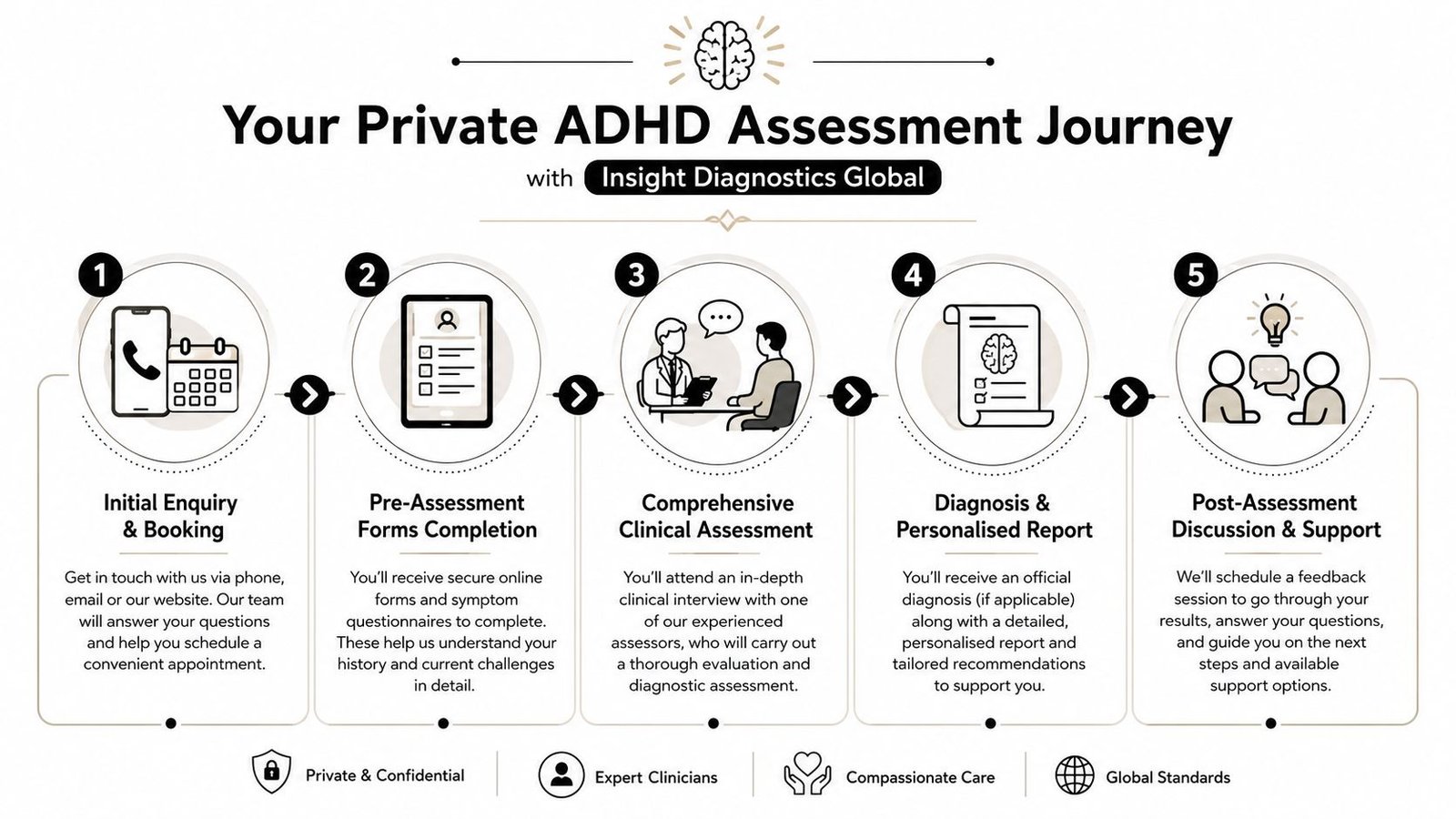
From first enquiry to booking
The first contact should be straightforward. You provide your background, the clinic checks whether an ADHD assessment is the right fit, and then you're booked into the right pathway. That initial filtering saves time later because it reduces the risk of being placed in the wrong appointment type.
Pre-assessment forms and preparation
Before the interview, you'll usually complete questionnaires about symptoms, developmental history, and current difficulties. These forms matter because they help the clinician spot patterns before the live appointment, and they make the interview more focused. Bring anything that helps you give a clearer history, such as school comments, old reports, medication lists, or a partner's observations if the clinic asks for them.
What happens in the clinical interview
The interview should feel structured but human. Expect questions about how you manage work, home life, relationships, time, attention, impulsivity, and emotional regulation. A good clinician will also ask what your coping strategies look like, because many adults have masked their difficulties for years.
Operationally, Birmingham providers commonly advertise appointments within days to weeks and reports within 5 working days (privateadhd.co.uk). That quick turnaround is only valuable if the report is detailed enough for GP handover and treatment planning, including medication titration where appropriate.
Feedback and next steps
The final appointment should leave you with clarity, not loose ends. You should understand the result, the reasoning, and the practical implications for work, study, health, and treatment. If medication is being considered, the report should support the next clinical step rather than end the journey abruptly.
Understanding Costs Insurance and Funding Options
Birmingham prices make private assessment more reachable than many people expect, but the spread is still broad. Local clinic comparisons show private ADHD assessments in Birmingham typically cost between £400 and £1,500, with examples at £550, £595, and £995; the same comparison also places many Birmingham options below the 2024 UK national average of £1,267 (Compare ADHD Clinics Birmingham).
The more useful question is what sits behind the fee. A lower price only represents good value if the assessment follows NICE-aligned practice, the clinician is properly qualified, and the report can support next steps. A higher fee can still be reasonable when it includes stronger clinical oversight, clearer documentation, or medication-related support that makes the outcome easier to use.
Self-funding versus insurance
If you are paying privately, you need clarity on what the fee includes. Ask whether it covers the interview, the written report, feedback, and any follow-up discussion, because those parts turn a consultation into a diagnosis you can use. If you are using private cover, approval usually needs to be checked in advance, so confirm authorisation before you book.
For a plain guide to how insurers may handle mental health assessment funding, the article on private mental health insurance is a useful starting point. The practical point is to get written confirmation of cover and know what documents the insurer wants before the appointment.
How to judge value properly
Judge the full pathway, not just the headline fee. A cheaper assessment that leads to a weak report can cost more later if you need a second opinion or your GP cannot act on the outcome. A good clinic should be able to explain what happens after diagnosis, including any follow-up discussion and how shared-care conversations may be supported.
Value is the combination of clinical quality, speed, and downstream usefulness.
That is the standard I would use if I were comparing providers for myself or a family member. Cost matters, but so does whether the result moves care forward.
Take the First Step Book Your Birmingham Assessment Today
A good private pathway should do more than label symptoms. It should give you a consultant-led assessment, a reasoned diagnosis, and a report that can support next steps such as GP discussions, medication planning, or wider psychological care. That's particularly relevant when ADHD may sit alongside autism or other mental health needs, because the assessment has to reflect the full picture rather than one narrow concern.
What accessibility can look like in Birmingham
Some Birmingham clinics offer appointments 7 days a week from 8am to 8pm, and some mention the possibility of same-day appointments (The Vesey). That kind of availability can matter a lot if you're balancing work, study, childcare, or shift patterns and need the assessment to fit around real life.
The right service should also feel calm and clear from the moment you enquire. You should know who is assessing you, what the process involves, and what support is available after diagnosis. In consultant-led services, that often includes ADHD titration and ongoing monitoring when medication is appropriate, which helps the diagnosis connect to actual treatment rather than stopping at a report.
Why consultant-led care matters
A consultant psychiatrist brings experience to more complex presentations, especially when ADHD overlaps with autism, mood symptoms, anxiety, or long-standing personality patterns. Insight Diagnostics Global provides adult mental health assessments in a consultant-led format, with structured evaluation and follow-up options that can include ADHD medication support. For adults who want a clear, clinically grounded route through assessment, that combination can make the process much easier to follow.
If you're ready to stop guessing and get a proper assessment, book with Insight Diagnostics Global today. Start the conversation, complete the forms, and move towards a diagnosis that's built to be understood, documented, and used.