

Many adults start looking for a private ADHD test after years of feeling out of step with everyday life. Deadlines slip, routines break down, emotions feel harder to regulate, and simple tasks seem to take far more effort than they should. By the time someone seeks an assessment, the deeper question is often larger than "Do I have ADHD?" It is "What has been causing this pattern, and what happens if I finally get a clear answer?"
That distinction matters.
ADHD can overlap with autism, anxiety, depression, trauma, sleep problems, and personality-related difficulties. The diagnostic process works like putting together a clinical timeline rather than ticking off a quick checklist. A careful assessment looks at childhood history, current symptoms, mental health, functioning, and possible alternative explanations, so the final opinion is grounded in evidence and makes sense in the wider picture of your life.
This is also why the quality of the pathway matters as much as the assessment itself. A consultant-led service such as Insight Diagnostics Global should not only identify whether ADHD is present. It should also explain what the diagnosis means, whether medication is appropriate, how titration would be supervised, and whether the report is likely to be accepted by GPs, employers, universities, or NHS services. In practice, patients need more than an appointment. They need a regulated clinical process, clear documentation, and follow-up care that does not stop at the moment a diagnosis is given.
For adults who have spent years second-guessing themselves, that kind of structure can bring relief as well as clarity. A well-run private pathway is not only faster. It is safer, more useful after the diagnosis, and more likely to give you an answer that stands up to scrutiny.
The Growing Need for Private ADHD Assessments
Long waits change the meaning of an assessment. What begins as a search for answers can turn into months, or longer, of coping without a clear plan for work, study, relationships, or mental health care.
That is why more adults are considering private assessment. The issue is not simple curiosity about ADHD. It is the gap between noticing that something has been wrong for years and being able to access a diagnosis that is clinically sound, properly documented, and useful after the appointment has ended.
For many people, the unanswered question is bigger than concentration alone. ADHD can affect time management, emotional regulation, follow-through, finances, driving, parenting, and self-confidence. Over time, repeated difficulties often get misread as laziness, lack of discipline, anxiety, or personal failure. By the time someone seeks help, they are often carrying a long history of frustration and self-doubt.
Private care becomes appealing at that point because adults are rarely looking for speed in isolation. They are looking for a pathway that makes sense from start to finish. That means an assessment led by a qualified psychiatrist, clear reasoning about whether ADHD is present, and a report that can support practical next steps such as workplace adjustments, university support, shared care discussions, or treatment planning.
Why adults look outside the NHS
Adults usually seek private assessment when uncertainty starts affecting daily life in a sustained way. Some need clarity before changing jobs or returning to education. Some want to understand whether medication is appropriate. Others have already been treated for anxiety or depression and still feel that the main problem has not been fully explained.
A well-run private service should look at the wider clinical picture, including autism traits, mood symptoms, sleep, trauma history, substance use, and physical health where relevant. That wider view matters because ADHD diagnosis works like assembling a case file, not ticking off a few familiar symptoms. The clinician has to decide whether the pattern fits ADHD, whether another condition explains it better, or whether more than one condition is present.
A diagnosis should do more than label symptoms. It should explain the pattern, the risks, and the next clinical step.
This is also where standards matter. A regulated, consultant-led pathway gives patients more than an opinion on the day. It provides clinical governance, careful documentation, and follow-up arrangements that make the diagnosis more likely to be safe, valid, and accepted by other professionals. In practical terms, people often need to know whether the clinic is CQC-regulated, whether the assessment is carried out by a GMC specialist psychiatrist, and whether medication titration and review are available if ADHD is confirmed.
When the question is bigger than ADHD alone
Some adults book an ADHD assessment expecting a straightforward answer and instead receive a more detailed formulation. They may meet criteria for ADHD. They may also show signs of autism, anxiety, depression, trauma-related symptoms, or another psychiatric difficulty that changes the treatment plan.
That does not mean the assessment has failed. It means the process has done its job.
A careful private pathway should reduce confusion, not add to it. If the outcome is ADHD, the next question becomes how treatment will be monitored. If the outcome is not ADHD, the patient should still leave with a clear explanation of what the clinician believes is happening and what kind of support or further assessment is appropriate. That is one of the strongest reasons demand for private ADHD assessments continues to grow. Adults do not just want a faster appointment. They want an answer that holds up clinically and helps them understand what happens next.
Understanding the Diagnostic Pathway
Around the UK, adults seeking ADHD answers often arrive with years of self-doubt behind them. The diagnostic pathway matters because a valid assessment has to do more than identify symptoms on a questionnaire. It has to show how those symptoms developed, how they affect daily life, and whether ADHD is the best explanation.

Screening is not the same as diagnosis
An online screener works like a smoke alarm. It can alert you that ADHD may be worth investigating, but it cannot tell you what caused the smoke, how serious the problem is, or what should happen next.
A diagnosis requires a fuller psychiatric assessment. In practice, that usually means a structured interview based on DSM-5 or ICD-11 criteria, with careful attention to childhood history, current impairment, and alternative explanations for the symptoms. This overview of private adult ADHD assessment accuracy explains why that distinction matters.
A clinician is not only asking whether the traits sound familiar. They are working through a more careful set of questions:
- Were these patterns present in childhood, even if they were missed at the time?
- Do they affect more than one part of life, such as work, study, relationships, or home routines?
- Have they been persistent over time rather than appearing only during stress or burnout?
- Could anxiety, depression, trauma, sleep problems, substance use, or autism explain the picture more accurately?
- If ADHD is confirmed, what follow-up care will make the diagnosis useful in real life rather than just descriptive on paper?
That last point is easy to overlook. A diagnosis without a plan can leave patients stuck at the very moment they expected clarity.
Who should carry out the assessment
For many adults, the safest option is a Consultant Psychiatrist on the GMC Specialist Register, especially when symptoms overlap with other psychiatric or neurodevelopmental conditions. Adult ADHD rarely appears in neat textbook form. Someone may describe distraction and disorganisation, but also panic symptoms, low mood, emotional volatility, autistic traits, or a trauma history. Sorting those threads requires senior clinical judgment.
The setting matters too. A regulated pathway gives structure to the whole process, not just the appointment itself. Patients often ask a practical question at this stage: will this diagnosis be recognised by my GP, the NHS, my university, or occupational health? Recognition is more likely when the assessment sits within proper clinical governance, includes clear documentation, and is completed by an appropriately qualified specialist. That is one reason many people researching a private ADHD assessment UK route look beyond speed alone.
Insight Diagnostics Global is one example of a service that uses a consultant-led model for adults aged 18 and over, with assessment of ADHD, autism, and other mental health concerns within a regulated framework. The point is not the brand name. The point is the standard. Patients should know who is diagnosing them, what diagnostic framework is being used, how comorbidity is assessed, and what follow-up is available after the report is issued.
Practical rule: If a provider cannot explain who makes the diagnosis, how childhood history is evaluated, how overlapping conditions are considered, and what happens after diagnosis, keep looking.
Why senior psychiatric expertise changes the outcome
A good adult ADHD assessment is part detective work, part formulation. The clinician gathers school history, family observations, patterns of impairment, and mental health history, then tests whether those pieces fit ADHD consistently enough to justify diagnosis. If they do not, the patient still needs a clear explanation of what does fit.
That can be reassuring. A careful pathway may confirm ADHD, but it may also show that anxiety, depression, autism, trauma-related symptoms, or personality-related difficulties are playing a larger role. Senior psychiatrists with neurodevelopmental expertise, including Dr Sai Achuthan, add value here because they are trained to weigh the full picture rather than forcing every difficulty into a single label.
For patients, this is often the difference between receiving an answer and receiving a plan.
Private vs NHS Pathways A Clear Comparison
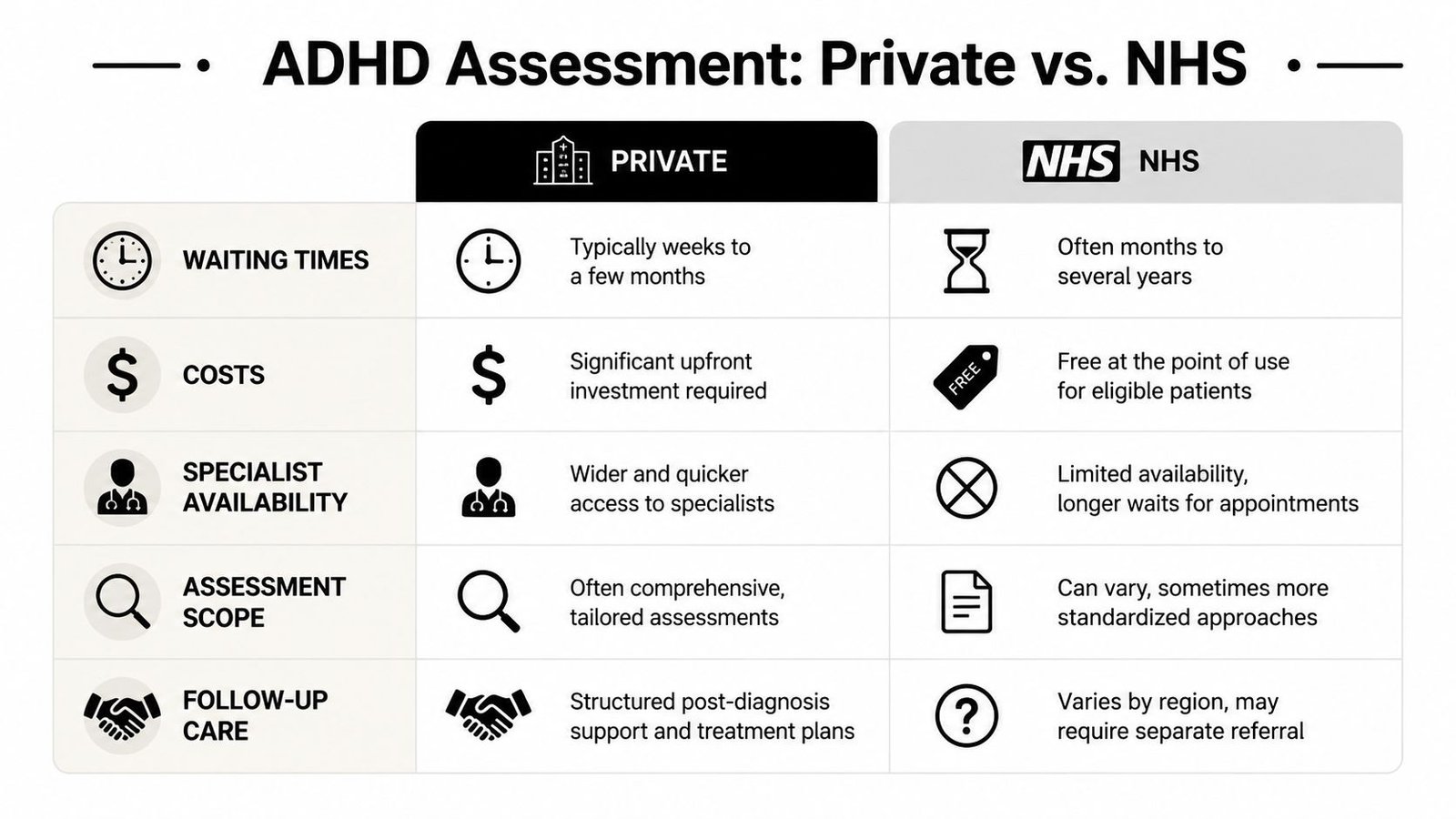
For most adults, the decision comes down to access, cost, flexibility, and what happens after diagnosis. Both NHS and private routes can lead to a valid assessment. The difference is often how long you wait, how much choice you have, and how coordinated the follow-up is.
The pressure point is waiting time
Many adults start on the NHS route and then reconsider when they realise how stretched services are. A major review from the University of York found that many NHS sites in England report waiting times of 1 to 2 years for triage, with the majority waiting over 48 weeks for assessment, and some facing waits of 5 to 10 years for a full ADHD evaluation, according to the PREPARE report on adult ADHD assessments.
That doesn't mean the NHS pathway lacks quality. It means access can be extremely delayed, and delay has consequences. People often seek assessment during a crisis point: workplace trouble, academic collapse, worsening mental health, relationship breakdown, or severe burnout.
Private ADHD Assessment vs NHS Pathway
| Factor | Private Pathway (e.g., Insight Diagnostics) | NHS Pathway |
|---|---|---|
| Waiting time | Often quicker, with more flexible booking options | Can involve long waits for triage and assessment |
| Cost | Self-funded or insurance-funded in many cases | Free at the point of use for eligible patients |
| Choice of clinician | More choice over provider and appointment format | Less choice, determined by local service structure |
| Assessment style | Often more individually scheduled and easier to arrange around work or study | Usually limited by local service capacity |
| Post-diagnostic support | May be integrated, but you must check this carefully before booking | Varies by area and pathway |
| Acceptance of report | Stronger when consultant-led and clinically robust | Integrated within NHS systems |
The Right to Choose route isn't always straightforward
Some adults hope to avoid private fees by using Right to Choose. That can work in some areas, but it isn't as simple or as universal as many websites make it sound. Regional policies can affect eligibility and funding in ways that catch people by surprise.
One issue that deserves more attention is the over-25 funding gap. In some areas, including Coventry and Warwickshire, adults over 25 have faced a pause in NHS and Right to Choose funding since May 2025, as discussed in this explainer on what to expect from ADHD assessment questions. If you're in that age group, your GP may not be able to refer you through the route you expected.
For a grounded overview of how people weigh these options in practice, this piece on a private ADHD assessment UK pathway is also useful.
If you're relying on Right to Choose, check local policy before you assume the route is open to you.
What Happens During a Private ADHD Assessment
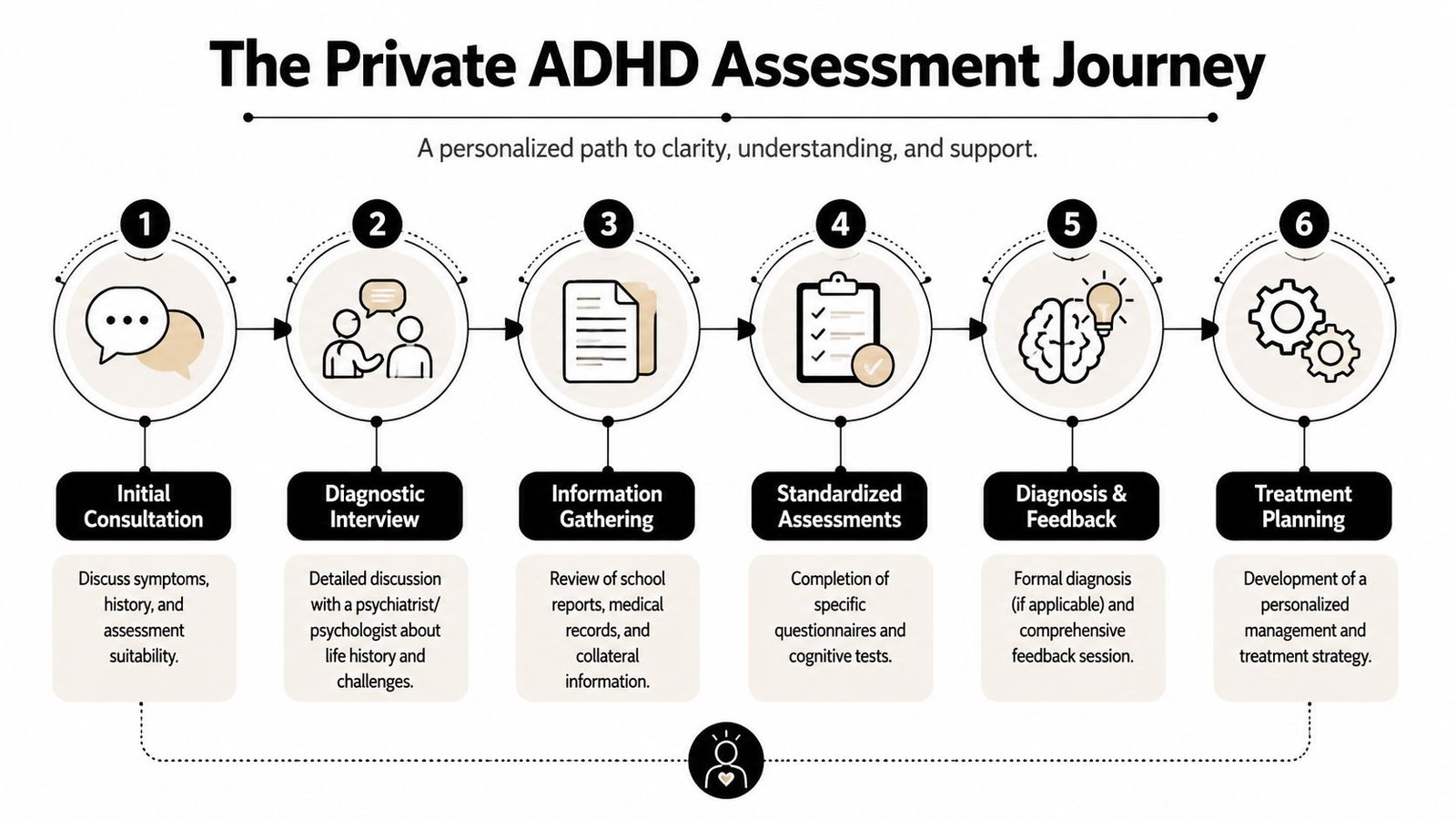
Most adults feel anxious before the appointment because they don't know whether it will feel like an exam. It usually doesn't. A proper assessment feels more like a structured, detailed conversation where the clinician is trying to understand your history, not catch you out.
The appointment itself
A robust private ADHD test for adults should follow NICE-based standards. That means a structured diagnostic interview using DSM-5 or ICD-11 criteria, not just a symptom checklist. It should also include 60 to 90 minutes of clinician-led evaluation, with attention to developmental history and current functional impact, as noted in the earlier linked guidance on diagnostic standards.
In plain terms, the clinician is usually trying to answer four things at once:
What are the current symptoms?
You may be asked about focus, disorganisation, lateness, forgetfulness, restlessness, impulsivity, emotional regulation, task initiation, and finishing tasks.Were these traits present earlier in life?
ADHD is developmental. The psychiatrist will often ask about school, homework, behaviour, friendships, family observations, and how you managed structure when you were younger.How do these difficulties affect day-to-day functioning?
It's not enough to have traits. The key issue is impairment at work, home, in education, financially, socially, or in self-care.Could something else be contributing?
Anxiety, depression, trauma, sleep problems, autism, substance use, and other psychiatric conditions can overlap with ADHD symptoms.
Why collateral history matters
You may be asked to provide supporting information from a parent, partner, sibling, or someone who has known you for a long time. Adults sometimes worry this means they won't be believed without another witness. That's not the point.
Collateral information helps the clinician test whether the pattern is long-standing and consistent. School reports, family memories, or a partner's account of current difficulties can strengthen the overall picture.
A short visual summary can help make the process feel less abstract:
What the clinician may ask about
Questions often move across different parts of life rather than staying narrowly focused on attention.
- Work and study: missed deadlines, underperformance, job-hopping, difficulty sustaining effort
- Home life: clutter, unfinished chores, lost items, unpaid bills, inconsistent routines
- Relationships: interrupting, forgetting plans, emotional reactivity, conflict linked to disorganisation
- Mental health: panic, low mood, overwhelm, shutdown, masking, shame
- Autism-related themes: sensory issues, social exhaustion, literal thinking, rigid routines, masking in social settings
Bring examples if you can. “I struggle to focus” is helpful. “I reread the same email six times and still don't send it” is more clinically useful.
The assessment works best when you answer concretely, even if the examples feel messy or embarrassing. That detail is often what makes the diagnosis accurate.
Your Diagnostic Report and What It Means
The report is one of the most important parts of the whole process. A diagnosis without a clear report can leave you stuck, especially if you need to share the outcome with a GP, employer, university, or another clinician.
A thorough report usually does more than say whether ADHD criteria are met. It sets out the clinical reasoning. That includes your background history, the symptoms discussed, the developmental pattern, how impairment shows up in adult life, and whether other conditions need consideration. For many adults, this is the first time they've seen their experiences described in a way that makes coherent sense.
What a strong report usually includes
A useful psychiatric report often covers:
- Background and history such as childhood development, education, work pattern, relationships, and relevant mental health history
- Assessment findings drawn from the interview, questionnaires, and any collateral information
- Functional impact across daily living, work, study, organisation, and emotional wellbeing
- Comorbidity analysis where the clinician considers autism, anxiety, depression, trauma, or personality-related patterns
- Diagnostic conclusion with a clear statement about whether criteria are met
- Recommendations for treatment, workplace adjustments, therapy, medication review, or further assessment
Why this matters after the appointment
A detailed report helps other professionals understand that the assessment was careful and medically grounded. That matters if you later discuss medication, ask for workplace support, or need academic adjustments.
It also matters emotionally. Many adults don't just want a label. They want an explanation that accounts for the full picture, including the possibility that ADHD sits alongside autism or another mental health condition.
The best reports are clinically precise but also readable. You should be able to understand your own assessment without needing a translator.
If the outcome is not ADHD, the report should still be valuable. A good service explains why the criteria weren't met and what alternative formulation or support should be considered instead.
After the Diagnosis Follow-up Care and Medication
Many private pathways frequently exhibit a significant oversight. People often concentrate so intently on securing the assessment that they neglect to inquire about what occurs once the results are received.
That question matters because a common gap in private care is the post-diagnostic disconnect. Some services provide a report but don't offer immediate medication titration or ongoing monitoring, and report turnaround can take 4 to 6 weeks, delaying access to care, as outlined in ProblemShared's overview of adult ADHD assessment.
Diagnosis is the start, not the endpoint
A formal diagnosis can bring relief, but it also creates practical decisions. Do you want medication? Are there risks or contraindications? Do you need support for anxiety, sleep, or autistic burnout as well? Will your GP consider shared care later on? Do you need a letter for work or university now?
Without follow-up, people can end up with a diagnosis but no plan.
That's why a regulated, consultant-led pathway is so important. You want a service that can do more than confirm ADHD. You want one that can manage the next stage responsibly, especially if medication is being considered.
What good follow-up care looks like
Look for a pathway that includes these elements:
- Feedback consultation: time to go through the diagnosis and ask questions
- Treatment planning: discussion of medication, psychological strategies, lifestyle adjustments, and whether autism or another condition also needs support
- Medication titration: careful prescribing and dose adjustment under psychiatric supervision when appropriate
- Monitoring: follow-up reviews, side-effect checks, and outcome tracking
- Clear documentation: letters and reports suitable for GP communication and future care coordination
For day-to-day self-management between appointments, practical strategy guides can also help. Some adults find resources like Pretty Progress's ADHD focus advice useful alongside formal treatment, especially when they're learning how to structure work, reduce distractions, and recover from chronic overwhelm.
Why regulation matters here
Prescribing and monitoring require governance, not just convenience. If a clinic isn't set up for ongoing care, patients may be left trying to assemble treatment piecemeal after diagnosis. That can be frustrating and, in some cases, unsafe.
When a service is CQC regulated and consultant-led, there's usually a clearer framework for follow-up, record-keeping, clinical responsibility, and communication with other healthcare providers. That doesn't guarantee every pathway will suit every patient, but it does provide a safer foundation.
Choosing a Reputable Clinic What to Look For
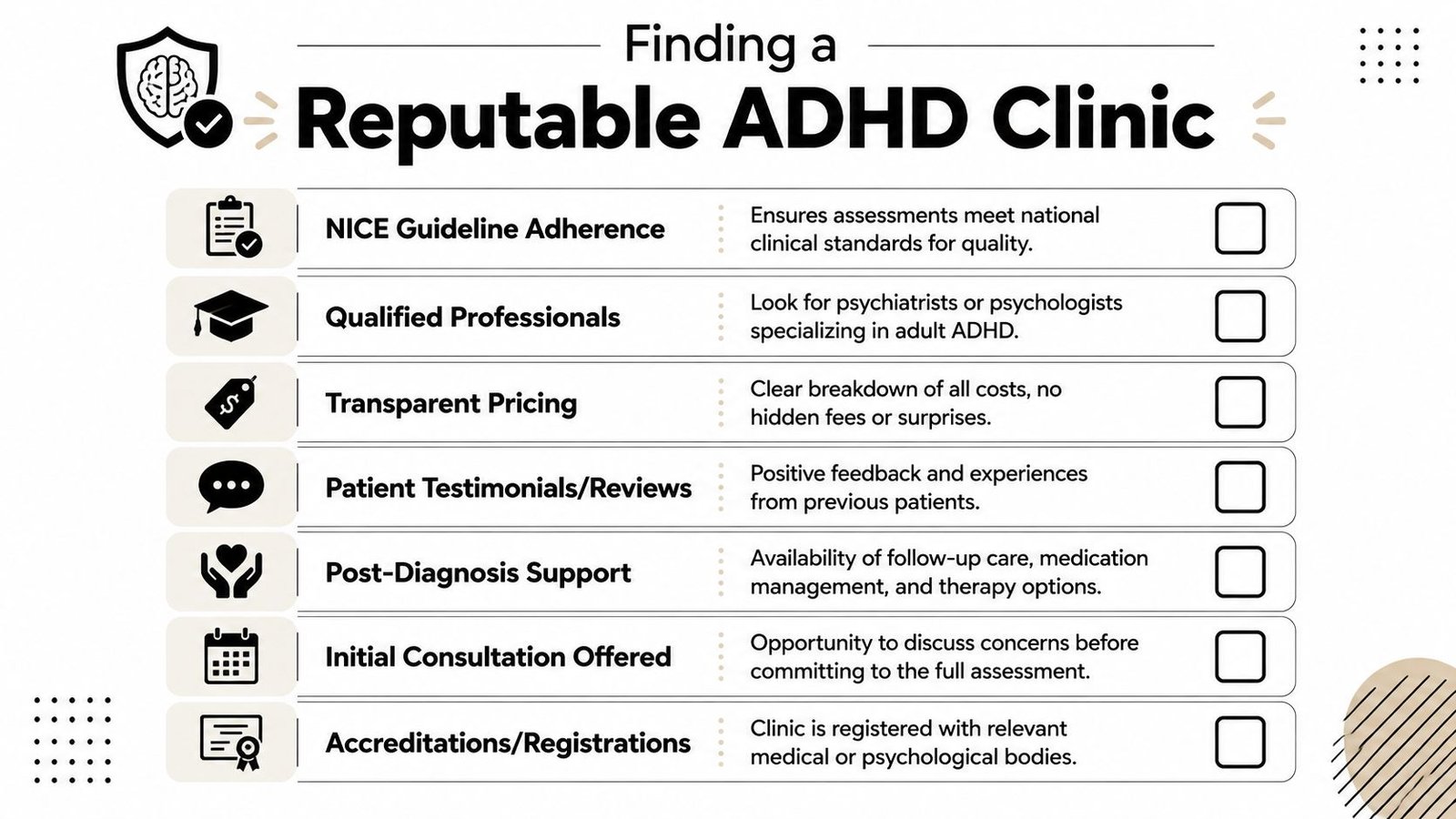
A private ADHD assessment can be the start of treatment, workplace support, university adjustments, or shared care discussions with your GP. That is why the clinic you choose matters as much as the assessment itself.
A practical checklist
Cost often draws people in first, especially when waiting lists feel long. For context, in 2024 the average private ADHD assessment cost for adults in the UK was £1,200, with follow-up consultations averaging £173 and monthly private prescription costs ranging from £25 to £125, according to My Tribe Insurance's cost overview. The more useful question is what that fee buys you after the assessment day.
A good clinic should give you a clear pathway from first appointment to next steps. In practice, that means asking about the parts patients often discover too late: who makes the diagnosis, how the report is written, whether prescribing is available if appropriate, and who remains clinically responsible once treatment starts.
Use this checklist when choosing a clinic:
- Check regulation: If the provider is regulated by the CQC, there is a clearer framework for safety, record-keeping, complaints handling, and clinical accountability.
- Confirm clinician status: For adult ADHD, GMC-registered consultant psychiatrist involvement matters, especially if the diagnosis may affect prescribing, GP communication, or questions about overlapping conditions.
- Ask how the assessment is carried out: The clinic should be able to explain how it examines childhood history, current impairment, and other possible explanations such as anxiety, trauma, autism, sleep problems, or mood disorders.
- Request full cost clarity: Ask what is included in the fee, whether the written report is included, and what follow-up, medication reviews, and titration appointments cost.
- Ask one practical question: “If I am diagnosed, what happens next?” A strong answer should cover feedback, treatment options, prescribing arrangements, monitoring, and communication with your GP.
- Look closely at report quality: A credible report should do more than give a label. It should explain the evidence, record differential diagnosis, and support future care.
What a safer gold-standard pathway tends to include
The strongest private pathways are built like a well-run medical service, not a one-off test. You need a qualified specialist to assess the evidence, a regulated setting to support safe decision-making, a clinically sound report that other professionals can follow, and a plan for aftercare if ADHD is confirmed.
That last part is where many adults get stuck. A quick diagnosis without follow-up can leave you holding an answer but no treatment plan, no titration support, and no clear route back to your GP. For many patients, a key value of private care is not speed alone. It is access to a pathway that continues after the report is sent.
If you want a consultant-led assessment that considers ADHD, autism, and wider mental health together, Insight Diagnostics Global offers online and face-to-face assessments for adults aged 18 and over, with structured diagnostic interviews, detailed reports, and optional follow-up including ADHD medication titration and ongoing monitoring. If you're unsure whether your difficulties reflect ADHD, autism, burnout, anxiety, depression, or a more complex overlap, their pathway is designed to give clear clinical answers and practical next steps.