

You may be here because you're exhausted by uncertainty rather than by symptoms alone. You know something isn't right. Perhaps concentration has become unreliable, sensory overload is affecting work, your mood has flattened, or you've spent months wondering whether this is ADHD, autism, burnout, anxiety, depression, or a mix of several things.
That uncertainty can become its own burden. People often arrive for a private mental health diagnosis after trying to hold everything together for far too long. Some have already spoken to a GP and are waiting. Others have avoided seeking help because they worry they'll be dismissed, labelled too quickly, or sent away with a questionnaire that doesn't explain the full picture. A proper assessment should do the opposite. It should organise the confusion, test alternative explanations, and leave you with something clinically useful.
Navigating the Path to Mental Health Clarity
A familiar pattern goes like this. An adult starts missing deadlines they used to meet. They feel mentally scattered, then ashamed, then burnt out. Someone suggests ADHD. Another person says it sounds like anxiety. A manager notices performance has changed. At home, relationships become strained because everyday tasks feel harder than they should.
That experience sits within a system under real pressure. In the UK, a major primary care analysis found that 1 in every 8 GP encounters involves a mental health condition, and 47% of registered patients sought help for their mental health at least once during the study period, which helps explain why delays and fragmented pathways are so common in practice (Nature Mental Health analysis).
Private assessment can help, but it's important to think of it properly. It isn't just a faster lane. It's a chance to get a more deliberate clinical formulation when the main question is still unclear.
Private diagnosis is most useful when the problem isn't simply access. It's when you need clarity about what is actually driving the symptoms.
If you're still weighing up whether the private route fits your situation, this guide to UK private mental health assessments gives a useful consumer-level overview of how people approach the decision. For a more condition-focused discussion around routes to diagnosis in the UK, the mental health diagnosis guide from Insight is also worth reviewing.
When private diagnosis makes practical sense
Private mental health diagnosis tends to be most useful in a few situations:
- Symptoms overlap: You're not sure whether attention problems are ADHD, trauma-related, mood-related, or part of autistic burnout.
- Function is slipping: Work, study, relationships, sleep, or self-care are being affected and you need a documented clinical opinion.
- You need a report that travels: You may want to speak to a GP, employer, university, or insurer after the assessment.
- You want specialist fit: Adult neurodevelopmental presentations often need a clinician who routinely handles differential diagnosis, not just symptom screening.
The aim isn't to buy a label. It's to establish what the evidence supports, what it doesn't, and what should happen next.
What a Private Assessment Actually Involves
A proper private mental health diagnosis is closer to a full diagnostic work-up than a checklist exercise. If you only test whether certain symptoms are present, you can easily miss why they're present. That matters enormously in adults, because ADHD, autism, anxiety, depression, trauma responses, personality factors, and burnout can look similar on the surface.
The standard to look for
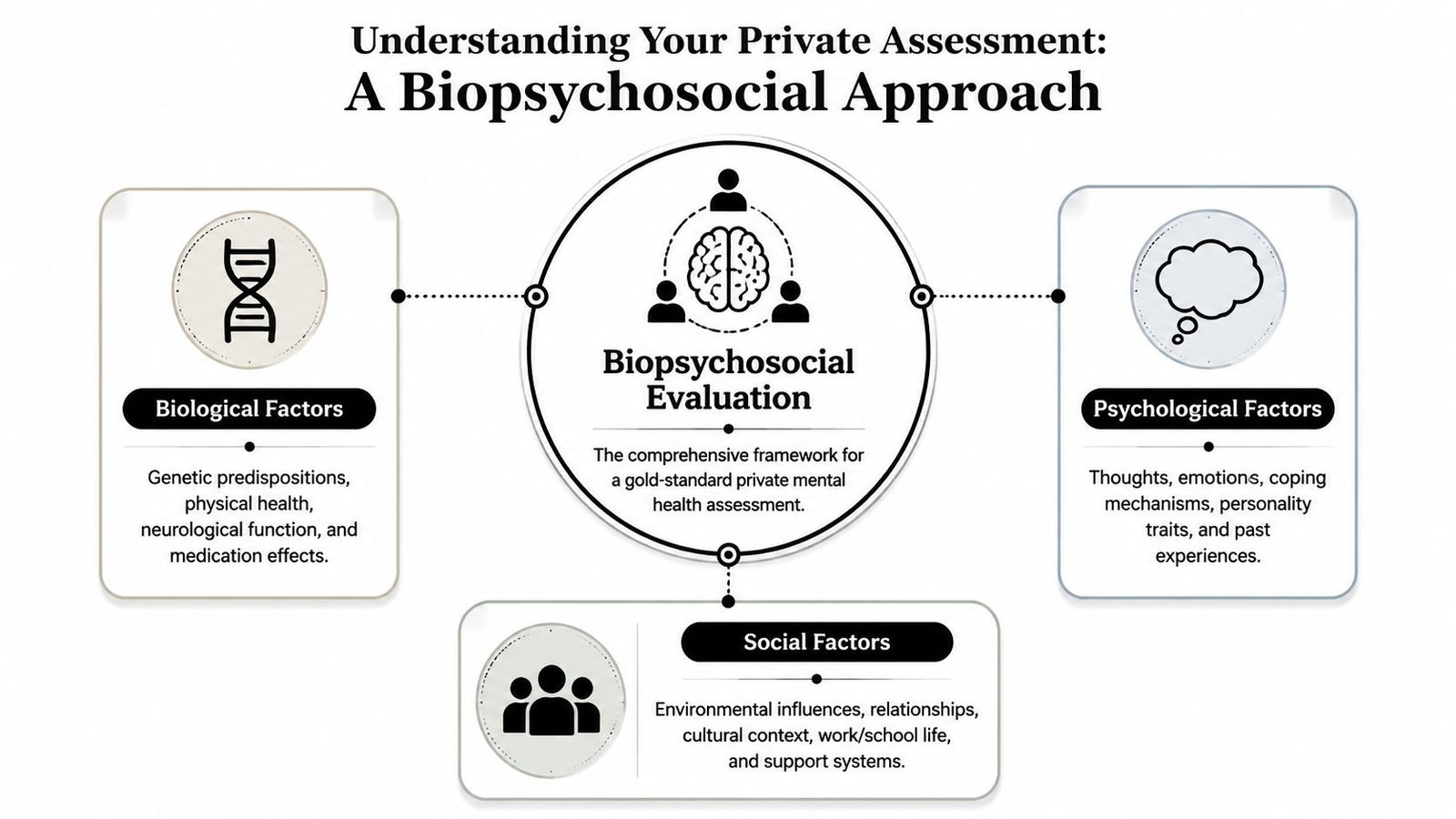
The clinical benchmark is a structured biopsychosocial evaluation. That means combining psychiatric history, mental state examination, and collateral information where available, then deciding whether symptoms cause functional impairment, which is the threshold for a clinical diagnosis (clinical standard summary).
In plain terms, the clinician is asking questions such as:
- What symptoms are present: Inattention, impulsivity, social communication difficulty, low mood, panic, irritability, shutdown, insomnia, emotional dysregulation.
- How long they've been there: Since childhood, after a stressful life event, only during a depressive episode, or mainly during periods of overload.
- Where they show up: At work, at university, in close relationships, during unstructured tasks, or across almost every setting.
- What they cost you: Missed deadlines, conflict, exhaustion, avoidance, financial disorganisation, academic difficulty, or loss of confidence.
A symptom list alone can't answer those questions. That's why a high-quality service should feel thorough, not rushed. If you want a practical overview of what private assessment can include, the private mental health assessment overview sets out the broad pathway clearly.
Why overlap is the hardest part
ADHD and autism are often discussed as if they are easy to spot. In adults, they often aren't. Someone may report poor focus, social exhaustion, sensory sensitivity, or emotional flooding. Those features can occur in neurodevelopmental conditions, but they can also appear in chronic anxiety, depressive illness, trauma-related states, sleep disruption, or prolonged stress.
This is where specialist experience matters. A consultant working regularly with neurodevelopmental and complex adult presentations will usually spend time on differential diagnosis rather than rushing to a yes or no answer. That includes exploring developmental history, personality style, current pressures, and whether another condition better explains the difficulties.
Practical rule: If an assessment doesn't explore childhood patterns, current functioning, and alternative explanations, it's probably too thin to rely on later.
A thorough evaluation should leave you with more than a diagnosis code. It should give you a formulation that explains how the symptoms fit together.
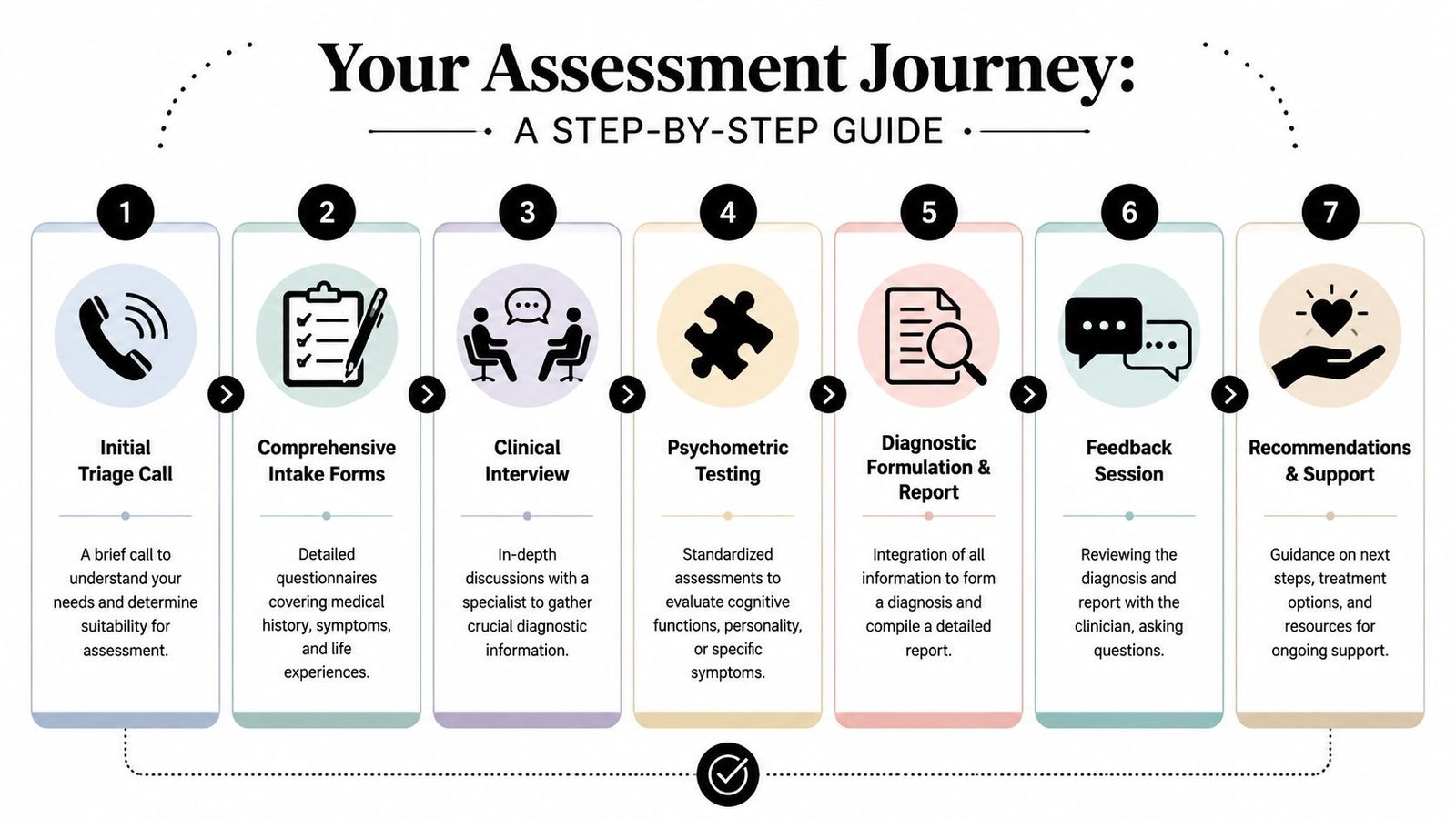
Your Assessment Journey Step by Step
Before the formal appointment, it helps to know what the process should look like. Good clinics make the route visible. Poor ones leave you guessing.
Step one to three
Initial triage
This is usually a short screening conversation or intake review. The purpose isn't to diagnose you on the spot. It's to decide whether the service matches your needs, whether the presentation sounds straightforward or complex, and whether there are signs that a different route would be safer or more appropriate.
Background forms and history gathering
Expect questionnaires about symptoms, medical history, medication, mental health history, family background, education, work, and daily functioning. If ADHD or autism is being considered, the most useful information often includes school history, developmental patterns, and examples from before adulthood.
Consultant-led clinical interview
This is the core of the assessment. A good interview is structured but flexible. It covers what's happening now, when it began, what was present in childhood, what helps, what makes things worse, and what other diagnoses need to be ruled in or out.
For adults with overlapping symptoms, this conversation is often the most valuable part. It's where the clinician can test whether “I can't focus” reflects ADHD, anxiety, depression, sleep disruption, autistic overload, or a combination.
A number of providers, including Insight Diagnostics Global, describe a consultant-led pathway with adult assessments typically arranged within seven working days and reports completed within five working days after assessment, alongside follow-up options such as treatment recommendations and ADHD medication titration.
Step four to seven
A later stage often includes structured measures and written evidence gathering. Some people expect these tools to produce the diagnosis by themselves, but they don't.
Screening tools can be useful when they're used properly. For example, the PHQ-9 measures depression symptom severity over the previous two weeks, and its scores can help with triage and follow-up monitoring, but a positive result still requires clinician evaluation of duration and functional impact before a formal diagnosis is made (PHQ-9 clinical use summary).
Here's what usually follows:
- Psychometric input: This may support the clinical picture but shouldn't replace a full assessment.
- Collateral information: A partner, parent, or someone who knows you well may help fill in developmental or day-to-day details.
- Diagnostic formulation: The clinician pulls the evidence together, including uncertainty where appropriate.
- Report writing: The final report should state diagnoses if supported, differential diagnoses if relevant, and practical recommendations.
- Feedback appointment: You should have the chance to ask what the diagnosis means and what to do next.
A short explainer can help if you want to see the process in visual form:
The best reports don't just answer “What is this?” They answer “What supports this conclusion?” and “What should happen now?”
Private Diagnosis Versus NHS Pathways
People often frame this as a simple choice between speed and cost. In reality, the decision is more nuanced. The route you choose affects who assesses you, how much choice you have, and how the report may be used afterwards.
One point often missed is that private psychiatry isn't only for one narrow diagnostic group. In a published analysis of patients attending a private psychiatric clinic, affective disorders accounted for 40% of diagnoses, schizophrenia 20%, and OCD 8%, showing that private services have long been used for a broad range of mental health presentations rather than just one or two headline conditions (private psychiatric clinic analysis).
Private vs NHS Mental Health Assessment Pathways
| Factor | Private Pathway (e.g., Insight Diagnostics) | Standard NHS Pathway |
|---|---|---|
| Cost | Self-funded or sometimes insurer-funded, depending on provider and policy | Usually funded through the NHS |
| Speed of access | Often faster, depending on clinic capacity and suitability | Can involve longer waits and local variation |
| Choice of clinician | Usually more direct choice about specialist focus | Usually determined by local service structure |
| Assessment format | Often flexible, with online and face-to-face options | Depends on local provision |
| Report style | Can be detailed and designed for practical follow-through | Varies by service and clinical purpose |
| Medication follow-up | May offer titration and monitoring privately | Depends on diagnosis, service remit, and local pathway |
| Best fit | Useful when you want clarity, speed, and specialist matching | Useful when you want a publicly funded route and local continuity |
The middle route people miss
There's also a third possibility that some patients don't realise exists. In some situations, people explore whether an NHS-funded referral pathway can direct them to an external provider, often discussed under Right to Choose in England. Whether that applies depends on your location, GP, the condition being assessed, and whether the provider fits the relevant regulatory and commissioning requirements.
That route can be worthwhile to ask about, but it shouldn't be assumed. Patients are often best served by treating it as a practical enquiry rather than a guaranteed entitlement in every circumstance.
If your main concern is complex overlap, the key question isn't only “How quickly can I be seen?” It's “Will the service produce an assessment thorough enough to guide treatment and support afterwards?”
Using Your Diagnostic Report Effectively
A diagnosis only becomes useful when you can do something with it. That's where many people are left under-informed. They receive a report, feel relieved for a week, then realise the harder question is what happens next.

A major concern for patients is whether a private diagnosis will be accepted by the NHS, employers, or universities. Guidance on access has improved, but public information still often leaves out the practical issue of post-diagnosis acceptance and evidence standards (overview of access and follow-through concerns).
What makes a report usable
A report is more likely to be accepted when it clearly includes:
- Clinical rationale: Why the diagnosis fits and what alternatives were considered.
- Functional impact: How symptoms affect work, study, communication, organisation, attendance, or daily living.
- Relevant history: Developmental, psychiatric, medical, and social background.
- Recommendations: What support, treatment, or adjustments are clinically indicated.
If any of those are missing, the report may still be valid clinically, but it becomes harder to use outside the consultation room.
Where patients commonly use the report
A strong report can support several routes:
- GP discussions about ongoing care: This may include whether shared care is appropriate, especially where medication is relevant.
- Workplace adjustments: Clear evidence of functional impact can help conversations about reasonable changes in workload, environment, supervision, communication style, or scheduling.
- University or training support: Students may need documentation that explains not just the diagnosis, but how it affects learning, deadlines, sensory tolerance, or examination conditions.
- Insurance or occupational processes: Requirements vary, so the wording and detail of the report matter.
If English isn't the only language involved in your records, or if you need documentation prepared for institutions outside the UK, accurate medical document translation can help preserve clinical meaning. Small wording errors in diagnostic reports can create large practical problems.
For patients who want to understand what a formal report should contain before booking, the mental health assessment PDF guide is a useful reference point.
A diagnosis is a beginning, not an endpoint. Its value depends on whether it changes treatment, support, or self-understanding in a concrete way.
How to Choose a Reputable Provider
The growth of online assessment has made access easier, but it has also made vetting more important. Some services are careful and consultant-led. Others are little more than simplified screening funnels.
The non-negotiables
Use this checklist before you book:
- Check regulation: In England, CQC regulation is one practical sign that the service is operating within a recognised framework of oversight.
- Confirm clinician status: For diagnostic psychiatry, you should know whether the assessor is a Consultant Psychiatrist and whether they are on the GMC Specialist Register.
- Match the specialty to the question: ADHD, autism, personality complexity, mood disorders, and trauma overlap need different levels of experience.
- Ask what the report includes: A diagnosis without rationale, impairment analysis, or recommendations may not serve you well later.
- Review follow-up options: If medication, monitoring, or further treatment might be needed, check whether the provider offers that or only assessment.
- Look for transparent process details: You should be able to understand how triage works, what information is collected, and what happens if the clinician concludes that your initial assumption is wrong.
Signs to be cautious
A provider deserves extra scrutiny if it promises certainty too early, relies heavily on self-report forms without a proper interview, or markets diagnosis as a quick confirmation exercise. Neurodevelopmental and mental health assessment in adults is rarely that simple.
If you're comparing online psychiatric options, the online psychiatrist guide for UK patients covers useful points about what to ask before committing.
A reputable service won't make the process look easier than it is. It will make the process clearer.
Preparing for Your Assessment and Final Thoughts
Preparation doesn't need to be elaborate, but it should be deliberate. The more organised your examples are, the easier it is for the clinician to distinguish long-standing patterns from recent distress.
Bring or prepare the following where possible:
- A symptom timeline: When did problems begin, and what changed over time?
- Concrete examples: Missed deadlines, conflict, sensory issues, overwhelm, emotional dysregulation, or repetitive patterns that affect life.
- Past records: School reports, previous assessments, GP summaries, therapy letters, or occupational health notes.
- Input from someone who knows you well: A parent, partner, or sibling can sometimes add useful developmental or functional detail.
- Questions for the clinician: Ask what the diagnosis explains, what it doesn't explain, and what support should follow.
Try not to rehearse a diagnosis. Rehearse your lived examples instead. That gives the clinician better material to work with and lowers the risk of fitting yourself into the wrong category.
Private mental health diagnosis is most helpful when it leads to a clearer map. Sometimes that map confirms ADHD or autism. Sometimes it identifies depression, anxiety, or another condition that had been overshadowed. Sometimes it shows that more than one problem is present. The value lies in getting a defensible explanation and a practical next step.
If you're considering a consultant-led assessment for ADHD, autism, or overlapping adult mental health concerns, Insight Diagnostics Global provides online and face-to-face evaluations for adults, along with structured reports and follow-up options where appropriate.