

A neutral email from a manager can land like a blow. You read it once, then again, and suddenly your mind is filling in the blanks, the tone seems colder than it should, and the rest of the day disappears into replaying one line that might not even have meant anything harsh. For many adults with ADHD, that kind of reaction feels baffling in the moment, then exhausting afterwards.
That experience is often called rejection sensitive dysphoria, or RSD, in ADHD circles. It’s not a formal diagnosis, but the pattern is real enough that patients recognise it quickly once someone names it properly. In the UK, it usually sits inside ADHD and broader mental health assessment rather than as a separate condition, which is why people can go a long time feeling misunderstood before they get a clear explanation.
When a Friendly Comment Feels Like a Personal Attack
The trouble often starts with something tiny. A colleague says, “Can you just tidy that up before sending it?” or a partner answers with less warmth than usual, and your body reacts before your rational mind catches up. You may feel a jolt in your chest, a wave of shame, or the sudden conviction that you’ve upset someone beyond repair.
That reaction can look dramatic from the outside, but inside it usually feels immediate and overwhelming. The mind starts scanning for proof, replaying every recent conversation, and building a story that ends with rejection, criticism, or failure. The facts are often thin, yet the emotion is loud.
People sometimes think this means they’re too sensitive, too needy, or being “difficult”. That framing misses the point. The issue isn’t that the event is always huge, it’s that the emotional alarm system is firing as if it is.
Practical rule: if the reaction is much bigger than the trigger, and it arrives fast, you’re probably dealing with an emotional regulation problem rather than a character flaw.
That’s why this topic matters so much in rejection sensitive dysphoria ADHD conversations. Adults don’t usually need more generic reassurance. They need a clear, clinically sensible explanation of what RSD is, how it shows up, how it differs from other patterns, and what a UK assessment can do about it.
What Rejection Sensitive Dysphoria Means
RSD is best understood as a descriptive term, not a formal illness label. It refers to intense emotional pain triggered by perceived rejection, criticism, or failure, and it is often discussed alongside ADHD, although it is not a DSM-5 diagnosis. That distinction matters in UK practice because there is no separate NHS code, no standalone screening pathway, and no official RSD box to tick in a routine adult assessment, so clinicians usually record it as part of the wider emotional picture.
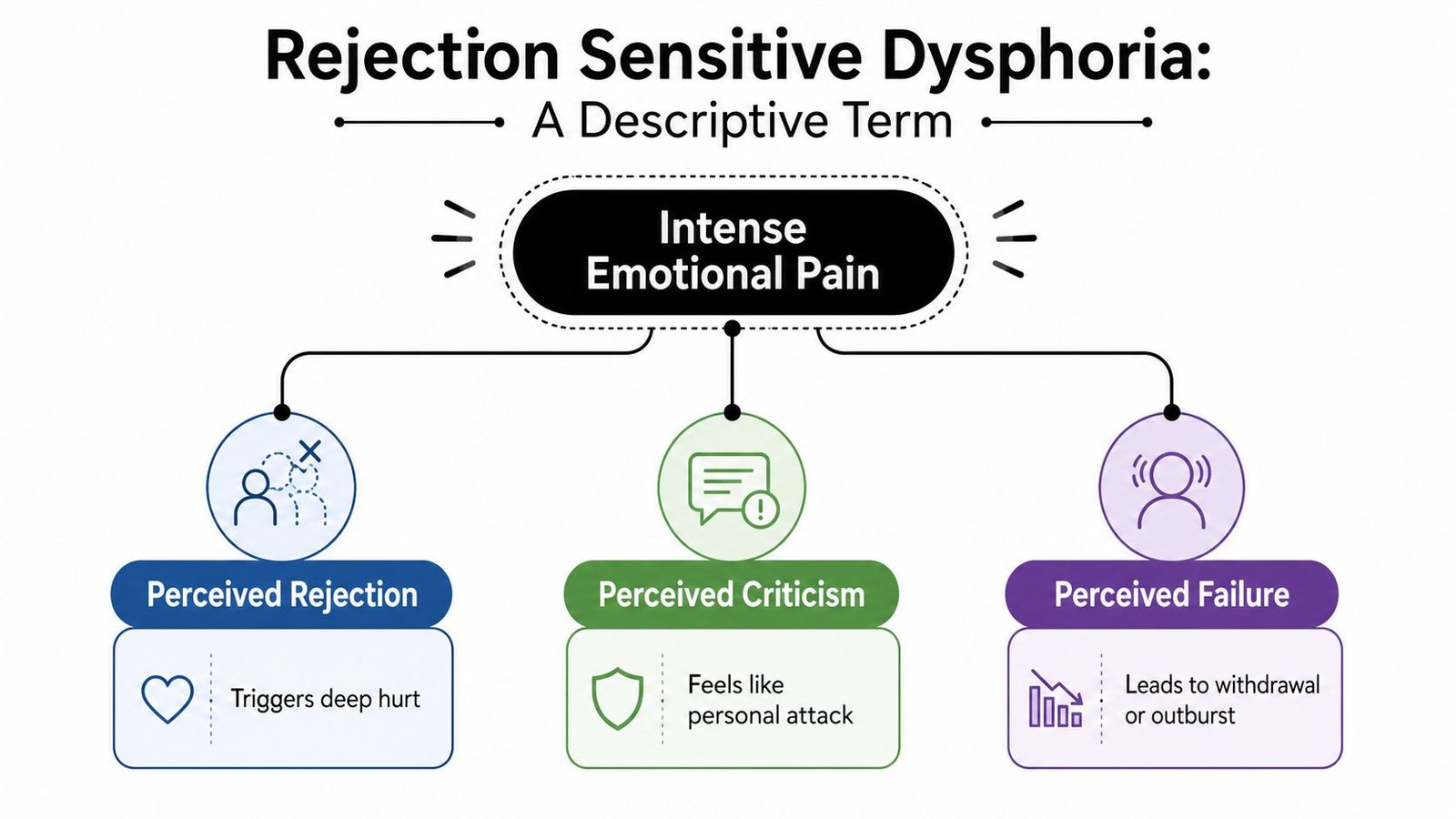
A smoke alarm that goes off because someone made toast is a useful comparison. The alarm is real, the noise is real, and the panic is real, but there is no house fire. RSD works in a similar way, the emotional system signals threat far more strongly than the situation itself would justify.
Why the label matters in UK care
In UK practice, clinicians usually consider this within an ADHD assessment, a mood review, and a look at day-to-day functioning. They are asking what happens, how quickly it starts, how long it lasts, and whether it affects work, relationships, or ordinary tasks. The label can still be useful, even though it is not an official diagnosis.
The Cleveland Clinic’s overview of RSD explains that it is not a formal DSM-5 diagnosis and describes it as severe emotional pain linked with perceived rejection or criticism, often discussed alongside ADHD-related emotional dysregulation (Cleveland Clinic on Rejection Sensitive Dysphoria). That is the right clinical frame. It is a pattern to understand, not a label to collect for its own sake.
For a plain-language explanation you could give to a sceptical friend or clinician, keep it simple. RSD means the nervous system reacts to social threat as if the threat is bigger and more urgent than it really is. The feeling is genuine, but the meaning attached to it may be distorted by ADHD-related emotional intensity, as explained in our guide to ADHD and emotions.
Common Triggers and Everyday Symptoms in Adults
Small social moments often carry the most charge. A delayed reply can feel like being frozen out, a flat tone in a text from your partner can read like anger, and a raised eyebrow in a meeting can look like silent disapproval. None of those things is proof of rejection, yet they can start the same spiral.
What the reaction can look like
The internal response varies, but the themes are familiar. Some people ruminate for hours and keep checking their message thread. Others feel a rush of shame, then shut down or snap back. A few go straight into people-pleasing mode, sending extra explanations, over-apologising, or trying to smooth everything over before anyone has even complained.
The longer pattern is often more telling than the single flare-up. Adults may stop volunteering ideas, avoid feedback, keep relationships carefully masked, or delay new tasks because the risk of criticism feels unbearable. That doesn’t mean they lack confidence in a simple sense. It means their system has learned to treat evaluation as danger.
The adult ADHD checklist on adult ADHD symptoms checklist is useful here because many people first notice the problem in patterns, not in one dramatic incident. They recognise themselves in the exhaustion of constant self-monitoring, the urge to rehearse every sentence, or the feeling that ordinary feedback lands like a verdict.
Clinical clue: if you often dread feedback more than the task itself, the pain may be tied to rejection sensitivity rather than laziness or poor motivation.
Everyday examples that fit the pattern
A friend cancels plans and you assume you’re unwanted.
A manager says, “We need to talk,” and your stomach drops for the rest of the afternoon.
A partner goes quiet and your mind fills in the blanks with worst-case meanings.
The important point is that RSD-like reactions are usually fast, emotionally intense, and self-reinforcing. The more you try not to feel them, the more attention they seem to demand. That cycle is what makes adult life feel so tiring when rejection sensitivity is running in the background.
Why the ADHD Brain Reacts So Strongly
ADHD is not just about distraction. Emotional regulation is part of the picture, and that includes how quickly someone escalates, how long the feeling lasts, and how hard it is to step back once the reaction has started. In practical terms, the brain can register a social cue, tag it as threat, and lock onto it before there’s time to test the evidence.
What’s known, and what isn’t
Current expert summaries describe RSD as part of ADHD-related emotional dysregulation, with reactions shaped by sensitivity to social cues, difficulty identifying and naming internal states, and the impact of repeated criticism over time. That’s a sensible working model, but it’s still a model. Because RSD isn’t a formal diagnosis, large peer-reviewed studies using the exact term are limited, so clinicians should hold the label lightly and stay close to the person’s actual symptom pattern.
The most useful way to think about it is as a sequence. A social cue lands, the mind interprets it quickly, the body reacts, and then the story becomes harder to revise because the feeling is already so intense. If someone has spent years being corrected, misunderstood, or told they’re “too much”, their threshold for threat gets lower.
For adults trying to assess their own pattern, a structured ADHD evaluation for adults can be a useful comparison point, even if the immediate concern is emotional reactivity rather than attention alone. A proper assessment looks at the whole profile, not just one symptom.
Why the body gets involved
Many adults describe RSD as physical, not only emotional. That fits with the broader ADHD picture of intense inner activation, where a comment can produce a knot in the stomach, heat in the face, or a sudden urge to escape. Those bodily signals can then be mistaken for proof that something terrible has happened.
The internal loop is especially confusing when the original trigger was ambiguous. A neutral sentence gets read as criticism, the body reacts, and the reaction itself becomes evidence that the social situation must be unsafe. Once that loop starts, reassurance often arrives too late to feel convincing.
For adults who notice this happening, the priority isn’t to force calm. It’s to slow the interpretation down enough to ask a better question, namely, “What else could this mean?” That single pause can interrupt a lot of unnecessary distress.
The article on reducing high cortisol is a helpful companion if stress physiology is part of your picture, because many people with rejection sensitivity are also living in a near-constant state of tension.
RSD Compared With Anxiety, Autism and Personality Patterns
Adults are often told they are “too sensitive” when the issue is more specific than that. Several conditions can produce a strong reaction to other people, but the timing, trigger, and emotional meaning are different, and those differences matter in assessment.
| Feature | Rejection Sensitive Dysphoria | Social Anxiety | Autistic Burnout | Personality-Based Patterns |
|---|---|---|---|---|
| Trigger | Perceived criticism, rejection, or failure | Social scrutiny and embarrassment | Prolonged overload, masking, and depletion | Interpersonal threat, instability, abandonment fears |
| Speed of reaction | Often immediate | Often anticipatory, before the event | Usually builds over time | Can be intense and relationally charged |
| Core fear | “I’ve been rejected” | “I’ll be judged” | “I can’t keep coping” | “I’ll be left, hurt, or devalued” |
| Response to reassurance | May help briefly, but the feeling can return fast | Can reduce worry, at least for a while | Reassurance alone rarely fixes exhaustion | Reassurance may not settle the pattern fully |
| Clinical focus | ADHD, emotional regulation, functioning | Fear and avoidance in social settings | Recovery from overload and support needs | Broader interpersonal and emotional history |
A useful comparison is the difference between a smoke alarm and a slow leak. RSD often sounds immediately after a small social cue, while other problems may build before the person reaches that point. The same moment can be painful in all four patterns, yet the clinical story behind it is not the same.
What clinicians look for
In RSD, the reaction is often sudden and specific. A brief message, a facial expression, or a change in tone can set off a strong surge that feels out of proportion to what happened. Social anxiety tends to look different, because the worry is often present before the interaction and centres on being watched, judged, or embarrassed.
Autistic burnout has another shape. The person may have spent a long time masking, adapting, and pushing through difficulty before they finally hit a wall. At that stage, the problem is often depletion, reduced tolerance, and loss of capacity, rather than a rapid rejection response. The autism assessment framework used in NICE guidance relies on a multidisciplinary team, detailed developmental history, and more than one assessment method, which helps separate autistic social-communication differences from anxiety-driven avoidance or other causes.
Personality-based patterns need careful handling too. A clinician looks at whether there is a broad relational pattern, how long it has been present, and whether fear is tied to abandonment, instability, or repeated interpersonal rupture. NICE-aligned specialist assessment also requires full psychiatric history, risk assessment, comorbidity review, and clear documentation of functional impact, which is why a quick label can mislead rather than clarify (specialist assessment principles).
A careful differential matters. If someone has ADHD and also shows fear of judgment, exhaustion from masking, or longer-standing relational instability, the clinician has to sort those strands rather than force them into one box. Pairing differential assessment with nervous system regulation techniques for executives can also support clients while they are waiting for clarification.
If you are trying to make sense of your own pattern, avoid asking which label sounds most familiar. Describe what happens instead. Say what set it off, how fast it hit, what your body did, and whether the feeling was about criticism, scrutiny, overload, or being left. That kind of description is what helps a good clinician separate RSD from social anxiety, autistic burnout, and personality-based patterns, and it is often the right starting point for practical ADHD coping strategies.
Practical Strategies That Actually Help
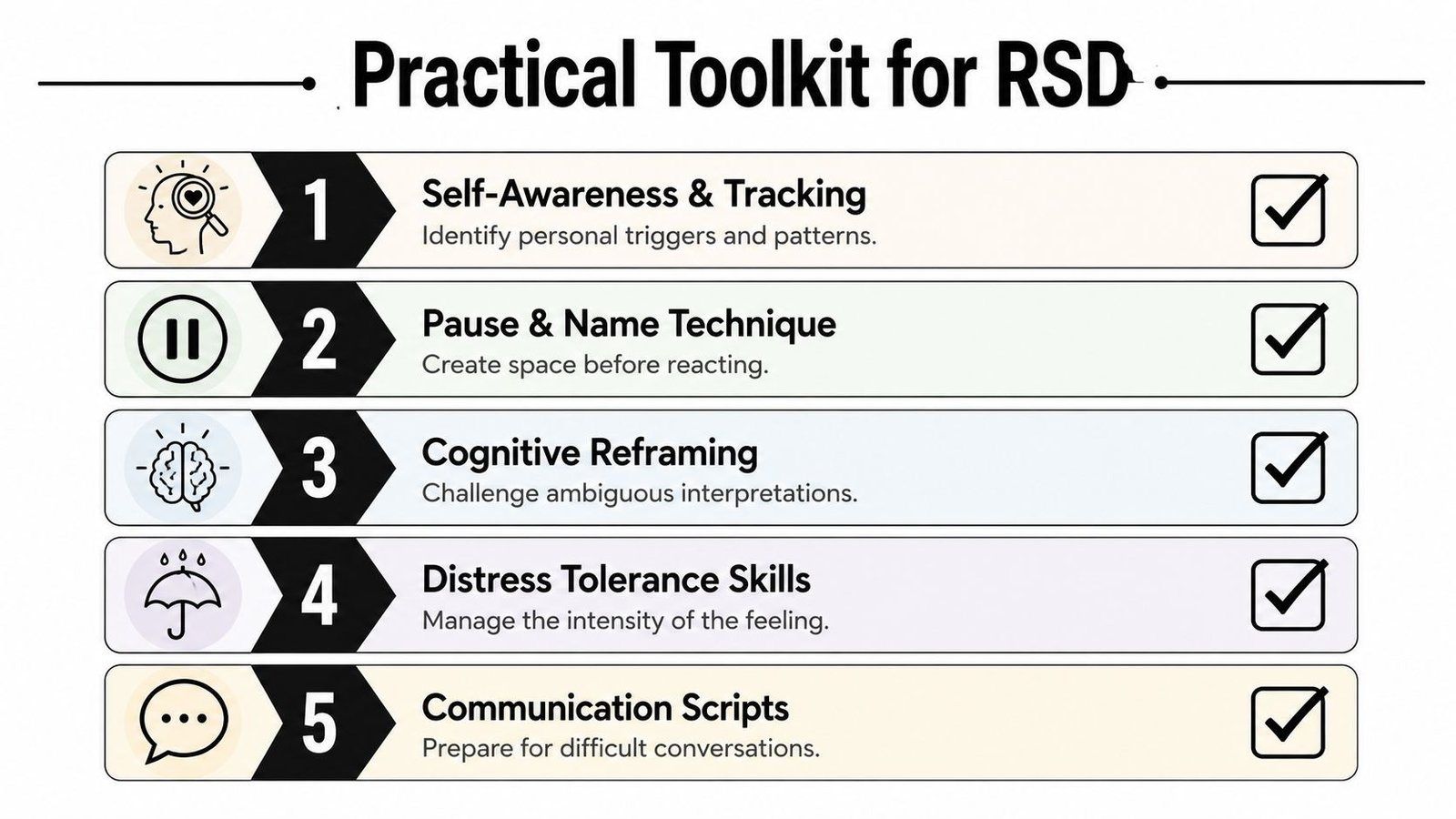
The best approach is usually layered. No single trick fixes rejection sensitivity, and no honest clinician should promise that it will. What helps most is a combination of tracking, skills, therapy, and, where ADHD is present, treatment for the underlying condition.
Start with observation, not self-criticism
Keep a brief note of the trigger, the first thought, the body sensation, and what you did next. That pattern matters more than the intensity of the episode itself. Once you can see the sequence, you can interrupt it earlier.
Then practise a pause-and-name move. Say to yourself, “This feels like rejection,” rather than “I’ve been rejected.” That wording leaves room for error, and that matters because ambiguous cues are where RSD does its worst damage.
Use strategies that slow the spiral
Cognitive-behavioural work helps many adults because it challenges catastrophic interpretations and tests alternative explanations. Mindfulness-based skills and distress-tolerance tools can also help the nervous system ride out the peak without making the feeling worse. Those approaches show up repeatedly in clinician guidance for adult ADHD-related emotional regulation, and they make sense here because the aim is not to erase emotion, it’s to make the response more proportionate.
Medication can matter too, but in a specific way. ADHD pharmacotherapy may reduce baseline emotional impulsivity by lowering the overall symptom burden, while some specialists discuss off-label alpha-2 agonists such as guanfacine or clonidine in selected cases. Evidence is limited, so this is a discussion for a qualified prescriber, not a do-it-yourself experiment.
For a broader skills-based overview, the strategies for coping with ADHD resource can help you think about routines, communication, and emotional regulation together rather than in separate boxes.
Useful sentence for difficult conversations: “I’m reacting strongly to how that came across, so I’d like a minute before I answer.”
Getting Assessed in the UK and How Insight Diagnostics Global Helps
The UK pathway is often frustratingly uneven. Some adults go through NHS waiting lists, some use the Right to Choose route, and others choose private assessment because they need clarity sooner or want a consultant-led opinion with broader mental health considered alongside ADHD or autism. The right route depends on urgency, access, and how much complexity is in the presentation.
What a good assessment should include
A high-quality adult assessment should not stop at “Do you have ADHD, yes or no?”. It should explore symptoms, impairment, developmental history, current functioning, risk, and comorbidities such as anxiety, depression, or mood disorder features. That matters because RSD-like distress is often documented within the emotional profile, not as a separate disorder, and because the treatment plan changes when the full picture is known.
For adults who want a structured private option, Insight Diagnostics Global offers online and face-to-face consultant psychiatrist assessments for adults aged 18 and over, with typical scheduling within seven working days and reports within five working days thereafter. The service is CQC-regulated, consultant-led, and includes ADHD and autism assessment alongside broader mental health triage, which is important when rejection sensitivity might sit alongside burnout, anxiety, or depression.
When to consider private assessment
Private assessment can be sensible if you need a faster route, if your symptoms are affecting work or relationships, or if previous care has only skimmed the emotional side of ADHD. It can also help when you’re unsure whether the problem is ADHD, autism, anxiety, or a combination, because careful differential assessment is part of the process rather than an afterthought.
If you’re starting from scratch, ask for a consultant-led adult neurodevelopmental assessment and mention the emotional reactions, not just the attention issues. Describe specific examples, how long they’ve been happening, and whether they affect work, home life, or relationships. That gives the clinician the material they need to judge whether this is rejection sensitivity within ADHD, something else, or a mix of conditions.
Frequently Asked Questions About Living With RSD
Can RSD happen without ADHD? Yes, the label is often discussed with ADHD, but rejection sensitivity can appear in other contexts too. That’s one reason a proper adult assessment matters.
Should I tell my GP about it? Yes, but describe the symptoms, not just the term. Say what happens, what triggers it, and how it affects your functioning.
Will medication fix it on its own? Usually not. Medication may reduce emotional impulsivity, but many adults also need therapy, communication changes, and practical coping strategies.
Can workplace adjustments help if my employer thinks this is just being oversensitive? They can. Predictable feedback, clear written expectations, and fewer ambiguous messages can reduce unnecessary triggers.
What if ADHD treatment doesn’t touch the rejection sensitivity? Then the clinician should reassess for anxiety, depression, trauma-related patterns, autism, or personality-related features rather than only increasing stimulant treatment.
A careful adult assessment can turn all this from mystery into something workable. If the pattern sounds familiar, book a consultant-led evaluation with Insight Diagnostics Global and bring concrete examples of the reactions, triggers, and fallout you’ve been living with, because that’s the fastest way to get a serious, clinically useful answer.