
Getting an adult ADHD test isn't like a quick blood test or a brain scan. The real answer to how is ADHD tested is through a thorough clinical assessment – a process designed to build a complete, detailed picture of your life, both now and in the past. Think of it as a deep dive into your unique experiences, your challenges, and your strengths, especially when conditions like Autism or anxiety might also be present.
Your Guide to the Adult ADHD Testing Process in the UK
If you've spent what feels like a lifetime wondering why you struggle with focus, organisation, or impulsivity, even just considering an assessment is a huge step forward. So many adults get to this point after a long, winding road of self-doubt, often wondering if their difficulties are just personal failings.
The truth is, neurodevelopmental conditions like ADHD and Autism often look very different in adults. Over the years, we build up a whole toolkit of coping mechanisms to get by, which can mask the underlying signs.
Receiving a formal diagnosis can be an incredibly validating moment. It reframes years of struggles, replacing that harsh inner critic with genuine understanding and, crucially, a clear path forward for your mental health. This guide will walk you through what to expect, step-by-step, so you can approach the process feeling prepared and informed.
The Core Assessment Journey
The journey to a diagnosis has several key stages, with each one building on the last to give the clinician the full picture. It’s also vital to understand exactly who is qualified to diagnose ADHD, as the assessment must be carried out by a specialist.
The flowchart below gives you a clear overview of how it typically works, from your first enquiry right through to the final report.
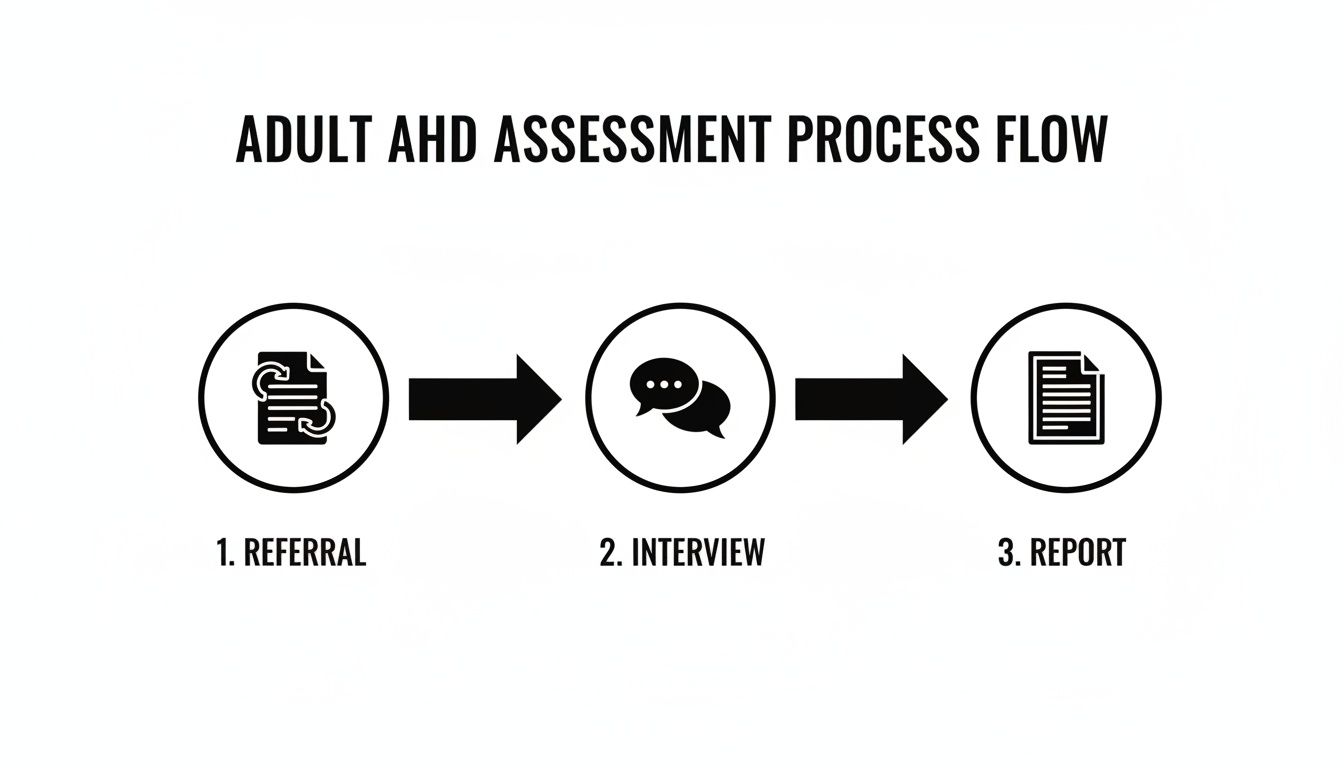
As you can see, a proper assessment is a structured, multi-faceted medical process. It's much more than just a single chat or a simple questionnaire.
To break it down even further, here's a quick look at the essential parts of a comprehensive evaluation.
Table: Core Components of an Adult ADHD Assessment
A robust ADHD assessment is made up of several complementary parts. This table outlines what you can expect from a specialist-led evaluation in the UK, ensuring every angle is covered for an accurate outcome.
| Assessment Component | What It Involves |
|---|---|
| Referral & Triage | An initial screening to see if your symptoms align with ADHD and warrant a full assessment. |
| Clinical Interview | A detailed, structured conversation with a specialist about your childhood, education, work, and daily life. |
| Rating Scales | Standardised questionnaires for you (and often a partner or parent) to complete to measure ADHD symptoms. |
| Collateral Information | Gathering insights from someone who knows you well, like a family member, to get an outside perspective. |
| Differential Diagnosis | The clinician carefully considers and rules out or identifies co-occurring conditions like Autism, anxiety, or depression. |
| Final Report | A comprehensive document outlining the findings, the diagnosis, and personalised recommendations. |
Each of these steps plays a crucial role in building a complete and accurate diagnostic picture.
Navigating Mental Health and Neurodiversity
It’s also important to remember that our mental health is never simple. The symptoms of ADHD can often overlap with other conditions like anxiety, depression, or even Autism Spectrum Disorder (ASD). A skilled clinician isn't just looking for signs of ADHD; they're trying to understand the whole you.
An accurate diagnosis isn't about sticking a label on you. It's about unlocking a true understanding of how your brain is wired. It explains patterns, validates struggles you've had your whole life, and creates the foundation for support that actually works for you.
This is exactly why a thorough assessment will always explore your full mental health history. The goal is to carefully distinguish between conditions or, as is often the case, identify when they exist together. ADHD and Autism, for example, frequently co-occur. This detailed approach ensures that any treatment plan created is the right one for you, tackling the root cause of your challenges, not just the symptoms on the surface.
Navigating Your First Steps from Referral to Triage
Getting started on the path to an adult ADHD assessment always begins with one thing: a referral. The route you choose here will make a huge difference in how quickly you get answers. In the UK, you generally have two choices – go through your NHS GP or approach a private specialist service directly.
Your GP is the most common starting point. When you have that conversation, it really helps to come prepared. Think about specific examples of how you believe ADHD is affecting your life, whether that’s at work, in your relationships, or just trying to manage day-to-day tasks. This conversation is what helps your GP decide if a referral to a local NHS mental health service is the right call.
The tough reality, though, is that the NHS pathway often involves an incredibly long wait. We know that waiting lists for ADHD and autism assessments have ballooned over recent years. In fact, a Nuffield Trust survey revealed that of those waiting for an NHS evaluation, a staggering 24% wait between one and two years, and another 10% wait even longer.
The Private and Self-Referral Route
For most adults, waiting years for an answer simply isn't an option. This is why private services and the ability to self-refer have become such critical lifelines. Specialist clinics like Insight Diagnostics Global let you skip the GP step entirely and refer yourself directly for an assessment.
This direct approach has one massive advantage: speed. Instead of joining a queue that can stretch for years, you can often be booked in for a full, comprehensive assessment within a matter of weeks. It's also worth understanding all your options, including the NHS Right to Choose pathway, which we cover in our detailed guide. This can sometimes open up a faster route through an approved provider.
The decision to go private often comes from an urgent need for understanding and support. When daily struggles with focus, organisation, or emotional regulation are damaging your career and wellbeing, getting timely answers isn't a luxury—it's an absolute necessity.
The Crucial Triage Stage
No matter which path you take, your referral information will go through a clinical triage. Think of this not as the assessment itself, but as a vital preliminary review. A qualified clinician will carefully look over all the information you’ve provided, from screening questionnaires to any notes from your GP.
The whole point of triage is to see if your symptoms and life experiences align with the profile of ADHD, making a full diagnostic assessment the right next step. It also helps to flag potential co-occurring conditions like Autism or significant mental health concerns early on. It's a professional filtering process that makes sure the right people move forward to a deep-dive evaluation, saving everyone time and resources. If the triage confirms an assessment is warranted, you'll be guided on what comes next: the in-depth clinical interview.
The Clinical Interview: Getting to the Heart of Your Story

When people ask how ADHD is tested, they often imagine brain scans or complex computer tasks. While other tools play a part, the single most important element is the clinical interview. Forget a cold, sterile interrogation; this is a deep, guided conversation with a specialist psychiatrist.
The goal is to build a rich, three-dimensional picture of your life. It’s about connecting the dots between your experiences as a child and the challenges you’re facing right now. This conversation is the very foundation of an accurate diagnosis, allowing the clinician to see beyond a simple checklist and understand how your symptoms truly affect you—at work, at home, and in your relationships.
What to Expect During the Conversation
To make sure nothing gets missed, psychiatrists often use structured frameworks to guide the discussion. A well-regarded tool for this is the Diagnostic Interview for ADHD in Adults (DIVA). It’s not a rigid script, but a way to systematically explore the different chapters of your life.
The interview will likely touch on several key areas:
- Your Early Years: The psychiatrist will want to hear about your childhood. They'll ask about things like school reports, your behaviour in class, and any early signs of inattention or hyperactivity. A key part of diagnosing ADHD is establishing that these patterns were present before the age of 12.
- Life Right Now: You'll talk about your current struggles. This is where you can share the real-world impact of your symptoms, whether that’s constantly missing deadlines, finding it impossible to manage household chores, or struggling to maintain friendships.
- Your Overall Mental Health: The conversation will also explore your wider mental health history. This is incredibly important because conditions like anxiety, depression, and even traits of autism often exist alongside ADHD, and untangling them is vital for an accurate picture.
Even when conducted online, a skilled psychiatrist knows how to create a non-judgemental space where you feel comfortable sharing your story. This isn't just about being nice; it's essential for getting an accurate outcome. To get a better sense of the overall process, our guide explains what a full psychiatric assessment involves.
Building the Full Diagnostic Picture
The clinical interview is far more than just a chat. It's a highly sophisticated diagnostic exercise. The psychiatrist is actively listening for specific patterns and looking for real-life examples that bring your struggles to life. They are piecing together a puzzle, figuring out how different parts of your story fit together.
This detailed, conversational approach isn't just our preference; it’s the gold standard. According to the 2023 UKAAN Adult ADHD Assessment Quality Assurance Standard (AQAS), a comprehensive semi-structured interview is mandatory. This must evaluate the DSM-5 criteria throughout your life, assess current impairments, and check for any co-occurring conditions, all backed up by information from someone who knows you well.
The real power of the clinical interview is that it captures the lived experience of ADHD and Autism. It goes beyond a checklist to understand the deep frustration of knowing what to do but being unable to start, the emotional weight of feeling constantly misunderstood, and the incredible, often unseen, ways you've adapted to cope over the years.
Ultimately, this conversation allows the clinician to see you as a whole person, not just a list of symptoms. It's this deep, human understanding that paves the way for a diagnosis you can trust and a practical plan to help you move forward.
Getting the Full Picture: Why Questionnaires and Outside Views Matter

While the heart of any ADHD assessment is your story—the clinical interview—a thorough diagnosis doesn't stop there. We need to add objective data to the narrative to get a truly well-rounded view of how ADHD affects you. This is where standardised rating scales and information from people who know you well come into the picture.
Think of these tools not as tests you can pass or fail, but as a way of providing evidence. Your interview is the detailed testimony, and the questionnaires are like supporting documents, adding hard data to your personal account. Combining your lived experience with this structured information is what leads to a truly reliable diagnosis.
Using Questionnaires to Pinpoint Symptoms
So, how do we actually measure the impact of ADHD? We use specific, evidence-based questionnaires designed to assess the frequency and severity of your symptoms. These aren't the kind of quick quizzes you find online; they are carefully developed clinical instruments.
A common one you might encounter is the Adult ADHD Self-Report Scale (ASRS). This scale asks you to rate how often you run into specific challenges linked to inattention or hyperactivity. Your answers take your real-world experiences and put them into a format that a clinician can analyse systematically.
These rating scales are crucial for a few key reasons:
- They add objectivity. Your answers provide a numerical score, which helps the psychiatrist gauge the severity of your symptoms against established clinical benchmarks.
- They ensure consistency. Using a standardised tool means every assessment follows the same high-quality, best-practice guidelines.
- They cover all bases. Questionnaires make sure we explore every key symptom area, even things that might not come up in a normal conversation.
It’s worth remembering that scores don't always tell the whole story. Many adults, particularly those who might also be autistic or have spent years building clever coping mechanisms, find their scores don’t fully capture their internal struggle. A good psychiatrist knows this and will always use these results as just one piece of the puzzle, interpreting them alongside your personal history.
The Value of an Outside Perspective
One of the key requirements for an ADHD diagnosis is that your symptoms show up in more than one setting—at work and at home, for instance. This is why gathering 'collateral information' is so important for a high-quality assessment. In simple terms, this just means getting the perspective of someone who knows you well.
This could be anyone from a partner or parent to a sibling or a close friend who has known you for years. They'll typically be asked to fill out a similar questionnaire about you, giving an external view on how your symptoms appear to others. Their input can be incredibly helpful, often highlighting patterns that you might be too close to notice yourself.
Collecting collateral information isn't about checking up on you or doubting what you've said. It's about building a 360-degree view. An observer might notice how often you misplace your keys or get sidetracked mid-sentence, providing external evidence that powerfully backs up what you've reported.
This entire process is handled with the strictest confidentiality. We would never contact anyone without your explicit consent, and their feedback is simply treated as another piece of evidence to help build a complete picture.
If you’re wondering about the first steps, our online ADHD test can act as a useful screening tool before you commit to the full assessment. This multi-layered approach ensures the final diagnosis is not only accurate but also deeply understands the real-world challenges you face every day.
Ruling Out Overlapping Conditions like Autism and Anxiety
Getting an accurate diagnosis is more than just checking off a list of ADHD symptoms. A skilled psychiatrist has to be a bit of a detective, carefully ruling out other conditions that can look remarkably similar. This essential step, called differential diagnosis, is what makes the difference between a simple screening and a truly robust, life-changing medical assessment.
Many adults who suspect they have ADHD discover their situation is a bit more complicated than a single label can capture. The boundaries between different mental health and neurodevelopmental conditions can be fuzzy, with symptoms often overlapping. A seasoned clinician knows how to tease these apart by digging into the history, patterns, and specific context of your challenges.
Untangling ADHD from Similar Conditions
Figuring out what's ADHD and what might be something else is crucial because the right diagnosis points to the right support. A treatment plan for anxiety, for instance, looks very different from one for ADHD, even if both leave you feeling restless and overwhelmed.
Here are a few of the most common conditions that share traits with ADHD:
- Anxiety Disorders: Both can make you feel restless, on edge, and unable to concentrate. The key difference often lies in why you can't focus. If your mind is derailed by constant worry, that points towards anxiety. If it's more about an underlying struggle to regulate attention and filter out distractions, that sounds more like ADHD.
- Mood Disorders (like Depression): Feeling apathetic, unmotivated, and disorganised can be a hallmark of both depression and ADHD. The psychiatrist will often look at the timeline. Did these struggles start in childhood, suggesting a lifelong ADHD pattern? Or did they appear later, often in distinct waves or episodes, which is more typical of a mood disorder?
- Autism Spectrum Disorder (ASD): ADHD and autism are both neurodevelopmental conditions that very often show up together. They can both involve challenges with executive function and navigating social situations. The reasons behind these challenges, however, can be quite different. Social difficulties in ADHD might come from interrupting people impulsively, whereas for an autistic person, they might stem from differences in how they process social cues and communicate.
The Reality of Co-Occurring Conditions
It's actually incredibly common for someone to have ADHD alongside another condition. Clinicians call this comorbidity, and it means the goal isn't just to pick one diagnosis over another. It's about identifying all the pieces of your mental health puzzle that need attention.
A comprehensive psychiatric evaluation isn’t about forcing you into a neat little box. It's about creating a complete map of your mental health, one that acknowledges that conditions like ADHD, autism, and anxiety can—and often do—exist together. This holistic view is the only way to build a treatment plan that actually works for you.
This is why a thorough assessment is so important. It moves beyond a simple "yes" or "no" on ADHD to give you a full picture of your neurotype and mental wellbeing. For more on related neurodevelopmental profiles, you might find some useful insights on neurodiversity-affirming strategies for demand avoidance autism.
The complexity of diagnosis helps explain a shocking gap in our public health system. In the UK, ADHD is thought to affect 3-5% of the population. However, a huge study of 9 million GP records found that only 0.32% of people had an official ADHD diagnosis on file. That means just 1 in 9 people who likely have the condition ever receive a formal diagnosis. This staggering statistic really highlights why expert differential diagnosis is so vital for getting people the recognition and support they deserve.
Receiving Your Diagnosis and Planning Your Next Steps

After all the interviews, questionnaires, and deep dives into your past, we arrive at the final part of the process: the diagnosis itself. This isn't just a simple yes-or-no answer. It’s really the beginning of a new chapter in understanding yourself, all laid out in a detailed medical report that acts as your personal roadmap.
This diagnostic report pulls together every single piece of information we've gathered. It will clearly state whether your experiences line up with the official criteria for ADHD, referencing the DSM-5 or ICD-11. But more than that, it tells a story, connecting the dots between the challenges you’ve faced your whole life and the specific traits of ADHD, as well as any co-occurring conditions like autism or anxiety.
This moment can be profoundly validating. It takes years of feeling lazy, disorganised, or simply "not good enough" and reframes it all within a clear, neurodevelopmental context. The diagnosis isn't a label; it's a key that unlocks a much more compassionate way of looking at yourself and why certain things have always felt like such an uphill battle.
Creating Your Personalised Treatment Plan
Getting the report is just the first step. That document will also contain personalised recommendations, built specifically around your unique situation. This is where the journey shifts from diagnosis to actively managing and supporting your ADHD and overall mental health.
We'll schedule a follow-up consultation to walk through the findings together. This is your chance to ask absolutely anything and for us to collaboratively build a treatment plan that feels right for you. It’s never a one-size-fits-all approach; the plan is multi-faceted and goes far beyond a single solution.
Your next steps could involve a combination of things:
- Medication Titration: For many adults, medication is a highly effective tool for managing core symptoms like inattention and impulsivity. Titration is simply the careful, monitored process of finding the right type and dose of medication that gives you the best results with the fewest side effects, all under the guidance of your psychiatrist.
- Therapeutic Support: Therapy can be invaluable for unpacking the emotional weight of a late diagnosis and challenging years of negative self-talk. It provides a safe space to explore how ADHD has shaped your life and to build healthier, more effective coping strategies.
- Practical Skills Development: A huge part of moving forward is building the practical skills that ADHD can make difficult. Many people find huge benefits in personalised executive function coaching to strengthen things like organisation, focus, and time management.
An ADHD diagnosis isn't an endpoint. It's a powerful starting point for building a life that works with your brain, not against it. Our goal is to give you the tools, knowledge, and support to manage your symptoms and truly improve your overall wellbeing.
Ultimately, this final stage is all about empowering you with a clear path forward, giving you both the medical validation you need and the practical strategies to start thriving.
Your Questions Answered: Navigating an Adult ADHD Assessment
Getting your head around the ADHD testing process can feel a bit overwhelming. Let's break down some of the most common questions people have when they start looking into an assessment in the UK. This should give you the clarity you need to take the next step.
Can an Online ADHD Test Actually Be Trusted?
Absolutely. A proper, reliable ADHD assessment from a qualified specialist psychiatrist can definitely be done online. Regulated services, like those monitored by the CQC, adhere to the very same gold-standard guidelines from UKAAN that NHS clinics use. You're getting the same high standard of care.
The heart of any diagnosis is the in-depth clinical interview, and this works just as effectively over a secure video call. The biggest upside of going online? Speed, convenience, and being able to connect with a top specialist no matter where you are in the UK.
What’s the Difference Between a Quick Screening and a Full Assessment?
Think of an ADHD screening test – those short questionnaires you see online – as a quick temperature check. It can flag up symptoms that might point towards ADHD, but it cannot give you a diagnosis. It's just a preliminary step.
A full diagnostic assessment, on the other hand, is the real deal. It's a formal medical evaluation carried out by a psychiatrist. This involves a comprehensive clinical interview, a deep dive into your childhood development and mental health history, and the use of professionally validated rating scales. We also gather information from someone who knows you well to get a complete picture and see if you meet the official criteria for ADHD and any other co-occurring conditions, like autism.
How Much Should I Expect a Private ADHD Assessment to Cost?
The cost for a private ADHD assessment in the UK does vary, so it’s really important to find a service that is completely upfront about their pricing, with no hidden extras. It’s an investment, for sure, but many people decide it’s worthwhile to bypass the incredibly long NHS waiting lists, which can stretch on for several years.
Going private means getting a swift, thorough diagnosis and a clear plan for treatment and support within a matter of weeks, not years. For many, that speed makes a massive difference to their career, relationships, and general quality of life.
What if the Test Comes Back Negative for ADHD?
If the assessment finds that you don't meet the criteria for ADHD, it doesn't mean the struggles you're experiencing aren't real. Far from it. A detailed psychiatric evaluation is still hugely valuable for getting to the root of what's going on with your mental health.
The psychiatrist will walk you through why ADHD was ruled out and discuss what else might be causing your symptoms. Often, the signs can overlap with other conditions, such as:
- Anxiety or depression, which can seriously impact focus and motivation.
- Autism Spectrum Disorder (ASD), as it shares some executive function challenges with ADHD.
- Other underlying mental health conditions that require a totally different kind of support.
A "negative" result isn't a dead end. Think of it as a crucial signpost pointing you in a new direction. It helps guide you toward the right diagnosis and the most effective support for your unique needs, making sure you get the help that will actually work.
No matter the outcome, you'll receive a detailed report full of insights and recommendations for other support or treatment options. You won't be left without a clear plan to move forward.
Your mental health is too important to leave on a waiting list. At Insight Diagnostics Global, our consultant-led online service provides CQC-regulated, gold-standard ADHD and Autism assessments with the clarity and compassion you deserve. Book your assessment and get the answers you need in weeks, not years. Find out more at insightdiagnostics.co.uk.