
If you've typed "test for autism" into a search engine, you’ve probably been flooded with online quizzes. While these can be a helpful starting point, a real diagnosis is a very different, much more thorough clinical process. For many adults, exploring an assessment for autism and co-occurring conditions like ADHD is the first step toward making sense of lifelong difficulties—whether in social situations, at work, or with their own mental health.
This guide will walk you through what to expect, drawing a clear line between those simple online screeners and a full, professional diagnostic evaluation that considers your whole mental health profile.
Starting Your Journey to an Autism Diagnosis

For a lot of adults, the journey towards considering an autism assessment starts with a persistent feeling of being fundamentally different. It's a feeling that might come to the surface after years of battling anxiety or depression that never quite responds to standard treatments, or noticing a recurring pattern of difficulty in keeping jobs or relationships afloat. It’s a search for clarity—a need to finally understand the "why" behind it all, especially when traits of conditions like ADHD and autism seem to overlap.
Deciding to get a formal diagnosis is a big step. It means moving beyond personal reflection and into a structured clinical process led by qualified experts. This isn't about passing or failing a test; it's about gaining a precise, authentic understanding of how your brain is wired and how it impacts your mental health.
Why Adults Seek an Assessment
The reasons for wanting a diagnosis are deeply personal and incredibly varied. Many people have spent decades "masking" their natural traits just to fit in, leaving them feeling exhausted and burnt out. Others might have been misdiagnosed with different mental health conditions, always feeling that the label and the treatment just didn't quite fit.
Some of the most common motivations include:
- Finding Validation: To finally have a name for your experiences can be profoundly validating. It helps replace years of self-doubt with self-compassion and acceptance.
- Improving Mental Health: A diagnosis can completely reframe mental health struggles, clarifying how anxiety or depression might stem from the constant stress of navigating a world not built for an autistic or ADHD mind.
- Accessing Support: A formal diagnostic report is often the key to unlocking workplace accommodations, disability benefits, or specialised therapeutic support tailored to your neurotype.
- Understanding Relationships: It offers a brand-new lens for understanding past and present challenges with communication, social cues, and building connections.
For many, an autism or ADHD diagnosis isn't a restrictive label. It’s more like finally getting the user manual for your own brain. It gives you the language and framework to build a life that works with your neurotype, not against it.
Screening Quizzes vs Formal Diagnostic Assessments
It’s crucial to understand the difference between a quick online screener and a comprehensive clinical assessment. The former can point you in a direction, but only the latter can provide a definitive diagnosis and explore the complex interplay with your mental health.
| Feature | Online Screening Quiz (e.g., AQ-10) | Formal Diagnostic Assessment (e.g., ADOS-2) |
|---|---|---|
| Purpose | Informal self-screening to indicate possible autistic traits. | Clinical process to provide a definitive, legally recognised diagnosis. |
| Performed By | Yourself, online. | A multi-disciplinary team led by a Consultant Psychiatrist or Clinical Psychologist. |
| Process | A short, self-reported questionnaire (e.g., 10-50 questions). | Multiple hours of interviews, observation, and collateral information gathering. |
| Accuracy | Prone to misinterpretation; cannot diagnose or rule out autism or co-occurring conditions. | Considered the 'gold standard' for diagnostic accuracy. |
| Outcome | A score that suggests whether further investigation might be useful. | A comprehensive diagnostic report explaining the findings and recommendations. |
| Recognition | Not recognised by employers, educational institutions, or for medical support. | Legally and medically recognised for support, accommodations, and treatment. |
While screening tools have their place, they are just one small piece of a much larger puzzle. A formal diagnosis provides the depth and certainty that a quiz simply cannot offer.
Navigating the Path to a Diagnosis
The demand for adult autism assessments has soared, creating real challenges. In the UK, diagnosis waiting times have reached a crisis point. Over 204,000 people in England are currently waiting for an assessment—a staggering 25% increase in just one year. For adults, these long delays can make existing mental health struggles worse and prolong a painful state of uncertainty.
Insight Diagnostics helps bridge this gap by offering fully online, consultant-led assessments that can be scheduled within seven working days. We provide a faster, more accessible route to the clarity you deserve.
Recognising the signs in yourself is that first, crucial step. Many adults only connect the dots later in life after learning how autism can present differently from the childhood stereotypes we often see. If you’re wondering whether your own experiences might align, you can explore the common signs of undiagnosed autism in adults in our detailed article. Next, this guide will explain what to expect from the formal assessment process itself.
Screening Tools vs A Definitive Diagnosis
Trying to figure out the autism assessment process can feel like you’ve been handed a map without a key. You'll come across terms like "screening tools" and "diagnostic assessments," which sound similar but are worlds apart. Getting this distinction right is the most important first step towards getting clear, reliable answers about your neurotype and its impact on your mental health.
Think of an online screening quiz as a signpost on a motorway. It can point you in a certain direction, suggesting your journey might be heading towards an autism diagnosis, but it isn't the final destination. These tools are really just quick, accessible ways to flag potential autistic traits, not provide conclusive proof.
What Screening Tools Can and Cannot Do
Common screening tools, like the Autism Spectrum Quotient (AQ-10 or AQ-50), are basically questionnaires you fill out yourself. They ask about your preferences, how you behave in certain situations, and your social experiences. Based on your answers, you get a score that indicates whether you have a higher-than-average number of traits associated with autism.
Here’s an example of what the scoring for one version of the Autism Spectrum Quotient test looks like.
While this image shows how the scores are added up, it's crucial to remember that this isn't a clinical judgement. A high score simply suggests that a formal test for autism could be a sensible next step.
A screening tool is a conversation starter, not a conclusion. It gives you a reason to talk to a professional, but it can't give you the answers a professional can.
This difference matters, especially when you realise how many undiagnosed autistic adults there are in the UK. Recent research suggests that a staggering 89% to 97% of autistic adults over 40 may not have a diagnosis. This can lead to real struggles with mental health, feeling isolated, and finding and keeping a job, which shows just how vital proper assessments are. You can learn more about the research into undiagnosed autism.
The Power of a Formal Diagnosis
A definitive diagnosis is the destination. It’s a comprehensive clinical process, carried out by a qualified psychiatrist or psychologist, and it’s much more than a simple quiz. This kind of evaluation involves several key parts:
- In-depth Interviews: A clinician will sit down with you and go through your life story, from your earliest childhood memories right up to your current experiences at work and in your personal life.
- Observational Assessments: They often use specific tools, like the ADOS-2, which create structured situations to observe your social communication, interactions, and behaviour.
- Gathering Background Information: With your permission, the clinician might look at old school reports or chat with a parent or partner to build a more complete picture of your developmental history.
- Differential Diagnosis: A key part of the job is for the specialist to consider and rule out other conditions that can have overlapping traits, like ADHD, anxiety, or certain personality disorders, to ensure an accurate diagnosis.
The result is a detailed diagnostic report. This document does more than just say "yes" or "no" to an Autism Spectrum Disorder (ASD) diagnosis; it explains your unique profile of strengths and challenges. Importantly, this report has legal and medical weight. It’s the key to getting workplace adjustments, accessing the right support, and finding better ways to look after your mental health.
Since autism often goes hand-in-hand with other conditions like ADHD, getting a precise diagnosis is essential for getting the right kind of support. You can get a better sense of how clinicians untangle this by looking into what's involved in a mental health assessment online. This clinical clarity is what can turn a vague feeling of being "different" into a solid, confident understanding of who you are.
The Clinical Pathway for an Autism and ADHD Assessment
Starting the process for a formal autism and ADHD assessment can feel a bit like you’ve been given a map to a city you've never visited. It can seem overwhelming. But knowing the route—the step-by-step clinical pathway—helps make sense of it all, turning that initial uncertainty into a clear, manageable journey.
This pathway is a structured process that clinicians have refined over many years to build a complete and accurate picture of who you are. It’s so much more than a simple checklist. Think of it as a deep dive into your life story, exploring your developmental history, your social experiences, and your mental health to understand the real you, not just surface-level behaviours.
The flowchart below gives you a bird's-eye view of the main stages you can expect.
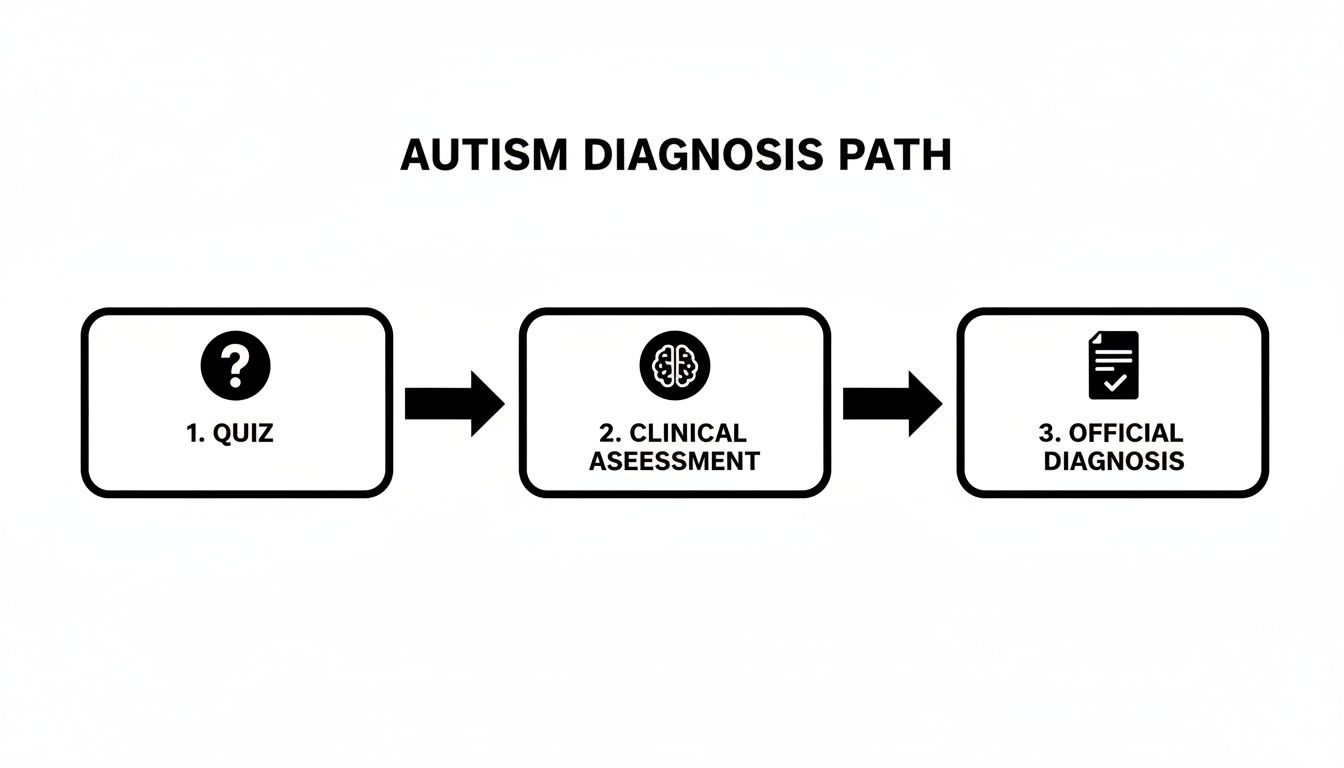
As you can see, the journey often starts with self-discovery (the quiz), moves into a professional evaluation (the clinical assessment), and leads to a formal outcome (the official diagnosis).
The Initial Consultation and Triage
Your first proper step is usually an initial consultation or triage. This is where you’ll have your first chat with the clinical team to discuss why you're seeking a test for autism and what you're hoping to get out of it. It’s a crucial stage that makes sure a full assessment is genuinely the right path for you and helps the team gather some preliminary information.
This is also the point where any co-occurring conditions are first considered. It’s not uncommon for adults exploring an autism diagnosis to also have traits of ADHD, anxiety, or depression. A good clinician looks at the whole picture right from the start, thinking about how these different elements might be interacting to affect your overall mental health.
The Diagnostic Interview
At the very heart of any good assessment is the in-depth diagnostic interview. This isn’t a quick chat; it's a comprehensive conversation with a consultant psychiatrist or specialist clinician that can last for several hours. The best way to think about it is as a collaborative exploration of your life.
You’ll be asked about all sorts of things, including:
- Your Childhood: What were your early years like? Think about friendships, school experiences, and how you used to communicate.
- Your Adult Life: This covers everything from university and work to romantic relationships and how you navigate social situations now.
- Your Mental Health History: You’ll likely discuss any previous diagnoses, treatments, and how you’ve learned to manage challenges like anxiety, burnout, or low mood.
This conversation is absolutely vital for building a detailed developmental history, which is a cornerstone of the diagnostic criteria for both autism and ADHD.
A diagnostic interview isn’t an interrogation; it's a guided reflection. The goal is to understand your lived experience from your perspective, connecting past events to present-day challenges and strengths.
Observational Assessments and Collateral Information
Alongside the main interview, clinicians use specialised observational tools. For an autism assessment, this often involves specific activities designed to see your social communication and interaction styles in a more structured setting. For ADHD, it might involve rating scales and targeted questions focused on attention, impulsivity, and executive functioning.
With your permission, the clinician might also ask to speak with someone who knows you really well—perhaps a parent, a long-term partner, or a sibling. This is known as gathering "collateral information." It provides a more rounded view, especially for understanding what you were like in early childhood, long before you could form your own lasting memories.
To give you a clearer picture, here’s a breakdown of the typical stages involved in a comprehensive assessment.
Key Stages of an Adult Autism Assessment
| Stage | What Happens | Purpose |
|---|---|---|
| 1. Referral & Triage | You make initial contact with a clinic. A clinician reviews your reasons for seeking assessment and any self-screening results. | To ensure an assessment is appropriate for you and to gather baseline information. |
| 2. Diagnostic Interview | A long, structured conversation with a specialist about your entire life, from early childhood development to present-day experiences and mental health history. | To build a comprehensive developmental history and understand your unique profile of traits and challenges. |
| 3. Observational Assessment | You'll participate in standardised activities (like the ADOS-2) designed to observe social communication and interaction. | To see your traits "in action" in a consistent, structured way that complements the interview data. |
| 4. Collateral Information | With your consent, the clinician speaks to someone close to you (e.g., a parent) to get another perspective, often using a tool like the ADI-R. | To gather historical information about your early development and provide a richer, more complete picture. |
| 5. Synthesis & Reporting | The clinical team reviews all the collected information, analyses the findings against diagnostic criteria, and writes a detailed report. | To formulate a clear diagnostic conclusion, including any co-occurring conditions, and provide personalised recommendations for support. |
| 6. Feedback & Next Steps | You have a final session to discuss the report's findings, ask questions, and talk about what comes next. | To ensure you fully understand the outcome and feel empowered to move forward with the information. |
Each step is designed to build on the last, creating a thorough and evidence-based understanding of your neurotype.
The Final Report and Diagnosis
Once all the information has been gathered, the clinician pulls everything together into a detailed diagnostic report. This document does far more than just give you a ‘yes’ or ‘no’ answer. It provides a full diagnostic formulation, carefully explaining how your experiences and traits align with the clinical criteria for autism, ADHD, or any other relevant mental health conditions.
This final report is your personal roadmap. It offers a clear explanation of your neurotype, gives you personalised recommendations for support, and acts as the official document you might need for things like workplace accommodations or accessing further support. It marks the end of the assessment journey but, for many, the beginning of a new chapter of self-understanding and acceptance.
How Online Assessments Make Getting a Diagnosis Easier
For many adults, the thought of getting a formal diagnosis for autism or ADHD can feel overwhelming, especially when managing anxiety or sensory sensitivities. Traditional, face-to-face assessments are thorough, but they often come with real-world obstacles. Think long waiting lists, the expense and hassle of travel, and the sheer stress of sitting in an unfamiliar clinic.
This is where modern, consultant-led online assessments have really changed the game.
Using secure video calls and online tools, this approach delivers a full, clinically sound evaluation right in the comfort of your own home. It cuts through many of the old barriers, making it far easier for people to get the clarity they deserve.
An online assessment isn't a watered-down version of the real thing. It’s simply a different, more flexible way of delivering the same expert clinical care, putting a reliable test for autism within reach for far more people.
What Does a Virtual Assessment Actually Involve?
So, how can a comprehensive clinical assessment possibly work through a screen? The whole process is carefully designed to be just as thorough as an in-person evaluation, meeting the same high clinical and regulatory standards. It blends a few key digital tools to build a complete picture.
Here’s what you can expect:
- Secure Video Calls: The heart of the assessment is a series of in-depth interviews with a consultant psychiatrist, all conducted over encrypted video. This allows for genuine, face-to-face interaction, which is crucial for building rapport and observing communication nuances.
- Private Online Portal: You’ll use a secure platform to fill out background information, complete standardised questionnaires for conditions like autism and ADHD, and upload supporting documents. This ensures all your sensitive information is kept completely confidential.
- Comprehensive Digital Report: Once the assessment is finished, you’ll receive a detailed diagnostic report as a secure digital file. Just like a paper version, it will lay out the clinical findings, explain the diagnosis, and offer personalised recommendations for what to do next.
This approach makes sure every stage of the process, from the first chat to the final feedback session, is handled with real clinical precision.
It's not about technology replacing clinical expertise. It’s about using technology to bring that expertise directly to you, in a place where you feel comfortable enough to be yourself.
The Real-World Benefits of Going Online
Opting for an online assessment brings some major advantages, especially for adults juggling anxiety, sensory sensitivities, or the executive function difficulties that can go hand-in-hand with autism and ADHD.
1. Less Stress and Anxiety
Being assessed in your own home can make a world of difference to your stress levels. There’s no busy public transport to navigate, no hunt for a parking space, and no sitting in a sterile waiting room. Feeling more at ease often means you can communicate more openly and authentically with the clinician.
2. Genuinely Accessible Specialist Care
Online assessments are a lifeline for people in rural areas, or for anyone with mobility problems or other health conditions that make travel a nightmare. They completely remove geography from the equation, giving you access to specialist care no matter where you live.
3. A Much Faster Path to Clarity
NHS waiting lists can sometimes stretch into years, which is a painfully long time to be in limbo. Private online services offer a much faster route. At Insight Diagnostics, for instance, we can typically schedule an assessment within seven working days. This speed is similar for other conditions, like our ADHD assessment online service. Getting answers quickly can lift a huge weight and is often the first step towards improving your mental wellbeing.
Costs, Timelines, and What Comes Next
So, you’ve decided to explore a formal assessment. This is where the practical side of things—money and time—really comes into play. Figuring out this part of the journey is crucial, and it often means weighing up the pros and cons of going through the NHS versus a private clinic. Knowing what to expect helps you make a choice that feels right for you.
Let's be upfront: getting an autism assessment as an adult requires an investment. It's either an investment of your time, waiting for public services, or a financial investment for a private diagnosis. Understanding this from the get-go can save a lot of frustration and help you plan your next move.
NHS vs. Private: The Trade-Offs
In the UK, you've got two main routes: the NHS or a private provider. NHS assessments are free, which is a huge plus. The significant downside, however, is the waiting list. It’s not uncommon to wait many months, and in some parts of the country, it can be several years. That long stretch of not knowing can be incredibly tough, especially if you're already struggling with your mental health.
This is where private assessments come in as a much faster alternative. Yes, you have to pay for it, but the wait is dramatically shorter. A specialist online clinic, for instance, might be able to see you for a full diagnostic assessment within a week or two. That means getting answers and a plan to move forward without that long, agonising wait.
Speed can be a game-changer, particularly if you suspect co-occurring conditions like ADHD. A timely diagnosis means you can access support or treatment that can make a real, immediate difference. To get a clearer picture of the costs involved, you can explore what's included in a typical cost of an ADHD assessment, which helps break down the investment needed for a swift, expert-led evaluation.
What’s Included in a Private Assessment?
When you see the cost of a private autism or combined autism/ADHD assessment—typically ranging from £1,800 to £3,000 or more—it can feel like a lot. It’s helpful to reframe it. You aren’t just paying for a label; you’re investing in a comprehensive, life-changing clinical service.
Here’s a breakdown of what that investment actually covers:
- Expertise: This includes several hours of a Consultant Psychiatrist's time, dedicated to your interviews, analysing all the information, and carefully writing your report.
- Clinical Tools: You’re paying for the use of 'gold-standard' diagnostic tools and validated questionnaires that ensure a thorough and accurate assessment.
- Admin and Coordination: Behind the scenes, a team is managing the process, coordinating appointments, and handling your sensitive medical data securely.
- A Detailed Report: You receive a comprehensive, multi-page document that doesn’t just give a diagnosis but provides a full clinical formulation and practical, actionable recommendations.
When you think about the cost, it's also worth weighing it against the hidden costs of not knowing—the toll on your mental health, the strain on relationships, or the challenges in finding and keeping a job that works for you.
A diagnostic report is more than a confirmation; it's a blueprint. It provides the official validation needed to access support and the personal insight required to build a life that aligns with your true self.
Life After a Diagnosis: Your Personal Roadmap
Getting a diagnosis isn't the finish line; it’s the starting block. A good diagnostic report is a practical tool. It’s designed to help you, and the people around you, understand your unique profile of strengths and challenges. Think of it as a key that unlocks meaningful support and fosters genuine self-acceptance.
Here’s how a diagnosis can lead to real, tangible changes in your life:
- Support at Work: A formal report is the evidence you need to ask for 'reasonable adjustments' under the Equality Act 2010. This could mean getting flexible hours, a desk in a quieter spot, or having instructions provided in writing. Small changes can make a massive difference.
- Better Mental Health Support: Your diagnosis gives therapists and doctors vital context. It helps them see that your anxiety might be rooted in sensory overload or that your low mood is linked to social burnout from masking autistic traits. This leads to strategies that actually work because they address the root cause, not just the symptoms.
- Empowered Self-Advocacy: Finally understanding your own brain gives you the language and confidence to ask for what you need—from friends, family, and colleagues. It helps shift your internal narrative from "What's wrong with me?" to "This is how I operate, and this is what helps me thrive."
Ultimately, the goal of an assessment is clarity. It's this newfound understanding that becomes the foundation for building a life that feels more authentic, sustainable, and fulfilling.
Preparing for Your Assessment and Understanding the Report

Going into an assessment feeling prepared can make a world of difference. This isn't about revising for an exam; it's about organising your thoughts so you can give the clinician a clear, honest picture of who you are. A little bit of prep work can calm your nerves and help you get the most out of the process.
Think of it as gathering the evidence of your own life. The more specific, real-world examples you can share, the easier it is for the expert to understand your unique profile. This is especially vital for teasing apart the often-overlapping traits of autism, ADHD, and other conditions like anxiety.
How to Gather Your Thoughts
It’s a good idea to spend some time reflecting before your appointments. Trying to recall key moments on the spot can be tough, so jotting down some notes beforehand is a massive help.
You could make lists or notes covering these areas:
- Childhood Memories: What do you remember about school? Think about old reports, friendships (or lack thereof), how you communicated, and any sensory sensitivities or all-consuming interests.
- Work and Career: Have you noticed any recurring patterns or challenges? This could be anything from struggling with small talk in the office to feeling overwhelmed by project management or noisy environments.
- Relationships: Reflect on your friendships and romantic partnerships. What are the common themes? How do you connect with people, and what difficulties seem to crop up repeatedly?
- Mental Health: Make a note of your experiences with anxiety, depression, or burnout. Try to connect these feelings to specific triggers, like big social gatherings, executive function struggles, or periods of intense pressure.
Preparing for an assessment isn't about finding the "right" answers. It's about providing the clinician with the raw data of your life, enabling them to see the patterns that you might have been too close to notice.
This groundwork helps make sure your test for autism is as accurate as it can be. It's also a great chance for you to think of questions you want to ask, so you can leave the process feeling properly heard and informed.
Making Sense of Your Diagnostic Report
Once the assessment is complete, you’ll receive a detailed report. It can look a bit dense and clinical at first, but it’s essentially your personal manual for moving forward. It's far more than a simple "yes" or "no"—it’s a guide to how your brain is wired.
Typically, your report will contain:
- Clinical History: This is a summary of all the information you shared during the interviews.
- Diagnostic Formulation: Here, the clinician explains exactly how your experiences and traits line up with the diagnostic criteria for autism or any other co-occurring conditions like ADHD or anxiety disorders.
- Strengths and Challenges: A balanced look at what you excel at and the areas where you might need a bit of support.
- Personalised Recommendations: This is the most practical bit—a list of actionable advice tailored specifically to you.
Think of these recommendations as your roadmap. They might suggest certain therapies, practical strategies for handling sensory overload, or advice on how to ask for adjustments at work. By understanding the report, you can start to navigate your life with a much deeper level of self-awareness and a new set of tools to help you thrive.
Your Questions About Adult Autism Assessments, Answered
If you’re thinking about getting assessed for autism as an adult, it's completely normal to have a lot of questions swimming around. Let's walk through some of the most common ones to help clear things up and give you the confidence to take the next step.
Can I Still Be Assessed for Autism if I Already Have a Diagnosis for ADHD or Anxiety?
Yes, absolutely. In fact, it’s incredibly common for autism, ADHD, and anxiety to show up together. Their traits can overlap so much that it's easy to see why trying to figure it out on your own can feel confusing.
This is where a specialist psychiatrist comes in. A proper, thorough assessment is designed to carefully untangle these threads. The clinician's job is to look at how all your different traits interact, building a complete and accurate picture of your neurotype and how it impacts your mental health. This isn't about swapping one label for another; it’s about understanding the whole you. The clinical term for this is differential diagnosis.
An autism diagnosis doesn't cancel out anything else you might be experiencing. Think of it as finding a new, crucial piece of the puzzle. It can offer a powerful context that helps explain why you experience things like anxiety or executive function challenges in the unique way that you do.
What’s the Difference Between a Psychiatrist and a Psychologist for an Autism Diagnosis?
Both are highly qualified professionals, and both can diagnose autism. The main difference really comes down to their medical training and what they can do as part of their practice.
- Psychiatrist: A psychiatrist is a medical doctor first who then specialises in mental health. This means they can diagnose autism and are also able to prescribe medication if you have co-occurring conditions like ADHD. Their diagnostic reports often carry a specific kind of weight in medical or legal situations.
- Psychologist: A clinical psychologist has a doctorate in psychology. They are experts in psychological testing, therapy, and interventions, but because they aren't medical doctors, they can't prescribe medication.
If you suspect you might have both autism and ADHD, seeing a psychiatrist can be a more direct route, as they can handle every aspect of the diagnosis and any potential treatment plan that follows.
Will Getting a Diagnosis Change Who I Am?
Not at all. A diagnosis doesn't change your fundamental self—it simply gives you a new, more accurate lens through which to understand the person you've always been. For many adults, it’s a deeply validating and empowering moment.
Often, the biggest change is a profound sense of relief. It can quieten years of self-doubt and replace it with self-compassion. It provides a new framework for making sense of past experiences, navigating present challenges, and planning for a future that genuinely supports your mental health and wellbeing.
Is an Online Autism Assessment as Valid as an In-Person One?
Yes, as long as it's done right. A high-quality online assessment, carried out by experienced, qualified clinicians following national guidelines (like those from NICE in the UK), is every bit as robust and valid as a face-to-face one.
These modern assessments use the very same 'gold-standard' clinical interviews and tools. The only difference is that they're delivered through a secure video call, which makes specialist care far more accessible without cutting any clinical corners.
At Insight Diagnostics Global, we provide CQC-regulated, consultant-led online assessments for adults seeking clarity about autism, ADHD, and their mental health. Our expert team offers a supportive and efficient pathway to a formal diagnosis, helping you gain the understanding you deserve. Find out more about our services at https://insightdiagnostics.co.uk.