

For many adults grappling with lifelong challenges, a private ADHD diagnosis offers a direct, and often much quicker, path to getting some real answers. It's a way to bypass the notoriously long NHS waiting lists and finally start making sense of things, opening the door to support like medication and therapy that can improve your overall mental health.
Why Consider a Private ADHD Diagnosis

Does it ever feel like your brain is running on a completely different operating system to everyone else’s? For a growing number of adults, that persistent feeling is the first clue they might have Attention Deficit Hyperactivity Disorder (ADHD). This neurodevelopmental condition, which can often exist alongside others like autism, can have a massive impact on everyday life, affecting everything from your performance at work to your closest relationships and overall mental health.
Living with undiagnosed ADHD, or co-occurring conditions, can take a serious emotional toll. It often looks like chronic self-doubt, anxiety, and that nagging feeling you’re not quite reaching your potential, all while you’re left wondering why seemingly simple tasks feel like climbing a mountain.
The Challenge of Getting Answers
The first step to understanding what’s going on is usually a formal assessment, but this is where many people hit a major roadblock: NHS waiting times. According to ADHD UK, you could be waiting anywhere from a few months to several years for an assessment, depending on where you live. That kind of delay can feel excruciating when you’re desperately searching for answers and support for your mental health.
This is exactly why a private ADHD diagnosis has become such a crucial alternative for so many people.
Going private isn't just about skipping the queue. It’s about taking control of your own mental health journey. It gives you a clear, structured way to understand your unique neurotype—including potential co-occurring autism—and get access to specialist care when you actually need it.
Choosing the private route means you can sidestep the long delays and speak directly with specialists. For many, it's the first tangible step towards getting clarity and learning how to build a life that works with their brain, not against it. The process usually kicks off when you fill out a patient intake form, which gives the clinic the background information they need to get started.
This guide is here to walk you through that entire process. We’ll cover everything from what to expect in an assessment and how much it costs, to finding a provider you can trust and making sense of your report. If you’re just starting to explore your options, our overview of getting an ADHD diagnosis in the UK offers more detail on all the available pathways.
So, What Exactly Is a Private ADHD Diagnosis?
A private ADHD diagnosis is essentially a way to get a professional, clinical assessment without the often lengthy waits of the public healthcare system. For a lot of adults, this isn't just a preference; it’s a necessity. When your mental health is suffering, work is a struggle, or your relationships are strained, waiting years for answers isn't really an option. It’s about taking back control and getting a clear, timely evaluation to finally understand how your brain is wired.
This path is often chosen out of sheer frustration. The hard truth is that ADHD is massively underdiagnosed here in the UK, leaving a huge hole in mental health support. A landmark study that looked at nine million GP records found that a tiny 0.32% of people had a recorded diagnosis. But here's the kicker: population estimates suggest the real figure is probably closer to 2.8%. That means for every nine people who actually have ADHD, only one has been officially diagnosed. This gap is only getting wider as the NHS struggles to keep up with demand. You can read more about the UK's ADHD diagnosis rates to get a sense of the scale of the problem.
Going private offers a direct route to a specialist, but it's important to be clear on how this route differs from what the NHS offers.
Private Diagnosis vs. The NHS Pathway at a Glance
When you're weighing up your options, it really helps to see how a private assessment stacks up against the standard NHS journey. Each route has its own timeline, costs, and processes. Knowing the key differences upfront will help you decide what’s right for you and your situation.
Here’s a simple breakdown of what to expect from each path.
| Feature | Private Diagnosis Pathway | NHS Pathway |
|---|---|---|
| Wait Times | Usually very short. You can often get an assessment booked within a few weeks. | This is the big one. Wait times can be incredibly long, from many months to several years. |
| Cost | You cover the costs yourself for the assessment, the report, and any follow-up care. | Free at the point of use, as it’s covered by the NHS. |
| Flexibility | Much more flexible. You can often find appointments in the evenings or on weekends. | Less flexible. You'll be given an appointment based on when the service has availability. |
| Choice of Specialist | You're in the driving seat. You can research and choose a specific psychiatrist or clinic. | You are generally assigned to the next available specialist within your local NHS trust. |
As you can see, the main trade-off is pretty clear: cost versus speed. While the NHS provides an invaluable service for free, the private sector offers a fast, flexible alternative for those who feel they can't afford to put their mental health on hold.
Why a Clinically Sound Diagnosis is Non-Negotiable
This is a really important point: not all private providers are created equal. For a private ADHD diagnosis to be taken seriously—by your GP, your university, or your employer—it has to come from a credible, regulated source. The gold standard is finding a clinic that operates by the book and follows national guidelines.
Here’s what makes a diagnosis clinically robust and properly recognised:
- CQC Regulation: The provider absolutely must be regulated by the Care Quality Commission (CQC). They are the independent watchdog for all health and social care in England, making sure services are safe and effective.
- GMC-Registered Psychiatrists: Your assessment needs to be carried out by a consultant psychiatrist who is on the General Medical Council (GMC) Specialist Register. This is your guarantee that they have the highest level of training for diagnosing complex neurodevelopmental conditions like ADHD and autism.
- NICE Guidelines Adherence: The entire assessment process must follow the best-practice standards laid out by the National Institute for Health and Care Excellence (NICE).
A diagnosis from a CQC-regulated clinic with GMC-registered specialists isn't just a piece of paper; it's a recognised medical validation. It means your report carries clinical weight and makes it much easier to work with your GP on things like a Shared Care Agreement for medication.
Ultimately, choosing a reputable provider isn't just a good idea—it's essential. It’s the only way to be sure you’re getting a thorough, ethical, and officially recognised assessment. This turns your diagnosis from just an answer into a powerful tool for getting the right support and building a better future for your mental health.
The Private ADHD Assessment from Start to Finish
Deciding to go for a private ADHD assessment can feel like a massive step, but knowing what’s involved can make the whole thing feel a lot less daunting. A proper, reputable assessment isn't just a quick chat followed by a prescription; it's a careful, detailed look into your life, your history, and your challenges to build a truly accurate picture of your mental health.
The entire process is usually broken down into a few clear stages, each one designed to gather the right information. This methodical approach means that by the end, you get a clear, clinically sound answer. Let's walk through what you can expect, from that first phone call to getting your final report in hand.
This flowchart maps out the two main routes to getting a diagnosis, showing the key differences between the private and NHS pathways.
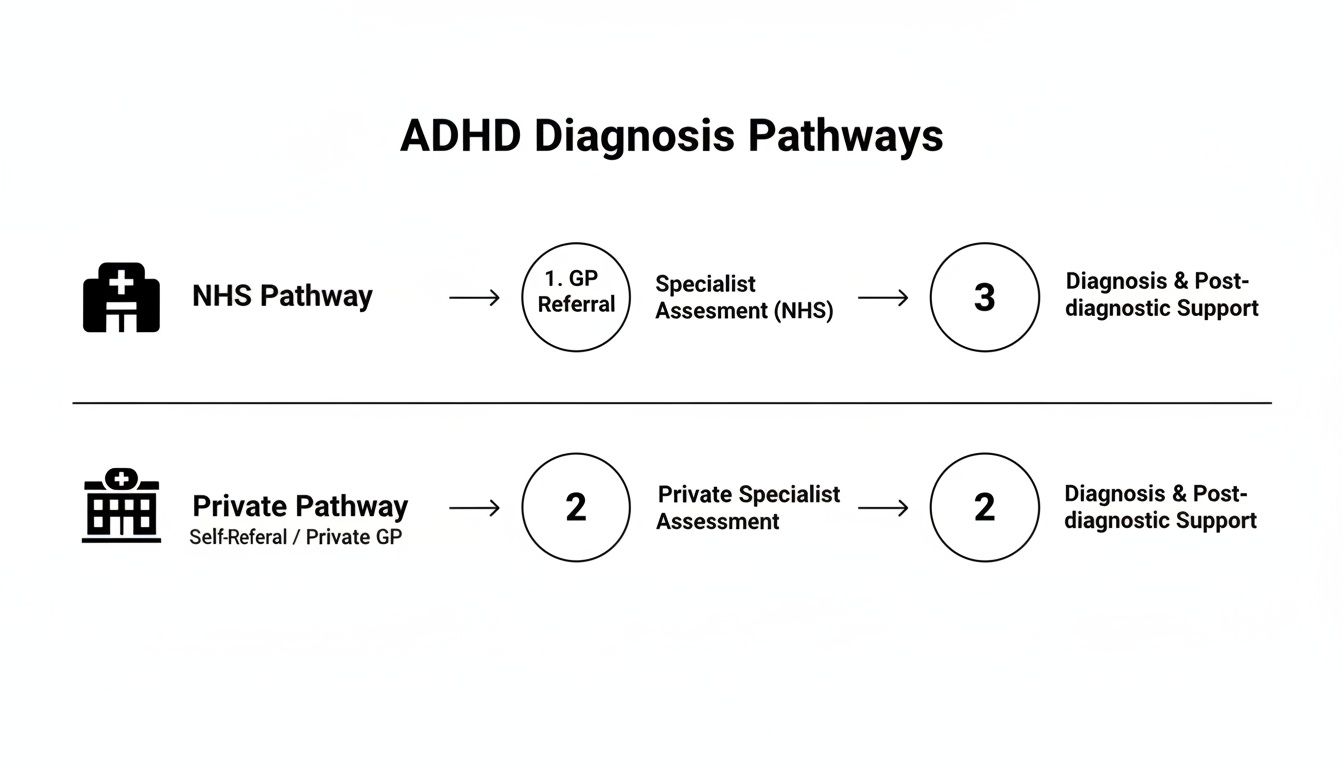
As you can see, the private route lets you go directly to a specialist, which means you don't need a GP referral to get the ball rolling.
Your Initial Consultation and Pre-Assessment Forms
The journey almost always starts with an initial chat or enquiry. This is your chance to get a feel for the clinic and ask any burning questions you might have. After that, you'll be sent a set of detailed pre-assessment forms to fill out.
Don't underestimate these forms—they’re absolutely crucial. They aren’t just a bit of admin; they lay the groundwork for your entire assessment. You’ll be asked about your current struggles, what you were like as a child, how you got on at school, and your work history.
A thorough assessment is all about finding lifelong patterns. It goes beyond just focus and fidgeting to look at emotional regulation, executive function, and the real-world impact your symptoms have on your day-to-day life and mental health.
Many clinics also find it incredibly helpful to get input from someone who knows you well, like a parent, partner, or a friend you’ve had for years. Their perspective can add valuable context for the clinician piecing everything together.
The In-Depth Clinical Interview
This is the heart of the whole process. You’ll have a detailed interview with a consultant psychiatrist, which usually lasts between one and two hours. Think of it as a collaborative conversation, not an interrogation. The specialist will use your forms as a starting point, asking more questions to really dig into your experiences.
A huge part of any robust assessment is screening for other conditions, because ADHD rarely shows up alone. A good psychiatrist will also explore symptoms of common co-occurring conditions, such as:
- Autism Spectrum Disorder (ASD): They’ll touch on social communication, sensory issues, and deep interests to see if a separate autism assessment might be worth considering. The overlap between ADHD and autism is significant.
- Anxiety and Depression: It’s important to figure out if mood or anxiety issues are separate conditions, or if they’re a direct result of living with undiagnosed ADHD.
- Other Mental Health Conditions: Ruling out other possibilities is key to making sure the final diagnosis is the right one.
This ‘whole picture’ approach is vital. The right support plan can only be built on an accurate understanding of your entire mental health profile. To get a better idea of the specific tools and methods involved, you can learn more about how ADHD is tested in a clinical setting.
Receiving and Understanding Your Diagnostic Report
Once the interview is over, the psychiatrist will pull all the information together into a comprehensive diagnostic report. This document is so much more than a simple "yes" or "no." It should lay out the clinical findings, explain how your symptoms line up with the diagnostic criteria, and give a clear conclusion.
Most importantly, a quality report will include personalised recommendations. These aren't just generic tips; they are concrete next steps tailored to you and your complete mental health picture. This could include suggestions for medication, therapy (like CBT), workplace adjustments, or practical strategies for managing daily life.
This report becomes your roadmap. It validates your experiences and gives you the clinical evidence you need to get support, whether that's medication, therapy, or accommodations at work or university. It’s the end of the diagnostic journey, and the beginning of a new, more informed chapter.
Understanding Your Diagnostic Report and What Comes Next
Getting your hands on your diagnostic report is a big moment. It’s not just the end of the assessment; it’s the start of a new chapter where you finally have a clear framework for understanding how your brain works. A proper report from a private ADHD clinic won’t just slap a label on you—it will give you a detailed roadmap for improving your overall mental health.
This document pulls together all the clinical findings from your assessment. It’ll lay out exactly how your personal history and the symptoms you’ve described line up with the formal diagnostic criteria for ADHD. Crucially, it will also include a set of personalised recommendations, created just for you.
Decoding Your Personalised Recommendations
Think of this part of the report as your personal action plan. It takes you beyond the diagnosis itself and outlines practical, supportive steps you can begin to take. Any decent report will suggest a well-rounded approach, because managing ADHD, especially if it co-occurs with autism or anxiety, is rarely about a single solution.
Your recommendations might cover things like:
- Medication: A professional opinion on whether medication could be a helpful option for you.
- Therapeutic Support: Suggestions for specific therapies like Cognitive Behavioural Therapy (CBT), which is brilliant for building strategies to tackle things like procrastination or emotional regulation.
- Practical Adjustments: Ideas for reasonable adjustments at work or university, such as flexible working hours or being given a quieter space to focus.
- Coaching: Information about ADHD coaching, which can help you sharpen executive function skills like planning, organising your day, and managing your time.
This guidance is all about empowering you. It’s validation for your experiences and provides you with concrete, evidence-based options to explore. The goal is to help you build a life that works with your neurotype, not constantly fight against it.
The Medication Process Explained
For many people, the prospect of trying medication is a major reason for going private. If your report recommends it, the next stage is a carefully managed process called titration. This isn't about just being handed a prescription and sent on your way; it's a methodical journey to find the right medication and the right dose for you.
Titration is a partnership between you and your psychiatrist. You’ll start on a very low dose, which is then gradually increased over several weeks. Throughout this period, you’ll have regular check-ins to see how you’re getting on and to monitor for any side effects. It’s a careful, deliberate process to make sure your treatment is both safe and genuinely effective.
The aim is to find the lowest possible dose that manages your core ADHD symptoms well, without causing any troublesome side effects. It’s a highly individual process—what works wonders for one person might not be right for another. Patience is key here, but the outcome is a treatment plan that’s been fine-tuned to your unique needs. If you want to know more about the practicalities, our guide explains how to get a private prescription in the UK.
The Path to Long-Term Support
Once you and your specialist have found a stable treatment plan, the focus shifts to ongoing management. A really important step here is setting up a Shared Care Agreement (SCA) with your GP. This is a formal arrangement where your private psychiatrist hands over the responsibility for prescribing and monitoring your medication to your NHS GP, which makes things much more convenient and affordable in the long run.
A good private provider will supply you with all the necessary paperwork to get this ball rolling. But that doesn't mean you're on your own. Most clinics will recommend an annual review with your specialist to check in, ensure your treatment is still working for you, and make any tweaks needed as your life changes.
This whole journey is becoming far more common as awareness around adult ADHD grows. Recent UCL research pointed to a big jump in diagnoses across the UK, but also highlighted the massive gap between the number of people thought to have ADHD and those actually getting treatment. It’s this gap that keeps driving people towards private options, offering a vital lifeline to those who simply can't face the long wait. You can read the full research about these ADHD findings for the bigger picture. Your report is the first step to unlocking this essential, ongoing support.
Choosing a Reputable and Trusted Private Provider
The surge in people seeking a private ADHD diagnosis has, unfortunately, opened the floodgates to a wave of new services. The trouble is, not all of them are up to scratch. Learning to spot the difference between a thorough, ethical provider and a questionable 'quick-fix' service is absolutely crucial for your safety and for getting a diagnosis that actually means something for your mental health.
This isn't just about getting a piece of paper. It’s about a proper medical evaluation that your GP, your employer, and your university will take seriously. The gap between the sheer demand and what the NHS can offer is enormous. In fact, official NHS data shows a massive under-recognition of ADHD, with diagnosis rates far lower than they should be. This situation has fuelled the boom in private care, but it has also created a tough reality for those who can't afford to pay. You can read the full NHS taskforce report to really grasp the scale of the problem.
Making a well-informed choice is your best protection and the only way to ensure you get the right support.
The Non-Negotiable Credentials
As you start looking into clinics, there are a few credentials that are complete non-negotiables. Think of these as the gold standard of a legitimate, professional service that puts you, the patient, first. This is your quality assurance checklist.
A trustworthy provider must have:
- CQC Regulation: The clinic absolutely has to be registered with and regulated by the Care Quality Commission (CQC). They are the independent watchdog for all health and social care in England, making sure services meet fundamental standards of quality and safety.
- GMC Specialist Register: Your assessment must be carried out by a consultant psychiatrist who is on the General Medical Council's (GMC) Specialist Register. This is your guarantee that they have the highest level of training needed to diagnose complex neurodevelopmental conditions like ADHD and autism. You can learn more about finding the right psychiatrist for ADHD in our detailed guide.
- Adherence to NICE Guidelines: The entire process—from the first forms you fill out to the final report you receive—must follow the National Institute for Health and Care Excellence (NICE) guidelines. These are the evidence-based rules of the road for healthcare in the UK.
A diagnosis from a provider that ticks all these boxes is a recognised medical conclusion. It’s the key that unlocks collaborative care with your GP, such as Shared Care Agreements for medication, and provides the official evidence needed for workplace or academic adjustments.
Expertise in Co-occurring Conditions like Autism
ADHD rarely shows up to the party alone. It often comes along with other conditions, most commonly Autism Spectrum Disorder (ASD), anxiety, and depression. A genuinely specialist provider won’t just look for ADHD symptoms in a vacuum; they’ll conduct a holistic evaluation to get a clear picture of your entire neurodevelopmental and mental health profile.
This is so important because the symptoms can overlap in confusing ways. For instance, finding social situations tricky or having an intense focus on certain interests can be a feature of both ADHD and autism. A psychiatrist with real-world expertise in neurodiversity can skilfully untangle these threads, making sure your diagnosis is accurate and your support plan is truly built for you. Choosing a clinic that gets this complexity is essential for a meaningful outcome.
Finally, as you weigh up your options, don't forget to look into practical things like how they handle your personal health information. It’s worth checking that they take issues like EU data sovereignty matters seriously, as this is a big part of what makes them a trustworthy organisation.
Deciding What's Right For You
Thinking about a private ADHD assessment is a big decision, and it’s a positive one. For many, it’s about finally getting answers and finding a way forward that doesn't involve the long, often frustrating waits on the NHS, especially if you think other conditions like autism might be playing a part.
This isn’t just about getting a diagnosis. It’s an investment in yourself – your wellbeing, your work, and your relationships. Finally understanding why you’ve always found certain things so difficult can be a massive relief. It often lifts a huge weight of self-blame that people have carried around for years, changing the story from "What's wrong with me?" to "Oh, my brain just works differently."
A diagnosis isn't a label or a finish line. Think of it as a starting point—the beginning of a new chapter where you have the right tools and understanding to build a life that truly fits you.
When you’re ready, the first real step is simply starting a conversation. Reaching out to a trusted, CQC-regulated provider lets you ask those initial questions and get a feel for the process, all without any pressure to commit.
Taking that step gives you the knowledge to start advocating for yourself. That might mean asking for adjustments at work, looking into therapy, or finding out if medication could help. It’s all about moving from a place of uncertainty to one of clarity and control over your mental health. You're in the driver's seat, and this is how you start the engine.
Your Questions About Private ADHD Diagnosis, Answered
Thinking about private healthcare can feel like stepping into a whole new world, and it’s natural to have questions. To help you get your bearings, we’ve answered some of the most common things people ask when considering a private ADHD diagnosis.
How Much Will a Private ADHD Assessment Cost?
Let's get straight to the point: what’s the financial commitment? In the UK, you can expect a comprehensive private ADHD diagnosis to cost somewhere between £700 and £1,500. It’s a bit of a range, I know, but the final price really depends on the clinic and what they bundle into their assessment package.
Any good provider will be upfront about their pricing. A standard package should always include the initial screening forms, the main clinical assessment with a psychiatrist, and a detailed diagnostic report with tailored recommendations.
Make sure you ask about any potential extras. Things like follow-up appointments or the fees for starting medication titration can sometimes be billed separately. Getting a clear idea of the total cost from the outset means no nasty surprises down the line.
What if I Think I Might Have Autism or Anxiety Too?
This is such an important question, because ADHD rarely travels alone. It very often shows up alongside other conditions like Autism Spectrum Disorder (ASD), anxiety, or depression. Their symptoms can get tangled up, which is why a proper assessment is so much more than just ticking boxes on an ADHD checklist.
A psychiatrist who truly specialises in neurodiversity will take a much wider view. During your assessment, they’ll look at your life experiences from multiple angles to build a complete picture of your mental health. They'll ask about social communication, sensory issues, and how you regulate your mood to see if any other conditions are part of the story.
This holistic approach is absolutely essential for getting an accurate diagnosis. It ensures your treatment plan is built for you, addressing not just the ADHD but anything else that’s affecting your daily life.
The whole point is to achieve total clarity, so you get the right support for everything you're going through.
Will My GP Actually Accept a Private Diagnosis?
This is a big worry for many, and the answer really comes down to the quality and credibility of the clinic you choose. Your GP is far more likely to accept a diagnosis if it comes from a provider that meets the highest professional standards.
For your diagnosis to hold weight within the NHS, you need to pick a clinic that is:
- Regulated by the CQC (Care Quality Commission).
- Run by GMC-registered specialist psychiatrists.
- Adhering strictly to NICE (National Institute for Health and Care Excellence) guidelines.
When a clinic ticks all these boxes, the report they produce has real clinical authority. This makes it much easier for your GP to work with you on your care, especially when it comes to setting up a Shared Care Agreement for your medication.
Can I Start Medication on the Day I'm Diagnosed?
It makes perfect sense to want to start treatment right away, but getting medication isn't like picking up a prescription after a quick chat. It's a careful, medically-managed process called titration.
You won't be handed a prescription and sent on your way. Instead, titration means starting on a very low dose of medication, which is then slowly and carefully increased over several weeks. You'll have regular contact with your psychiatrist during this time to see how you're feeling, track the benefits, and watch for any side effects. It’s a methodical process, but it’s crucial for your safety and for finding the exact dose that works for your unique brain and body.
At Insight Diagnostics Global, we provide CQC-regulated, consultant-led assessments designed to give you the clarity and support you deserve. If you're ready to take the next step in understanding your own mind, explore our services and start your journey today. https://insightdiagnostics.co.uk