Waiting months—or sometimes even years—for an NHS mental health assessment can feel like an impossible situation. The good news is, there's another way. To get a private prescription in the UK, you can book a consultation directly with a private specialist, like a psychiatrist. They can carry out an assessment, provide a diagnosis for conditions such as ADHD or Autism, and then issue the medication you need. It's often a much, much faster path to getting treatment.
Why a Private Prescription Can Be a Lifeline

When you're struggling with your mental health, every single day counts. The long waiting lists on the NHS, especially for specialist assessments for conditions like ADHD and Autism, can leave you feeling completely stuck and unsupported. This is precisely where exploring a private prescription becomes more than just an alternative—for many people, it's a necessary and empowering step towards getting help.
Taking the private route puts you back in the driver's seat of your own healthcare. Instead of waiting indefinitely for a referral to come through, you can actively research and choose a specialist who feels right for your specific needs. This direct access drastically cuts down the time between realising you need help and actually starting a treatment plan, which is particularly critical for managing ADHD and other mental health conditions.
The Core Benefits of Going Private for ADHD and Autism
When it comes to mental health support, particularly for neurodevelopmental conditions like ADHD and Autism, the advantages of a private assessment and prescription really stand out. The whole process is designed to deliver faster, more personalised care that can make a world of difference.
Here are the key advantages:
- A Timely Diagnosis: You can often book an assessment within weeks, not years. This means getting a much faster diagnosis for ADHD or Autism and finally understanding what's going on.
- Choice of Specialist: You have the freedom to find and select a psychiatrist or clinic that has deep expertise in adult ADHD or Autism, ensuring you're speaking with a true expert.
- Personalised Care: Private consultations tend to be more in-depth, allowing for longer discussions. This leads to a treatment plan that’s carefully built around your individual symptoms, lifestyle, and personal goals.
Opting for a private pathway for ADHD or Autism can feel daunting at first, but it often means receiving a comprehensive, tailored assessment much sooner. This speed isn’t about skipping steps; it’s about accessing expert care precisely when you need it most, preventing months of unnecessary struggle.
In the UK, a private prescription offers a clear shortcut to specialist medications for mental health conditions, bypassing NHS waiting lists that can stretch on for years. This accelerated access is a major reason why so many people are exploring their options for UK private prescriptions, as it can lead to much quicker relief and a better quality of life.
Finding a Mental Health Specialist You Can Trust
Choosing the right private psychiatrist is easily the most important part of this whole process, particularly if you’re looking for help with conditions like ADHD or Autism. It's about more than a quick online search; you need to know what to look for to ensure the care you get is safe, effective, and right for you. Think of it as finding a professional who truly gets the complexities of what you're going through.
Your first port of call, and it’s a non-negotiable one, is to check their professional credentials. Any psychiatrist you’re considering must be on the General Medical Council (GMC) Specialist Register. This isn't just red tape—it's your guarantee that they've completed the incredibly demanding training required to become a consultant psychiatrist in the UK. Without that registration, you have no real assurance of their expertise.
Key Credentials to Verify for ADHD and Autism Care
Once you've confirmed their GMC status, the next thing to look for is whether the clinic or service is regulated by the Care Quality Commission (CQC). The CQC is the independent watchdog for health and social care in England. Their seal of approval means the service meets essential standards for quality and safety, which gives you an extra layer of confidence.
So, when you're sizing up a specialist or clinic for an ADHD or Autism assessment, make sure you check these boxes:
- GMC Specialist Register Status: This confirms they are a fully qualified consultant psychiatrist.
- CQC Regulation: This acts as an independent quality check on the entire service.
- Specialised Experience: Do they explicitly mention working with adults with ADHD, Autism, or other mental health conditions? You want someone with a proven track record.
Doing this homework isn't just for your peace of mind. It ensures that any diagnosis or prescription you receive is credible, which is vital if you hope to set up a shared care agreement with your NHS GP down the line.
Weighing Your Provider Options
The private mental health sector offers a few different ways to get help. You'll find solo practitioners running their own small practices, as well as much larger, dedicated online clinics specialising in conditions like ADHD and Autism. Each has its pros and cons.
A solo practitioner might offer a more personal, one-to-one service where you deal with the same person from start to finish. On the other hand, established online clinics often have a more structured setup, with admin teams to handle appointments and clear, well-trodden paths for assessment and treatment. As you explore your options, understanding the importance of seeing a specialist can really help clarify why this choice matters so much.
My advice? Before you commit to anyone for an ADHD or mental health assessment, ask direct questions. What does their assessment process actually involve? What are the typical timelines? What happens after a diagnosis? A good, reputable provider will be upfront and give you clear answers, making you feel confident you're in safe hands.
Ultimately, finding the right person is a personal choice, but verifying their credentials is not. For anyone needing an ADHD assessment, it's worth learning what a dedicated psychiatrist for ADHD can provide in terms of focused expertise and treatment. Taking that extra time to vet your options properly is the best way to find a professional you can genuinely trust on your journey.
What Really Happens During a Private Assessment
The thought of a psychiatric assessment can be daunting, particularly when you’re already feeling overwhelmed. Let’s walk through the entire process for conditions like ADHD and Autism, from the moment you make that first enquiry to getting the final report in your hands. Knowing what to expect can make a world of difference.
Your journey will almost always start with some pre-assessment questionnaires. These forms are usually quite comprehensive, asking about your current challenges, personal history, and family background, specifically looking for indicators related to ADHD or Autism. It might feel like a lot of paperwork, but this information gives the psychiatrist crucial context before you even speak, making your actual consultation far more productive.
Preparing for Your Consultation
To really get the most out of your assessment, it’s a good idea to pull together some supporting information beforehand. While it's not strictly required, it helps the clinician build a complete picture, which is especially important for neurodevelopmental conditions like ADHD and Autism that have roots in childhood.
Think about collecting things like:
- Old School Reports: You'd be surprised how insightful those old teacher comments can be. Phrases like "daydreamer," "easily distracted," or "struggles to stay on task" are often tell-tale signs of ADHD.
- Family and Partner Input: Ask a parent, an older sibling, or your partner for their honest take on your challenges, both past and present. They often see patterns related to ADHD or Autism that we miss ourselves.
- Your Own Notes: Before the appointment, spend some time jotting down specific, real-world examples of how your symptoms impact your daily life—at work, in your relationships, or just trying to manage household chores.
This kind of preparation means you can provide solid examples instead of vague feelings, which is exactly what a clinician needs for an accurate diagnosis. The timeline below gives you a rough idea of the initial research and preparation phase.
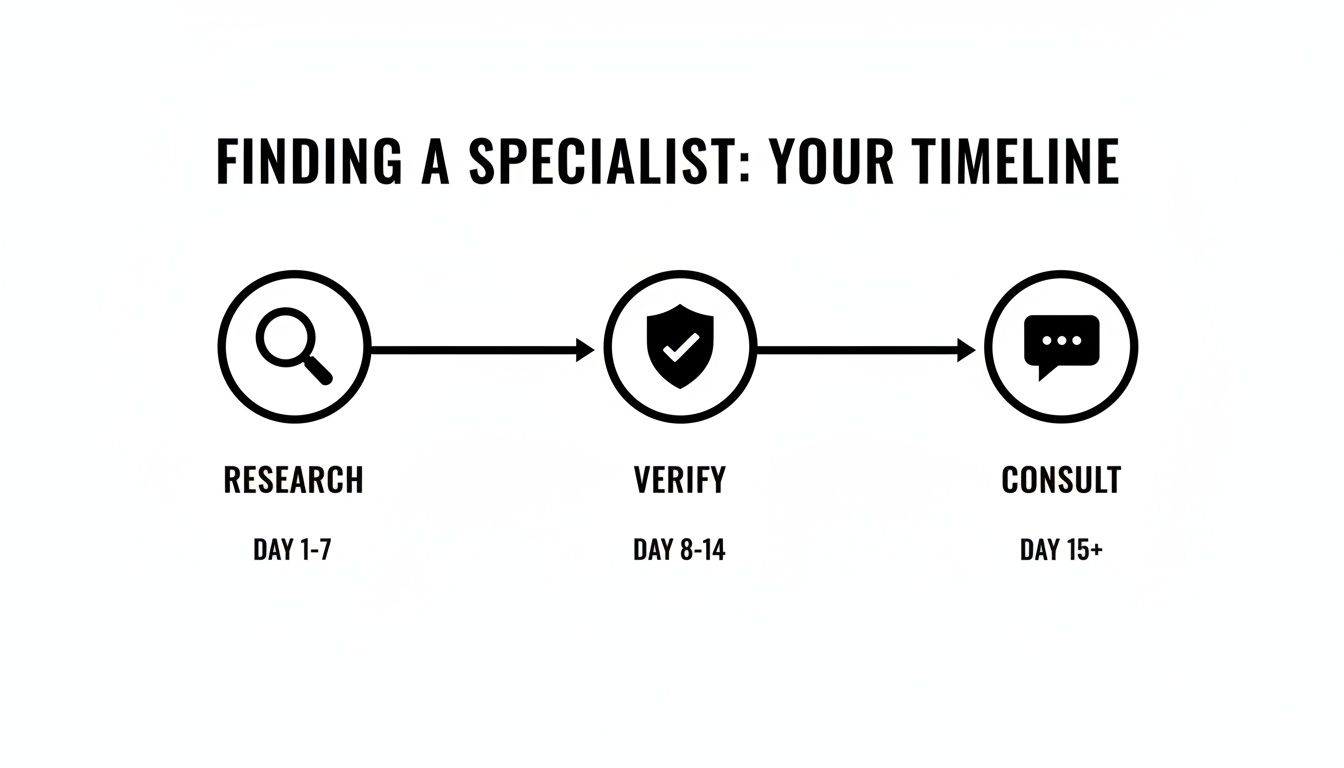
Taking the time to research, verify, and prepare properly ensures you’re seeing the right specialist for your needs before you commit to the formal assessment.
One of the main reasons people go private for mental health is speed. The difference in waiting times between the private sector and the NHS for specialist assessments can be stark.
Private vs NHS Mental Health Assessment Timelines
| Stage | Typical Private Route (e.g., Online Clinic) | Typical NHS Route |
|---|---|---|
| Initial Enquiry to Assessment | 2-6 weeks | 18 months – 5+ years (varies by region for ADHD/Autism) |
| Assessment to Diagnosis/Report | 1-4 weeks | Several weeks to months |
| Start of Treatment (e.g., Titration) | Immediately after diagnosis | Can involve another long wait |
While the NHS provides essential care, the reality is that waiting lists for specialist assessments, particularly for adult ADHD and Autism, are incredibly long. For many, a private assessment is the only feasible route to getting timely support.
The Diagnostic Interview
The heart of the process is the diagnostic interview with the consultant psychiatrist, which typically lasts around 60 to 90 minutes. This is a structured, guided conversation—it's not an interrogation. The psychiatrist will use established clinical criteria (like the DSM-5) to explore your symptoms.
For an adult ADHD assessment, for example, they’ll ask detailed questions about hyperactivity, impulsivity, and inattention. A key part of this is understanding how these traits showed up in your childhood and how they continue to affect you now. The goal is to establish a consistent, lifelong pattern of behaviour.
A good assessment is a two-way street. The psychiatrist is there to listen to your experiences and use their expertise to connect the dots. It’s your opportunity to speak openly in a confidential, non-judgemental environment.
Following the interview, the psychiatrist brings everything together—your questionnaires, any documents you provided, and the conversation itself—to form a clinical conclusion. This is written up into a comprehensive diagnostic report, which becomes the cornerstone of your treatment plan.
This report will clearly explain the findings, confirm a diagnosis if one is made, and recommend the next steps, whether that’s medication, therapy, or coaching. If you want to get into the nitty-gritty, you can learn more about what is a psychiatric assessment and what it involves.
From Diagnosis to Your First Prescription
Getting a diagnosis for something like ADHD or Autism is a massive step, but it’s really just the beginning of the next chapter. It's so important to understand what happens next—how you get from a diagnostic report in your hands to an effective treatment plan—so you can manage your expectations and feel in control of the process.
The first prescription you receive is rarely the final one. For many conditions, especially ADHD, treatment kicks off with a careful and collaborative process called titration. This isn't just about being handed some pills; it's a dedicated phase where you and your specialist work closely together to find the right medication and the perfect dose for you.
What Is the Medication Titration Phase?
Think of titration as a highly personalised fine-tuning process. Your psychiatrist will start you on a very low dose of a medication and then, over several weeks or even months, gradually increase it. The whole point is to find that "sweet spot"—the lowest possible dose that gives you the best results with minimal, if any, side effects.
This slow-and-steady approach is vital for a few reasons:
- Minimising Side Effects: Starting low gives your body time to adjust, which can make a huge difference in avoiding or reducing uncomfortable side effects.
- Finding the Right Fit: Not every ADHD medication works for everyone. Titration gives you and your doctor the breathing room to see if a particular treatment is a good match before you commit to it long-term.
- Putting Safety First: You'll have regular follow-up appointments throughout this phase. These check-ins are crucial for monitoring your physical health (like your blood pressure and heart rate) and talking through how you're feeling.
Titration really does require patience. It’s a period of adjustment that relies on open and honest communication with your specialist. A great tip is to keep a simple daily log of your symptoms, any side effects, and positive changes you notice. This gives your psychiatrist invaluable feedback during your follow-up calls.
This kind of focused, specialist-led care is a hallmark of the private route. For conditions like ADHD and Autism, many adults seek out consultant-led services that can provide everything from comprehensive online assessments and diagnostic reports to the critical medication titration, all handled by Specialist Register psychiatrists.
Getting Your Hands on Your Private Prescription
So, your specialist has written your first prescription for ADHD medication. What now? The process is usually quite straightforward. Your private clinic will typically send the prescription one of two ways: either directly to you in the post, or electronically to a pharmacy they partner with. If you want to dive deeper, you can find more detail on ADHD medication for adults in the UK and how it's all managed.
When it comes to getting the prescription filled, you've got a couple of options:
- Your Local Pharmacy: You can take a paper prescription to any high-street chemist, like Boots or Lloyds. The key thing to remember is that you'll be paying the full private cost of the medication, not the standard NHS prescription charge.
- Online or Partner Pharmacies: Many private clinics have arrangements with specific online pharmacies. They can dispense your medication and deliver it straight to your door, which is often a more convenient and discreet choice.
Remember, ongoing monitoring is a non-negotiable part of good private care. You'll have scheduled follow-ups—often quite frequent during titration, then maybe every few months once your dose is stable—to make sure the treatment continues to be safe and effective for you.
How to Manage the Costs of Private Care
Let's talk about the elephant in the room: the cost. Going private for conditions like ADHD and Autism is a significant financial commitment, so it’s crucial to go in with your eyes wide open.
The initial assessment fee is just the beginning. You also need to factor in the cost of follow-up appointments, especially during the medication titration phase, and the price of the private prescriptions themselves. It’s not uncommon for a month's supply of ADHD medication, for example, to cost upwards of £100 before your dose is stabilised.
The Game-Changer: Shared Care Agreements
So, how do you make this sustainable long-term? The answer is a Shared Care Agreement (SCA).
This is a formal arrangement where your private specialist hands over the prescribing responsibility to your NHS GP once your treatment for ADHD or another mental health condition is stable. It’s the bridge that connects the speed of a private diagnosis with the affordability of the NHS. Once it's in place, you’ll only pay the standard NHS prescription charge.
To get an SCA, your private clinician will write to your GP, detailing your diagnosis, your stabilised treatment plan, and the formal request to share care. Your GP reviews it, and if they agree, they’ll start issuing your prescriptions on the NHS.
How to Talk to Your GP About Shared Care
Timing is everything. The best time to have this conversation is before you even book a private assessment for ADHD or Autism.
It can feel a bit daunting, but a quick chat with your GP can save you a lot of stress and money later on. Just explain you're considering a private assessment due to long waiting lists and ask if they would, in principle, be open to a shared care agreement with a GMC-registered specialist.
Here's a simple approach:
- Book a regular appointment with your GP.
- Mention you're looking into a private diagnosis for ADHD or Autism.
- Directly ask about their practice's policy on Shared Care Agreements.
- Check if they're happy to accept a diagnosis and treatment plan from a CQC-regulated clinic.
It's really important to know that GPs are not required to accept a Shared Care Agreement. Some practices have a blanket policy against it. Having this conversation upfront prevents any nasty surprises and ensures everyone is on the same page from day one.
Getting your care successfully transferred is what makes private treatment manageable in the long run. If you're looking for more general advice, there are some great strategies for reducing overall healthcare costs that can offer a broader perspective. A bit of planning is what turns a private prescription from a short-term fix into a sustainable part of your healthcare.
Common Questions About Private ADHD and Autism Care
When you're looking into private healthcare for ADHD, Autism, or other mental health conditions, it's natural to have a lot of questions. Knowing what to expect can make the whole process feel much less daunting. Let’s walk through some of the practical queries we hear most often.
A big one is whether the NHS will actually accept a private diagnosis. The good news is that a diagnosis for ADHD or Autism from a specialist who is registered with the General Medical Council (GMC) is typically considered valid. However, while the NHS will recognise the diagnosis, they might still want to do their own assessment before they officially take over your care or start prescribing medication.
This is where a high-quality, detailed diagnostic report from a clinic regulated by the Care Quality Commission (CQC) becomes your best asset. It makes the conversation with your GP much more straightforward.
Getting Down to the Details
People often ask about Shared Care Agreements and whether their NHS GP has to agree to one. The short answer is no. A GP isn't obliged to take on prescribing duties from a private specialist. This can be due to local NHS trust policies, a lack of resources, or simply not feeling they have the specialist expertise for ADHD medication.
That’s why it’s so important to speak with your GP before you start any private treatment. Understanding their stance from the beginning will give you a clear picture of what your long-term medication costs will look like.
So, how do you get your hands on the medication itself?
- You can take any private prescription to most high-street pharmacies, like Boots or Lloyds.
- The key difference is you'll pay the full price for the medication, not the standard NHS prescription charge.
- Many online clinics now partner with digital pharmacies, which can be a really convenient way to get your medication delivered directly to your door.
Don't forget: online assessments for conditions like ADHD and Autism are just as rigorous as face-to-face appointments, as long as they're carried out by experienced, specialist psychiatrists at a CQC-regulated clinic. They follow the exact same diagnostic guidelines, just in a more accessible format.
Is Going Private Really Quicker?
For getting an initial diagnosis for ADHD or Autism, going private is almost always dramatically faster. You get to skip NHS waiting lists that can, unfortunately, stretch on for years.
But it’s crucial to look at the whole picture. After diagnosis comes the titration phase—this is where your specialist works with you to carefully fine-tune your medication and dosage. This isn't a quick fix; it can take several months to find what works best for you.
This is a really important stage, and it requires a bit of patience. Some people wait years for an NHS assessment, only to find themselves stuck on another long waiting list just to start titration. A good private clinic builds titration directly into your care plan, starting you on the path to feeling better without any frustrating gaps. This end-to-end support is one of the biggest advantages of choosing a specialist private service for ADHD care.
At Insight Diagnostics Global, we provide clear, consultant-led pathways for adult ADHD and Autism assessments, ensuring you receive a thorough diagnosis and a tailored treatment plan from a CQC-regulated service. To find out how we can help, please visit us at https://insightdiagnostics.co.uk.