

Living with ADHD and autism, or AuDHD, often feels like you're playing life on a higher difficulty setting. It’s not about a lack of trying; it’s about having a brain that’s wired differently. The key isn't to force yourself to work like everyone else, but to find strategies that work with your unique neurotype, acknowledging the profound impact on mental health.
Why Does Coping with Adult ADHD and Autism Feel So Hard?

If you’re an adult with ADHD, especially if you also have autistic traits, you’ve probably heard it all before: "Just try harder." "You need to be more organised." These well-meaning but frustrating comments completely miss the mark. Coping with neurodivergence has very little to do with willpower. It’s about learning to manage a brain that handles information, focus, and motivation in a fundamentally different way.
Think of it like this: your brain is a busy radio receiver, constantly scanning every station on the dial at once. A neurotypical brain can tune into one clear station and filter out the background noise. The ADHD brain, on the other hand, is picking up static, snippets of songs, and news headlines from every frequency simultaneously. This constant sensory overload makes focusing on a single task—like holding a conversation—feel utterly draining, a feeling often intensified by autistic sensory sensitivities.
How ADHD Symptoms Change in Adulthood
The stereotypical image of a hyperactive kid bouncing off the walls doesn't capture the reality for most adults. As we grow up, the core traits of ADHD—inattention, hyperactivity, and impulsivity—tend to morph into more subtle, internalised experiences. This shift is one reason why it can be so hard for others, and even for ourselves, to pinpoint the real source of our daily mental health struggles.
For a clearer picture, it helps to see how these symptoms evolve.
How ADHD Symptoms Evolve From Childhood To Adulthood
| Core Trait | Common Childhood Presentation | Common Adult Presentation |
|---|---|---|
| Hyperactivity | Running, climbing, unable to sit still. | Inner restlessness, fidgeting, talking excessively, needing constant activity. |
| Inattention | Daydreaming, easily distracted in class. | Losing track of conversations, misplacing items (keys, wallet), struggling to finish projects. |
| Impulsivity | Blurting out answers, interrupting others, acting without thinking. | Making rash decisions, impulsive spending, difficulty with patience, starting new hobbies frequently. |
Understanding this evolution is often the first step toward self-compassion. The difficulties you face aren't character flaws; they are legitimate symptoms of a neurodevelopmental condition that requires the right support and strategies.
The Overlap with Autism and Mental Health
ADHD rarely travels alone. There’s a huge, and increasingly recognised, overlap between ADHD and Autism Spectrum Disorder (ASD). When someone has both, a profile sometimes referred to as AuDHD, they experience a unique mix of traits. For instance, they might crave the structure and routine common in autism but find it impossible to maintain because of the executive dysfunction that comes with ADHD. This internal conflict is a significant source of stress.
On top of this, the daily grind of living with undiagnosed or unsupported neurodivergence takes a serious toll on mental health. This constant friction can trigger or worsen other conditions, including:
- Anxiety Disorders: The persistent fear of forgetting something important, missing a deadline, or navigating social situations can be all-consuming.
- Depression: Feelings of failure, frustration, burnout, and social isolation can easily lead to depressive episodes.
- Emotional Dysregulation: This can cause intense emotional reactions that seem completely out of proportion to the situation. You can find out more about the link between ADHD and emotions in our detailed guide.
This web of interconnected challenges is precisely why a "one-size-fits-all" approach to coping just doesn't work. In the UK, it's estimated that 2.5 million people in England have ADHD, yet only 0.32% of GP records show a formal diagnosis. This staggering gap means millions are navigating these complex issues without the clarity and tailored support a specialist assessment can provide.
Practical Everyday Strategies for Managing ADHD

Getting a diagnosis and understanding the 'why' behind your struggles is a massive relief. But the real work starts now: building a toolkit of practical, everyday strategies that actually stick. Effective coping with ADD ADHD isn’t about forcing your brain to act neurotypical. It's about creating clever systems that work with its unique wiring.
By making small, deliberate changes to your environment and routines, you can dramatically reduce daily friction and improve your mental health. Instead of fighting your brain's natural flow, you learn to accommodate it. This shift in mindset is everything. The goal is to offload the mental heavy lifting onto your surroundings, freeing up your brainpower for what really matters.
Structure Your Environment for Success
If you have an ADHD brain, you probably know the pain of "out of sight, out of mind" all too well. It’s a real phenomenon related to object permanence. It’s the reason your keys, wallet, and phone seem to possess a magical ability to disappear. The antidote? Create designated "landing zones" for your essential items.
A landing zone is just a consistent spot where something always lives. Think of a specific bowl on the table by the door where your keys and wallet go the second you walk in. This tiny habit removes the need to remember where you put them, automating the process and saving you from those frantic morning searches.
Another game-changer is managing sensory input. For many with ADHD and especially AuDHD, the constant buzz of an open-plan office or a chaotic home is kryptonite for focus. A pair of high-quality, noise-cancelling headphones can be a lifesaver. They create a personal bubble of quiet, block out distractions, and send a clear signal to others that you’re in deep work mode.
Master Your Relationship with Time
"Time blindness" is one of the most frustrating parts of ADHD—that feeling of not being able to accurately sense time passing. A ten-minute task can easily gobble up an hour, and deadlines have a nasty habit of appearing out of nowhere. To get a handle on this, you have to make time visible.
The most effective strategies for ADHD don't try to 'fix' the brain's perception of time, but rather provide external, tangible cues that make its passage visible and manageable.
One of the most popular techniques for this is the Pomodoro Method. You work in focused 25-minute sprints, separated by short breaks. The key is using a physical or visual timer. It makes the countdown real, creating just enough urgency to keep you on track without tipping you into burnout.
Visual timers, the kind that show a shrinking wedge of colour as time passes, are particularly brilliant. They give you an instant, intuitive sense of how much time is left—something the ADHD brain understands far better than abstract numbers on a clock. A big, shared family calendar or command centre in the kitchen can also work wonders, making everyone’s commitments visible and harder to forget.
Calm the Mental Clutter
The inside of an ADHD mind can feel like a browser with 100 tabs open at once. Thoughts, ideas, worries, and to-do lists are all vying for your attention, making it nearly impossible to focus on one thing. It's exhausting. A "brain dump" is a beautifully simple way to clear your head.
Just take five minutes before a big task or at the end of the day and scribble down everything that's buzzing around in your mind. Don't organise it, just get it out onto paper or a digital note. This simple act tells your brain that these thoughts are captured and won't be forgotten, giving it permission to relax and focus on the now. Exploring options for treating ADHD without drugs can uncover more powerful strategies like this.
Mindfulness and even super-short meditation exercises can also help. Just 60 seconds spent focusing on your breath can act as a mental reset button, breaking the cycle of overwhelm and pulling you back into the present moment. These strategies tackle the core challenges of executive dysfunction head-on. To go deeper, you might find this step-by-step guide to executive function repair incredibly helpful. Building these small, consistent habits is what lays the foundation for better focus and emotional balance.
The Role of Professional Treatment and Support
While developing your own daily strategies is a fantastic and essential first step, professional treatment is often the key to unlocking real, long-term change. For many adults, effectively coping with ADD ADHD – especially when it overlaps with autism or other mental health conditions – means combining self-management with expert guidance.
Thinking about treatment isn't a sign of failure; it’s about equipping yourself with the best possible tools for the job. Countless adults struggle on, simply unaware that specialised therapies and modern medications can significantly lighten their mental load and smooth out the friction in their day-to-day lives. Professional support can provide the missing pieces of the puzzle, helping you shift from just getting by to genuinely thriving.
Therapy and Coaching: Building Your Mental Toolkit
Therapy provides a dedicated space to untangle the often complex thoughts and emotional knots that can come with ADHD and autism. It's so much more than just talking; it's about learning practical, actionable skills to reframe how you see the world and, crucially, how you respond to it.
Two of the most helpful approaches for adults are:
- Cognitive Behavioural Therapy (CBT): This well-established therapy helps you catch, challenge, and change the negative self-talk that often builds up after years of struggling with ADHD. Instead of that automatic, "I'm so useless, I forgot again," CBT teaches you to pause, recognise the thought as a symptom, and replace it with something more compassionate and constructive.
- Specialised ADHD Coaching: An ADHD coach is less focused on your past and more on building a better future. They act as your strategic partner, helping you break down overwhelming projects, design organisational systems that actually work for your brain, and provide accountability. Think of them as an external support system for your executive functions.
These approaches can be especially powerful for those with AuDHD (autism and ADHD). A good therapist or coach can adapt their methods to address the executive function struggles of ADHD while also being mindful of the sensory or social communication needs that come with autism, creating a safe space to build confidence.
Professional support isn't a cure; it's a powerful collaboration. Therapy and medication are tools that, when combined with your own efforts, create a stable foundation for managing ADHD and its related challenges effectively.
Understanding How Medication Can Help
For a lot of adults, medication is a genuinely transformative piece of the treatment puzzle. It’s vital to understand that ADHD medication isn't a "magic pill" that makes symptoms vanish. Instead, it works on a neurochemical level, helping to balance key neurotransmitters like dopamine and noradrenaline, which play a huge role in focus, motivation, and impulse control.
Here’s a simple analogy: if your brain's communication network has a bit of static on the line, medication helps to clear up the signal. It doesn't change who you are; it just helps your brain function more efficiently, in the same way that glasses help your eyes to see more clearly.
Stimulant and Non-Stimulant Options
There are two main families of medication for adult ADHD, and finding the right fit is a careful, collaborative process you'll undertake with a psychiatrist.
- Stimulants: These are the most common type of medication prescribed (e.g., methylphenidate, lisdexamfetamine). They tend to work quite quickly, often within an hour or so, to sharpen focus and dial down impulsivity.
- Non-Stimulants: These medications (e.g., atomoxetine) take a bit longer to build up in your system but can offer smooth, 24-hour symptom management. They're often a great choice for people who don’t get on well with stimulants or who also have conditions like anxiety.
A specialist psychiatrist will take you through a process called titration. This involves starting on a very low dose and adjusting it slowly and carefully over time. The goal is to find the sweet spot—the most effective dose with the fewest possible side effects—making sure the treatment is tailored precisely to you. This medical support, working hand-in-hand with the skills you learn in therapy, creates a truly robust framework for managing the complexities of adult ADHD.
Navigating Workplace and Legal Accommodations
Living with ADHD, especially when it co-occurs with autism, can create some unique friction in a professional setting. But it's crucial to remember you have significant rights and options. Learning how to advocate for yourself at work isn't about asking for special treatment; it's about levelling the playing field so you can truly perform at your best.
Understanding your legal protections is the first, most powerful step. In the UK, ADHD is often covered under the Equality Act 2010. This means your employer has a legal duty to make 'reasonable adjustments' for you. This is precisely where a formal diagnosis becomes invaluable, providing the official foundation for these requests.
Requesting Reasonable Adjustments
So, what is a 'reasonable adjustment'? It's any change to a work practice, a policy, or even the physical environment that helps you overcome the specific barriers you face at work. The goal is to find practical, effective solutions that allow you to manage your ADHD or autism-related challenges without fundamentally changing your job role.
Advocating for yourself can feel a bit daunting, I know. But it often starts with a simple, confidential chat with HR or your line manager. The key is to go in prepared. Instead of a vague statement like, "I struggle with distractions," try proposing a concrete solution that actually benefits both of you by boosting your productivity.
Here are a few common examples of what this can look like in practice:
- Flexible start and end times to work with your natural peaks in focus and energy.
- Access to a quiet workspace or permission to use noise-cancelling headphones to minimise sensory overload.
- Getting instructions in writing (like a follow-up email after a meeting) to reduce the strain on your working memory.
- Regular, brief check-ins with your manager to help break down big projects into smaller, more manageable steps.
These small tweaks can make a monumental difference. We dive much deeper into this in our guide on reasonable adjustments for ADHD.
The Importance of a Formal Report
While a conversation is a great start, a formal diagnosis backed by a robust psychiatric report is your strongest asset. This document provides clear, medical validation for your requests and removes any guesswork for your employer. It transforms what might be seen as personal preferences into medically substantiated requirements, making them much harder to dismiss.
In any medico-legal situation, like an employment tribunal or a dispute over workplace support, a comprehensive psychiatric report from a GMC-registered specialist is essential. It acts as impartial, expert evidence, clearly detailing how your condition impacts your work and what specific adjustments are needed.
This professional documentation is incredibly empowering. It shifts the dynamic from simply asking for help to formally requesting legally protected accommodations. With a clear report in hand, you’re in a much stronger position to ensure your workplace doesn't just understand your challenges, but takes the necessary steps to help you succeed.
How to Get a Specialist ADHD or Autism Assessment
Realising you might have ADHD or autism is a massive step. But what comes next? For many adults, this is where the daily coping mechanisms you've cobbled together over the years start to feel like they're not quite enough. The path to getting a formal diagnosis can seem murky and, frankly, a bit daunting.
Choosing to seek an assessment is a powerful move. It's about deciding you want to understand how your brain is wired so you can access the right support and finally start working with it, not against it.
In the UK, there are two main routes you can take: going through the NHS or seeking help from a private specialist service. Each has its own process, timeline, and things to consider, and knowing what to expect can make the whole journey feel a lot less overwhelming.
Starting the Conversation with Your GP
For most people, the first port of call is their local GP. Think of them as the gateway to specialist services on the NHS.
Before you book that appointment, it's a really good idea to get your thoughts in order. Jot down a list of the specific challenges you're facing. How do they show up at work? What impact are they having on your relationships or just your general sense of well-being? Having concrete examples makes the conversation much more productive.
Your GP will listen to your concerns and might give you a screening questionnaire to fill out. If they agree that your symptoms warrant a closer look, they'll refer you to the local adult ADHD or autism service. Now, here's the difficult part: NHS waiting lists for these assessments can be incredibly long. We’re often talking several years in many parts of the country.
An assessment isn’t a test you can pass or fail. It’s a collaborative process where a specialist helps build a complete picture of your life experiences, strengths, and challenges to get to an accurate understanding of your neurotype.
This long delay is a huge barrier when you're struggling and need help now. It’s the main reason so many people decide to explore private options.
What Does the Assessment Process Actually Involve?
Whether you go through the NHS or a private clinic, a proper assessment for ADHD or autism is a deep dive, not a quick checklist. A specialist psychiatrist needs to gather information from a few different angles to build a clear and accurate diagnostic picture.
You can generally expect the process to include a few key things:
- Clinical Interviews: This is a detailed chat about what you're struggling with right now, but it also goes way back. The specialist will want to know about your developmental history, right from your school days.
- Psychometric Testing: You'll likely complete some standardised rating scales and questionnaires. These are tools designed to measure the intensity and impact of your symptoms in a structured way.
- Gathering Background Info: This is crucial. The specialist will often want to speak to someone who knew you as a child, like a parent, or someone who knows you well now, like a partner. Old school reports can be like gold dust here, providing invaluable, objective insights.
This flowchart gives a simple overview of how a diagnosis helps you get the support you need, particularly in a workplace setting.
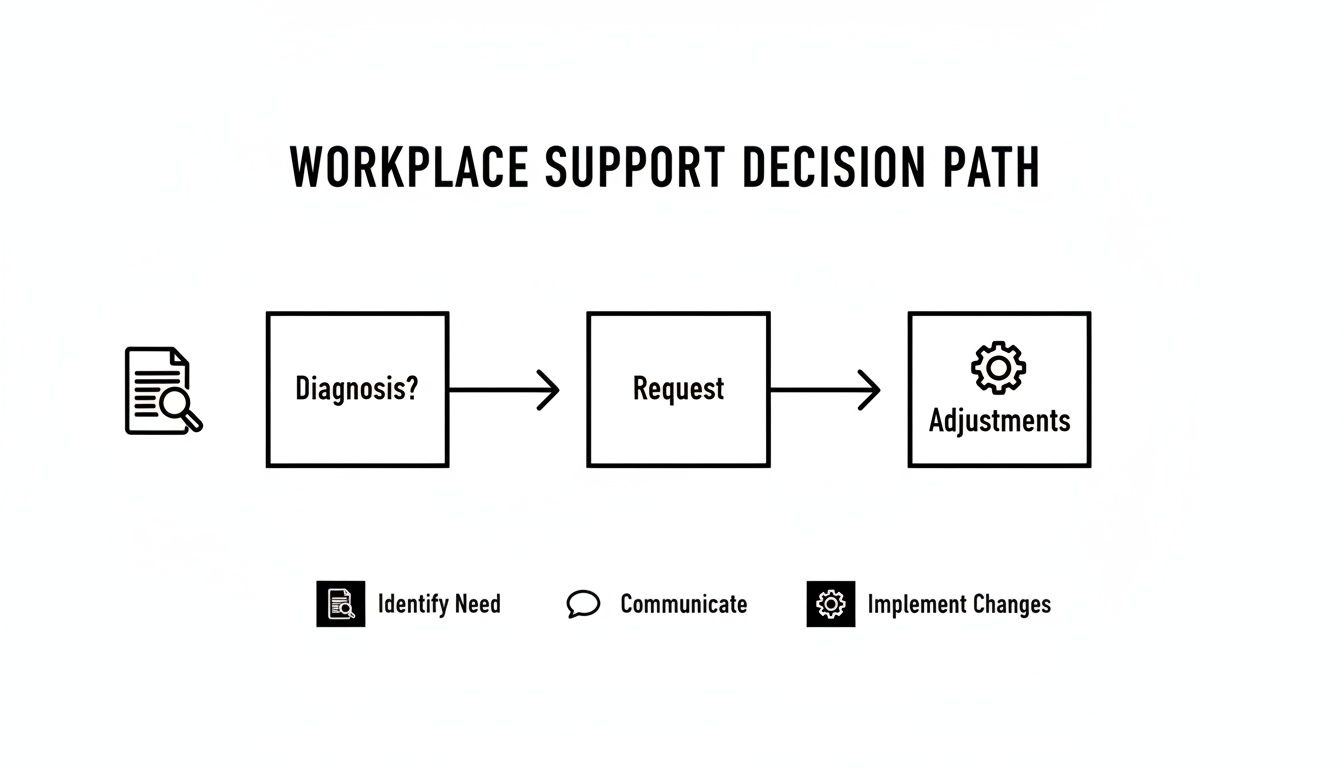
As you can see, getting that formal diagnosis is often the first, essential step that unlocks the ability to request and implement the right adjustments.
Comparing NHS vs Private Assessment Pathways
Deciding which route to take can be tricky. This table breaks down the main differences to help you weigh up the options.
| Feature | NHS Pathway | Private Pathway |
|---|---|---|
| Referral Source | Typically requires a GP referral. | Often allows for self-referral. |
| Wait Times | Can be very long, often 2-5 years. | Much shorter, usually a few weeks. |
| Cost | Free at the point of service. | Self-funded, with costs varying. |
| Choice of Clinician | Limited; assigned by the local service. | You can choose your clinic and specialist. |
| Post-Diagnosis Support | Varies significantly by NHS trust. | Often includes a clear, integrated treatment plan. |
Ultimately, the choice depends on your personal circumstances, including how urgently you need support and your financial situation.
The Benefits of a Private Specialist Service
For anyone who simply can't put their life on hold for years, a CQC-regulated online service provides a much quicker, more direct route to getting an assessment. These clinics give you access to GMC-registered psychiatrists who specialise in adult neurodevelopmental conditions, so you can be confident you're receiving a high standard of care that employers and other professionals will recognise. For more personal stories, this guide to navigating ADHD assessments offers some great first-hand insights.
Opting for a private pathway means you can be seen in a matter of weeks, not years. That speed can make a world of difference to your mental health, allowing you to get answers, start treatment, and put effective support strategies in place so much sooner.
If you want to understand exactly what’s involved, you can learn more about how to get tested for ADHD with a specialist provider. The goal is to make the entire process clearer and more accessible, giving you a straightforward path to the answers you need.
Your Path Forward with Insight Diagnostics Global
Living with the challenges of adult ADHD or autism can feel like a long, uphill battle. You’ve probably spent years figuring out your own ways to get by, but just coping day-in and day-out is utterly exhausting. If the strategies we've talked about in this guide feel familiar, it might be time to get some proper support—someone to offer clarity, validation, and a real plan for the future.
At Insight Diagnostics Global, we provide a complete service for adults ready to stop just surviving and start properly living. We get the unique pressures that come with neurodivergence and mental health conditions, so we’ve designed our service to be both medically sound and easy to access.
Expert Care That Comes to You
We are a fully online clinic, regulated by the Care Quality Commission (CQC). This means we bring the highest standards of medical care directly to you, wherever you are. You can speak with our team from the comfort of your own home, without the added stress of travel or sitting in a waiting room.
Our team is led by consultant psychiatrists who are on the GMC Specialist Register. This is a crucial detail, as it guarantees your assessment and treatment are managed by genuine specialists in the field. It gives you peace of mind that your diagnosis will be accurate and recognised by employers, universities, and other healthcare professionals.
A Clear and Comprehensive Process
We specialise in providing clear, thorough assessments for both ADHD and Autism Spectrum Disorder (ASD). Our process is designed to be straightforward but incredibly detailed, leaving you with a genuine understanding of your own mind and how it works.
Our services include:
- Detailed Diagnostic Assessments: We use in-depth clinical interviews and recognised assessment tools to make sure we get to an accurate diagnosis of ADHD, autism, or any co-occurring conditions.
- Personalised Treatment Plans: Once a diagnosis is made, we’ll work together to build a support plan that actually fits your life. This could include therapy, coaching, and medication.
- Medication Titration: If you decide medication is right for you, our specialists will guide you through a careful, supportive titration process to find the right type and dose that works best for you with minimal side effects.
Moving forward isn’t just about getting a label; it’s about finally getting the user manual for your own brain. A specialist assessment gives you the insight to build a life that plays to your strengths and supports your challenges.
We also provide court-compliant medico-legal reports for situations that require formal, expert documentation. Whether it’s for an employment tribunal or another legal matter, our reports offer the impartial, authoritative evidence you need. At Insight Diagnostics Global, we’re here to be your expert partner, ready to help you take that next step with confidence.
Your Questions Answered
When you start exploring neurodiversity as an adult, it’s natural to have a lot of questions. We’ve put together some straightforward answers to the queries we hear most often about ADHD, autism, and how to get the right support.
Can You Have Both ADHD and Autism?
Yes, absolutely. It's actually very common for ADHD and Autism Spectrum Disorder (ASD) to show up together. You might see this referred to as AuDHD.
Living with both can feel like a contradiction sometimes. For example, the autistic part of you might crave a predictable, structured routine, but the ADHD side makes it incredibly difficult to stick to one due to challenges with executive function. Because symptoms like social difficulties and organisational struggles can overlap, getting a comprehensive assessment from a specialist psychiatrist is essential. It’s the only way to get a clear picture and build a support plan that truly fits your unique neurotype.
What Exactly Is Medication Titration for ADHD?
Think of titration as a careful calibration process. It’s all about finding the exact dose of ADHD medication that works best for you and your brain chemistry—it’s not a one-size-fits-all solution.
Working closely with your psychiatrist, you’ll begin on a very low dose. Over several weeks, this will be increased in small, methodical steps. During this time, you'll keep track of how you're feeling, noting any improvements in focus or any side effects that pop up. This personalised, step-by-step approach is the safest way to find that sweet spot where you get the maximum benefit from the medication with minimal drawbacks.
Is an Online ADHD Diagnosis Recognised in the UK?
It certainly is, as long as it comes from a credible provider. For a diagnosis to be fully valid and recognised, it must come from a clinic regulated by the Care Quality Commission (CQC) and be conducted by a psychiatrist who is on the General Medical Council’s (GMC) Specialist Register.
A valid diagnosis is the key that unlocks access to recognised support systems. It is accepted by employers for reasonable adjustments, by universities for academic support, and can be used to establish shared care agreements with your GP for ongoing treatment.
Opting for a CQC-regulated online service means you're getting a high standard of care. The detailed assessment report you receive holds the same authority as one from an in-person clinic. This gives you the official documentation you need to access proper support and move forward with confidence.
If you’re ready to stop just getting by and want clear answers and a plan that’s built for you, Insight Diagnostics Global can help. Our team of specialist psychiatrists provides CQC-regulated online assessments for adults seeking clarity on ADHD, autism, and mental health. Start your journey towards understanding and effective support by visiting our website.