

Your heart starts thumping out of nowhere. Then comes the chest tightness, the breathlessness, the quick mental scan: Is this anxiety, or is something wrong with my heart?
That fear is understandable. I see many adults who arrive at assessment after weeks or months of trying to work it out alone, often replaying symptoms at night, checking their pulse, avoiding exercise, caffeine, busy places, or even ordinary daily tasks because they're worried about triggering another episode.
For neurodivergent adults, especially those with ADHD or autism, this can feel even more confusing. Body signals may feel unusually intense, hard to interpret, or impossible to ignore. The result is a distressing loop: physical sensation, alarm, more adrenaline, stronger sensation. If you're trying to make sense of anxiety symptoms involving the heart, clarity usually starts with taking both the mind and the body seriously.
That Frightening Flutter Is It Anxiety or Your Heart?
A common scenario goes like this. You're sitting on the sofa after a long day. Nothing dramatic is happening. Then your heartbeat suddenly feels heavy, fast, or irregular. Your chest tightens. You become sharply aware of every beat. Within seconds, your thoughts jump to the worst-case possibility.
That reaction isn't overdramatic. It's human.
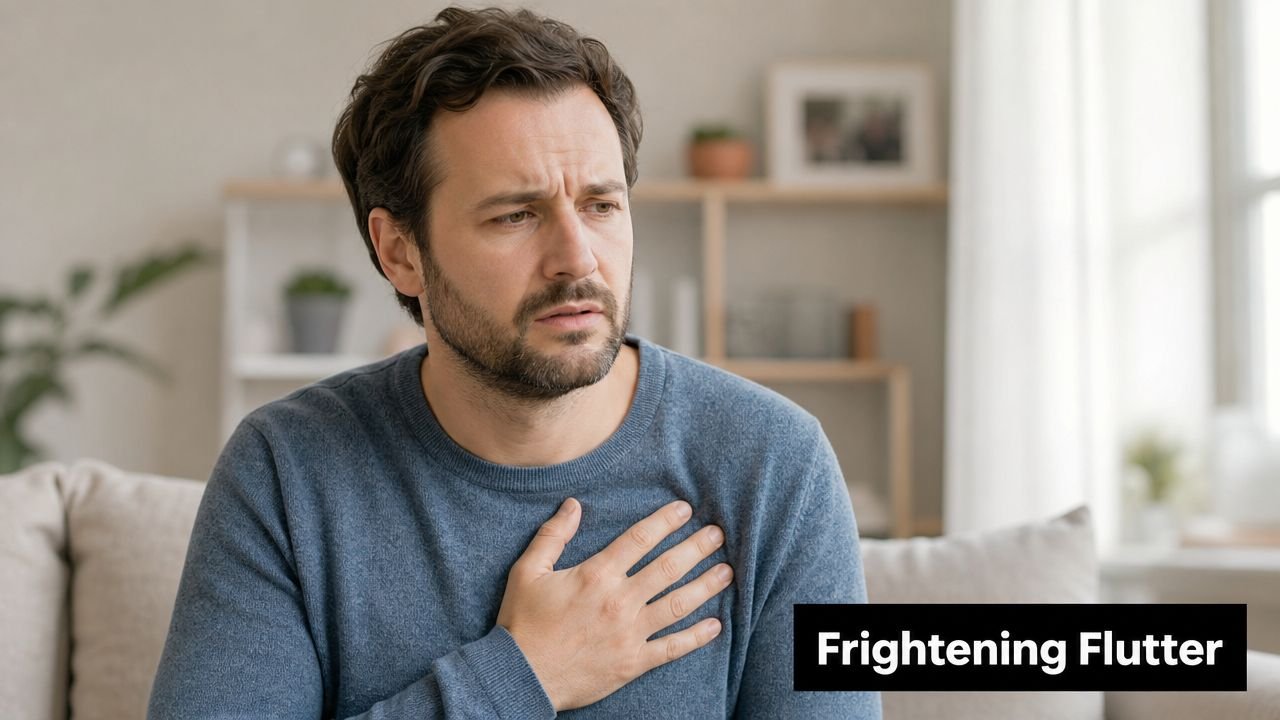
Many people look for reassurance by trying to decide whether the feeling seems “emotional” or “physical”. In real clinical work, that divide is often too simple. Anxiety can cause very physical symptoms, including palpitations and chest discomfort. At the same time, heart symptoms shouldn't be dismissed purely because stress is present.
Why this feels so alarming
Heart-related sensations command attention. A skipped beat, pounding pulse, fluttering sensation, or sudden awareness of breathing can feel dangerous even when the cause turns out not to be a cardiac emergency. The body's alarm system doesn't wait for a careful medical conclusion. It reacts first.
Clinical reality: People often seek help because they can't tell whether symptoms are anxiety, a heart rhythm issue, or both. That uncertainty itself can intensify panic.
This is especially relevant if you already live with chronic stress, burnout, health anxiety, panic symptoms, ADHD, autism, or sensory sensitivity. In those situations, the body's signals may arrive louder, faster, or with less internal context.
What deserves attention
If symptoms are new, recurrent, worsening, or feel different from your usual pattern, they deserve proper assessment. The NHS recognises that anxiety can contribute to palpitations and chest discomfort, while clinical literature also supports taking persistent chest symptoms seriously rather than assuming they're benign. A review discussing UK-relevant primary care implications notes that anxiety symptoms and cardiac symptoms can overlap, and that escalation should be guided by symptom pattern, cardiovascular risk factors, and red-flag features rather than reassurance alone, with cohort data also linking anxiety burden to coronary risk through a dose-response pattern (clinical review on anxiety and coronary risk).
If stress has been building for a while, some readers find it useful to reflect on the broader pattern of symptoms and strain described in these signs of stress.
The Science Behind Anxiety and Your Heartbeat
The simplest way to understand anxiety symptoms involving the heart is to think of the body as having a smoke alarm that sometimes becomes too sensitive. It doesn't only react to actual danger. It can also react to perceived threat, uncertainty, overload, remembered stress, or a sudden internal sensation.
Once that alarm activates, the body shifts into fight-or-flight mode. The heart beats faster. Blood pressure rises. Breathing changes. Muscles tense. Your attention narrows onto whatever feels threatening, which is often your chest, heartbeat, or breathing.
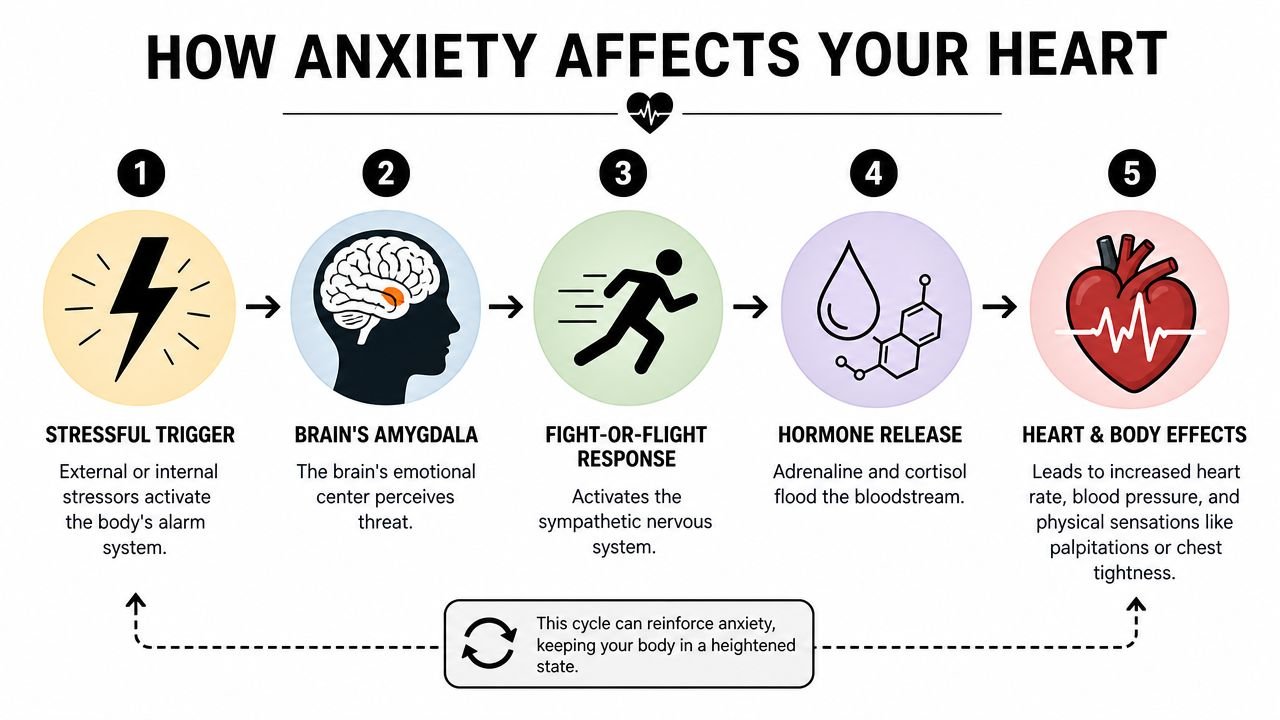
What anxiety does in the body
In cardiovascular physiology, anxiety activates the sympathetic nervous system, producing tachycardia, higher blood pressure, and lower heart-rate variability, with persistent autonomic overactivation proposed as one pathway linking anxiety disorders to poorer cardiovascular outcomes. Repeated or chronic episodes can add haemodynamic load and may warrant cardiovascular review if symptoms are recurrent or severe (cardiovascular physiology review).
That's why anxiety can feel so physical. The symptom isn't “just in your head”. The trigger may begin in the brain's threat system, but the experience is embodied.
For people who want a plain-English explanation of this measure, this guide to understanding HRV is a useful companion to the medical picture.
Why the sensation can spiral
A fast heartbeat from anxiety can be brief and harmless. The problem is what happens next. You notice it, interpret it as dangerous, and the alarm system ramps up further. Then the physical sensation gets stronger, which seems to confirm the fear.
That loop often includes:
- Adrenaline release that makes the heartbeat feel forceful or rapid
- Faster breathing that can create light-headedness, chest tightness, or tingling
- Muscle tension in the chest wall, shoulders, and upper back
- Hypervigilance that makes normal body sensations feel unusually prominent
Later in the cycle, people may feel exhausted, shaky, unreal, or emotionally drained.
Some people also notice that poor sleep, stimulant use, irregular meals, high caffeine intake, or prolonged stress seem to lower the threshold for episodes. If cortisol and stress physiology are part of the picture, these practical ways to reduce high cortisol can help make sense of the broader stress response.
A short visual explanation can also help if your mind goes blank when symptoms hit:
Anxiety Chest Pain vs a Cardiac Event Comparing Symptoms
The difficult truth is that symptoms overlap. Anxiety can cause chest tightness, racing heart, dizziness, sweating, and breathlessness. Cardiac problems can do the same. That means symptom comparison can guide you, but it cannot safely replace medical assessment.
A practical comparison
| Symptom Feature | Often Associated with Anxiety | Can Be a Sign of a Cardiac Issue (Seek Medical Advice) |
|---|---|---|
| Trigger | May appear during stress, panic, overload, conflict, or after noticing a body sensation | May occur with exertion, at rest, or without a clear emotional trigger |
| Chest sensation | Tightness, sharp discomfort, chest wall tension, awareness of breathing | Pressure, heaviness, squeezing, or chest pain that feels unfamiliar or concerning |
| Heart sensation | Racing, pounding, fluttering, skipped-beat awareness | Palpitations can also occur with arrhythmias or other heart conditions |
| Breathing | Rapid breathing, “can't get a full breath”, sighing, breathlessness during panic | Significant shortness of breath, especially if sudden, marked, or accompanied by other red flags |
| Pattern | Episodes may build quickly and fluctuate with fear level | Symptoms may persist, worsen, recur with exertion, or appear with other physical warning signs |
| Response to reassurance | Sometimes settles as panic reduces, though not always quickly | Cardiac symptoms may continue regardless of reassurance |
| Associated features | Fear, derealisation, trembling, urge to escape, sense of doom | Fainting, radiating pain, collapse, or marked breathlessness need urgent assessment |
What not to do
Don't use a table like this to talk yourself out of getting checked. Educational comparisons are helpful only if they push you towards sensible assessment, not self-diagnosis.
Anxiety can mimic serious heart symptoms, and serious heart symptoms can occur in anxious people. Those facts can both be true at once.
If you want a simple patient-friendly explainer on the overlap, Therapsy explains anxiety chest pain in a way many people find accessible.
When uncertainty itself is enough reason to seek help
General guidance on palpitations and anxiety makes an important safety point. While anxiety can cause chest tightness and a racing heart, symptoms that may indicate a heart attack and need immediate help include chest pain that radiates to the jaw, neck, or arms; fainting; or significant shortness of breath. The key message is not to self-diagnose (clinical guidance on palpitations and anxiety).
If symptoms are persistent, your GP may also think in terms of wider physical screening, not just symptom relief. For a broad overview of what that kind of medical review can involve, this page on health screenings may be useful.
Urgent Red Flags When Heart Symptoms Need Emergency Care
This part is simple. Some symptoms should never be filed under “probably anxiety” at home.
Seek urgent emergency help, such as 999 or A&E, if you have:
- Chest pain with spread to the jaw, neck, or arms
- Fainting or loss of consciousness
- Significant shortness of breath, especially if severe or sudden
- Chest pain that feels intense, crushing, or alarming, particularly if it's new
- A combination of chest symptoms and collapse, marked weakness, or severe distress
A firm rule
Safety first: If heart symptoms feel new, severe, or frighteningly different from your usual anxiety pattern, get urgent medical help first and analyse later.
Anxiety is a common explanation for palpitations and chest tightness, yet symptoms alone aren't a reliable way to distinguish anxiety from arrhythmia, angina, or heart attack. Red-flag features should push the decision towards urgent care, not reassurance.
If you're unsure, treat uncertainty itself as a warning sign. It's far better to be assessed and find no emergency than to delay care for a true cardiac problem.
Why ADHD and Autism Can Amplify Heart-Related Anxiety
Adults with ADHD or autism often describe heart-related anxiety in ways that general mental health advice doesn't fully capture. They may say, “I can't filter it out”, “I can feel every beat”, or “once I notice it, I can't think about anything else”. That pattern makes sense clinically.
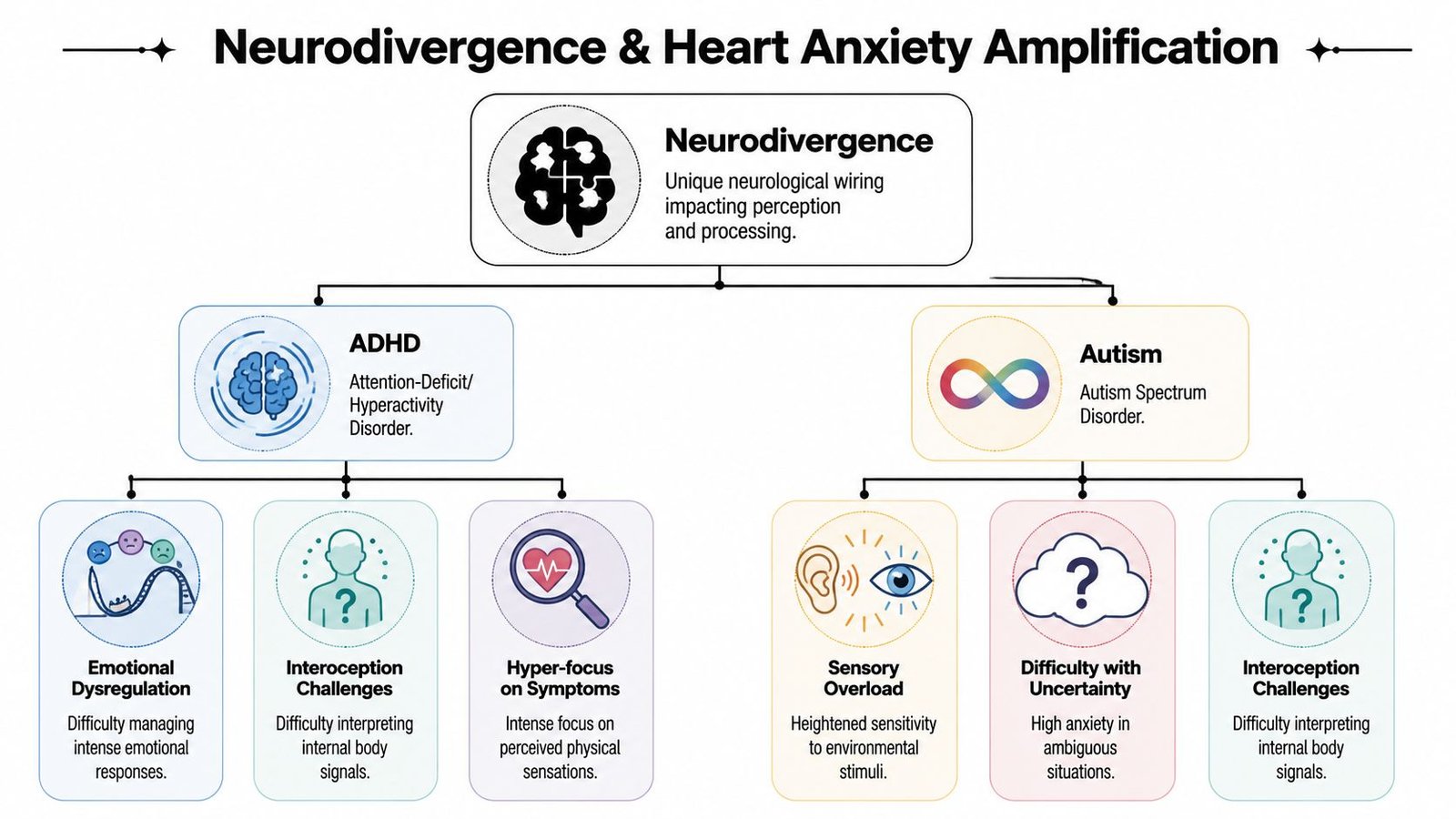
Interoception, sensory load, and threat interpretation
Interoception is your awareness of internal body signals such as heartbeat, breathing, nausea, tension, hunger, or temperature. In neurodivergent adults, this can be atypical in either direction. Some people notice internal signals intensely. Others struggle to interpret them accurately until the sensation becomes overwhelming.
That can create a difficult sequence. You notice a heartbeat change. You can't quickly place it in context. Your brain flags uncertainty as threat. Then anxiety rises and the physical symptoms become stronger.
Autism can add sensory sensitivity and distress around unpredictability. ADHD can add rapid attentional shifts, difficulty disengaging from a sensation, emotional impulsivity, and a tendency to hyperfocus on whatever feels urgent in the moment.
Why the overlap matters medically
The anxiety-heart link isn't trivial. A major review reported that 38% to 70% of people with congestive heart failure experience some form of anxiety, and it concluded that anxiety is associated with higher morbidity and mortality after cardiac events. The same review also summarised later cardiovascular research linking depression and anxiety with about a 35% higher risk of a major cardiovascular event such as heart attack or stroke (review of anxiety and cardiovascular disease).
For neurodivergent adults, the clinical implication is straightforward. If a person has both sensory or interoceptive vulnerability and real cardiovascular risk factors, it's unhelpful to reduce every symptom to panic. Some need anxiety treatment. Some need physical assessment. Quite a few need both.
Neurodivergent patterns I watch for in assessment
- Masked distress: The person looks composed but reports intense internal panic, chest awareness, or shutdown afterwards.
- Body-signal uncertainty: They can describe sensation in detail but can't tell whether it reflects emotion, illness, or overload.
- Symptom amplification under overload: Social fatigue, noise, sleep disruption, caffeine, stimulant timing, or change in routine make episodes more likely.
- Fear of misreading the body: Previous dismissal can lead to repeated checking, avoidance, and escalating health anxiety.
For some adults, it's also helpful to consider whether a broader anxiety vulnerability may run through the picture. This overview of whether anxiety disorder can be genetic can add context, especially when there's a strong family history.
Your Path to Clarity Assessment and Long-Term Management
When people are frightened by heart-related symptoms, they often want one clean answer. Anxiety or heart. Panic or arrhythmia. Mental health or physical health. Real life is rarely that neat.
The most useful approach is structured clarification. Rule out urgent physical causes. Identify patterns. Understand the role of anxiety, overload, neurodivergence, medication, sleep, caffeine, and stress. Then build a management plan that fits the person, not just the symptom label.
What a good first assessment usually involves
A GP or urgent medical clinician will usually start with the basics. They'll ask about the symptom pattern, timing, triggers, severity, associated symptoms, medical history, medications, stimulant use, caffeine, alcohol, and cardiovascular risk factors. Depending on the presentation, they may arrange tests such as an ECG, blood tests, ambulatory monitoring, or further cardiac review.
That's good practice. Persistent anxiety symptoms involving the heart should not be brushed off. A foundational Circulation study found that men reporting two or more anxiety symptoms had an age-adjusted odds ratio of 3.20 for fatal coronary heart disease and 5.73 for sudden death compared with men reporting no anxiety symptoms. Even after multivariable adjustment, the association remained at 1.94 for fatal CHD and 4.46 for sudden death, while the study found no excess risk for nonfatal myocardial infarction or angina (1994 Circulation study on anxiety and coronary outcomes).
The point isn't to alarm you. It's to explain why clinicians should take persistent anxiety symptoms seriously in cardiovascular triage.
A symptom can be anxiety-related and still deserve medical respect.
What psychiatric assessment adds
Once urgent cardiac causes have been considered, psychiatric assessment becomes valuable for a different reason. It helps answer questions that routine medical review often can't fully settle.
A thorough psychiatric assessment should look at:
- The exact shape of anxiety symptoms. Panic attacks, generalised anxiety, health anxiety, trauma-related anxiety, and autistic burnout don't feel the same in the body.
- Neurodevelopmental factors. ADHD and autism can change how you notice, interpret, and cope with internal signals.
- Behavioural responses. Pulse checking, repeated online searches, avoidance of travel or exercise, reassurance seeking, and fear-based restriction all keep the cycle going.
- Medication effects. This includes prescribed stimulants, antidepressants, over-the-counter products, supplements, and caffeine intake.
- Functional impact. Sleep disruption, work difficulties, driving avoidance, social withdrawal, shutdown, and exhaustion matter clinically.
For neurodivergent adults, this can be the difference between a vague statement such as “it's probably anxiety” and an explanation that fits lived experience.
What tends to help and what usually doesn't
Management works best when it is layered. Individuals don't improve merely because someone tells them to “try not to worry”.
What usually helps
- Clear medical triage: Knowing that urgent causes have been considered reduces the fear that every symptom is being missed.
- Pattern tracking: A brief symptom diary can help identify links with sleep, menstrual cycle, stimulant timing, caffeine, sensory overload, meals, dehydration, or conflict.
- Breathing work that is gentle: Forced deep breathing can make some people more light-headed. Slower, steadier breathing is usually better than exaggerated inhalation.
- Psychological treatment: CBT can help with catastrophic interpretation, avoidance, reassurance seeking, and panic loops. Some people need a broader approach if trauma, burnout, or autistic overwhelm is part of the picture.
- Medication review: In selected cases, medication for anxiety can reduce physiological arousal and anticipatory fear. The decision should always consider side effects and comorbidities.
- Routine protection: Regular sleep, fewer stimulants, steadier meals, and reduced overload often lower the frequency of episodes.
What often doesn't help
- Endless self-monitoring: Constant pulse checking usually increases alarm.
- Being told “it's only stress”: Reassurance without assessment rarely calms symptoms for long.
- All-or-nothing avoidance: Stopping all exercise, travel, meetings, or social contact can shrink life very quickly.
- Copying someone else's plan: The right approach for panic disorder may not fit ADHD-related dysregulation, autistic sensory overload, or medication-related palpitations.
Special considerations for ADHD medication and neurodivergence
This area needs nuance. Some adults notice more heartbeat awareness after starting stimulant medication. Others feel less anxious overall once untreated ADHD improves. That's why assessment has to examine timing, dose pattern, baseline anxiety, sleep, appetite, and whether the sensation appears mainly during stress or more generally.
Autistic adults may need a different pace and style of intervention. A plan is more likely to work if it is concrete, predictable, low in sensory burden, and not overloaded with vague wellness advice. Some benefit from written plans, fewer variables, and explicit thresholds for when to seek urgent help.
Natural supports may also have a place for some people, but they should never replace medical review for chest pain or severe palpitations. If you're exploring adjunctive options, this overview of effective natural stress support is a reasonable starting point for discussion with a clinician.
When to ask for specialist input
Consider specialist assessment if:
- Symptoms keep recurring and you still don't have a coherent explanation
- Anxiety and heart sensations are affecting daily functioning
- You suspect ADHD or autism is shaping the picture
- You've been told it's anxiety, but the explanation feels incomplete
- You're avoiding work, driving, study, exercise, or sleep because of fear of symptoms
- Medication questions are complicating matters, especially if ADHD treatment is involved
The goal isn't to prove that symptoms are “all psychological” or “all cardiac”. The goal is to understand what is happening well enough to respond effectively.
Clarity is often what finally settles the nervous system. Not perfect certainty. Not endless reassurance. Clear assessment, sensible triage, and a treatment plan that respects both mind and body.
If you want a structured assessment for anxiety, ADHD, autism, or overlapping mental health concerns, Insight Diagnostics Global offers consultant-led evaluations for adults in the UK, online and face to face. The service provides clear triage, detailed diagnostic interviews, personalised recommendations, and optional follow-up, which can be especially helpful if heart-related anxiety symptoms sit alongside neurodivergence, burnout, or diagnostic uncertainty. It isn't a crisis service, so if you have urgent chest pain, fainting, or severe shortness of breath, call 999 or contact NHS 111.