

You might be reading this because something has felt off for a long time.
Perhaps you work hard but still miss deadlines, lose track of conversations, or feel mentally exhausted by tasks that seem straightforward for other people. Perhaps social situations leave you confused, drained, or oddly “out of step”, and you've started wondering whether this is anxiety, burnout, ADHD, autism, or a mixture of several things. Many adults reach this point after years of coping in silence.
A proper assessment can bring order to that uncertainty. It doesn't reduce you to a label. It helps a clinician understand how your mind works, what may be driving the difficulties, and what kind of support makes sense next.
That Lingering Feeling Is It ADHD or Something Else
A lot of adults come to assessment after years of explaining things away.
They tell themselves they're lazy, disorganised, too sensitive, bad with people, or that they are not trying hard enough. Then a pattern starts to emerge. They notice they've always struggled to focus in meetings unless the topic is urgent or intensely interesting. They realise they rehearse conversations before making a phone call. They see that noise, change, or unclear expectations can leave them overwhelmed for the rest of the day.

Sometimes the question begins at work. Sometimes it begins in a relationship. Sometimes it begins after a child is diagnosed and an adult suddenly recognises the same lifelong traits in themselves. If you're at that stage, a short reflective tool such as this guide on whether you might have autism or ADHD can help you organise your thoughts before you speak to a clinician.
Why the confusion is so common
ADHD, autism, anxiety, low mood, trauma, sleep problems, and physical health issues can overlap in how they feel day to day. Trouble concentrating might reflect ADHD. It might also happen when someone is anxious, depressed, sleep-deprived, or under strain for a long time.
Hormonal changes can complicate the picture too. For some adults, especially in midlife, anxiety symptoms seem to intensify for reasons that aren't purely psychiatric. A resource like this quiz for perimenopause anxiety symptoms can be useful if you're trying to separate emotional distress from possible hormonal factors before seeking a full assessment.
Many people aren't asking for a diagnosis straight away. They're asking for clarity.
What usually helps next
The most useful next step is often a formal mental health assessment. That phrase can sound daunting, but in practice it means a structured, thoughtful conversation with a clinician who knows how to sort overlapping symptoms into a coherent picture.
You don't need to arrive with the right answer. You only need to bring your experience.
What a Mental Health Assessment Really Is
A mental health assessment is not a pass or fail test. In UK practice, the NHS describes it as a way to decide what support you need, and a specialist psychiatrist will usually ask about symptoms, daily impact, and possible causes before explaining the findings clearly, which helps reduce the risk of confusing one condition with another such as depression, anxiety, or an underlying medical issue, as set out in the NHS guide to mental health assessments.
That matters because many people arrive fearing they'll be judged, dismissed, or forced into a label that doesn't fit. A good assessment does the opposite. It slows things down and looks carefully.
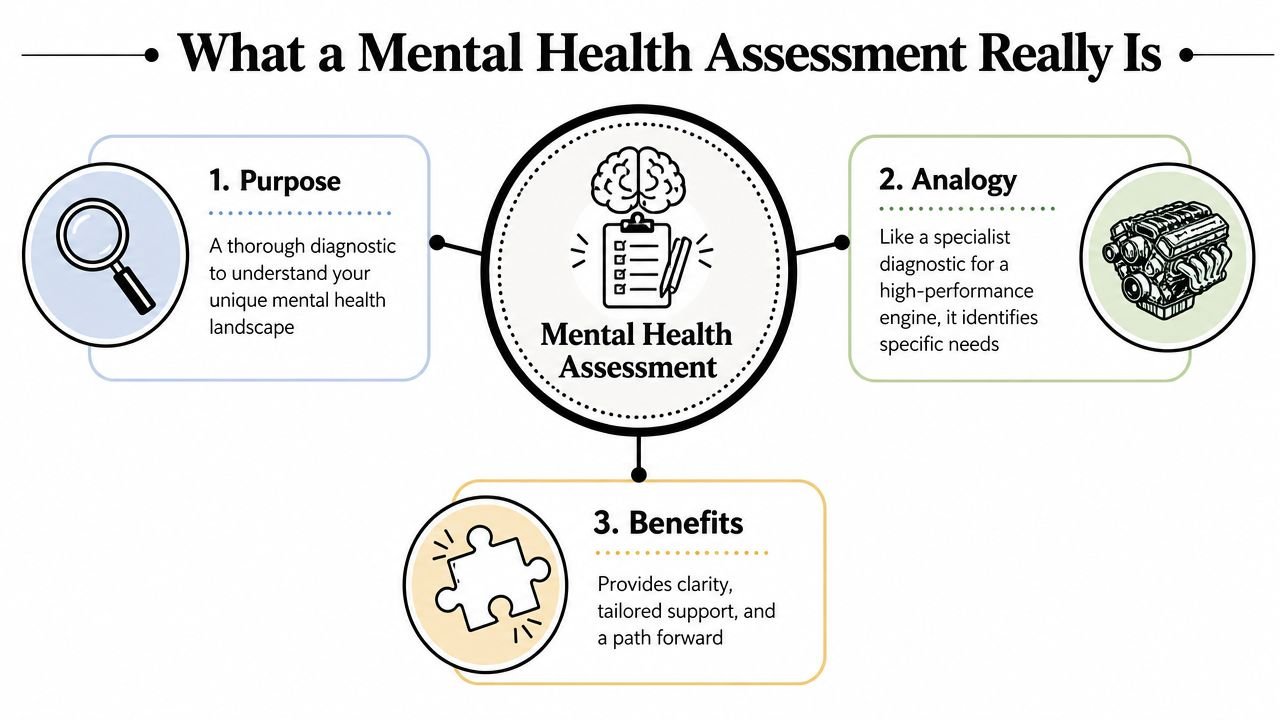
Think of it like a specialist diagnostic
If a high-performance car keeps stalling, you wouldn't want someone to glance at the dashboard and guess. You'd want a mechanic to look at the whole system, test key functions, review the history, and work out whether the issue is fuel, electrics, wear and tear, or several factors together.
Mental health is similar. A clinician isn't just asking, “Do you have ADHD?” They're asking:
- What symptoms are present
- When they started
- Whether they've been lifelong or recent
- How they affect work, relationships, daily tasks, and emotional wellbeing
- Whether another explanation fits better, or fits alongside it
That's why an online checklist can only do so much. It may raise a possibility, but it can't weigh developmental history, context, coping style, or contradictions in the way a trained psychiatrist can.
What happens inside the conversation
In practical terms, what is a mental health assessment in the UK? It's usually a structured clinical conversation. The psychiatrist gathers your account, asks follow-up questions, and observes how you present. They may also review previous diagnoses, medication history, physical health, substance use, sleep, and stressors.
Some readers find it helpful to compare this with a fuller psychiatric assessment overview because the two terms are closely related in specialist practice.
Practical rule: the assessment is not there to catch you out. It's there to understand you accurately.
What it is not
People often feel calmer when they know what an assessment is not.
- Not a character judgement: Struggling with concentration, emotion regulation, or social communication doesn't mean you're weak.
- Not one questionnaire: Forms can help, but they don't replace clinical judgement.
- Not only about diagnosis: The aim is also to work out what support, treatment, or adjustments may help.
A useful assessment gives you more than an answer. It gives you a framework.
Types of Assessments for Adults
Not every adult needs the same kind of assessment. The right assessment depends on the question being asked.
If someone says, “I've felt low and anxious for six months since a bereavement,” the clinician will focus differently than if someone says, “I've never been able to organise myself, I was always called dreamy at school, and now work is unravelling.” Those are different clinical puzzles.
Neurodevelopmental assessments
For ADHD and autism, the assessment usually looks for lifelong patterns rather than a recent change. The clinician wants to know what you were like as a child, how you managed at school, whether the same traits show up across different settings, and how you've compensated over time.
For adults, this can be surprisingly emotional. Many people have spent years masking. They've built systems, copied social behaviours, overprepared, or worked twice as hard to appear “fine”. A neurodevelopmental assessment tries to see past those coping strategies.
Areas commonly explored include:
- Attention and organisation: losing track of tasks, difficulty starting, finishing, prioritising, or remembering practical details
- Social communication: reading tone, managing small talk, knowing when to speak, interpreting ambiguity
- Sensory profile: noise, texture, lighting, crowding, or unexpected interruption
- Routine and flexibility: reliance on structure, distress around changes, repetitive habits, intense interests
- Developmental history: childhood behaviour, school reports, family observations, long-term patterns
General psychiatric assessments
A general mental health assessment often focuses more on the current clinical picture. The psychiatrist may ask about low mood, panic, intrusive thoughts, trauma symptoms, sleep, appetite, motivation, mood changes, and whether there has been a recent decline in functioning.
The core question is often, “What has changed, and why now?”
That doesn't mean childhood is irrelevant. It means the weight of the assessment is different. In mood or anxiety presentations, time course can be essential. A person may have been functioning well for years and then deteriorated after stress, illness, grief, or burnout.
For adults considering a broader psychiatric review rather than a condition-specific pathway, a clinician-led online mental health assessment for adults can be one route to clarifying what sort of assessment is needed.
When conditions overlap
In this context, specialist experience matters most.
Someone may appear anxious because they've spent years compensating for undiagnosed ADHD. Another person may seem inattentive because they're severely depressed and sleeping badly. An autistic adult may have panic symptoms that are triggered by sensory overload and uncertainty rather than a primary panic disorder.
A diagnosis should explain the pattern. If it doesn't, the clinician has to keep thinking.
A simple way to tell them apart
| Assessment focus | Main clinical question | Typical emphasis |
|---|---|---|
| Neurodevelopmental | Have these traits been present across life? | Developmental history, lifelong patterns, functioning across settings |
| General psychiatric | What symptoms are active now, and what may be causing them? | Current symptoms, recent changes, risk, mood, anxiety, sleep, stressors |
The distinction isn't absolute. Many adults need both lenses.
The Assessment Journey Step by Step
You book an assessment because something has felt off for years, or because work, relationships, or daily life have become harder to hold together. A lot of adults worry that they will be judged, rushed, or expected to present their whole life story in perfect order. In practice, a good assessment is much more structured and much more humane than that.
In the UK, the process often follows two linked stages. Questionnaires are used first to gather background information, measure symptom patterns, and flag any risks that need prompt attention. Then a clinician-led interview examines what those answers mean in real life and whether they fit ADHD, autism, another mental health condition, or a mixture of factors. A broader outline of this kind of staged process is described in this explanation of behavioural health assessment workflow.
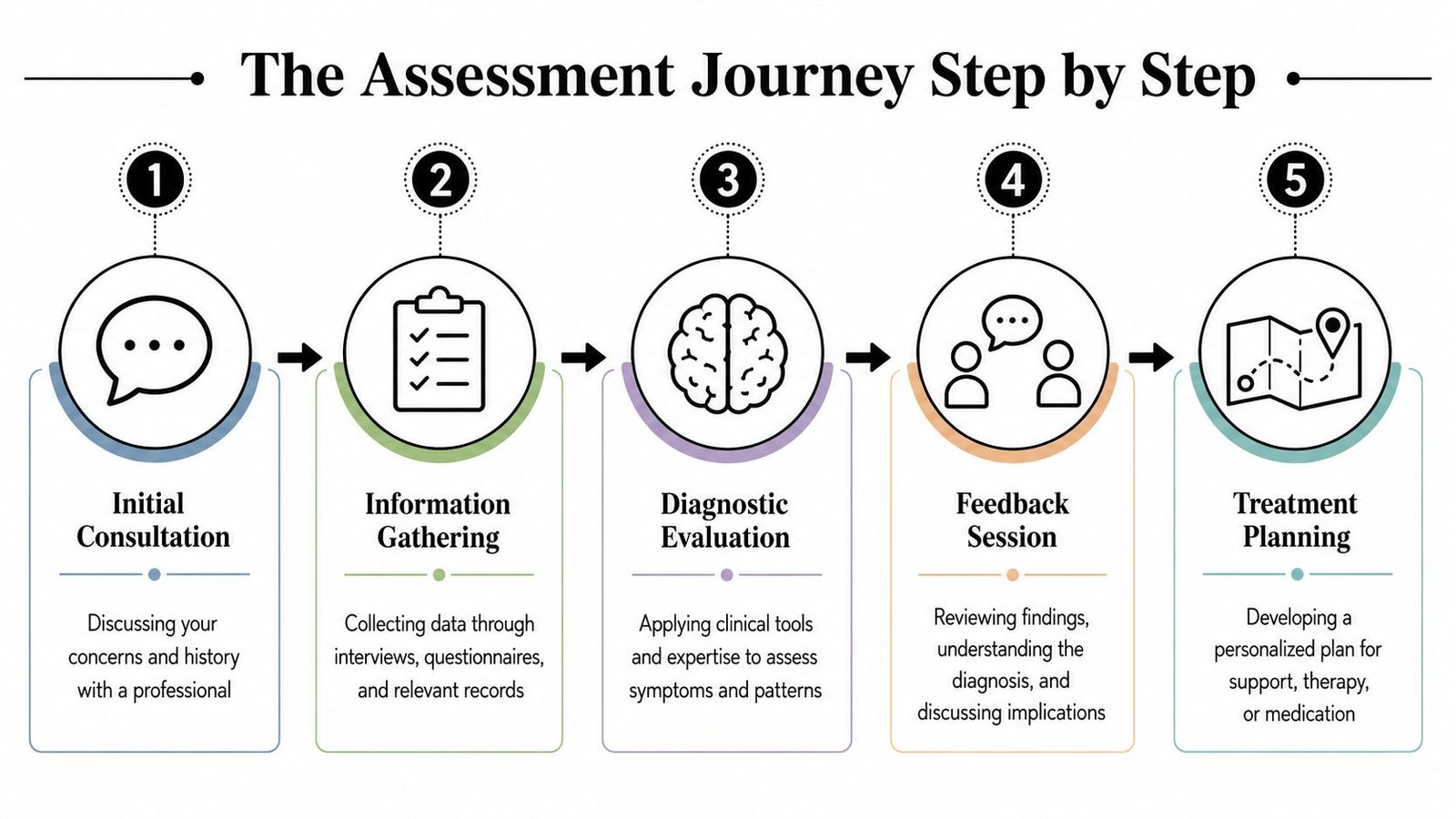
Step one, first contact and triage
The first step is usually brief, but it shapes everything that follows.
The service needs to understand why you are seeking help now, what question you want answered, and whether there are any urgent concerns. You may be asked to complete forms before your appointment. Those forms do not replace the assessment. They work like a map at the start of a journey. They show the clinician where to look more closely.
Someone asking about ADHD may be sent attention and impulsivity questionnaires. Someone whose symptoms are less clear may be asked about low mood, anxiety, sleep, alcohol use, trauma, or daily functioning. In a consultant-led adult service, this stage helps decide whether you need an ADHD assessment, an autism assessment, a broader psychiatric review, or faster support because risk is present.
Step two, the diagnostic interview
This is the main part of the assessment.
A psychiatrist or other suitably qualified clinician will usually start with open questions. After that, they will ask more specific ones to test patterns carefully. For adult ADHD and autism, the interview often moves between the present day and earlier life, because the clinician is trying to work out whether the traits are longstanding and consistent, not only visible during periods of stress or burnout.
You may be asked about school, friendships, work, routines, concentration, sensory experiences, emotional regulation, sleep, relationships, and how you cope when demands rise. Real examples matter. “I struggle to focus” is a useful starting point. “I reread the same email six times, miss deadlines unless there is pressure, and leave admin until it becomes urgent” gives the clinician something concrete to assess.
You do not need to sound medical. Plain, ordinary descriptions are often the most helpful.
Step three, structured tools and psychometrics
Some services add structured interviews or rating scales to support the clinical interview. These are common in adult ADHD and autism pathways, including specialist UK services.
Their role is simple. They bring consistency. They help the clinician check the same areas in the same way across patients, rather than relying only on general impressions. They support judgement. They do not replace it.
That distinction matters, because people sometimes worry about “passing” or “failing” a questionnaire. Mental health assessments do not work like an exam. A score is one part of the picture, alongside history, examples, level of impairment, and the clinician's analysis.
Step four, collateral information
For ADHD and autism assessments in adults, outside information can be very helpful if it is available and you agree to share it.
This might include:
- A family informant, such as a parent, sibling, partner, or someone who has known you over many years
- School records, including reports mentioning daydreaming, inconsistency, social difficulties, behaviour, or uneven attainment
- Previous documents, such as GP letters, older mental health reports, occupational health notes, or educational assessments
Collateral information is useful because it helps the clinician see the longer timeline. That is particularly important in neurodevelopmental assessments, where the question is often whether a pattern has been present since earlier life.
If you do not have old reports, the assessment can still go ahead in many cases. Records are often incomplete, lost, or never detailed enough to settle the question on their own.
Step five, feedback and report
After the clinician has reviewed the information, you should be told clearly what they think, how they reached that view, and what happens next. Some services give verbal feedback in a separate appointment. Others begin that discussion in the assessment itself and then send a written report afterwards.
A consultant-led service such as Insight Diagnostics Global may use this pathway for adult psychiatric assessments, with the final report setting out the clinical history, diagnostic opinion, and recommendations for treatment, support, or further review.
If it helps, bring notes. Many adults find it easier to remember key examples when they have written them down beforehand.
Understanding Your Diagnostic Report and Next Steps
People sometimes expect the report to be a dense medical document that sits unread in a folder. A good report should be much more useful than that.
Think of it as a structured explanation of how the clinician reached their conclusion and what that means for your life now. If you've ever wondered what to do with a diagnosis once you have it, the report is usually the answer.
What the report usually contains
A detailed report often includes several parts.
First, it sets out the reason for referral. That means the question being asked. ADHD, autism, anxiety, low mood, emotional dysregulation, burnout, or diagnostic uncertainty.
Second, it summarises the clinical history. This may include your developmental background, mental health history, current symptoms, family history, and examples of day-to-day impairment.
Third, it gives the diagnostic opinion. Sometimes that means a diagnosis is confirmed. Sometimes it means a diagnosis is not supported. Sometimes the answer is more nuanced, such as significant traits being present without meeting full diagnostic criteria.
Why the explanation matters
A diagnosis without reasoning can feel abstract. A proper report explains the evidence.
For example, it may describe how the clinician linked lifelong inattentive symptoms across school, work, and home to ADHD. Or it may explain why social exhaustion and sensory sensitivity fit autism more closely than social anxiety alone. If a diagnosis is ruled out, the report should still tell you what better explains the presentation.
The report is most helpful when it answers both questions. What is this, and what do I do next?
Turning the report into action
The most practical part of the report is usually the recommendations. These can include:
- Psychoeducation: learning how ADHD, autism, anxiety, or mood symptoms affect daily life
- Medication pathways: where appropriate, discussion of options such as ADHD medication and what monitoring may be required
- Psychological therapy: CBT, counselling, trauma-focused work, or supportive therapy depending on the formulation
- Workplace or university support: reasonable adjustments, clearer deadlines, quieter working conditions, or written follow-up after meetings
- Lifestyle and structure: sleep routines, workload pacing, sensory management, and planning strategies
For many adults, the first relief comes from finally understanding the pattern. The second relief comes from realising there are practical steps they can take.
If the answer isn't the one you expected
This can still be useful.
Some people go in convinced they have ADHD and learn that anxiety, sleep disturbance, alcohol use, or another factor is playing a larger role. Others suspect they are “just anxious” and discover a longstanding neurodevelopmental profile underneath years of coping. Either way, the purpose is accuracy.
A report isn't the end of the story. It's the start of making better decisions with better information.
How to Get an Assessment UK Pathways and Costs
In the UK, adults usually reach assessment through private self-funding, NHS routes including Right to Choose, or health insurance. The best route depends on urgency, budget, local GP support, and whether you want a particular provider.
A mental health assessment in UK practice is a standardised clinical evaluation, often using frameworks such as the Mental State Examination to create a formal record, and that standardisation is one reason the report can be used for triage, treatment planning, and access across NHS and private pathways, as outlined in this overview of mental status assessment and clinical documentation.
Private self-funded route
This route usually offers the most control.
You choose the provider, book directly, and don't need to wait for local NHS commissioning rules. It can suit adults who want clarity quickly, need flexibility around work, or want a consultant-led assessment for ADHD, autism, or wider mental health concerns.
The trade-off is simple. You pay directly.
Right to Choose route
For some adults in England, Right to Choose can be a very important option for ADHD and autism pathways. In broad terms, your GP refers you to an eligible provider rather than only using the local service.
Patients often like this route because it may widen choice and provide access to services outside the local waiting list structure. The details depend on eligibility, referral acceptance, and the specific condition being assessed, so it's worth checking the provider's process carefully.
Insurance-funded route
Some people use private medical insurance. If your policy includes psychiatric or neurodevelopmental cover, the insurer may ask for GP referral details and pre-authorisation before the assessment goes ahead.
This route can work well when cover is available, but the practical question is always the same. What exactly does your policy include?
UK assessment pathways compared
| Pathway | Typical Wait Time | Cost to Patient | Key Advantage |
|---|---|---|---|
| Private self-funded | Usually faster than publicly funded routes | Self-funded | Speed and direct choice of provider |
| NHS Right to Choose | Varies by provider and referral pathway | Usually NHS-funded if accepted | Access to an alternative provider through NHS referral |
| Health insurance | Depends on authorisation and provider availability | Depends on policy cover and excess | May reduce personal cost if covered |
If you're comparing practical options locally, a service finder such as this page on mental health assessment options near you can help you think through logistics as well as pathway type.
Looking beyond diagnosis
For many people, assessment is only one part of a wider life adjustment. If the outcome points toward autism or ADHD, you may also start thinking about work fit, training, and environments that are easier to manage. Resources on neurodivergent job training can be useful once you're exploring what support or direction might look like after diagnosis.
Preparing for Your Assessment and Urgent Support
You don't need to prepare perfectly. You only need to make it easier to tell your story clearly.
Before the appointment, it helps to jot down the main difficulties you've noticed, when they tend to happen, and a few concrete examples. If you're being assessed for ADHD or autism, old school reports, previous letters, or comments from someone who knew you as a child can be helpful if you have them. If you don't, still attend. The absence of paperwork doesn't make your experience invalid.

A short list like this can steady you on the day:
- Write down your questions: people often forget them once the appointment begins
- Note your daily impact: work, study, relationships, finances, sleep, and self-care
- Be open about masking or coping: what others see may not reflect how hard things feel inside
- Mention alcohol, sleep, medication, and physical health: these can affect the clinical picture
Above all, be honest rather than trying to present a “good case”. A careful clinician is looking for accuracy, not performance.
If you are in crisis, this kind of planned assessment is not the right service. If there is immediate risk to your safety or someone else's, call 999 or go to A&E. If you need urgent mental health help but it's not an emergency, contact NHS 111 or a crisis support service such as the Samaritans.
If you're ready to move from uncertainty to a clear clinical opinion, Insight Diagnostics Global offers consultant-led adult assessments for ADHD, autism, and broader mental health concerns, with structured reports and follow-up options designed for planned, non-crisis care.