

You type mental health assessment near me late at night, open six tabs, and end up more confused than when you started. One clinic mentions ADHD. Another mentions autism. A third offers a quick questionnaire. The NHS page tells you to speak to your GP. You're trying to work out one practical question: who can help me understand what's going on?
That uncertainty is common. Demand is high, and that affects access. In 2023/24, NHS England received 2.03 million referrals for mental health treatment, which helps explain why local pathways often involve waiting, triage, and difficult choices about route of access rather than directly booking the nearest appointment, according to NHS England mental health community data.
A proper assessment isn't a test you pass or fail. It's the first organised step towards clarity. For some people, that means understanding anxiety, depression, burnout, bipolar symptoms, trauma, or personality-related difficulties. For others, especially adults who have spent years feeling “different” without knowing why, it means finally exploring ADHD or autism in a serious clinical setting.
What matters most is choosing the right pathway and the right level of clinical depth. If you're unsure how to start, a practical first step is learning how to see a psychiatrist in the UK, because the route you choose often shapes how quickly you're assessed and how useful the final report will be.
Your Search for Answers Starts Here
Many adults begin this search at a point of exhaustion. They're struggling to focus at work, feeling socially overwhelmed, missing deadlines, masking through meetings, or wondering whether “burnout” is really the whole story. Some have lived for years with anxiety or low mood and are only later realising that neurodevelopmental traits may have been missed.
That's why the phrase mental health assessment near me can mean very different things depending on who is searching. One person wants urgent clarity about escalating symptoms. Another wants a formal ADHD assessment. Another needs a report their GP, university, or employer can use.
A good assessment should reduce confusion, not add to it.
In practice, the problem isn't only finding a clinic nearby. It's knowing whether the service offers proper psychiatric assessment, whether it can assess ADHD or autism with enough depth, and whether the route is NHS, private, or Right to Choose. Location matters, but clinical quality and pathway design matter more.
What people are usually trying to solve
- Clarity about symptoms: Are these difficulties anxiety, depression, ADHD, autism, trauma, or a mixture?
- A usable diagnosis or formulation: Will the outcome help with treatment, medication decisions, workplace adjustments, or university support?
- A realistic access route: Can you get assessed through the NHS, should you consider private care, or are you eligible for Right to Choose?
If you've been searching for answers for months, the confusion doesn't mean you're approaching it badly. It usually means the system is fragmented, and different providers describe very different things under the same label.
What a Mental Health Assessment Really Involves
A proper assessment is closer to building a clinical map than filling in a form. The clinician isn't just collecting symptoms. They're trying to understand patterns, timing, severity, risk, background history, and what kind of care fits best.
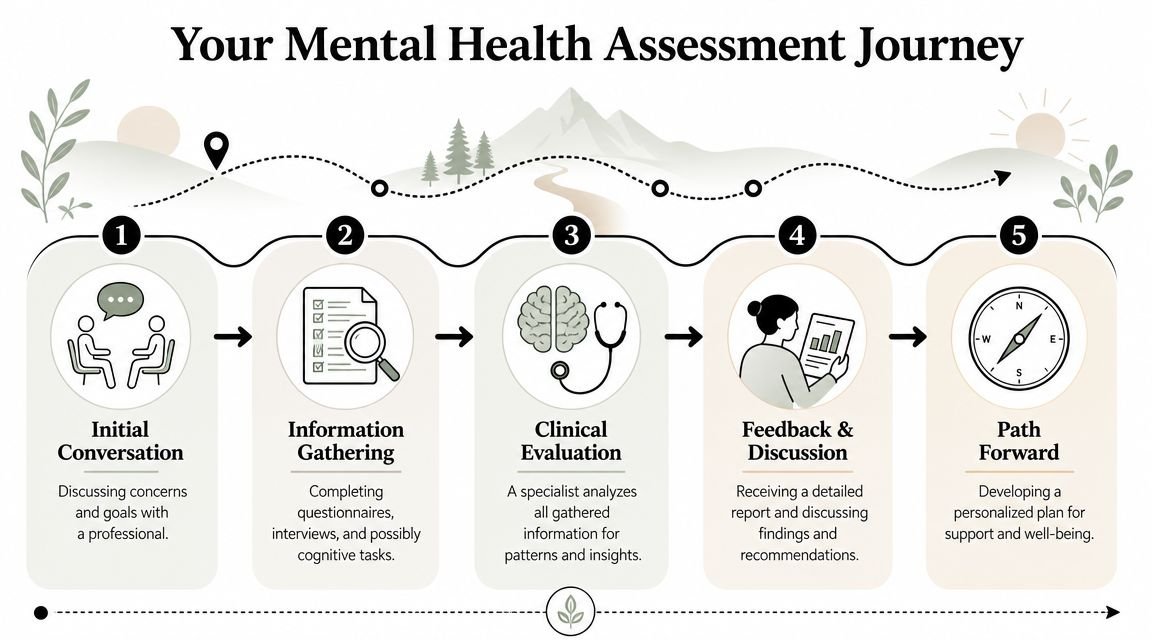
In the UK, that first structured conversation does real clinical work. A structured intake interview is a critical decision point that determines whether a patient is routed to primary care, talking therapies, specialist psychiatry, or community mental health teams, as reflected in NICE guidance on mental health assessment and management. In other words, the assessment isn't just descriptive. It guides what happens next.
What usually happens in a robust assessment
A high-quality assessment often includes several parts:
Presenting concerns
You explain what's happening now. That may include concentration problems, mood changes, panic, sensory overload, sleep issues, emotional dysregulation, impulsivity, or relationship strain.Background history
The clinician asks about childhood, education, work, family context, physical health, medication, substance use, and previous support.Pattern recognition
They explore whether symptoms fit a recognised condition, whether there are overlapping issues, and whether risk needs urgent attention.Clinical formulation
The information starts to make sense as a whole. A good clinician doesn't stop at “you scored high on a checklist”.Recommendations
You should leave with a clear sense of next steps, not just a label.
What doesn't work well
Some services rely too heavily on brief questionnaires or automated screens. Those tools can be useful as part of an assessment, but they aren't a substitute for one. A symptom score can suggest a possibility. It can't, on its own, tell you whether ADHD is present, whether trauma is driving concentration problems, or whether bipolar symptoms need further exploration.
Practical rule: If a service can diagnose a complex condition without a detailed interview, that should make you cautious.
For adults seeking clarity, especially where ADHD, autism, mood symptoms, and burnout overlap, the value lies in the clinician's judgement. The process should feel structured, thorough, and relevant to your life rather than generic.
Assessments for ADHD Autism and Mood Disorders
Not all assessments answer the same question. That's where many people get misled. A broad mental health assessment for anxiety or depression is not the same as a specialist neurodevelopmental assessment for ADHD or autism.
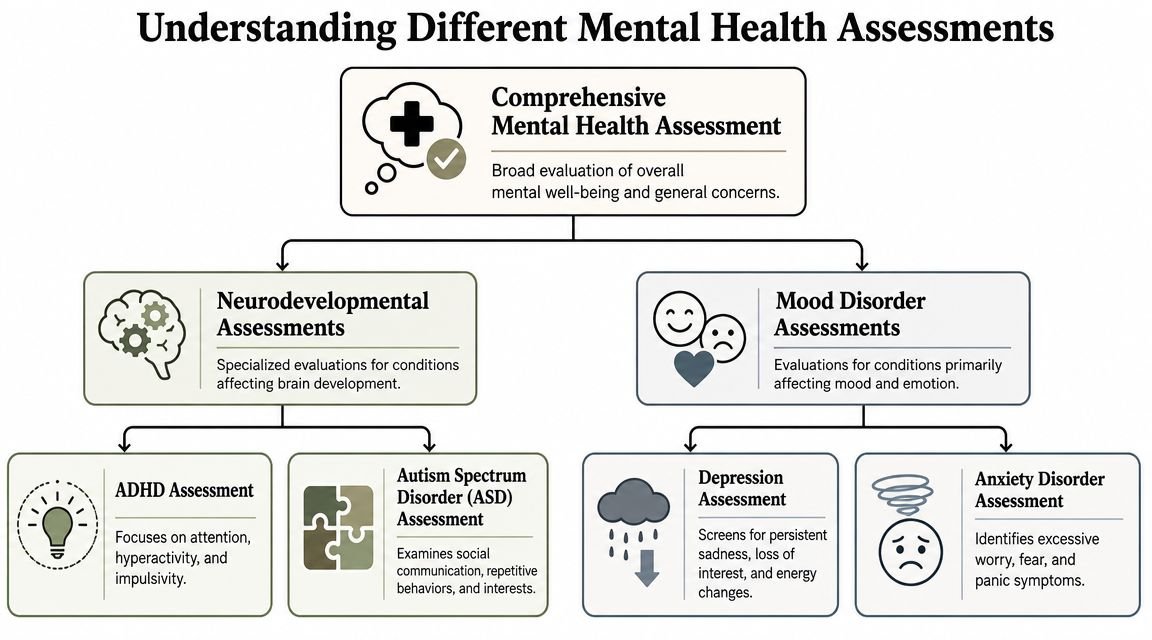
For ADHD and ASD, NICE-aligned practice requires a multi-domain diagnostic process, including developmental history and a specialist clinical interview, because symptom overlap with anxiety, depression, and trauma can otherwise lead to misdiagnosis, according to NICE guidance on ADHD assessment. That point matters enormously for adults who have spent years being told they are merely stressed, disorganised, shy, or emotionally reactive.
General mental health assessment
A general psychiatric assessment is usually the right starting point when the picture is mixed or unclear. It can help explore:
- Low mood and depression
- Anxiety and panic
- Mood instability
- Obsessive symptoms
- Trauma-related presentations
- Burnout that may be masking something else
This type of assessment looks broadly at your mental state, functioning, and history. It may identify that neurodevelopmental assessment is needed later, but it doesn't replace that specialist process.
ADHD assessment
A proper adult ADHD assessment should look beyond distractibility. Clinicians should ask about:
- Childhood patterns: school reports, forgetfulness, restlessness, repeated feedback about effort or organisation
- Current impairment: work performance, time management, finances, emotional impulsivity, driving, relationships
- Alternative explanations: anxiety, depression, sleep problems, trauma, substance use, or other psychiatric conditions
A checklist alone won't do this. If you want a clearer sense of how ADHD can affect everyday function in less obvious ways, That's Okay's ADHD guide is a helpful practical read alongside formal clinical advice.
For people specifically looking into adult diagnosis pathways, a focused ADHD assessment for adults near you should explain who leads the assessment, how developmental history is gathered, and what the written outcome includes.
Autism assessment
Autism assessments in adults require similar care, but the emphasis is different. The clinician should explore social communication, sensory experiences, routines, special interests, masking, and how your lifelong pattern fits together. Many adults, especially those who have adapted well outwardly, present with exhaustion, social confusion, shutdowns, or repeated misunderstanding rather than an obvious stereotype.
Why overlap matters
The hardest cases clinically are often the most common in real life. Someone may have ADHD and anxiety. Autism and depression. Trauma and attentional difficulties. Personality-related patterns and neurodevelopmental traits. Good assessment works by separating overlap from core pattern.
When a provider treats ADHD, autism, anxiety, and burnout as interchangeable, the assessment usually becomes shallow.
That's why expertise matters. The clinician needs enough experience to identify what belongs to which condition, what is comorbid, and what needs treatment first.
Navigating Your Assessment Pathway NHS Private or Right to Choose
Once you know what kind of assessment you need, the next question is practical. How are you going to access it?
Waiting pressure is a significant factor. The NHS in England reported 1.9 million people on the mental health waiting list in September 2024, which is why many adults compare pathways rather than looking only for the nearest service, according to NHS England Right to Choose and mental health access information.
UK assessment pathways compared
| Pathway | Typical Wait Time | Cost to You | Choice of Provider | Best For |
|---|---|---|---|---|
| NHS | Often variable because local services are under pressure | Usually no direct private fee | Usually limited by local commissioning and referral pathways | People who want NHS-funded care and can use the local route |
| Private | Often faster than standard NHS routes | Self-funded, or covered in some cases by insurance | Usually the greatest choice of clinician and appointment format | Adults who want speed, flexibility, and a defined report process |
| Right to Choose | Can be quicker than some local NHS pathways, depending on provider availability | NHS-funded if eligible in England | More choice than standard local NHS routing, but within the approved pathway | Adults in England seeking specialist assessment without self-funding |
NHS route
The NHS route often starts with a GP, although some services have self-referral options depending on the problem and local system. This pathway suits people who want care entirely within NHS structures and are willing to work through local triage.
The trade-off is predictability. Some areas have clear pathways. Others don't. For ADHD and autism especially, patients often discover that “speak to your GP” is only the beginning, not the answer.
Private route
Private assessment usually offers more control over timing, clinician choice, and appointment format. It can also be easier to arrange a consultant-led review when the case is diagnostically complex.
The trade-off is cost. Some patients self-fund. Others use private health insurance where mental health assessment is included, usually with pre-authorisation. A private route can be sensible when time matters, when documentation needs to be thorough, or when previous assessment has felt incomplete.
Right to Choose
Right to Choose is often misunderstood. In England, eligible patients can sometimes ask their GP to refer them to a different NHS-funded provider rather than only the local service. This can be especially relevant for ADHD assessment.
A clear explanation of the process is available through this guide to NHS Right to Choose. The value of this pathway is simple. It can widen your options without requiring you to self-fund, provided you meet the criteria and your GP uses the route correctly.
How to Choose a High-Quality Assessment Service
Once you've narrowed the pathway, choose the provider with care. The difference between a rigorous assessment and a superficial one is often obvious only after the report arrives. By then, people have already spent time, money, or months on a waiting list.

A strong service should produce more than a yes-or-no answer. A good assessment produces a structured report detailing functional impact, differential diagnosis, and actionable next-step recommendations that can be used by a GP, university, or employer, as outlined in the ADHD Foundation summary of NICE-guideline expectations. That standard is especially important for ADHD and autism, where the details matter.
What to check before you book
- Clinical leadership: Find out whether the assessment is consultant-led and whether the psychiatrist is on the GMC Specialist Register.
- Regulation: Check whether the service is regulated by the CQC where relevant.
- Assessment model: Ask whether they use full psychiatric interview, developmental history, rating scales, collateral information where appropriate, and differential diagnosis.
- Written output: Confirm that you'll receive a structured report rather than a brief letter.
- Follow-up options: If ADHD is diagnosed, ask whether medication titration or onward care is available.
What a weak service often looks like
Sometimes the warning signs are subtle:
- Fast but vague process: The provider promises speed but gives little detail on who assesses you or how.
- Checklist-heavy diagnosis: The whole pathway appears built around forms rather than clinical interviewing.
- Thin documentation: The report doesn't explain functional impact, differential diagnosis, or practical recommendations.
A report should help another professional understand you. If it reads like a summary of questionnaire scores, it probably isn't enough.
For adults seeking neurodevelopmental or broader psychiatric assessment, consultant involvement matters because overlapping conditions are common. Services such as Insight Diagnostics Global describe a consultant-led model with CQC regulation, GMC Specialist Register psychiatrists, and structured assessments for ADHD, autism, and other adult mental health conditions. That's the kind of framework worth looking for, whether you choose that provider or another.
Confidentiality matters too. If you're sharing reports, school records, or sensitive background history digitally, clear information governance is part of quality. For a practical overview of secure health information handling in digital communication, the 2026 HIPAA compliance guide offers useful context, even though UK services will follow their own regulatory requirements.
Preparing for Your Assessment and What to Expect
Knowing what to bring and how the appointment will run can ease anxiety. Preparation doesn't need to be elaborate, but it does help you give a clearer account of what has been happening.
A useful starting point is reading a plain-language overview of what a psychiatric assessment involves. That gives you a framework before the appointment so the questions feel less unfamiliar.
What to gather beforehand
Bring or note down the information that helps the clinician see the full pattern:
- Current concerns: Write a short list of symptoms and examples from work, home, study, or relationships.
- Timeline: Note when things began, what has changed, and whether there were earlier signs in childhood or adolescence.
- Past support: Include previous diagnoses, therapy, medication, or GP input.
- ADHD or autism clues: If relevant, gather school reports, developmental details, or observations from someone who knew you well when you were younger.
You don't need perfect paperwork. Even rough notes can help.
What the appointment may feel like
The consultation may be online or face to face. Expect detailed questions. A good clinician will ask not only what symptoms you have, but how they affect decisions, routines, work output, emotional regulation, social functioning, and daily life.
For ADHD and autism assessments, the questions usually go further back than many people expect. That's normal. These are developmental conditions, so the clinician needs to understand long-term patterns, not only your last difficult month.
Practical points about timing and payment
If you're using private health insurance such as Aviva or Vitality, check in advance whether mental health assessment is covered and whether you need a pre-authorisation code. That avoids surprises on the day.
Some consultant-led services provide defined timelines. Insight Diagnostics states that assessments are usually scheduled within seven working days and reports completed within five working days after the assessment. That kind of operational clarity can be helpful when you need documentation for treatment planning, work, or study.
After Your Assessment Understanding the Outcomes
The appointment itself is only one part of the process. What matters afterwards is whether the outcome gives you something you can use.
A thorough report may confirm a diagnosis, rule one out, or explain that the picture is mixed and needs a staged plan. For many adults, that alone is relieving. Clarity can change how you understand years of struggle. It can also stop you pursuing the wrong treatment.
What you may do with the report
- Take it to your GP: This may help with ongoing care, medication discussion, or onward referral.
- Use it for support planning: Universities and employers often need structured documentation when adjustments are being considered.
- Arrange follow-up care: That might include therapy, psychoeducation, ADHD titration, monitoring, or more specialist review.
The diagnosis is not the end point. It's the point at which decisions become more precise.
If your assessment identifies immediate risk, crisis symptoms, or severe deterioration, routine diagnostic pathways are not the right next step. Services such as consultant-led outpatient clinics are not crisis services. If you're at immediate risk, call 999. If you need urgent mental health help, contact NHS 111.
If you want a consultant-led adult assessment for ADHD, autism, or broader mental health concerns, Insight Diagnostics Global offers online and face-to-face assessments, structured reports, and follow-up options for adults across the UK.