

You may be searching for a mental health assessment PDF because life has become harder to explain than to endure. Work feels effortful. Social contact drains you more than it should. You lose track of tasks, miss small details, overthink conversations, and then wonder whether this is anxiety, burnout, ADHD, autism, depression, or a failure to cope.
That uncertainty is common in adult psychiatry. It's also one reason generic online checklists so often leave people stuck. They can confirm that you relate to symptoms, but they rarely answer the question that matters most in clinic. What is going on, and what should happen next?
A proper mental health assessment PDF is useful when it reflects clinical reasoning, not just symptom endorsement. For adults with possible ADHD, autism, anxiety, mood difficulties, or burnout, the document should help a GP, employer, university, insurer, or follow-up clinician understand not only what symptoms are present, but how they fit together, what alternatives were considered, and what support is now appropriate.
Feeling Lost Between Burnout and Diagnosis
A familiar story goes like this. An adult who has always worked hard starts slipping. Emails pile up. Meetings feel impossible to follow. Background noise suddenly feels unbearable. At home, they can function for a few hours and then collapse into silence. Friends say it's stress. Colleagues call it burnout. The person themselves isn't convinced, because some of these patterns were there long before the current pressure.
That's where confusion deepens. Burnout can look like poor concentration, irritability, emotional flattening, or avoidance. ADHD can look similar. Autism can also sit underneath social exhaustion, sensory overload, rigid coping patterns, and shutdown after prolonged masking. Anxiety and depression can complicate all of it.
Many people then do what anyone would do. They search online, download a checklist, compare themselves to strangers on forums, and try to decide whether they fit a label. That often brings temporary relief, then more uncertainty. If you've been trying to work out whether you're overwhelmed, neurodivergent, depressed, or all three, that's a sign you need assessment, not more guessing.
For some readers, a clearer explanation of occupational exhaustion is helpful alongside diagnostic work. This burnout overview is useful background, but burnout on its own shouldn't be used to explain every longstanding difficulty with attention, regulation, communication, or sensory experience.
The practical question in psychiatry isn't whether a symptom appears on a list. It's whether the full pattern makes sense as ADHD, autism, another mental health condition, a combination, or something else entirely.
That distinction matters because treatment, workplace adjustments, medication decisions, and referral pathways all depend on it.
What Is a Clinical Mental Health Assessment PDF
A mental health assessment PDF can mean two very different things.
One is a downloadable form or self-test. That may be a useful prompt. It may help you organise your thoughts before an appointment. But it isn't, by itself, a clinical document.
The other is a formal report produced after a structured assessment. That report is closer to a blueprint than a sketch. It records the reason for referral, the relevant history, observed mental state, results of validated measures, differential considerations, and recommendations. It's written so another professional can understand how conclusions were reached.
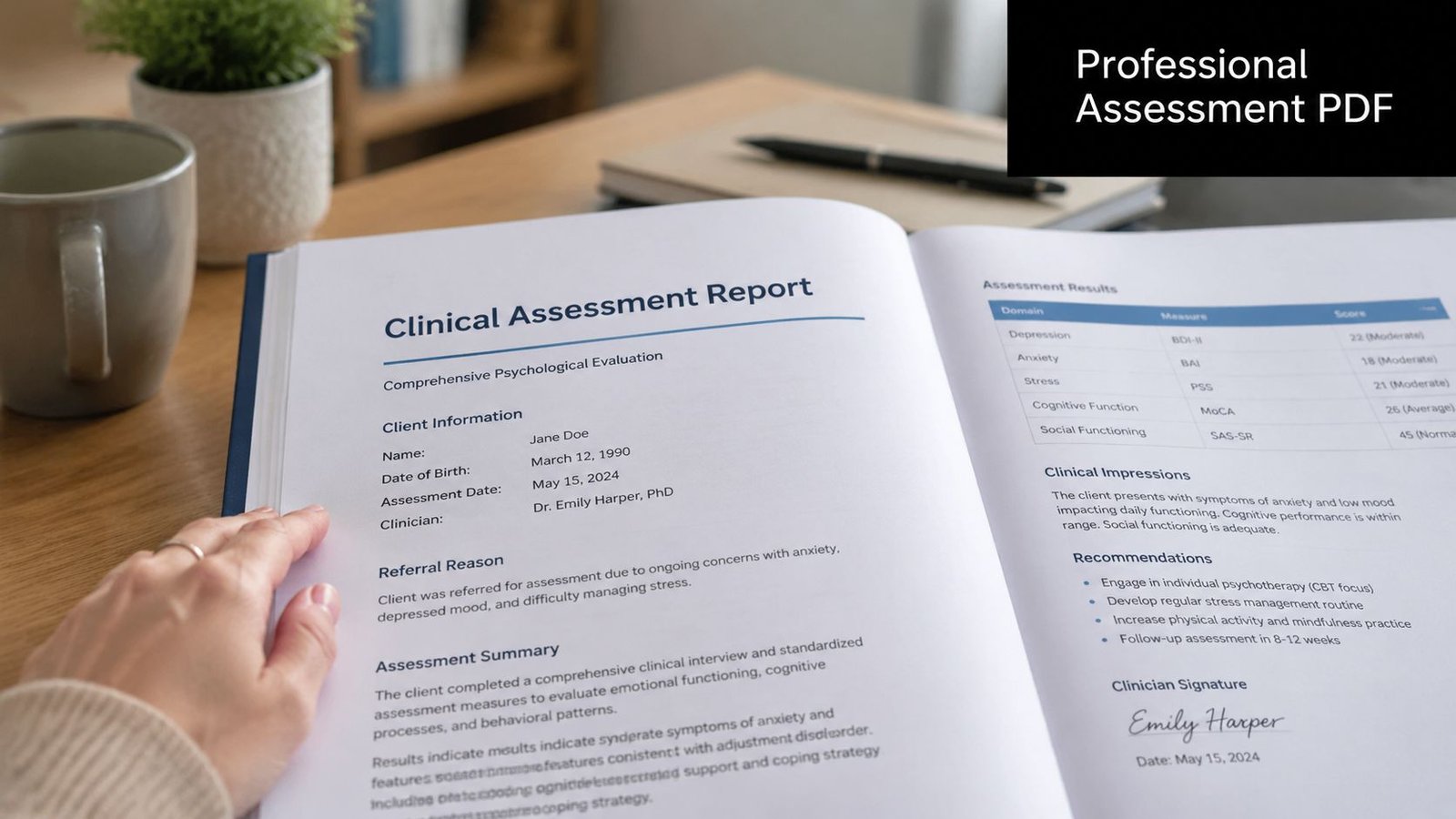
What separates a report from a template
A good report doesn't just say what you scored. It explains what those findings mean in context.
For example, UK-style measurement approaches rely on standardised symptom scales to monitor whether care is working. In a large longitudinal assessment study, patients' PHQ-9 depression scores fell by 1.30 points from one assessment to the next, and that change was statistically significant, which shows why repeatable measures are more useful for follow-up than a one-off impression (longitudinal assessment study on repeated symptom measurement).
That matters because adults presenting for ADHD or autism assessment often also report low mood, anxiety, poor sleep, emotional dysregulation, and reduced functioning. A one-page quiz can flag distress. A formal report can show whether the picture is primarily neurodevelopmental, affective, trauma-related, stress-related, or mixed.
Why the PDF matters after the appointment
The report often becomes the working document for everything that follows:
- GP communication so your record reflects the assessment properly
- Triage support if further psychiatric or psychological treatment is needed
- Work or university adjustments where functional impact needs to be described clearly
- Insurance or funding discussions when authorisation depends on formal documentation
- Personal understanding because many adults finally see a coherent account of difficulties that had previously seemed disconnected
A clinically useful PDF should stand up to scrutiny. If another psychiatrist, GP, psychologist, or occupational health professional reads it, they should be able to follow the reasoning.
Anatomy of a Professional Assessment Report
When a report is done well, every section answers a clinical question. It shouldn't read like a collection of notes pasted together. It should read like a structured judgement.
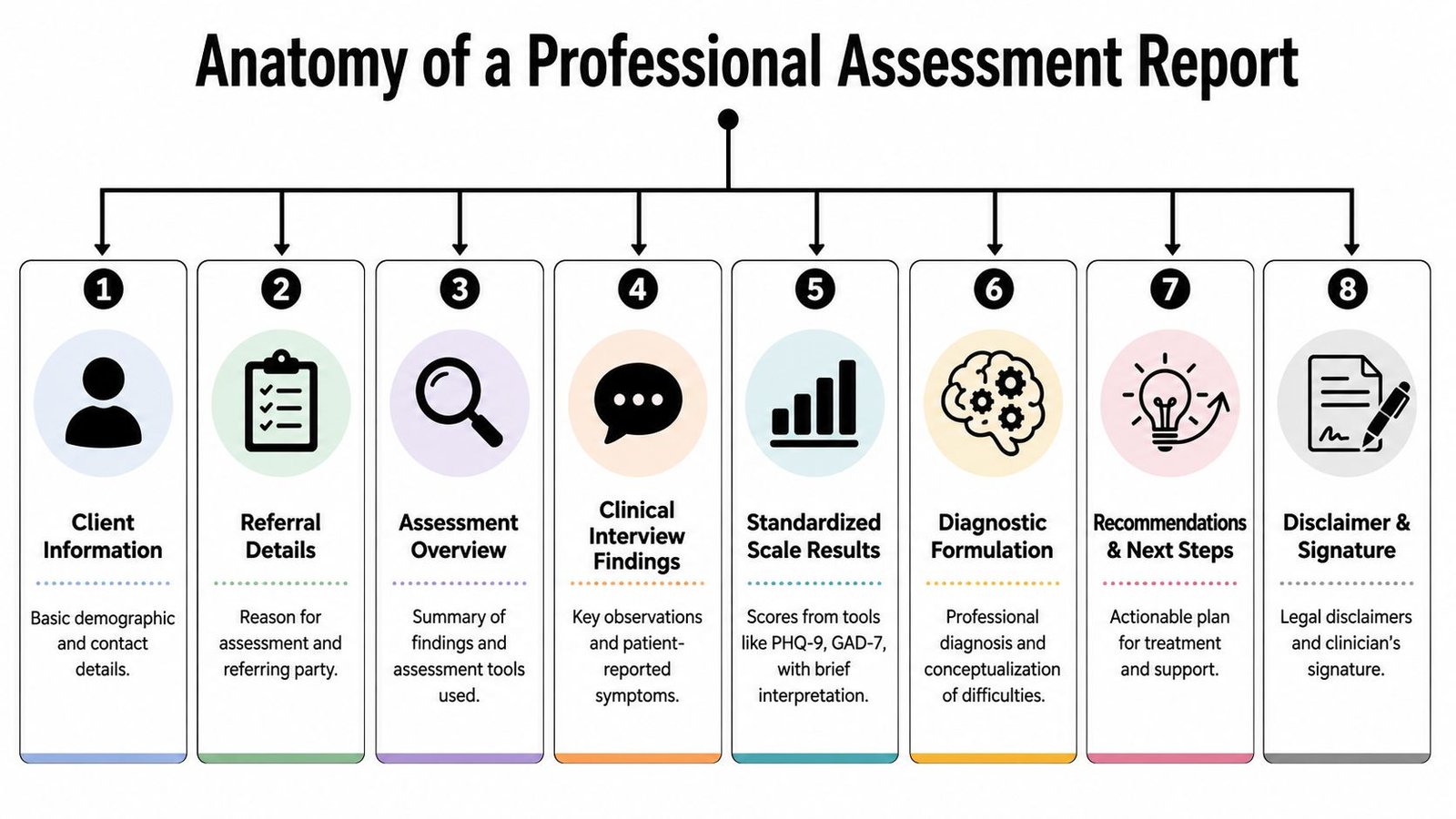
Referral and presenting problem
The report states why the person was seen. Sometimes the referral question is narrow, such as suspected ADHD. Often it is not. A GP may ask for clarification where inattention, anxiety, social strain, and burnout overlap.
A weak report repeats the referral question. A strong report sharpens it. It identifies what needs to be distinguished and why that distinction affects management.
History and developmental background
For ADHD and autism, this part is central. Adult diagnosis depends heavily on longitudinal understanding. The clinician needs to know what was present in childhood, how education and relationships developed, what coping strategies emerged, and whether current symptoms are long-standing or primarily recent.
This is also where mental health comorbidity starts to come into focus. Depression can reduce concentration. Anxiety can create restlessness and avoidance. Trauma can alter attention, sleep, arousal, and social behaviour. Without a careful history, overlap gets mistaken for equivalence.
Mental state and observed presentation
Some features are reported by the patient. Others are observed clinically. The way someone speaks, organises thought, responds socially, shows affect, manages eye contact, or describes internal experience can add useful information.
Professional guidance is clear that a robust assessment PDF should capture history, mental state, collateral information, risk, and explicit treatment recommendations, because that structure supports safer triage and follow-up planning (professional guidance on assessment documentation and integrated recommendations).
Practical rule: If a report has symptom lists but no mental state, no risk formulation, and no recommendations, it may be readable, but it won't be as useful when real decisions need to be made.
Rating scales and collateral information
Validated scales can strengthen the picture, but they shouldn't replace clinical judgement. Collateral information can also matter, especially in neurodevelopmental assessment, where historical patterns and external observations may clarify onset and functional impact.
Here is a simple way to think about report components:
| Report section | Clinical purpose |
|---|---|
| Referral details | Defines the question being asked |
| History | Shows pattern, onset, and context |
| Mental state | Records current observed presentation |
| Rating scales | Adds structured symptom data |
| Risk | Guides safety and urgency decisions |
| Formulation | Connects symptoms into a coherent explanation |
| Diagnosis | States whether criteria are met |
| Recommendations | Translates findings into action |
Formulation and diagnosis
Many patients focus on the diagnosis line. Clinicians pay close attention to the formulation.
Diagnosis answers, “What condition fits?”
Formulation answers, “Why does this presentation make sense in this person, at this time, with these vulnerabilities and stresses?”
That's often where the report becomes most valuable. In complex adult cases, the formulation may explain that ADHD traits were longstanding, autistic features affected social adaptation, and burnout or anxiety intensified the overall impairment. That is more helpful than forcing everything into a single label.
Understanding Your Scores on Rating Scales
People often worry about being reduced to a number. That isn't how good assessment works. A score is a data point, not an identity.
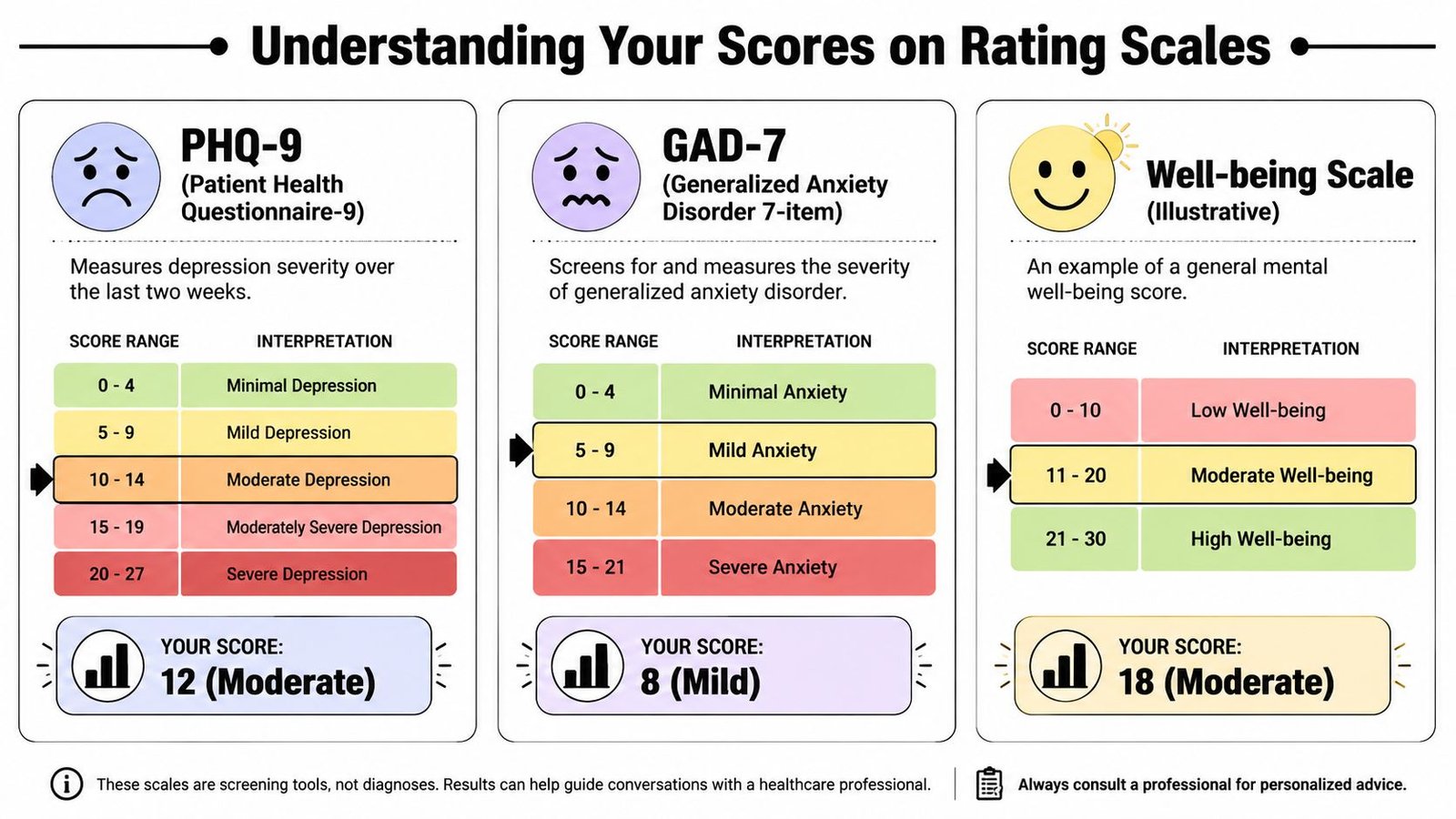
What rating scales do well
Rating scales help clinicians screen systematically and compare symptom burden over time. That matters when several conditions overlap. The strongest evidence-based approach is a structured clinical interview plus validated rating scales. The DSM-5-TR framework includes Level 1 screening across 13 symptom domains, with deeper follow-up where needed, helping reduce missed comorbidity when anxiety, depression, ADHD, ASD, and trauma-related symptoms overlap (DSM-5-TR assessment measures and cross-cutting screening framework).
So if you complete measures such as PHQ-9 or GAD-7, that doesn't mean the clinician is treating you like a spreadsheet. It means they're checking important domains in a standardised way.
What rating scales cannot do
A high score on anxiety doesn't prove anxiety is the primary diagnosis. A high score on depression doesn't explain whether low mood is secondary to years of unmanaged ADHD. An autism screening tool can suggest traits, but it doesn't establish differential diagnosis on its own.
That is why public-facing questionnaires should be treated as prompts, not verdicts. If you've been looking at autism screening forms, this overview of the Autism Spectrum Screening Questionnaire PDF is a useful place to understand what screening can and cannot tell you.
A score tells the clinician where to look more closely. It does not tell the whole story.
How to read your own results sensibly
Use your scores to ask better questions, not to self-sentence.
- Look for patterns: Are your difficulties concentrated in mood and anxiety, or do they sit alongside lifelong executive, sensory, or social differences?
- Notice timing: Did symptoms begin recently, or do current pressures seem to have exposed an older underlying pattern?
- Compare with functioning: Scores matter more when the report links them to daily impact at work, home, relationships, and self-care.
When patients understand that scales are only one layer of evidence, they usually feel less judged and more informed.
How to Use Your Assessment PDF for Next Steps
A good report shouldn't end up buried in your downloads folder. It should help you move through the system more effectively.
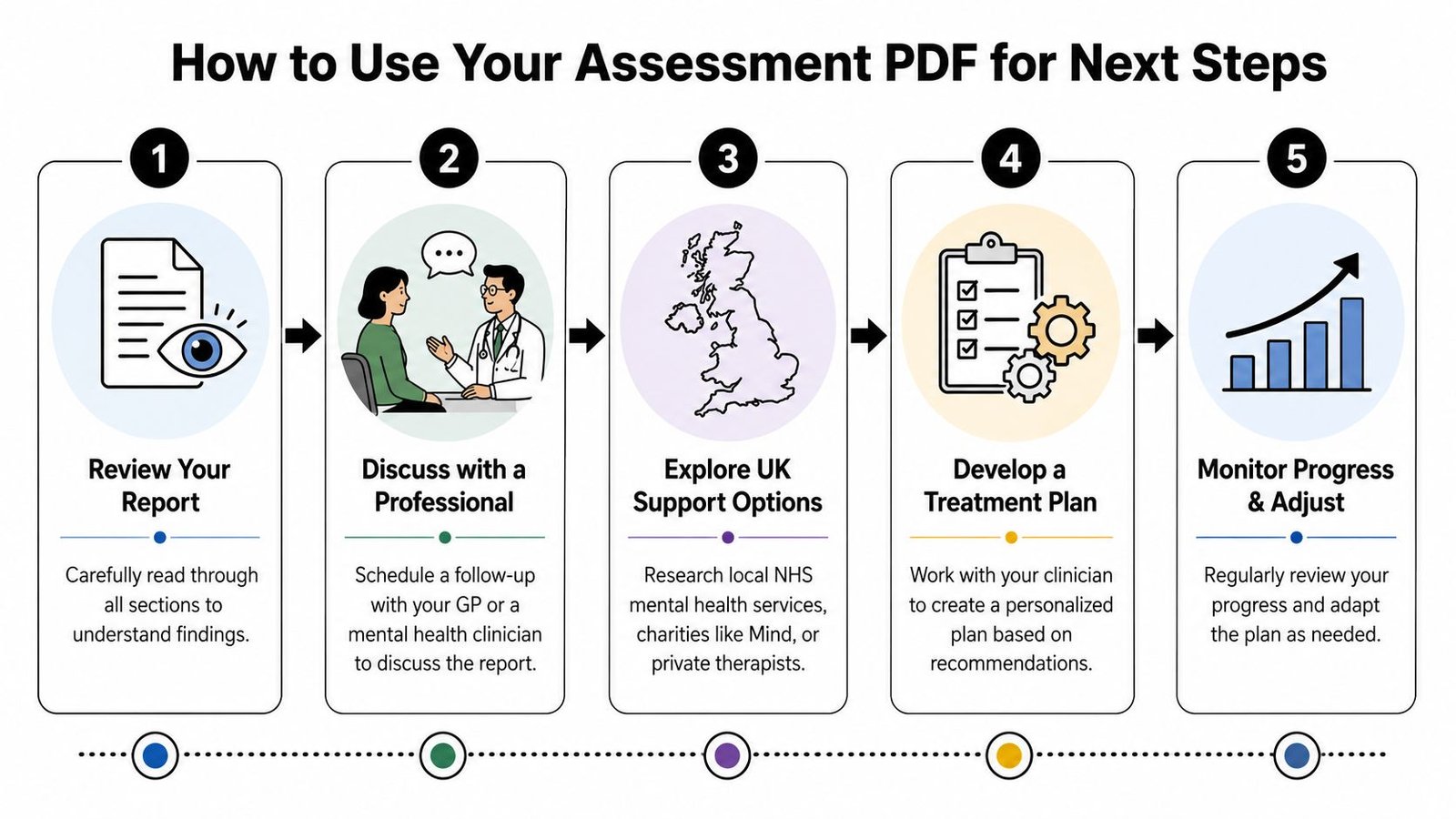
One useful overview of the wider process is this guide on how to get a mental health assessment, but the true value starts once the PDF is in hand.
Use it with your GP
Your GP is often the gateway for onward care, shared prescribing discussions, NHS record updates, and referrals. Bring the report to a dedicated appointment if possible. Don't assume it will be absorbed instantly into the system without discussion.
Ask your GP to note the assessment outcome, relevant diagnoses if applicable, and the recommendations that need action. If the report identifies ADHD, autism, anxiety, depression, or a mixed presentation, the practical implications should be discussed clearly.
Use it for access and navigation
For many adults in the UK, the challenge isn't recognising that they need help. It's navigating fragmented pathways and delays. Effective assessment tools should identify gaps between needs and available supports. That's why a structured assessment PDF can function as a decision-support document for service navigation, especially during long waits (needs assessment guidance on linking assessed need to available support).
That can include:
- Right to Choose discussions: Where the issue is not just diagnosis but how to access an appropriate service pathway.
- Private follow-up planning: If you are self-funding or using employer support.
- Insurance authorisation: Where treatment approval depends on formal evidence.
- University or workplace adjustments: If the report explains functional difficulties in a way decision-makers can act on.
Here is a simple decision table:
| If you need | What part of the PDF matters most |
|---|---|
| GP action | Diagnosis, formulation, recommendations |
| Workplace support | Functional impact and suggested adjustments |
| University support | Learning impact, communication needs, recommendations |
| Further therapy | Formulation, risk, comorbidity, treatment plan |
| Medication discussion | Diagnostic clarity, history, contraindications, monitoring recommendations |
A short video can also help if you're trying to make sense of practical next steps after assessment.
Use it actively, not passively
Some people read only the conclusion. That's understandable, but it misses the point. The most useful pages are often the ones that explain why the clinician reached that conclusion and what should happen next.
If a recommendation isn't obvious to a third party, pull the relevant section out in your covering email or appointment notes. Busy services won't always extract it for you.
The Insight Diagnostics Global Assessment Journey
In adult psychiatry, process matters because rushed assessment creates confusion later. A clinician-led pathway is especially important when the referral question involves ADHD, autism, burnout, anxiety, personality factors, or mood disorder features that may overlap.
At Insight Diagnostics Global comprehensive mental health assessment services, the process is built around consultant-led assessment for adults, delivered online and face to face, with structured triage, full psychiatric interview, and a formal report. The service states that assessments are usually scheduled within seven working days and reports are usually completed within five working days thereafter, which is useful for adults who need clarity promptly for GP follow-up, work, study, or treatment planning.
What happens during a proper assessment
The central task is not to confirm a label you already suspect. It is to test explanations properly.
WHO guidance makes this explicit. A proper assessment must go beyond simple checklists and consider the presenting complaint, past mental health history, general health, family history, psychosocial history, mental state examination, and rule-outs such as delirium, cognitive impairment related to depression, and other medical issues. In practice, a clinician-led assessment is more useful than a self-completed PDF when the actual question is not “Do I have symptoms?” but “What explains them best?” (WHO mhGAP guidance on assessment, mental state examination, and differential diagnosis).
Why that matters in ADHD and autism work
Adults seeking ADHD or autism assessment often come in with a mixture of understandable self-suspicions and equally understandable uncertainty. They may have read extensively. They may recognise themselves in neurodivergent accounts. They may also be exhausted, anxious, and demoralised.
A thorough psychiatric assessment has to hold all of that without collapsing into either extreme. It shouldn't dismiss neurodevelopmental concerns as stress. It also shouldn't assume that every concentration problem or social difficulty proves ADHD or autism. The work is in the distinction.
Good differential diagnosis is careful, not fashionable. It asks what fits, what doesn't, what predates current stress, and what needs treatment first.
The final PDF then becomes a secure clinical summary of that reasoning, with consent, confidentiality, and onward recommendations handled in a way other professionals can use.
Your Report Is the First Step Not the Last
A mental health assessment PDF is not the finish line. It is the document that lets the next stage happen with more clarity and less guesswork.
If the report identifies ADHD, autism, anxiety, depression, or a mixed picture, that should open a more focused conversation about support. You may need medication assessment, psychological therapy, occupational advice, university support, workplace adjustments, or a combination. You may also need someone to explain why a symptom belongs to one part of the picture rather than another.
The most useful reports do three things at once. They describe what is happening now. They explain how it developed. They point to realistic next actions.
For GPs, that means easier triage and clearer onward planning. For patients, it often means relief. Not because every answer is simple, but because the uncertainty finally starts to narrow.
If you've been carrying the sense that something is off, but you can't tell whether it's burnout, ADHD, autism, anxiety, or several things together, a proper assessment can turn a vague concern into a structured plan. That's what the document is for.
If you want a consultant-led assessment that results in a clear, usable report, Insight Diagnostics Global provides adult mental health, ADHD, and autism assessments with formal PDF documentation, treatment recommendations, and follow-up options. If your needs are urgent or you're in crisis, use emergency support through 999 or NHS 111 rather than waiting for a routine assessment.