

Burnout can last from a few weeks to a couple of years, and in more severe cases it can last even longer if the underlying drivers stay in place. The timeline depends on what's causing it, what support you have, and whether factors such as ADHD or Autism are subtly keeping your nervous system under strain.
You might be reading this after another morning where getting out of bed felt heavier than it should. You've slept, but you don't feel restored. Work that once felt manageable now feels abrasive, and even simple tasks seem to demand more effort than you have available.
That's often the point where people ask the same question in slightly different words. Is this stress? Is this depression? Am I just tired? Or is this burnout, and if so, burnout how long does it last?
The honest answer is that burnout doesn't run on a neat timetable. In clinical practice, what shapes recovery isn't only the level of exhaustion. It's whether the stressor continues, whether the person has been pushing through for months or years, and whether there's a missed explanation underneath the pattern. For some adults, especially those with undiagnosed ADHD or Autism, “burnout” isn't just a bad patch at work. It can be the visible collapse after a long period of coping at unsustainable cost.
That Feeling of Running on Empty
A common picture goes like this. Someone keeps performing. They meet deadlines, answer messages, attend meetings, smile when needed, and hold themselves together in public. Then the cracks widen. They become tearful, detached, forgetful, irritable, or numb. Sunday evenings start to feel dreadful, and Monday mornings feel almost impossible.
When that dread becomes persistent, practical resources can help name the experience. Acheloa Wellness' guide on work dread is useful because it speaks to that heavy, anticipatory feeling many people notice before they can yet admit they're burnt out. Sometimes the first sign isn't collapse. It's resistance.
Burnout is more than ordinary tiredness. Rest usually helps ordinary tiredness. Burnout often doesn't respond to a weekend off, a better bath routine, or one early night. If your body is still braced and your mind is still overloaded, the system never fully powers down.
When stress stops being just stress
Many adults minimise the early signs. They say they're just busy, just overwhelmed, just in a demanding season. But there's usually a shift in quality. Energy doesn't return properly. Concentration narrows. Patience shortens. Work that used to feel effortful but possible starts to feel impossible.
If that sounds familiar, it can help to compare your experience with common signs of stress and notice whether you've moved beyond pressure into depletion.
Burnout often feels less like “I need a break” and more like “I can't keep being this version of myself.”
Why the question matters
People often ask about duration because they're frightened by how different they feel. That fear is understandable. A person who has always been capable, organised enough, and reliable enough can suddenly feel as though their mind has stopped cooperating.
That doesn't mean you're lazy, weak, or failing. It means the load has exceeded the capacity available to carry it. And if burnout keeps happening, or never fully resolves, it's worth asking whether the problem isn't just the job. It may be the fit between your environment and your neurotype.
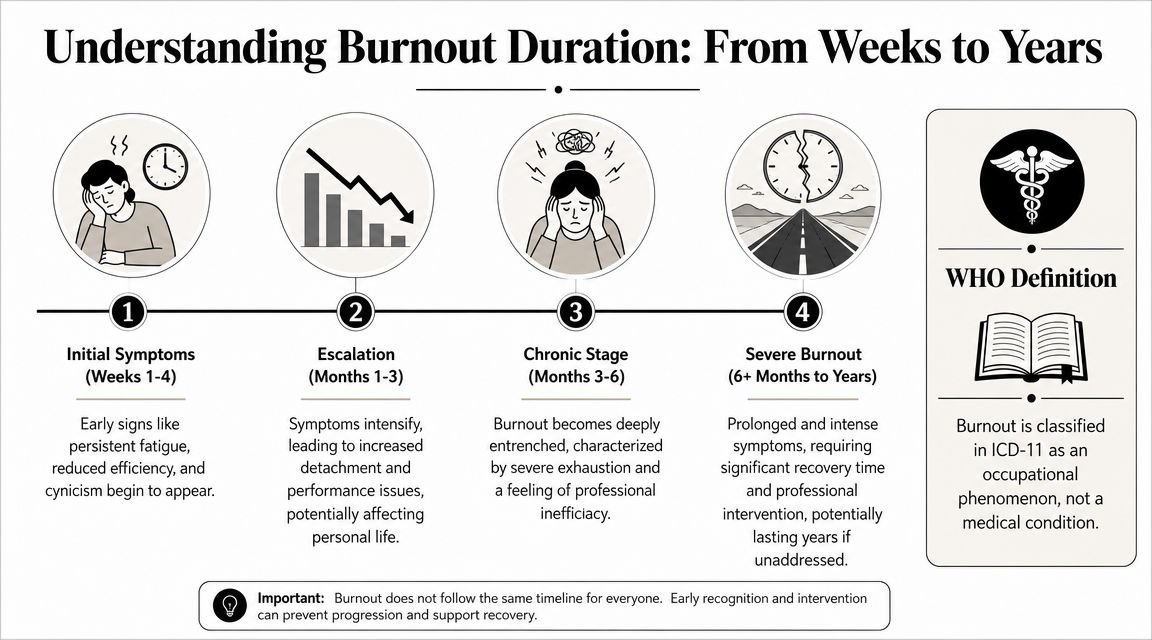
Understanding Burnout Duration From Weeks to Years
In the UK, burnout is generally understood as an occupational phenomenon, not a standalone medical diagnosis. That distinction matters because it points attention toward the conditions around the person, not only the person's symptoms. Burnout tends to develop when demands stay high and recovery remains too limited for too long.
Clinical guidance supports a broad timeline rather than a fixed one. Early burnout may improve within a few weeks if workload and recovery conditions change quickly, moderate burnout often takes several months, and severe or long term burnout can take six months or longer, especially when professional support is needed, as outlined in this clinical guidance on burnout recovery timelines.
A practical way to think about the timeline
The easiest mistake is expecting recovery to happen at the speed of ordinary fatigue. Burnout isn't the same as needing a holiday.
- Early burnout often looks like persistent tiredness, reduced motivation, and growing cynicism. If demands are reduced promptly, sleep improves, and boundaries become real rather than aspirational, some people do begin to recover within weeks.
- Moderate burnout usually has more grip. Concentration is affected. Emotional regulation worsens. The person may start dreading work, withdrawing socially, or feeling incapable in ways that are unlike them. This often takes months, not days, to settle.
- Severe burnout usually involves a more entrenched collapse in functioning. At this stage, work absence, structured support, and a deeper reassessment of lifestyle or occupational fit may be needed. Recovery can be prolonged.
What helps and what doesn't
A short break helps if the problem is acute overload and you return to changed conditions. It doesn't help much if you return to the same inbox, the same impossible expectations, the same sensory strain, or the same pattern of masking.
What works better is targeted recovery. That usually includes reduced demand, more predictable routines, nervous system recovery, better sleep protection, and fewer unnecessary drains on attention.
For many people, a more detailed recovery plan is useful. This guide on how to recover from burnout outlines practical measures that go beyond generic self-care.
Clinical reality: The more prolonged the burnout, the less useful it is to ask, “How quickly can I get back to normal?” A better question is, “What has to change for recovery to become possible?”
Factors That Influence Your Recovery Timeline
Two people can both say, “I'm burnt out,” and have very different recovery paths. One improves after decisive changes at work and a few protected weeks. The other remains exhausted for many months because the original pressures never really stop.
A key UK source captures this well. Mental Health UK's Burnout Report 2026 says recovery can take “from anywhere between a couple of months to a couple of years,” depending on whether the person remains exposed to the stressor and whether they receive support. The same source notes that one in five workers have taken time off for stress-related poor mental health, which underlines how often burnout affects real-world functioning and why recovery stalls when the trigger remains active. You can read that in Mental Health UK's burnout report overview.
The biggest variable is exposure
If the cause is still hitting you every day, recovery slows. That might mean an unmanageable workload, poor management, unresolved conflict, sensory overload in the workplace, or constant task-switching that keeps your brain in a state of friction.
People often tell themselves they'll recover if they “rest harder” in the evenings. Usually they won't. Recovery struggles when the person spends the day flooding their system and the evening trying to undo the damage.
Support changes the trajectory
Support isn't only emotional reassurance. It includes practical changes.
- Workplace support might mean reduced hours, fewer meetings, clearer priorities, or quieter working conditions.
- Home support might mean shared responsibilities, less masking, and more permission to do less while recovering.
- Professional support can help when burnout has become entangled with anxiety, low mood, trauma, or suspected neurodivergence.
Severity matters, but so does timing
The longer someone has been overriding warning signs, the more recovery tends to involve more than rest. They may need to rebuild cognition, confidence, self-trust, and tolerance for ordinary demands.
A recurring pattern I see is delayed recognition. High-functioning adults often wait until they're no longer functioning in the way others expect. By then, the system is not mildly strained. It is depleted.
Why taking a break often isn't enough
A break is useful when it creates enough distance for deeper decisions. It's far less useful when it becomes a pause before re-entering the exact same setup.
If your environment keeps demanding a version of you that costs too much to maintain, burnout tends to return.
That is especially important in adults with ADHD or Autism, where the visible burnout may be driven by an invisible daily load that colleagues and even clinicians can miss.
The Link Between Chronic Burnout ADHD and Autism
Some burnout is situational. Some is recurrent because the person's nervous system is working far harder than anyone realises.
For adults with ADHD, daily life can involve constant effort around organisation, time awareness, prioritising, starting tasks, switching between tasks, and holding information in mind. For adults with Autism, everyday life may involve sustained sensory strain, social decoding, masking, change intolerance, and exhaustion from environments that never quite fit. Neither of those experiences automatically means someone will burn out. But both can create a chronic load that makes burnout more likely, more frequent, and more confusing.
Why undiagnosed neurodivergence gets missed
Many adults have spent years compensating. They rely on perfectionism, overpreparation, people-pleasing, rigid routines, adrenaline, or self-criticism to stay afloat. Others describe feeling that they can cope, but only by paying a hidden tax in exhaustion.
The problem is that this can look, from the outside, like success. Then one day it doesn't.
When burnout keeps repeating, especially across different jobs or life stages, it's worth considering whether the person is not merely failing to cope. They may be coping with a nervous system and cognitive style that have never been properly understood. This is particularly relevant when ADHD sits alongside other difficulties, as outlined in this overview of ADHD comorbidities.
Symptom overlap can blur the picture
| Common Symptom | As a Burnout Symptom | As an ADHD / Autism Trait |
|---|---|---|
| Exhaustion | Emotional and physical depletion after prolonged stress | Fatigue from masking, sensory strain, or sustained compensatory effort |
| Poor concentration | Mental fog, reduced focus, slower thinking | Attention regulation difficulty, distractibility, or overload |
| Irritability | Low frustration tolerance due to depletion | Distress from overload, interruption, transition, or executive strain |
| Withdrawal | Pulling back because energy is spent | Social exhaustion, need for recovery time, or overload avoidance |
| Reduced performance | Tasks feel harder than before | Inconsistent output linked to executive function demands or environmental mismatch |
| Sleep disruption | Stress-related sleep difficulty | Difficulty winding down after stimulation or late cognitive overactivation |
| Feeling ineffective | Loss of confidence and capability | Lifelong experience of underperforming relative to effort despite strong ability |
This overlap is why generic advice often misses the mark. If burnout is being driven partly by executive dysfunction, sensory overload, or relentless masking, “just set boundaries” may be too thin an intervention.
What neurodivergent burnout often looks like in adults
It may show up as repeated crashes after periods of overperforming. It may look like needing far more recovery time than peers. It may involve shutting down at home after appearing capable all day. Some adults become convinced they are lazy or fragile because they can function brilliantly in bursts but can't sustain that output without fallout.
Recurrent burnout can be a clue. Not proof of ADHD or Autism, but a clue that the standard explanation may be incomplete.
Accurate assessment is important. Not because every exhausted person is neurodivergent, but because the right explanation changes the recovery plan. A person with unrecognised ADHD may need support with executive load, not just rest. A person with unrecognised Autism may need sensory and social demands reduced, not another lecture about resilience.
When to Seek a Professional Psychological Assessment
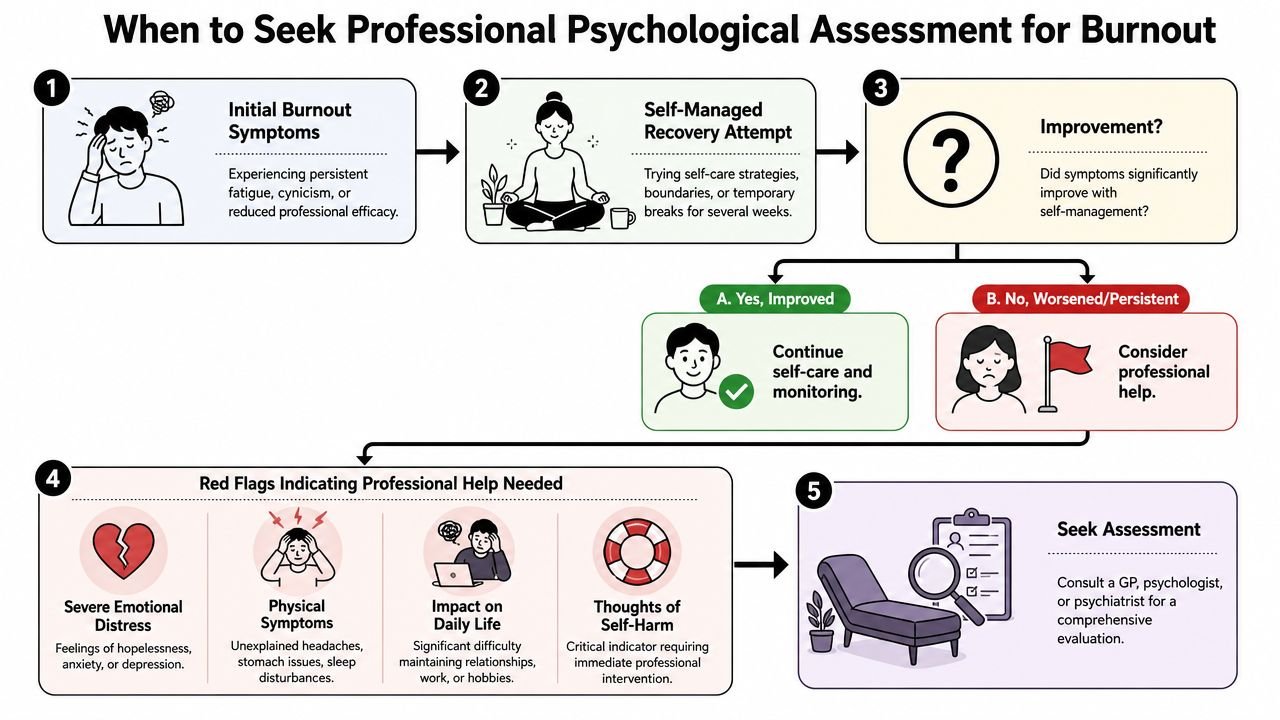
If burnout is recent, clearly linked to a temporary pressure, and improving once conditions change, self-managed recovery may be enough. If it keeps returning, feels disproportionate, or never fully clears, a professional assessment becomes far more useful.
That isn't because you've failed to recover properly. It's because repeated burnout usually means there is a driver you haven't yet named accurately.
Signs that assessment is the next sensible step
Consider seeking a fuller psychological or psychiatric assessment if any of these apply:
- Burnout keeps repeating across jobs, courses, or major life phases, even when you try to make sensible changes.
- Usual advice hasn't worked. Rest helps briefly, but the same problems return once demands resume.
- The pattern goes back years. You've long struggled with focus, sensory overwhelm, emotional regulation, social fatigue, or chronic overcompensation.
- Your functioning has narrowed. Work, relationships, domestic tasks, or self-care are all becoming harder to maintain.
- You suspect there's more underneath. The descriptions of ADHD, Autism, anxiety, depression, trauma, or personality factors resonate more than simple stress does.
Why proper assessment matters
A thorough assessment can separate overlapping problems that feel the same from the inside. Burnout can co-exist with depression. ADHD can co-exist with anxiety. Autism can be missed in adults who have learned to mask well. Personality patterns, trauma, sleep problems, and mood disorders can all complicate the picture.
That's why a broad, consultant-led evaluation is often more helpful than chasing one label in isolation. If you want to understand what that process involves, this overview of what a psychiatric assessment includes gives a useful practical outline.
The cost of leaving it unexplained
Occupational research shows that burnout has measurable functional consequences. Workers in the highest burnout quartile averaged 13.6 sickness-absence days per year versus 5.4 in the lowest quartile, and a one-step increase in burnout score predicted 21% more sickness-absence days and 9% more sickness-absence spells, according to this open-access occupational study on burnout and sickness absence. In plain terms, the more severe the burnout, the more it affects day-to-day function and work loss.
That functional burden often spills beyond work. Eating patterns may become erratic. Exercise may become compulsive or disappear entirely. Weight changes can follow, not because someone lacks discipline, but because the system is stressed and routines have broken down. If that part of the picture resonates, BodyBuddy's piece on the weight loss and mental health link adds a helpful perspective.
Assessment is not about collecting labels. It's about replacing self-blame with an accurate map.
If you are having thoughts of self-harm, feel unable to keep yourself safe, or your distress is acute, seek urgent help through emergency or NHS services rather than waiting for a routine assessment.
Building a Sustainable Future After Burnout
Recovery isn't complete when you can force yourself back into the same pace. Recovery is stronger when your life becomes more compatible with how your mind and nervous system work.
For some people, that means changing work boundaries. For others, it means accepting that they cannot sustainably live on urgency, masking, and self-criticism. If ADHD or Autism is part of the picture, long-term recovery usually improves when the environment is adapted, not just the person.
Build around your actual energy profile
A sustainable life rarely looks glamorous. It usually looks structured, predictable, and kind.
- Reduce unnecessary load. Simplify commitments, lower sensory clutter, and stop treating every task as equally urgent.
- Use external supports. Calendars, reminders, body-doubling, written routines, and visual task systems are not signs of weakness. They are good design.
- Protect recovery time. Solitude, reduced social demand, quiet transitions after work, and regular sleep rhythms matter more than people often admit.
Make accommodations part of recovery
If you've spent years masking, one of the hardest tasks is noticing how much effort normal life has really been costing you. Sustainable recovery often includes experimenting with adjustments such as noise reduction, clearer communication, remote working where possible, task batching, reduced meeting load, or more explicit expectations.
That can also mean unmasking carefully in safe contexts. Not all at once, and not everywhere. But enough to stop performing normality at the cost of your health.
A short explanation of burnout and restoration can help reinforce that shift in mindset:
Let the recovery plan fit the person
What works for one person won't work for another. One adult with ADHD may benefit most from medication review, external structure, and shorter task blocks. One autistic adult may benefit most from reducing social load, planning decompression time, and changing the sensory environment. Another person may need therapy first because burnout has become tangled with shame, grief, or trauma.
The important shift is this. Stop asking how to become the person who could tolerate unsustainable conditions forever. Start building the conditions that let you stay well.
Burnout can be a painful turning point. It can also be the moment where the old explanation stops working, and a more accurate understanding begins.
If recurrent burnout has made you wonder whether ADHD, Autism, or another mental health difficulty is part of the picture, Insight Diagnostics Global offers consultant-led assessments for adults, online and face to face. Their team includes psychiatrists on the GMC Specialist Register and provides structured evaluations, diagnostic reports, and personalised recommendations, with clear triage and follow-up options for ongoing support.