

Seeking a private ADHD assessment in Kent, you're not overreacting. You're responding to a system that moves far too slowly for many adults who need answers now, not years from now.
Kent is under serious pressure. NHS Kent and Medway data reported 7,860 people waiting for adult ADHD assessment in 2024, while only 1,272 were seen in 2023/24, creating an estimated 6.2-year wait according to ADHDUK's Kent and Medway NHS area summary. When people choose private care in that context, it isn't indulgent. It's often the only realistic way to get a proper diagnostic answer within a clinically useful timeframe.
The bigger issue isn't just speed. It's quality. A rushed ADHD label helps no one. Adults in Kent need assessments that look carefully at attention, impulsivity, developmental history, autism traits, anxiety, mood, trauma, sleep, and the practical impact on work, study, and relationships. That's where good private services separate themselves from weak ones.
Why Kent Residents Are Turning to Private ADHD Assessments
For many adults in Kent, the problem is no longer deciding whether to get assessed. The problem is how long they can afford to wait while work, relationships, finances, and mental health continue to suffer.
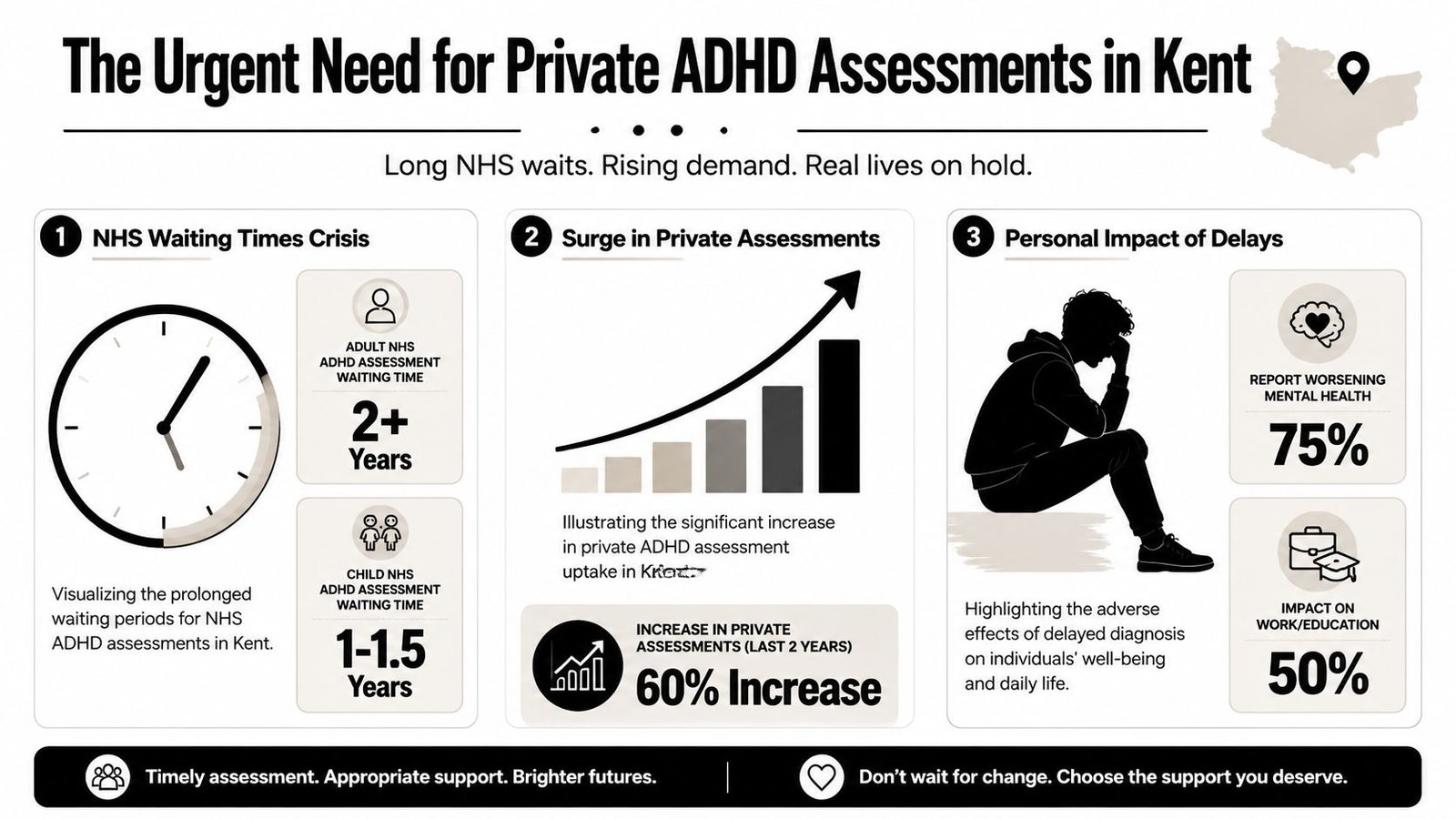
Why waiting matters in real life
Adults usually seek an ADHD assessment after years of friction, not because of a passing curiosity. They are missing deadlines despite trying hard, burning out in jobs they should be able to manage, forgetting basic admin, underperforming at university, or living with anxiety that may be a reaction to untreated neurodevelopmental symptoms. Delay keeps that pattern going.
That delay also distorts treatment. People may be given support for stress, low mood, or poor sleep without anyone properly examining whether ADHD is driving the problem. Some have autistic traits alongside attention difficulties. Others have trauma histories, panic symptoms, or obsessive patterns that need careful separation from ADHD, not a quick label.
A long wait can mean years of guessing.
Why private assessment appeals to Kent residents
Private care gives people access to clinician time sooner. That matters because ADHD diagnosis in adults is not a simple yes-or-no checklist. A proper evaluation needs enough time to review childhood history, current impairment, school or work patterns, physical and mental health, and the possibility of co-occurring conditions.
This is why private assessment is often a practical choice, not a luxury purchase. People are trying to make decisions about careers, exams, parenting, medication, and workplace support now. They need a clinically defensible answer now.
The key point is quality.
Speed only helps if the assessment is clinically sound
A quick appointment is useless if the clinician skips differential diagnosis or produces a thin report that your GP cannot act on. Kent residents should be looking for an assessment that holds up under scrutiny.
A provider is worth considering if they can show all of the following:
- CQC regulation for the service, where applicable
- A psychiatrist on the GMC specialist register with relevant experience in adult ADHD
- A full diagnostic interview, not just questionnaires and a short call
- Assessment of co-occurring conditions, including autism, anxiety, depression, trauma, and sleep problems
- A clear written report that explains the reasoning behind the diagnosis and sets out next steps
That is the standard to use. It is also the difference between a brief private screen and a real diagnostic evaluation. Services such as Insight Diagnostics, working with specialists including Dr. Sai Achuthan, reflect the kind of clinical rigour adults should be checking for before they book.
You are not paying for reassurance. You are paying for a careful medical opinion that can guide treatment and support.
Understanding Your Assessment Options
Not all ADHD assessments are equal. Some are thorough clinical evaluations. Some are glorified screening exercises. If you're paying privately, you need to know the difference.
Kent-specific NHS guidance from Whitstable Medical Practice states that the current waiting list in Kent is around 5 years for over-18 ADHD assessment and around 3 years for over-18 ASD assessment, as outlined on the practice's Right to Choose information page. That gap is why so many adults look at private pathways. But shorter access only helps if the assessment is thorough.
What a proper assessment actually is
A thorough ADHD evaluation is not an online quiz plus a brief call. It's a clinical investigation. Think of it less like ticking a checklist and more like assembling a reliable picture from multiple angles.
That usually includes your current symptoms, childhood pattern, level of impairment, collateral history, and possible co-occurring conditions. For many adults, that's where the value lies. The question isn't only "Do I relate to ADHD traits?" It's "Is ADHD the best explanation, and what else needs attention too?"
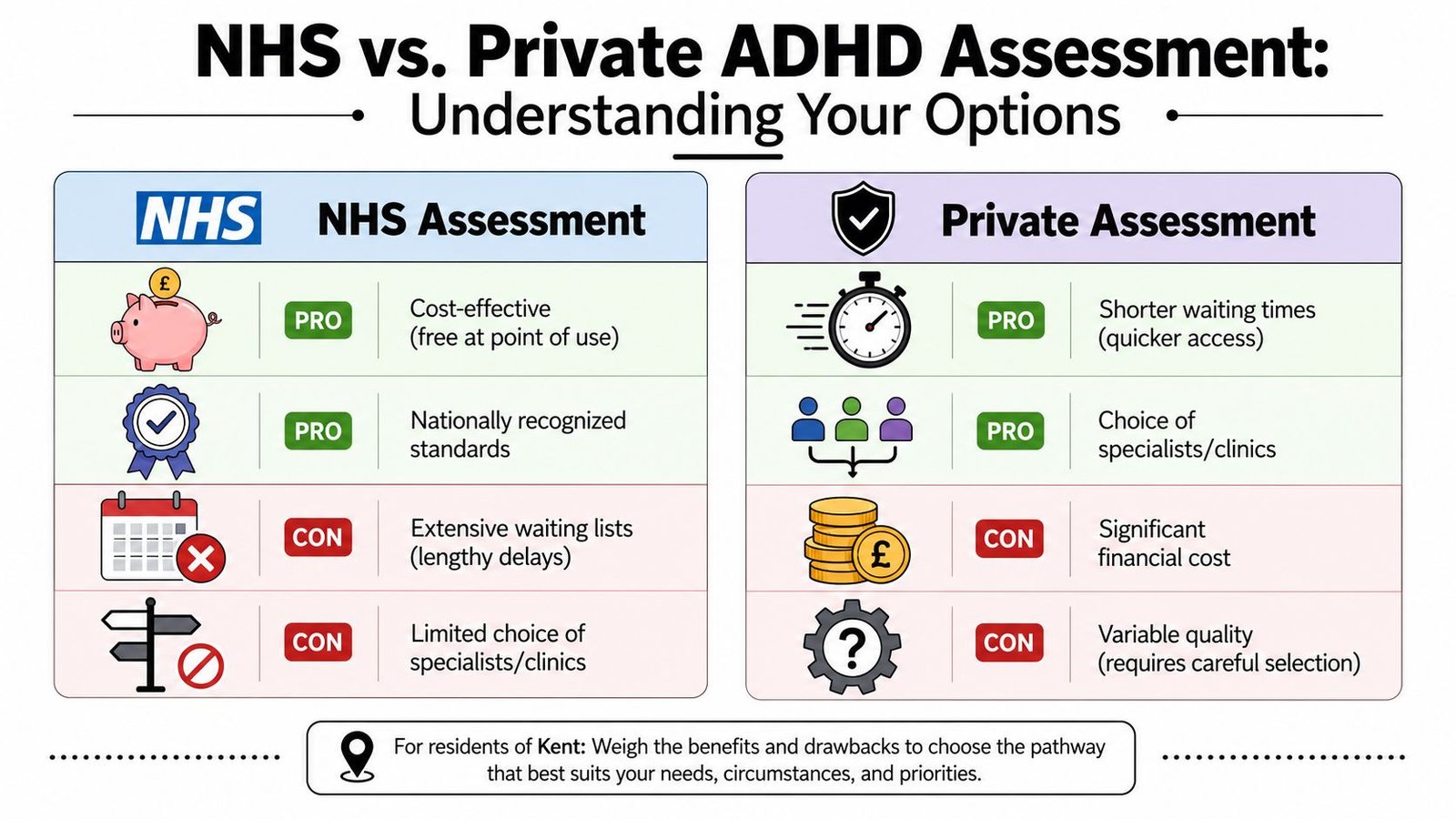
NHS and private routes differ in practical ways
Here's the clean comparison:
| Pathway | Main advantage | Main limitation |
|---|---|---|
| NHS | Free at point of use | Long waits and less choice over clinician or service |
| Private | Faster access and more provider choice | You must check quality carefully |
Private care gives you more control over timing, format, and clinician selection. NHS care gives you cost protection. Neither route automatically guarantees a strong assessment. Clinical rigour depends on the service.
The right question isn't "Can they assess ADHD?" Many clinics can. The right question is "Will they assess ADHD well enough to rule in or rule out the diagnosis with confidence?"
Co-occurring conditions must be part of the picture
Adults rarely arrive with neat textbook presentations. Some have autism traits. Some have longstanding anxiety. Some are dealing with depression, trauma history, or severe sleep disruption. A service that ignores that complexity is not saving you time. It's increasing the risk of a weak diagnosis.
If a clinic markets speed but says little about differential diagnosis, be cautious. Fast access is useful. Superficial assessment isn't.
The Private Assessment Process Step by Step
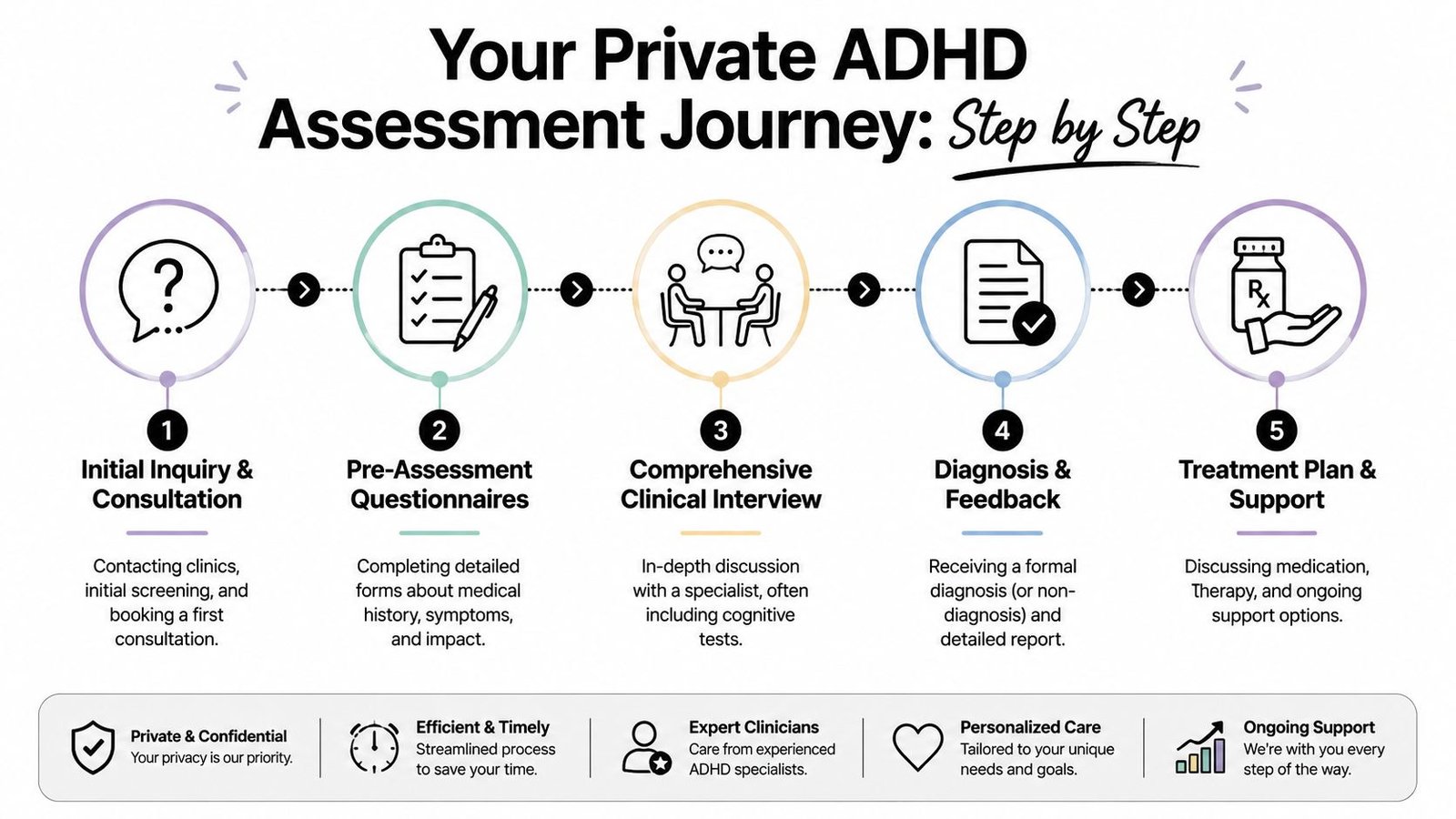
Most private ADHD pathways in Kent follow a recognisable structure. That's a good thing. You want a service with a defined process, not one that improvises. Kent-based private pathways commonly use screening, collateral history, and a clinician-led interview, with some providers completing the full process in 20 weeks and issuing the report within 2 weeks of the main assessment, according to Purple Octopus Management's ADHD pathway description.
If you want a fuller picture of the pathway before booking, this guide to a private adult ADHD assessment gives a useful overview of how consultant-led services typically structure the process.
Step one starts before you meet the clinician
The first stage is usually enquiry, triage, and screening. You'll be asked about symptoms, past mental health history, medication, risk issues, and whether ADHD is the main concern or part of a broader neurodevelopmental picture.
This early step matters because it shapes the rest of the assessment. A careful clinic doesn't just sell you a slot. It decides whether ADHD assessment is appropriate, whether autism should also be considered, and whether another issue needs urgent attention first.
The core assessment is an in-depth interview
The main appointment is where the essential clinical work occurs. A specialist should examine symptom patterns across childhood and adulthood, ask about impairment in different settings, and explore whether the presentation fits ADHD better than competing explanations.
Expect detailed questions. Good clinicians ask for examples, not vague impressions. They want to know how symptoms showed up at school, at home, at work, and in relationships.
Collateral information strengthens the diagnosis
Most reliable adult ADHD assessments use outside evidence where possible. That may include:
- School reports that show inattentiveness, disorganisation, or behaviour concerns
- Family input from a parent, sibling, or partner who can describe long-term patterns
- Work or study evidence such as repeated deadline problems, inconsistency, or sustained administrative difficulty
Collateral history doesn't mean your diagnosis depends on having perfect records. It means the clinic tries to build the strongest evidence base available.
The report should be useful, not vague
At the end, you should receive a written diagnostic report that explains the clinician's reasoning clearly. If ADHD is diagnosed, the report should set out the basis for that conclusion. If it isn't, the clinician should explain why and identify other relevant factors.
A good report doesn't just state an outcome. It shows how the clinician reached it.
After that, some services offer medication review, titration, monitoring, therapy referral, or guidance for workplace and university adjustments.
Navigating Costs Insurance and Right to Choose
Money matters, but people often focus on the wrong part of the financial question. The issue isn't only the price of an assessment. It's whether the pathway is self-funded, insurance-funded, or potentially accessible through Right to Choose.
Kent changed materially on this front. On 1 April 2025, NHS Kent and Medway stated that all referrals for adult ADHD assessments, diagnosis, prescribing and titration, as well as autism assessments, fall under Right to Choose, as described on the local Kent and Medway Right to Choose page. That same page lists Insight Diagnostics among providers available for autism services. For adults in Kent, that means RTC is now a formal route you should actively ask about rather than treat as a niche option.
Right to Choose is often underused
If your GP agrees that a referral is clinically appropriate, RTC may allow you to access an eligible provider outside the standard local pathway. That can change the practical choice set dramatically.
For many adults, the sequence should be:
- Ask your GP whether ADHD or autism referral is appropriate.
- Ask specifically about RTC, rather than assuming the local wait is your only NHS option.
- Check provider eligibility and process, because administrative details matter.
- Confirm what happens after diagnosis, especially around prescribing and follow-up.
For a clearer explanation of the pathway, this article on NHS Right to Choose is a useful starting point.
Insurance and self-pay require different questions
If you're using private medical insurance, ask whether outpatient psychiatry, neurodevelopmental assessment, and follow-up reviews are covered. Don't assume. Insurers often require pre-authorisation and may limit which clinicians or formats they accept.
If you're self-funding, insist on itemised clarity. Ask what the fee includes. You need to know whether it covers screening, the assessment appointment, the report, feedback, and any post-diagnostic review. The cheapest-looking option can become the most expensive if key parts are excluded.
Funding tip: Before you book, ask one blunt question. "What exactly is included from first screening to final report, and what costs extra?"
How to Choose a Reputable Provider in Kent
Many individuals err by comparing waiting times and prices, then booking the first clinic that looks convenient. That's backwards. You should judge the clinical standard first, then decide whether the timing and fee make sense.
A key under-answered question in Kent is not just how quickly you can be seen, but what diagnostic confidence the service can provide and which coexisting conditions it will actively rule out. That concern is reflected in the ADHD Centre's Kent page discussing comprehensive assessment and coexisting conditions, consistent with NICE-style expectations for thorough evaluation.
Your non-negotiable checklist
Use this before you pay anyone.
- CQC regulation. If a service is delivering regulated clinical care, you should know its regulatory status.
- GMC Specialist Register clinicians. For complex adult ADHD, psychiatrist-led assessment matters. You want a doctor with recognised specialist standing, not a vague claim of expertise.
- Clear diagnostic method. The clinic should explain how it assesses childhood history, current impairment, collateral evidence, and differential diagnosis.
- Transparent pricing. If fees are hard to pin down, expect problems later.
- Follow-up pathway. Diagnosis without treatment planning is incomplete.
One example of the standard to look for is a consultant-led service covering ADHD, autism, wider mental health assessment, and follow-up care. Insight Diagnostics' guide to ADHD doctors near me is useful here because it reflects the kinds of clinician credentials and service features patients should check for. The benchmark isn't branding. It's whether the provider is structured around proper psychiatric assessment.
Speed can be a trap
Some clinics market themselves almost entirely on rapid turnaround. That's not automatically a problem, but it should make you ask harder questions.
Ask these directly:
- Who makes the diagnosis? If the answer is blurry, walk away.
- How do you assess anxiety, depression, trauma, sleep, and autism traits?
- What evidence do you seek from earlier life?
- Will the report explain why ADHD was diagnosed or ruled out?
- What happens if the picture is mixed or uncertain?
A clinic that gets irritated by these questions is telling you something important.
Here's a useful explainer on what to listen for when comparing services:
Expertise matters when presentations are complex
Adults often present with overlap. ADHD may sit alongside autism, personality difficulties, anxiety, depression, or longstanding relational strain. That's why clinician background matters. If a provider highlights expertise in neurodevelopmental and personality disorder assessment, pay attention. That breadth is clinically relevant, especially for adults whose presentation doesn't fit a simplistic template.
Dr Sai Achuthan is the kind of consultant profile worth using as a benchmark when you assess providers. The point isn't celebrity. It's depth. You want someone equipped to handle complexity, not just confirm a suspicion quickly.
Preparing for Your ADHD Assessment
Preparation makes the assessment better. It also reduces anxiety. Many adults worry they'll forget examples, undersell their difficulties, or sound inconsistent. That's common, and it's exactly why some preparation helps.
Bring patterns, not polished answers
You don't need to rehearse a perfect narrative. You do need real examples. Think in terms of repeated patterns across life stages.
Useful material includes:
- School or college records if you have them
- Examples from work such as missed deadlines, avoidance, disorganisation, or inconsistency
- Daily living difficulties like finances, driving, admin, forgetting appointments, or emotional overload
- Relationship patterns including interrupting, distractibility, lateness, or conflict linked to impulsivity
If you've ever been told you're bright but inconsistent, always late, chaotic under pressure, or unable to sustain routine, note that down with examples.
Ask someone who knows you well
Collateral information can be very helpful. A parent, sibling, partner, or close friend may remember patterns you now normalise or forget. Ask them for observations, not praise or defence.
You can also prepare your own questions in advance. This checklist of mental health assessment questions is a practical prompt if you're not sure what to ask a clinician.
Bring examples of impairment, not just traits. Many people identify with ADHD characteristics. Diagnosis depends on whether those traits have caused meaningful difficulty over time.
Don't hide the messy parts
Tell the truth about anxiety, low mood, sleep issues, burnout, substance use, or trauma if they're relevant. Some adults worry that mentioning these things will "ruin" their ADHD assessment. It won't. It gives the clinician the information needed to make a stronger judgement.
If the diagnosis is ADHD, that complexity should still be recognised. If it isn't, you've saved yourself from paying for a simplistic answer that doesn't fit.
Life After Diagnosis Your Next Steps
A diagnosis is useful because it opens doors. It doesn't fix your life on its own. The next step is translating the assessment into treatment, support, and practical changes that improve functioning.
If ADHD is diagnosed
Some people move on to medication assessment and titration. Others start with psychological support, coaching-style strategies, workplace changes, or a combination. The right order depends on your symptoms, your health profile, and what impairment is causing the most difficulty.
Common next steps include:
- Medication review and titration if clinically appropriate
- Psychoeducation so you understand how ADHD affects your daily functioning
- Therapy adapted for ADHD, especially where anxiety, low mood, shame, or burnout are part of the picture
- Reasonable adjustments at work or university
- Ongoing monitoring if medication is prescribed
If ADHD isn't diagnosed
That result can still be valuable. A careful assessment may uncover a different explanation that needs proper treatment. Some adults leave with clearer understanding of anxiety, depression, autism, trauma-related symptoms, sleep disturbance, or overlapping difficulties rather than ADHD itself.
That isn't a failed assessment. It's a successful one. The purpose of diagnosis is accuracy, not validation of a hunch.
Use the report actively
Don't let the report sit unread in your inbox. Use it. Share it with your GP if appropriate. Refer to it when discussing support at work or university. Go back to the recommendations section and identify which actions are urgent, which can wait, and who needs to be involved.
The most productive mindset is this. Assessment gives you a map. Improvement comes from acting on it.
Some adults feel relief after diagnosis. Some feel grief about missed years. Some feel both. That's normal. What matters is that you now have a clearer basis for treatment and decisions, rather than guessing your way through another few years.
If you want a consultant-led route for ADHD, autism, and wider mental health assessment, Insight Diagnostics Global offers online and face-to-face assessments for adults, with structured diagnostic reports, optional follow-up, and pathways that also support Right to Choose enquiries in Kent.