

Waiting for an ADHD or autism assessment can leave you in a strange kind of limbo. You may be functioning well enough to get through work, university, parenting, or daily life on the surface, but privately you're trying to make sense of years of overwhelm, burnout, masking, missed deadlines, sensory strain, anxiety, or emotional dysregulation. Many adults reach the point of seeking assessment only after things have become hard to contain.
The difficult part is that the referral itself often doesn't bring relief. It can feel like you've finally asked for help, only to be told to wait. For neurodevelopmental assessments in particular, that wait can be long enough to affect employment, study, relationships, and access to treatment. Such extended waits highlight the importance of NHS Right to Choose. Used properly, it gives many adults in England a practical route to an NHS-funded assessment outside their local pathway.
From a clinical administration perspective, the people who manage this best usually do three things well. They understand what Right to Choose is, they check eligibility before approaching the GP, and they make the referral request easy for the practice to action. That sounds simple, but in real life it's where many referrals either move quickly or stall.
Stuck on a Waiting List? You Have More Power Than You Think
A common situation looks like this. An adult has spent months debating whether to ask for help. They finally speak to their GP about possible ADHD, autism, or related mental health concerns. The GP agrees an assessment may be appropriate, but the next step sounds discouraging because the local waiting list is long and vague, with no clear sense of when anything will happen.
That feeling of being stuck is real. It also leads many people to assume their only choices are to endure the wait or pay privately.

What many patients don't realise is that NHS Right to Choose is a legal route that may allow them to choose a different NHS-commissioned provider for an appropriate outpatient referral in England. Awareness is still low. In the Independent Healthcare Provider Network patient choice report, 53% of people said they knew there was a legal right to choose a hospital or clinic for a first NHS outpatient appointment, which means a large share of patients may never raise it with their GP at all (IHPN patient choice report).
What waiting in limbo often looks like
For adults seeking ADHD or autism assessment, the practical impact isn't just delay. It often means:
- Work problems continue because concentration, organisation, lateness, task switching, or communication difficulties aren't yet properly assessed.
- Mental health symptoms become tangled with the neurodevelopmental picture, making anxiety, low mood, sleep problems, or burnout harder to interpret.
- Support gets delayed because employers, universities, and families often need formal evidence before adjustments are made.
A long wait doesn't mean your concerns aren't valid. It usually means the pathway is under pressure.
Patients who start looking into alternatives often find that there is a route forward. If you're currently checking your local queue and wondering whether you have any control, you do. You can ask whether a Right to Choose referral is possible and prepare for that conversation properly. If you're trying to understand the wider problem first, this overview of the NHS ADHD waiting list gives useful context before you speak to your GP.
What Exactly Is NHS Right to Choose
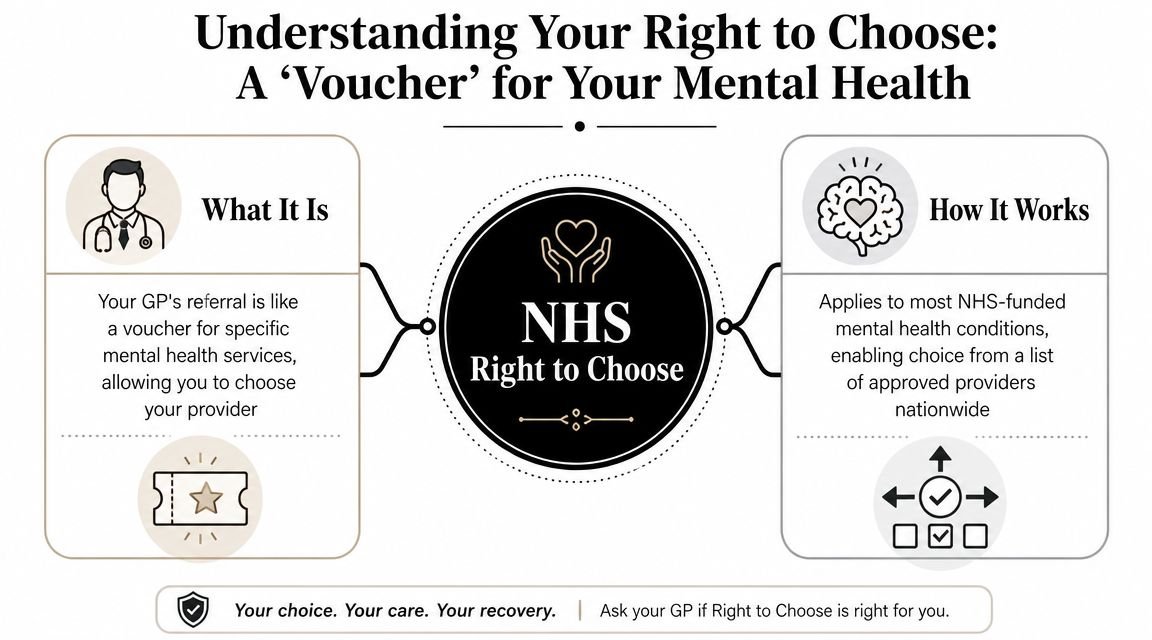
NHS Right to Choose isn't a separate diagnosis programme and it isn't a loophole. It's a patient-choice mechanism built into the way NHS outpatient referrals work in England. The easiest way to understand it is this: if your GP agrees a referral is clinically appropriate, you may be able to choose which NHS-commissioned provider receives that referral, rather than being placed automatically into the default local pathway.
The simple version
Think of the GP referral as permission to access a specific NHS-funded service. Right to Choose affects where that referral goes, provided the provider holds the right NHS contract for that service. For ADHD or autism assessment, that means the question isn't whether a clinic is described as private in everyday conversation. What matters is whether it is commissioned by the NHS for that pathway.
Many patients are told, incorrectly, that they can only use local services. In fact, the choice can extend beyond the local area when the provider has the relevant NHS contract for that service.
Why it matters legally
The legal foundation matters because it changes the tone of the conversation with your GP. You're not asking for a favour. You're asking for a lawful patient choice to be considered within the referral process.
NHS England states that the framework is rooted in the NHS Constitution, that commissioners must make arrangements so patients can exercise choice, and that referrers should offer an average of five providers where clinically appropriate (NHS England patient choice guidance).
Practical rule: Right to Choose is about choosing an NHS-funded provider for an eligible referral. It isn't the same as buying a private assessment, and it isn't guaranteed in every circumstance.
What it doesn't mean
It doesn't mean every service is open to choice in every situation. It doesn't override urgent care pathways, crisis needs, or local rules where specific exclusions apply. It also doesn't mean every provider will accept every referral. Providers can still screen and triage referrals for suitability.
For adults seeking ADHD or autism assessment, that distinction is important. Right to Choose can open the door to a different pathway, but you still need the right referral, the right provider, and the right paperwork.
Confirming Your Eligibility for an Assessment
Before you spend energy drafting letters or booking a GP appointment, check whether Right to Choose is even available in your case. This saves time and reduces the chance of a frustrating conversation based on the wrong assumptions.
The first filter is geography. NHS Right to Choose is a legal right for patients in England. It applies when your GP agrees a referral is clinically necessary and when the provider you choose holds an NHS contract for that specific service, even if the provider is outside your local area (Right to Choose guidance summary).
A quick self-check
You may be eligible if all of the following are true:
- You are registered with a GP in England. This is the starting point.
- Your GP agrees an assessment is clinically appropriate. Right to Choose begins with a referral decision. It doesn't replace clinical judgement.
- The service is an eligible outpatient service. Adult ADHD and autism assessment pathways are often the reason people explore this route.
- The provider has the relevant NHS contract for that service. This must match the assessment you need.
If you're specifically exploring autism referral options, this guide to a Right to Choose autism assessment can help you check the pathway details before speaking to your practice.
When Right to Choose usually isn't the right route
Some situations fall outside the practical scope of this pathway. For example:
- Urgent or crisis presentations. If someone needs immediate mental health intervention, Right to Choose isn't the priority pathway.
- Patients registered outside England. Scotland, Wales, and Northern Ireland have different systems.
- Referrals to a provider without the right NHS commissioning arrangement. This is one of the most common points of confusion.
If your GP agrees you need an assessment but says the provider isn't available under NHS contract for that service, the issue may be provider eligibility rather than your clinical need.
The question to ask your GP
Keep it precise. Ask whether you are eligible for a Right to Choose referral for an adult ADHD or autism assessment to an NHS-contracted provider in England. That wording keeps the discussion focused on the correct test. It avoids broad arguments about private care, local customs, or whether your area already has a waiting list.
In practice, many failed requests happen because the patient asks generally for “a referral elsewhere” rather than clearly invoking the Right to Choose framework. Specific wording helps.
Your Step-by-Step Guide to a Successful Referral
The strongest Right to Choose referrals are usually the least dramatic. They are clear, organised, and easy for a GP or admin team to process. If you walk into an appointment with only frustration, the conversation can drift. If you arrive with the right information, you give the practice something they can act on.
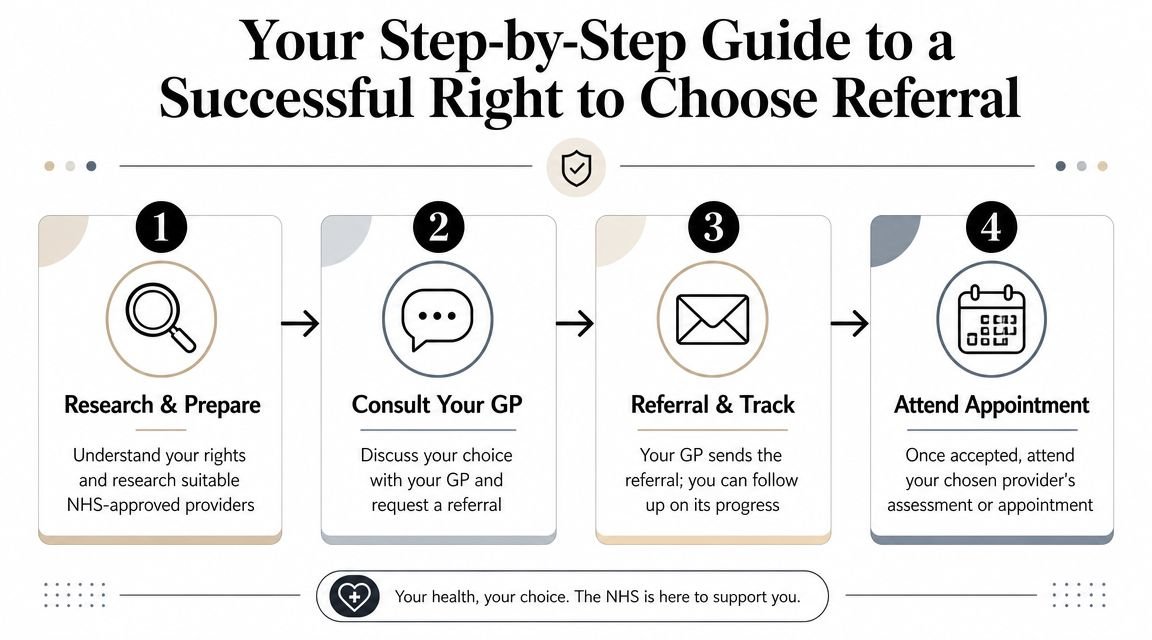
Step 1 Research the provider before you contact your GP
For ADHD or autism assessment, don't start with brand names alone. Start with the service details.
Check for:
- The correct pathway. Make sure the provider accepts adult ADHD or adult autism referrals under NHS commissioning where applicable.
- Clinical leadership. For neurodevelopmental work, consultant-led assessment is important. The author's brief for this article highlights the relevance of specialist consultant psychiatrists such as Dr Sai Achuthan in neurodevelopmental and personality disorder assessment.
- Regulation and clinician status. CQC regulation and psychiatrists on the GMC Specialist Register are sensible checks when you're comparing services.
- Follow-up planning. Diagnosis is only part of the pathway. Ask what happens next if you need medication titration, further review, or a detailed report.
One example is Insight Diagnostics Global's mental health assessment service, which offers consultant-led assessments for adults alongside broader mental health evaluation. That kind of service model helps when symptoms overlap and the picture isn't purely ADHD or purely autism.
Step 2 Prepare your reasons
Your GP doesn't need a dramatic story. They need a clinically useful one.
Write down:
- Your core symptoms and how long they have been present.
- The settings affected, such as work, education, home, or relationships.
- Any overlap with mental health concerns, including anxiety, depression, burnout, sleep issues, or emotional regulation problems.
- Why assessment matters now, such as worsening function, university support, workplace adjustments, or treatment planning.
Keep it factual. A clear summary often works better than a long narrative.
Step 3 Make the request directly
Use language that is respectful but specific. You can adapt the wording below:
I would like to request a referral for an adult ADHD/autism assessment under NHS Right to Choose. I understand this applies where a referral is clinically appropriate and where the chosen provider holds the relevant NHS contract for that service in England. I would like my referral to be considered for [provider name]. I have brought the provider details and the relevant pathway information to support the referral.
Later in the process, many patients want a clearer picture of timing. Local NHS sources have described waits in some areas of up to 7 years for ADHD or autism pathways, while Right to Choose providers are described as ranging from about 12 weeks to 12 months, depending on capacity and triage (Kent and Medway Right to Choose guidance).
That timing difference is why preparation matters.
A short explainer can help if you'd rather hear the process described than just read about it:
Step 4 Follow up like an administrator would
Once the GP agrees, don't assume the referral has gone through cleanly.
Use this checklist:
- Confirm submission. Ask when the referral was sent and by whom.
- Check the destination. Make sure it went to the exact provider and pathway requested.
- Keep copies. Save messages, forms, and any referral confirmation.
- Follow up with the provider. If appropriate, ask whether they have received and accepted the referral.
Patients often feel they are being difficult when they chase a referral. They aren't. Administrative gaps are common. Calm follow-up is one of the most effective ways to prevent unnecessary delay.
Right to Choose vs Standard NHS vs Private Assessment
A common adult assessment scenario looks like this. Someone has waited months already, their concentration is affecting work, or sensory overload is straining daily life, and they need to decide whether to stay on the local NHS list, ask for Right to Choose, or pay privately. The right answer depends less on theory and more on what happens after the referral, after the assessment, and after a diagnosis.
Independent guidance from ProblemShared reports average waits of 2 years and 2 months for autism assessments and 2 years and 5 months for ADHD assessments (ProblemShared guide to choosing a Right to Choose provider). For many patients, that turns the question from "Should I get assessed?" into "Which route can I realistically complete?"
Assessment pathways compared
| Factor | Standard NHS Pathway | NHS Right to Choose | Private Self-Funded |
|---|---|---|---|
| Funding | NHS-funded | NHS-funded | Patient-funded |
| Provider choice | Usually limited to the local commissioned service | Wider choice among eligible NHS-contracted providers in England | Direct choice of clinician or service, subject to availability |
| Waiting time | Often the longest route | Often shorter than the local pathway, but still affected by triage and capacity | Usually the quickest route |
| Referral needed | Yes, through the usual NHS pathway | Yes, usually via GP referral to the chosen provider | Often no GP referral needed for booking |
| Best for | Patients who want to stay within the local service structure | Patients who want NHS funding but more control over provider choice | Patients who prioritise speed, flexibility, and direct access |
The practical difference is not just speed.
Standard NHS assessment can work well where the local team is functioning well and the wait is manageable. The drawback is limited choice. You usually accept the local process, local timescales, and local model of follow-up.
Right to Choose sits in the middle. It keeps NHS funding in place but gives patients more say over who assesses them. For adult ADHD and autism, that matters because assessment quality varies. A service should be clear about who carries out the assessment, how developmental history is gathered, how risk is screened, and what the report includes. Patients comparing routes often find it helpful to review what a private mental health assessment in the UK typically covers so they can judge whether a provider's process is thorough enough, regardless of funding route.
Private assessment gives the most control at the front end. You can usually book faster, choose from more clinicians, and avoid some referral friction. The trade-off comes later. If medication is being considered for ADHD, the next steps may still depend on physical health checks, prescribing arrangements, and whether the GP is willing to enter a shared care agreement. A fast diagnosis is useful, but only if the follow-up plan is realistic.
That is why I advise patients to compare routes across the whole pathway, not just the first appointment date.
At Insight Diagnostics Global, the benchmark we work to is straightforward. The route should lead to a careful specialist assessment, a clear diagnostic outcome, and a report that is usable for GPs and onward care. Whether a patient comes through Right to Choose or another route, those basics matter more than marketing language.
Post-assessment logistics also affect the experience more than many people expect. If blood pressure checks, ECGs, or blood tests are requested before treatment decisions, ordinary NHS admin timelines still apply. This guide on understanding blood test turnaround times gives a useful sense of how routine follow-up can influence the pace of care after diagnosis.
A simple way to choose is to rank your priority first. If cost is the main issue, Right to Choose may be the strongest option if you are eligible in England. If continuity with the local team matters most, the standard NHS route may still fit. If delay itself is causing harm and you can fund it, private assessment may be the most workable route.
Common Roadblocks and How to Navigate Them
Most problems with NHS Right to Choose aren't about the principle. They happen in the handover between policy and practice. A patient understands the route. The GP is unsure. Admin staff send the referral to the usual local team. The provider says the paperwork is incomplete. Weeks pass.
The government guidance makes clear that while patient choice exists, some circumstances limit choice and local implementation can vary. In practice, some local NHS bodies have introduced restrictions, so a patient's experience can depend heavily on postcode and GP familiarity with the policy (NHS choice framework guidance).
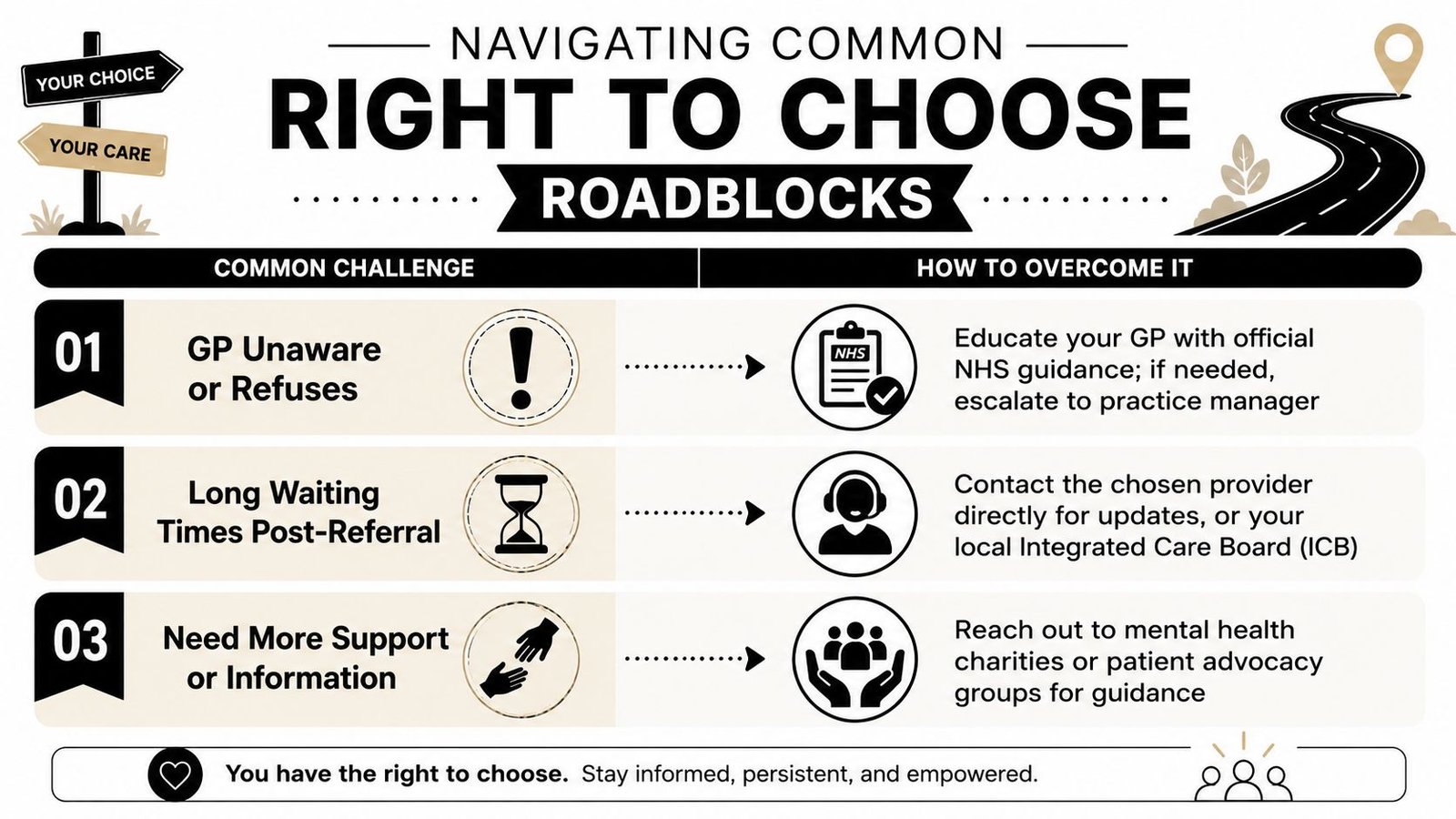
When the GP says they don't know the process
This is common. It doesn't automatically mean the answer is no.
Try this approach:
- Stay collaborative. Ask whether the practice can review the provider's Right to Choose referral instructions.
- Bring the pathway details. Give the exact provider name, service, and referral information.
- Ask for an admin follow-up. Sometimes the GP agrees in principle, but the referral stalls because nobody knows which form to use.
When the GP says your area doesn't allow it
That may reflect a genuine local rule, or it may reflect uncertainty. Ask what the restriction is based on. Is it your eligibility, the provider contract, the service type, or a local pathway policy?
If the answer is vague, ask for the reasoning in writing or request that the practice manager review it. Keeping the conversation factual usually works better than arguing abstract rights.
If you hit resistance, ask a narrower question. “Is the issue my eligibility, or is the issue the provider contract for this service?”
When the referral has been sent but nothing happens
Don't assume silence means progress.
A practical sequence is:
- Contact the GP practice and confirm the referral date.
- Check the destination and whether all documents were attached.
- Contact the provider to ask whether the referral has been received and accepted for triage.
- Escalate politely if the referral appears to have been misdirected or incomplete.
When your needs go beyond diagnosis
Some adults reach assessment needing more than a yes-or-no answer about ADHD or autism. They may also need mental health review, treatment discussion, workplace evidence, or medication planning. If that's your situation, don't focus only on who can assess. Focus on who can support the next step with a clear report and appropriate follow-up arrangements.
That single point often determines whether the referral feels useful once the diagnosis stage is over.
Your Right to Choose Assessment FAQs
Will Right to Choose cover medication and follow-up care
Sometimes, but not always in the same way patients expect. Assessment is one stage. Prescribing, titration, monitoring, and GP shared care are separate operational questions. Before you choose a provider, ask what happens after diagnosis, who manages medication if ADHD is confirmed, and whether follow-up appointments are available. Don't leave that until the report arrives.
Will my GP accept a diagnosis from a Right to Choose provider
That usually depends on whether the provider is appropriately commissioned for the service, whether the assessment is clinically sound, and what your GP is being asked to do afterwards. The diagnosis itself and any later prescribing arrangements are not always treated as the same administrative issue. Good reports and clear recommendations help.
What should I prepare before the assessment
Bring a concise history rather than trying to tell your whole life chronologically. For ADHD or autism assessment, that usually includes current symptoms, childhood patterns if known, educational or workplace difficulties, mental health history, medication history, and any supporting information from family or previous services. If you have old school reports or prior mental health letters, keep them available.
What if I have both neurodevelopmental and mental health concerns
Say so clearly at referral stage. Many adults don't present with a neat single-issue picture. Anxiety, depression, trauma history, burnout, or personality-related difficulties can overlap with ADHD and autism. A provider that can assess the wider clinical picture is often more helpful than one focused only on a narrow checklist.
Can I use Right to Choose if I live outside England
No. This pathway is England-only. If you're registered with a GP in Scotland, Wales, or Northern Ireland, different rules apply.
If you're looking for an adult ADHD, autism, or broader mental health assessment pathway and want a clear view of what a consultant-led process involves, Insight Diagnostics Global provides online and face-to-face assessments for adults, with structured evaluation, diagnostic reporting, and optional follow-up support.
One Response