

You finally decide to ask for help because the pattern has become hard to ignore. Work takes longer than it should. Emails pile up. You start tasks with energy, then lose the thread. At home, people may see forgetfulness, irritability, missed details, or a kind of exhaustion that never quite lifts. Then your GP tells you the local ADHD pathway is heavily backlogged.
That's often the point where people feel defeated. They assume the only options are to wait, pay privately, or give up.
There is another route for many adults in England. Right to Choose ADHD is an NHS pathway that can let you ask for referral to a different qualified provider for an NHS-funded assessment, rather than staying on a very long local waiting list. Used properly, it can move the process forward. Used badly, it can stall at referral stage, or leave you with a diagnosis but no clear treatment plan.
That distinction matters. In practice, the actual issue isn't only how to get assessed. It's how to move through the whole pathway with enough clarity that diagnosis leads to treatment, monitoring, and sensible follow-up.
The Long Wait and a Faster Path to Clarity
For many adults, the hardest part isn't the assessment itself. It's the stretch of time before it. You recognise longstanding traits. You read enough to suspect ADHD may fit. You may also wonder about autism, anxiety, burnout, or a mixture of all three. Then the next step feels blocked by delay.
In the UK, demand for adult assessment has risen sharply. Adult ADHD diagnoses are reported as rising four times faster than child diagnoses, and the estimated prevalence in adults is 4.4% according to NIMH ADHD statistics. That helps explain why so many local services are stretched.
A long wait doesn't just delay a label. It delays understanding. It delays workplace adjustments, university support, medication decisions, and the relief that can come when a consultant helps separate ADHD from other possibilities.
Why delay often worsens the problem
Adults usually seek assessment at a point of strain. They're not browsing out of curiosity. They're often trying to hold together work performance, parenting, finances, relationships, or study.
A delayed assessment can leave someone treating the wrong problem for months or years.
Sometimes the person has already been offered support for anxiety or low mood, but the underlying attentional and executive function pattern has never been properly examined. Sometimes autism is part of the picture as well. A proper neurodevelopmental assessment can clarify that.
If you're trying to make sense of current NHS delays, this guide on the NHS ADHD waiting list is a useful starting point.
Where Right to Choose fits
Right to Choose gives many patients in England a lawful route to request a different NHS-funded provider for a first outpatient assessment. That can be the difference between waiting passively and taking a structured next step.
The public understanding of this route is still patchy. Some GP practices know it well. Others know the term but not the practicalities. Good information design helps here. If you work in mental health services, or even just want an example of how complex care pathways can be explained clearly online, Baslon Digital's work on creating stunning mental health websites shows how presentation can reduce confusion rather than add to it.
Confirming Your Eligibility for Right to Choose
Before you speak to your GP, check whether Right to Choose is available in your situation. This saves time and avoids avoidable rejection.
Under NHS England guidance, patients in England have a legal right to choose a qualified provider for an NHS-funded ADHD assessment if that provider holds an NHS contract, and this can help patients avoid local waits that may exceed 70 weeks according to ADHD UK's Right to Choose guidance.
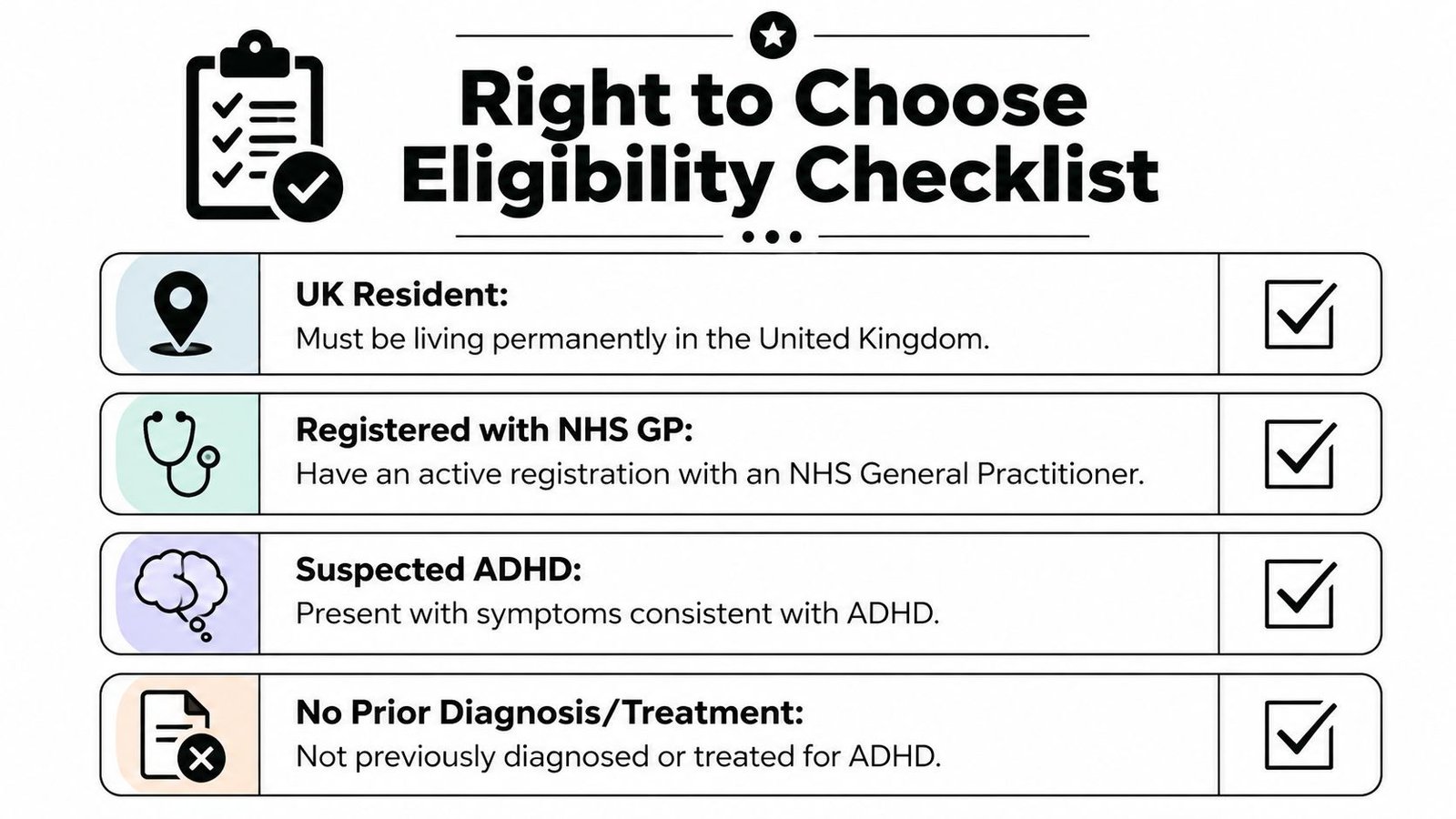
The checks that matter most
Use this as a practical screening list before booking your appointment.
- Registered with an NHS GP in England. Right to Choose applies within England. If your GP is not an NHS GP in England, this route won't usually apply.
- A referral is clinically appropriate. You can ask for a provider, but your GP still decides whether referral is clinically indicated.
- You're not already under another NHS mental health service for the same ADHD pathway. Existing care for the same condition can affect eligibility.
- The provider has an active NHS contract for the relevant service. This is one of the commonest points of confusion.
What often trips people up
The headline message sounds simple. In practice, the pathway depends on alignment between patient, GP, local rules, and provider.
A few problems come up repeatedly:
| Common issue | Why it causes delay |
|---|---|
| Wrong provider selected | The clinic may not hold the right NHS contract for your referral route |
| Incomplete referral forms | Triage teams may return or reject paperwork |
| Assuming Right to Choose is automatic | It isn't. The GP still has to make the referral |
| Existing ADHD care already in place | This can affect whether the referral is accepted |
Practical rule: Right to Choose is a provider-choice pathway, not a bypass around clinical triage.
Some patients also run into local policy uncertainty. The right exists, but local implementation can vary. That's why a clean, well-prepared referral matters. If you want a fuller breakdown of the route itself, the overview on NHS Right to Choose is worth reading before you contact your surgery.
How to Request Your Right to Choose Referral
This is the point where good preparation beats emotion. You don't need to make a dramatic case. You need to make a clear one.
The practical workflow is straightforward on paper. GP discussion, patient selects an eligible provider, GP sends the referral paperwork. Referral rejection is common when the chosen clinic lacks the required NHS contract or when forms are incomplete, as explained by ADD.org's guide to NHS Right to Choose ADHD.
How to prepare before the GP appointment
Bring order to the conversation before you ever speak to the GP.
- Write down your symptoms in adult terms. Focus on current impairment. Missed deadlines, disorganisation, impulsive spending, chronic lateness, losing track of conversations, task paralysis, and emotional dysregulation are easier for a GP to act on than a vague statement that you “think you have ADHD”.
- Note childhood history if you can. School reports, family recollections, or longstanding patterns help.
- Choose a provider before the appointment. Don't ask the GP to do that research during a ten-minute consultation.
- Download or review the provider's referral forms. If the provider asks for screening documents, have them ready.
- Be ready to explain why local waiting isn't manageable. Keep it factual. Work impact, study problems, worsening mental health, or repeated functional difficulties are all relevant.
What to say in the consultation
Keep the request calm and concrete.
You might say:
“I'd like to discuss referral for an adult ADHD assessment. My symptoms affect work and daily functioning, and I'd like to request referral under NHS Right to Choose to an eligible provider with an NHS contract.”
That wording does two things. It shows that you understand the route, and it leaves room for the GP's clinical judgement.
A sample email you can adapt
Some practices prefer an online consultation form or email before booking.
Subject: Request to discuss adult ADHD referral under NHS Right to Choose
Message:
Dear GP,
I'm writing to request an appointment to discuss referral for an adult ADHD assessment. I've had longstanding difficulties with attention, organisation, task completion, and day-to-day functioning, which are affecting my work and general wellbeing.
I'd like to discuss whether a specialist referral is clinically appropriate, and if so, whether this can be made under NHS Right to Choose to an eligible provider with an active NHS contract for ADHD assessment.
I'm happy to provide a summary of symptoms and complete any required forms in advance.
Kind regards,
[Your name]
What works and what doesn't
Here's the practical reality.
What tends to work
- A concise symptom summary. GPs need functional evidence, not a long self-diagnosis essay.
- A named provider with paperwork ready. This reduces admin friction.
- Polite persistence. If reception is unsure, ask how the GP would like the request submitted.
- Follow-up after a reasonable interval. Referrals can stall in admin rather than in the consulting room.
What tends not to work
- Turning the appointment into an argument about legality. It usually makes the conversation harder.
- Choosing a provider without checking contract status. That's one of the easiest ways to lose time.
- Sending partial forms. Triage teams notice every missing section.
- Assuming assessment automatically includes treatment. Some services separate diagnosis from titration and follow-up.
If the GP seems unfamiliar with Right to Choose
That's not unusual. Stay practical.
Ask whether they'd be willing to review the chosen provider's referral information and confirm whether they can make the referral if clinically appropriate. You're not asking the GP to endorse a social media trend. You're asking them to consider a recognised NHS pathway.
A consultant-led service can matter here because the referral destination needs to be clinically credible, administratively organised, and clear about what happens after diagnosis. That's particularly important where ADHD may overlap with autism or other mental health concerns.
Comparing Your Assessment Pathways and Timelines
Patients usually weigh three routes. Standard NHS, Right to Choose, and private assessment. The best option depends on urgency, cost, and whether you need a complete treatment pathway rather than an assessment alone.
The timing differences can be stark. The NHS constitutional standard is to start consultant-led treatment within 18 weeks of referral, but local adult ADHD waiting times can be up to 7 years, while Right to Choose referrals may take as little as 12 weeks to 12 months according to Eastwick Park Hospital guidance.
To keep the options clear, this comparison helps.
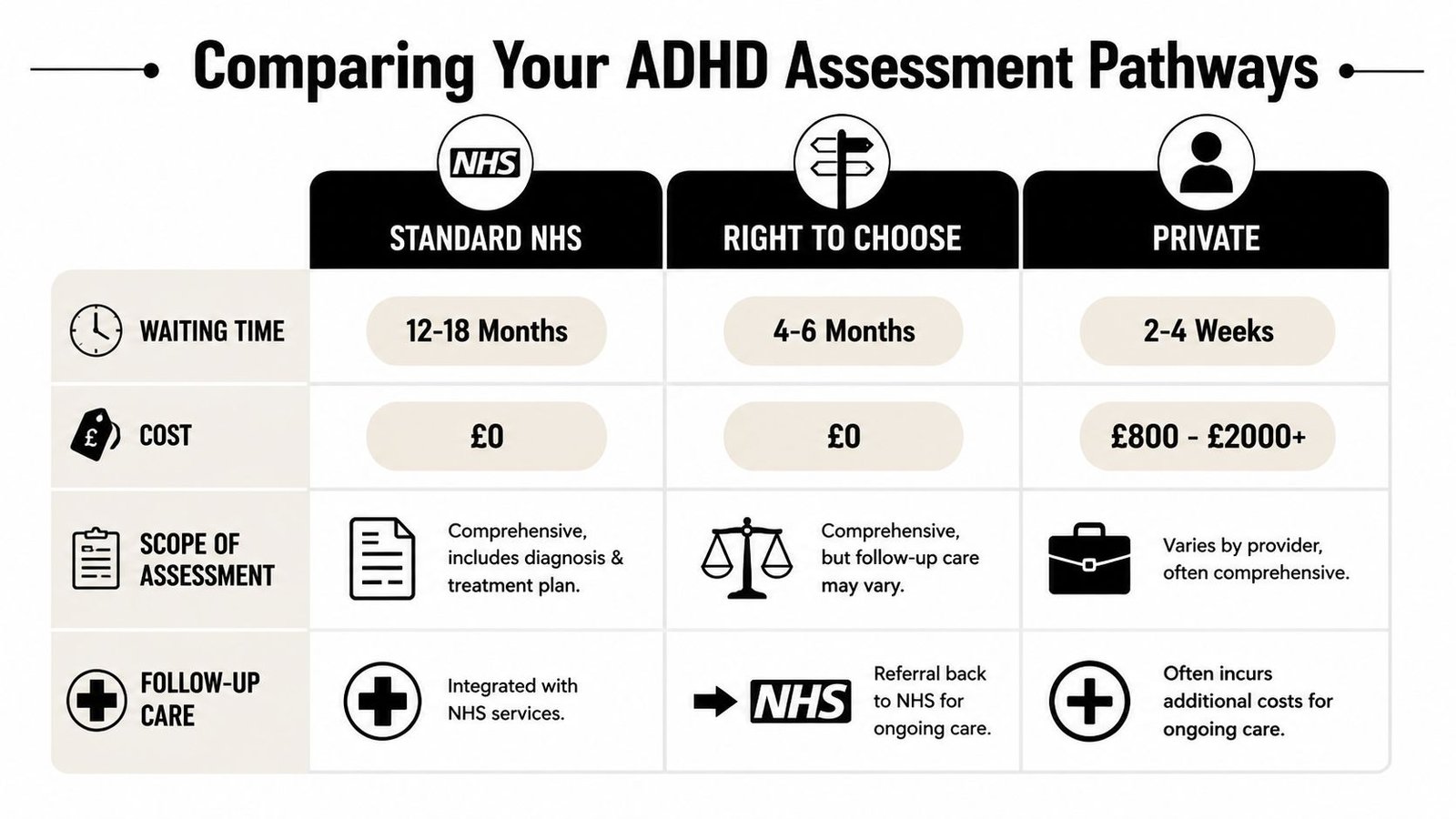
Side by side comparison
| Pathway | Funding | Waiting profile | Main advantage | Main trade-off |
|---|---|---|---|---|
| Standard NHS | NHS-funded | Often long and variable | Integrated local pathway | Delay can be substantial |
| Right to Choose | NHS-funded | Often quicker than local service | Access to another eligible provider | Admin and eligibility have to be right |
| Private | Self-funded | Usually fastest | Speed and flexibility | Cost, plus follow-up may also be self-funded |
The infographic above simplifies the picture, but the practical question is usually this: do you need speed alone, or do you need speed plus a clear route into treatment?
This video gives an accessible overview before you decide which pathway fits your situation.
When each route makes sense
Standard NHS suits people who can tolerate delay and want care entirely within their local system. That can work well when waits are manageable and the local team has capacity.
Right to Choose ADHD suits people who want NHS funding but can't reasonably wait for a heavily delayed local pathway. It often makes sense for adults whose functioning is already slipping at work, university, or home.
Private assessment tends to appeal when time is the overriding issue, or when someone wants flexibility in appointment timing and format. But private care needs careful scrutiny. Some private assessments are thorough. Others leave patients struggling to arrange medication, follow-up, or GP shared care afterwards.
The sensible comparison isn't only “How fast can I be seen?” It's “What happens after the report arrives?”
The complete-pathway question
Many guides often stop too early. They compare waiting time and price, then ignore continuity.
If you're exploring broader diagnostic questions around ADHD, autism, or overlapping mental health concerns, the article on mental health diagnosis in the UK is useful because it frames diagnosis as part of a wider clinical process rather than a one-off event.
One provider option adults may look at is Insight Diagnostics Global, which offers adult consultant-led assessments online and face to face, including ADHD, autism, and follow-up titration and monitoring. That combination matters when the question isn't just diagnosis, but whether treatment can continue in an organised way afterwards.
What to Expect from Your Consultant-Led Assessment
Once the referral is accepted, the focus shifts from paperwork to clinical quality. That's where patients often relax a little, because the process becomes more recognisable. You speak to a clinician. Your history is reviewed carefully. Symptoms are tested against diagnostic criteria, not guesswork.
A proper adult ADHD assessment should never feel like a rushed tick-box exercise. It should examine childhood pattern, current impairment, mental health background, and possible overlapping conditions.
What usually happens in a thorough assessment
Most consultant-led assessments include several strands of evidence rather than a single conversation.
- Structured clinical interview. This explores inattention, hyperactivity, impulsivity, organisation, emotional regulation, and day-to-day impairment.
- Developmental history. ADHD is neurodevelopmental, so childhood pattern matters even when the diagnosis is made in adulthood.
- Collateral information where available. A parent, sibling, partner, or school report can help clarify longstanding traits.
- Review of co-occurring conditions. Anxiety, depression, trauma, autism spectrum presentation, sleep problems, and personality factors can all complicate the picture.
- Functional analysis. The clinician looks at what symptoms do to your work, study, home life, and relationships.
Why consultant oversight matters
For adults with complex histories, senior psychiatric judgement matters. A consultant psychiatrist on the GMC Specialist Register can distinguish between true ADHD, partial traits, trauma-related concentration problems, autistic presentation, and mood or anxiety conditions that may mimic or mask ADHD.
That's one reason consultant psychiatrists such as Dr Sai Achuthan are valued in neurodevelopmental work. The aim isn't to confirm a label at all costs. The aim is diagnostic clarity.
A good assessment can end in several legitimate outcomes. ADHD confirmed, ADHD ruled out, autism considered, or a more mixed mental health formulation.
If you've never had a specialist mental health evaluation before, this explainer on what a psychiatric assessment involves will make the process feel more familiar before your appointment.
After Diagnosis Your Report Treatment and Next Steps
The report matters because it turns a clinical interview into an actionable plan. A strong report should explain the diagnosis clearly, summarise relevant history, outline reasoning, and set out recommendations for treatment and support.
For many adults, though, the important issue starts after the report lands in their inbox. They don't just want confirmation. They want help deciding what to do on Monday morning.
A key point often missed in Right to Choose discussions is that a faster diagnosis does not solve the downstream bottleneck of medication titration and monitoring, as noted by ProblemShared's Right to Choose guidance. That's why a complete pathway matters.
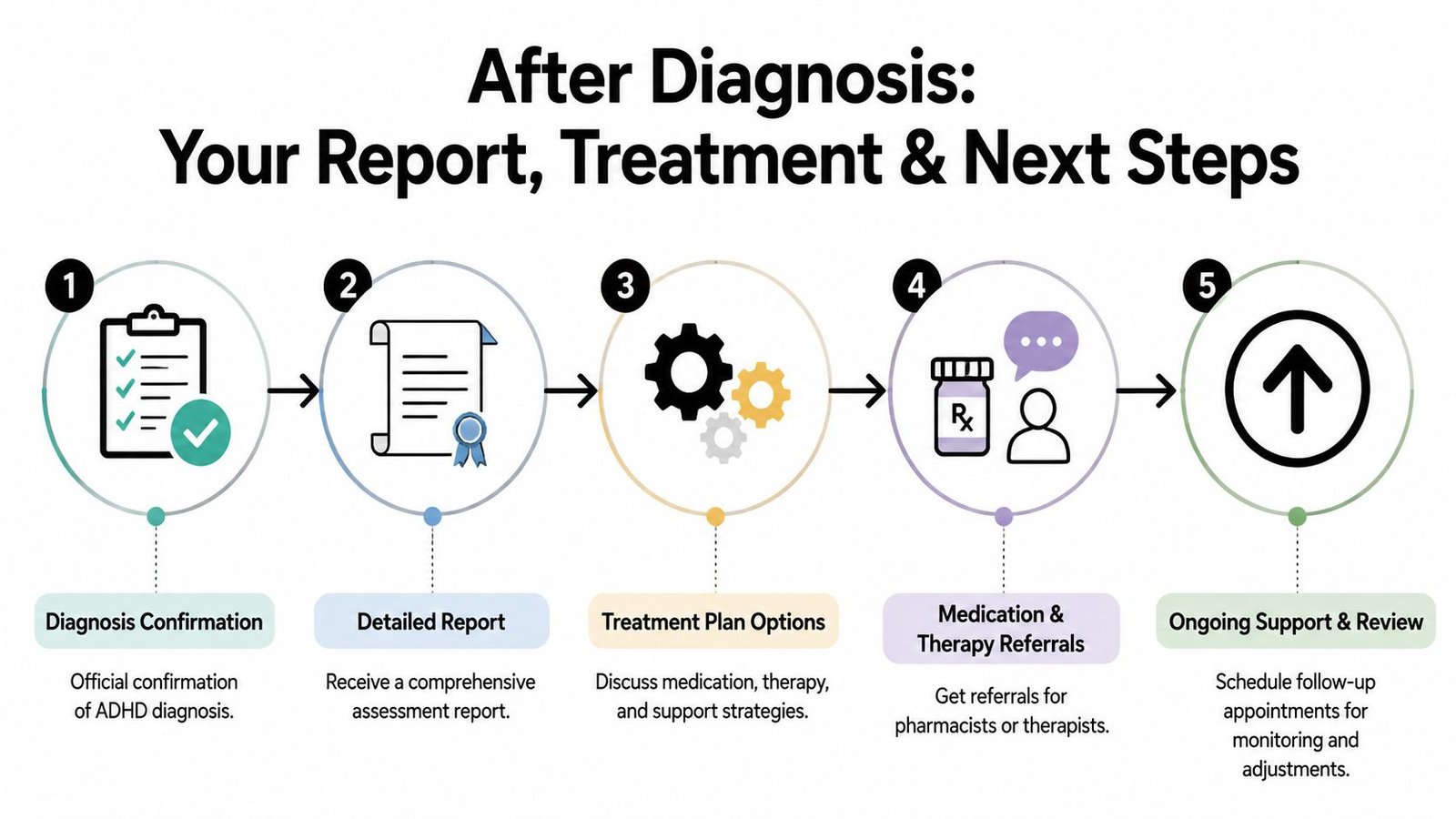
What should happen after diagnosis
A sensible post-diagnostic pathway usually includes the following:
Written diagnostic report
This should be detailed enough for the patient, GP, and other professionals to understand the outcome and recommendations.Treatment discussion
Medication may be appropriate for some adults. For others, psychoeducation, therapy, work adjustments, or autism-informed support may be more useful.Titration and monitoring where indicated
If medication is started, it needs supervision. Dosing, side effects, blood pressure, weight, and clinical response all need review.Planning for continuity
This can include handover to NHS services, shared care discussion with the GP, or ongoing follow-up with the diagnosing service, depending on the pathway.
What patients often overlook
The assessment is the visible part of the system. The less visible part is what determines whether treatment is sustainable.
- Medication isn't a same-day shortcut. It requires careful titration.
- GP shared care isn't guaranteed. It depends on local practice policy and the quality of the specialist plan.
- Support may need to be broader than medication. Work accommodations, university evidence, therapy input, or autism assessment may still be necessary.
- A negative ADHD diagnosis is still useful. It can redirect attention to the underlying cause of the difficulty.
Choose a pathway that answers two questions. Can they assess me properly, and can they manage what follows?
When people are already burned out, those details aren't small. They're the difference between receiving a report and receiving care.
If you're trying to move from uncertainty to a clinically organised plan, Insight Diagnostics Global offers adult consultant-led assessments for ADHD, autism, and broader mental health concerns, with options for follow-up, medication titration, and ongoing monitoring. If you're considering Right to Choose or a self-funded route, it's worth checking not just how assessment is booked, but how treatment and continuity are handled afterwards.