

You may be here because you've spent months reading about ADHD, autism, burnout, anxiety, masking, trauma, or all of them at once. Parts of each description fit. Other parts don't. You might recognise lifelong distractibility, intense interests, sensory overwhelm, social exhaustion, forgotten appointments, a strong need for predictability, and a mind that never seems to settle into a simple category.
That confusion is common in adult practice. It doesn't mean you're overthinking it, and it doesn't mean you've somehow failed to understand yourself properly. It often means the clinical picture is more layered than a single checklist can capture.
As a Consultant Psychiatrist, I see many adults who've been told for years that they are “just anxious”, “just disorganised”, “too sensitive”, or “high functioning so probably not autistic”. Others receive one diagnosis, feel some relief, and then realise it still doesn't explain the whole story. That's often where the ADHD autism overlap becomes clinically important.
Do I Have ADHD or Autism or Something Else Entirely
A typical adult presentation goes like this. Someone says, “I can't organise anything unless I'm under pressure, I interrupt people, and my mind jumps all day, so maybe it's ADHD. But I also rehearse conversations, get overwhelmed by noise, miss social subtext, and feel better when things are predictable, so maybe it's autism.”
Neither label feels fully wrong. Neither feels complete.
That “in-between” experience is often what brings people to assessment. It can look contradictory from the outside. You may crave novelty but also depend on routine. You may want connection but find social interaction effortful and confusing. You may hyperfocus on one interest while still struggling to start basic tasks.
Many adults aren't choosing between ADHD and autism. They're trying to understand why both descriptions keep appearing in their life.
For years, diagnostic systems often treated ADHD and autism as if they were separate lanes. Clinical practice has moved on. We now recognise that these conditions can co-occur, and when they do, the combined presentation can be easy to miss unless the clinician is actively looking for both.
The practical problem is that adults usually arrive after years of adaptation. They've built coping strategies, masked difficulties, changed jobs repeatedly, or pushed themselves through school and work at significant emotional cost. By the time they seek help, they may present with anxiety, low mood, exhaustion, relationship strain, or repeated burnout rather than a neat textbook picture of neurodevelopmental difference.
If you're trying to work out whether your traits fit one condition, both, or another explanation entirely, it helps to start with a careful comparison rather than self-diagnosing from isolated symptoms. A useful place to begin is this guide on whether your experiences point more towards autism or ADHD.
When uncertainty is clinically meaningful
Uncertainty isn't a dead end. In psychiatry, it's often a clue.
If your history includes longstanding executive-function problems, social misunderstandings, sensory issues, repeated comments that you're “too much” or “too intense”, or a sense that one diagnosis explains only half the picture, a dual assessment may be more appropriate than a single-condition screen.
What matters most is not finding the most fashionable label. It's understanding the pattern accurately enough that support fits your life.
Understanding the ADHD and Autism Overlap
A lot of adults come into assessment with a familiar problem. They can see traits of ADHD in themselves, and traits of autism too, but neither label seems to explain the full picture on its own.
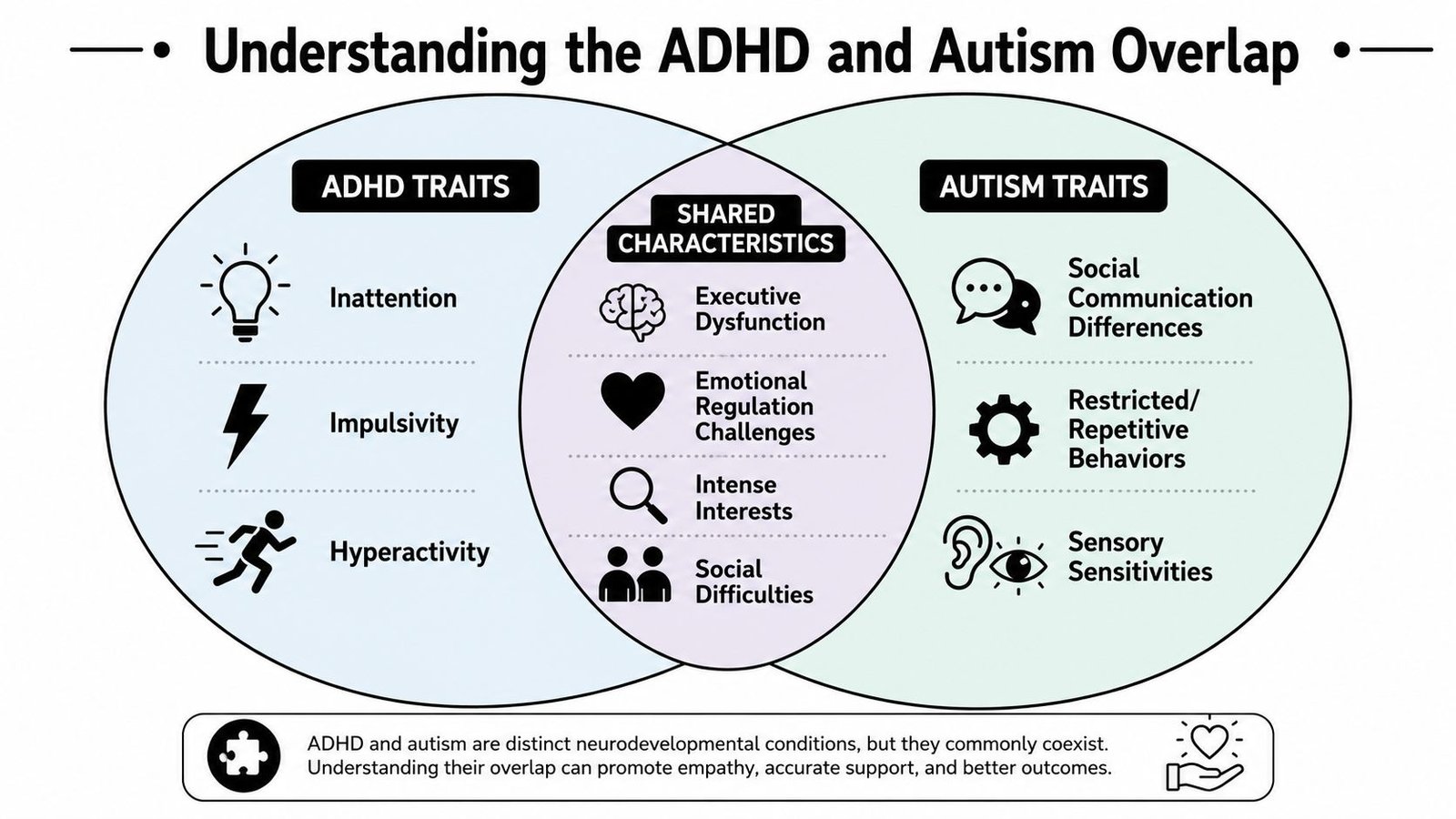
The overlap is real, and it is one reason adults are often missed or partially diagnosed. Similar outward behaviours can arise from different underlying processes. A person may interrupt because of impulsivity, miss social cues because of autistic communication differences, or do both in the same conversation.
Where they differ
ADHD usually centres on inattention, impulsivity, and restless or inconsistent regulation of attention and activity. In adult life, that can look like poor follow-through, chronic lateness, forgotten admin, difficulty sustaining effort, and a pattern of doing things either urgently or not at all.
Autism more often involves differences in social communication, sensory processing, and a stronger preference for predictability. Adults may find ambiguous social situations draining, become overloaded by noise or light, or need routines in order to stay steady.
These are useful distinctions, but real assessments rarely stay at that broad level. The clinical task is to ask what is driving the difficulty, how long it has been present, and whether the pattern has been there since early development.
Where they overlap
The overlap often shows up in executive function, emotional regulation, sensory strain, and social fatigue. Two adults may both struggle with deadlines, friendships, transitions, or burnout, while the reasons underneath are quite different.
A recent review on co-occurring autism and ADHD describes substantial overlap in attention, inhibition, social cognition, and sensory features, while also showing that the combined presentation has its own profile rather than being a simple sum of two separate conditions. That is part of why single-condition screening can miss the mark, especially in adults who have spent years compensating. You can read a broader explanation in this overview of autism and ADHD in adults.
In practice, I look closely at the function of a behaviour, not just the behaviour itself.
- Missing instructions may reflect distractibility, slower processing under pressure, sensory overload, or a mixture of all three.
- Talking at length may come from impulsivity, difficulty judging conversational pace, anxiety, or an intense interest.
- Difficulty switching tasks may reflect ADHD-related problems with activation and attention shifting, autistic distress around change, or both.
- Social withdrawal may be mistaken for anxiety alone when the actual picture includes exhaustion from masking, sensory overload, or repeated failures to keep up with fast-moving conversation.
Practical rule: Shared traits do not mean shared causes. A useful assessment explains the mechanism behind the symptom.
Why co-occurrence matters
Co-occurrence is common enough that clinicians should actively consider it rather than treating it as an exception. A large meta-analysis found that autism is present in a notable minority of people with ADHD, and ADHD is present in a substantial proportion of autistic people, although rates vary across studies and settings, as reported in this systematic review and meta-analysis of co-occurring autism and ADHD.
For adults in the UK, the practical consequence is clear. If one diagnosis explains only part of your history, it is reasonable to ask whether the other has been overlooked. That is particularly important when previous assessments have focused on the most visible problem, such as disorganisation, anxiety, burnout, or relationship difficulty, without examining the full developmental pattern.
A careful consultant-led assessment is built to separate overlap from overshadowing. It looks at childhood history, current functioning, masking, sensory profile, executive difficulties, social understanding, and other mental health factors that can muddy the picture. That level of detail is what turns confusion into a diagnosis you can use effectively.
Why Getting a Dual Diagnosis Is So Challenging for Adults
Adults often assume that if they've struggled for years, surely someone would have noticed by now. In reality, the opposite is common. One condition can easily overshadow the other.
This is called diagnostic overshadowing. A person may be identified as having ADHD because they are visibly disorganised, impulsive, and inconsistent, while their autistic social processing differences are missed. Or they may receive an autism diagnosis because they appear rigid, overwhelmed, and socially different, while their ADHD-related inattention and internal restlessness are written off as stress.
How one condition hides the other
In practice, mixed presentations can look messy rather than obvious. An adult may seek structure constantly but fail to maintain it. They may seem socially avoidant when the underlying issue is exhaustion from decoding conversations. They may appear emotionally reactive when they are trying to cope with executive overload, sensory strain, and repeated misunderstanding all at once.
Research has highlighted this as a major blind spot in adults who suspect both conditions. It also shows that co-occurring ADHD and autism is associated with more severe executive-function, social, and emotional difficulties than either condition alone, which is why accurate dual diagnosis matters, as discussed in this paper on diagnostic overshadowing and co-occurring ADHD and ASD in adults.
Why adult assessments can miss the full picture
Many adults have spent years masking. They've studied social scripts, overprepared for meetings, chosen jobs that minimise exposure, or built elaborate systems to compensate for attention problems. Some can describe their difficulties clearly. Others minimise them because they've been criticised for them for so long that they assume they're character flaws.
Clinicians also face a real trade-off. If they move too quickly, they risk mistaking overlap for clarity. If they rely on symptom counts alone, they may identify the loudest part of the presentation and miss the quieter one.
A few patterns raise my suspicion that a single diagnosis may be incomplete:
- Persistent mismatch: one diagnosis explains some difficulties but leaves major lifelong traits unaccounted for.
- Repeated misinterpretation: teachers, employers, partners, or family members have described the person in conflicting ways.
- Burnout cycles: the person copes for a period, then crashes when demands rise or structure falls away.
- Mental health complications: anxiety, depression, shame, or emotional dysregulation have become the main visible problem.
If you've been dismissed before, that doesn't prove there's nothing there. It may only show that the assessment lens was too narrow.
This is especially relevant for adults who don't fit stereotypes. The quieter, masked, high-achieving, or chronically anxious patient often gets recognised later.
The Hallmarks of a Trustworthy Assessment Process
Many UK adults reach this stage after years of partial answers. One clinician focused on anxiety. Another suspected ADHD. Autism was dismissed because you can hold a conversation, keep a job, or describe your feelings well. That is how diagnostic overshadowing happens. The most visible difficulty gets named, and the rest of the picture is left unexplained.
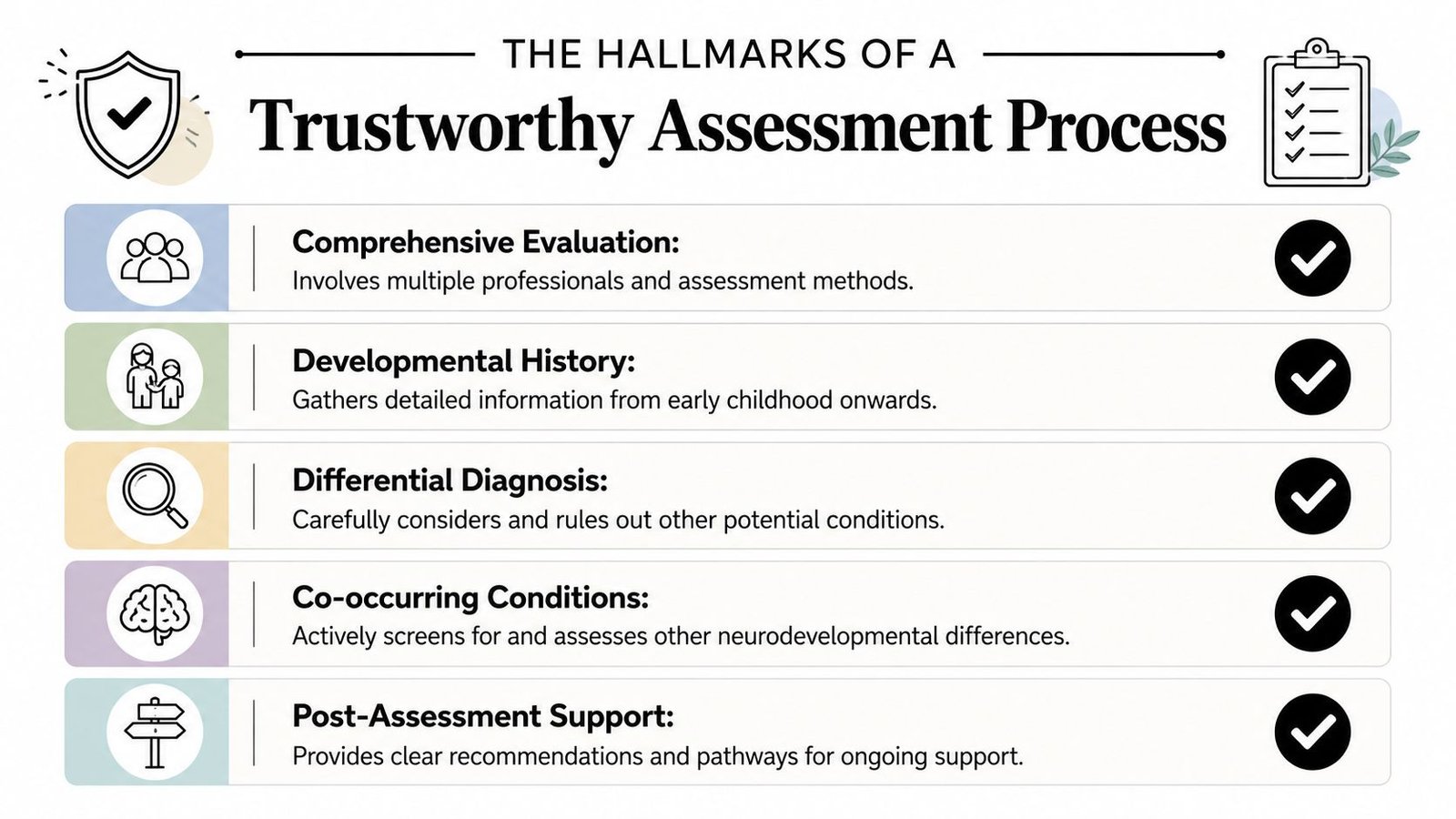
A trustworthy assessment corrects for that risk. It does not treat ADHD and autism as competing explanations that must cancel each other out. It tests both possibilities carefully, looks for other causes of the presentation, and explains why the final conclusion fits better than the alternatives.
What a proper assessment includes
A sound process builds a layered picture. It should cover developmental history, current functioning, mental health, and the situations where traits change under stress, structure, or sensory load. Screening tools can support that work, but they are only one part of it.
In practice, I would expect several elements:
- A developmental timeline: early routines, friendships, school experience, sensory patterns, attention, impulsivity, emotional regulation, and how these traits showed up across life stages.
- A consultant psychiatric interview: not only neurodevelopmental features, but sleep, anxiety, mood, trauma, substance use, physical health, and any history that could blur the picture.
- Collateral history where possible: a parent, sibling, partner, or old school report can help clarify what was present long before adult coping strategies took over.
- Active differential diagnosis: the assessor should examine whether traits are better explained by trauma, depression, anxiety, OCD, personality factors, bipolar disorder, sleep problems, or a combination.
- A written report with practical recommendations: the outcome should explain the reasoning, not just state a label.
The standard matters because adults with AuDHD often describe two opposite problems at once. They may crave novelty but become overloaded by change. They may want structure but struggle to maintain it. A clinician who works at surface level can mistake that pattern for inconsistency or poor insight, when it may be the clue that both conditions need proper consideration.
What tends to undermine the process
Fragmented assessment routes often create confusion. An ADHD-only service may identify distractibility and impulsivity but not examine sensory strain, literal communication style, or lifelong social exhaustion. An autism-only service may recognise masking and rigidity but miss disorganisation, time blindness, and variable attention. You can leave with one diagnosis, half an explanation, and recommendations that do not fit daily life.
Questionnaires create another common problem. They are useful for screening, but scores need interpretation. Masking, burnout, trauma, chronic criticism, and years of self-monitoring can all affect how adults answer. A high score does not settle the diagnosis. A low score does not rule it out.
A reliable assessor asks how a trait appears, when it started, what it costs you, what makes it better or worse, and what else could account for it.
Why consultant-led judgement matters
Dual presentations depend on clinical judgement. The task is not merely to confirm symptoms from a checklist. It is to work out which traits belong to ADHD, which fit autism, which reflect mental health difficulties, and where those strands interact.
That is why I advise adults to look closely at who is making the diagnostic decision. A consultant-led service should be able to explain the reasoning process, the limits of screening tools, and how differential diagnosis is handled. This guide to what a psychiatric assessment should involve is a useful benchmark.
One example of this kind of structured pathway is Insight Diagnostics Global, a CQC-regulated adult service that offers combined ADHD and autism assessments, written reports, and follow-up planning. The name matters less than the method. If you suspect AuDHD, the standard to look for is an integrated assessment that reduces diagnostic overshadowing and gives you a conclusion you can use.
How to Manage Co-occurring ADHD and Autism
Once both conditions are recognised, management usually becomes more coherent. Many adults have spent years trying strategies that worked for one part of the picture and worsened another. The task isn't to “fix” neurodivergence. It's to build a life that makes sense for your actual profile.
Shared biology is part of why this matters. Twin and family studies estimate roughly 50–72% overlap in the genetic factors contributing to ADHD and autism, reinforcing the need to assess both shared and distinct symptom clusters when planning treatment, as summarised in this overview of shared genetic liability in ADHD and autism.
Psychosocial support that fits both conditions
Support works better when it respects the tensions inside an AuDHD profile.
An ADHD-style strategy that pushes novelty, speed, and constant stimulation may overwhelm an autistic nervous system. An autism-style plan built entirely around strict routine may fail if ADHD makes consistency hard to sustain. Good management accepts both sides.
Useful supports often include:
- Executive-function support: practical coaching around planning, task initiation, prioritising, deadlines, and realistic systems.
- Autism-affirming therapy: understanding sensory load, social fatigue, communication style, and the cost of masking.
- Occupational therapy input: especially where daily living, sensory regulation, workspace design, or energy pacing are major issues.
- Mental health treatment: anxiety, low mood, shame, and burnout often need direct attention rather than being dismissed as secondary.
Medication and specialist oversight
Medication is usually considered for ADHD symptoms rather than autism itself. In a co-occurring presentation, the question isn't only whether ADHD medication “works”. It's whether the overall balance improves.
Some adults find that better attention control reduces overwhelm because daily life becomes more manageable. Others notice that once impulsivity drops, sensory strain or autistic social fatigue becomes more noticeable. Neither response is unusual. It means treatment needs review by someone who understands both conditions and monitors function, side effects, and tolerability carefully.
Shared vs distinct traits in ADHD and autism
| Domain | Often seen in ADHD | Often seen in Autism | The AuDHD Overlap |
|---|---|---|---|
| Attention | Distractibility, variable focus, novelty-seeking | Deep focus on preferred interests, difficulty shifting attention | Alternates between scattered attention and intense hyperfocus |
| Organisation | Difficulty planning, starting, sequencing, finishing | Preference for order or systems that may become rigid | Wants structure but struggles to maintain it consistently |
| Social interaction | Interrupting, impulsive speech, missing conversational timing | Difficulty reading social nuance, different communication style | Social effort feels high, with both impulsivity and misunderstanding |
| Sensory experience | May seek stimulation or become restless | Often more sensitive to noise, light, touch, or crowding | Can feel both under-stimulated and easily overwhelmed |
| Emotions | Fast reactions, frustration, low pause before response | Distress with change, overload, social confusion | Emotional regulation becomes harder under combined stress |
The best management plans are personalised. They don't force you to choose whether you are “more ADHD” or “more autistic”.
A good plan often includes environmental changes, permission to reduce masking, realistic work and study adjustments, and selective treatment aimed at the problems causing the most impairment.
Your Next Steps for Seeking Support in the UK
The hardest part is often moving from suspicion to action. Many adults stay stuck for months because the process feels opaque. It helps to break it down into a few concrete steps.

Start by documenting your own pattern
Before you speak to a GP or assessor, write down examples from daily life and from childhood. Don't aim for a perfect essay. Aim for specifics.
Include things like:
- Work or study problems: missed deadlines, inconsistent output, overwhelm in meetings, inability to start tasks.
- Social patterns: misunderstanding jokes, overexplaining, needing recovery time after interaction, feeling out of step.
- Sensory experiences: noise, light, fabrics, crowds, food textures, commuting stress.
- Childhood clues: school comments, friendships, routines, meltdowns, inattention, daydreaming, fidgeting.
The best notes are concrete. “I struggle socially” is less helpful than “I rehearse phone calls, miss when it's my turn to speak, and often realise afterwards that I answered too directly.”
Speak to your GP with a clear request
When you book the appointment, keep the goal focused. You don't need to prove your diagnosis in ten minutes. You need to explain why a formal assessment is justified.
You might say that you suspect overlapping ADHD and autistic traits, that these have been present since early life, and that they affect work, relationships, daily functioning, or mental health. If you think a dual assessment is needed, say so directly.
If you want to understand the NHS referral route in more detail, this guide to Right to Choose for ADHD and autism assessments is a practical starting point.
Understand the routes available
UK adults usually consider three broad pathways.
Standard NHS referral can be appropriate, but waiting times and local service structures vary. Some areas assess one condition more readily than the other, which can be frustrating if you suspect both.
Right to Choose may offer an NHS-funded alternative through eligible providers, depending on your circumstances and local arrangements.
Private assessment gives more control over timing and clinician choice, though it comes with self-funding considerations unless insurance applies. If you're weighing pace, continuity, and cost, this article on comparing healthcare options in UK gives a useful overview of the trade-offs.
A short explainer may help if you're still deciding what route fits your situation:
Know what you're asking for
If you strongly suspect the ADHD autism overlap, ask whether the service can assess both conditions properly and distinguish them from anxiety, depression, trauma, burnout, and personality-related difficulties where relevant. That question saves time.
Don't be reassured too quickly by services that promise speed if they can't explain method. Fast access is helpful. Thin assessment is not.
A worthwhile report should leave you with more than a label. It should tell you what the clinician found, why they reached that conclusion, what remains in the differential picture, and what practical recommendations follow.
If you want a consultant-led route to clarity, Insight Diagnostics Global provides adult ADHD, autism, and combined assessments online and face to face, with structured psychiatric evaluation, robust reports, and follow-up recommendations. For adults who suspect AuDHD, the value is in getting a joined-up formulation rather than another partial answer.