

You may be here because life feels harder than it looks from the outside. Work deadlines slip even when you are committed. Messages sit unanswered. You start one task, then another, then another, and by evening you're exhausted without feeling you've done what mattered. Some people assume this is stress, poor discipline, or modern life. Sometimes it is. Sometimes it isn't.
In clinical practice, understanding ADHD in adults often starts with that exact uncertainty. Adults don't usually come in saying, “I definitely have ADHD.” They say, “I can't keep up,” “I'm always firefighting,” or “I'm burnt out and I don't know why.” When autism, ADHD, and mental health symptoms overlap, a proper psychological assessment matters. That is particularly true when the picture is complicated by anxiety, low mood, personality traits, long-standing relational difficulties, or questions about neurodevelopment more broadly.
At Insight Diagnostics, this kind of work sits squarely within consultant-led assessment for adults, including ADHD, Autism Spectrum Disorder and wider mental health conditions. The clinical value is in careful differentiation, not rushing to a label. That is also where the experience of a consultant psychiatrist with a neurodevelopmental and personality disorder focus, such as Dr Sai Achuthan, becomes relevant. A good assessment doesn't just ask whether ADHD is present. It asks what else may be going on, what has been missed, and what support will help.
Is This Just Burnout or Could It Be Adult ADHD
A common story goes like this. An adult in their thirties or forties is managing a job, family responsibilities, bills, appointments, and constant digital noise. They're bright, capable, and often high-effort. Yet they miss deadlines, lose track of simple admin, forget conversations, and feel permanently behind. They may have been told for years that they're disorganised, lazy, inconsistent, or “bad at coping”.
Burnout can produce concentration problems, irritability, poor sleep, and emotional exhaustion. ADHD can also produce concentration problems, irritability, difficulty regulating effort, and a sense of chronic overwhelm. The difference is that burnout is usually a state that develops under sustained pressure. ADHD is a neurodevelopmental condition, so the clues often stretch back much further, even if nobody recognised them at the time.
What makes the picture confusing
Adults with undiagnosed ADHD often describe a pattern, not a single bad period. They remember school reports about not applying themselves, losing belongings, rushing work, talking too much, zoning out, or only performing well when intensely interested. Later, the same pattern shows up as chaotic inboxes, missed renewals, lateness, clutter, forgotten birthdays, impulsive decisions, or chronic inconsistency.
Burnout usually says, “I used to manage and now I can't.” ADHD often says, “I've always found this harder than other people seem to.”
In the UK, this matters because many adults have spent years being treated only for the consequences. The true community prevalence of adult ADHD symptoms in the UK may be closer to 2–3% of adults, while many remain undiagnosed, and that gap matters because persistent adult ADHD is associated with unemployment, relationship breakdown, and comorbid mental health conditions, as outlined in this UK adult ADHD overview.
When to look beyond stress
A few clues make me think more seriously about ADHD rather than stress alone:
- Long-standing pattern: the same difficulties were present at school, university, early employment, or in relationships.
- Executive dysfunction: the person knows what to do but can't reliably start, sequence, or finish it.
- Inconsistent performance: they can do complex work in some contexts yet fail on routine tasks.
- Emotional fallout: shame, self-criticism, and repeated “fresh starts” are common.
- Partial burnout explanation: rest helps a little, but doesn't fix the core pattern.
If you're unsure whether you're dealing with stress alone, it can help to compare your experience with a more detailed discussion of burnout and how long it lasts. If the problem feels broader, older, and more patterned than burnout alone, ADHD deserves proper consideration.
Beyond Hyperactivity The Real Symptoms of Adult ADHD
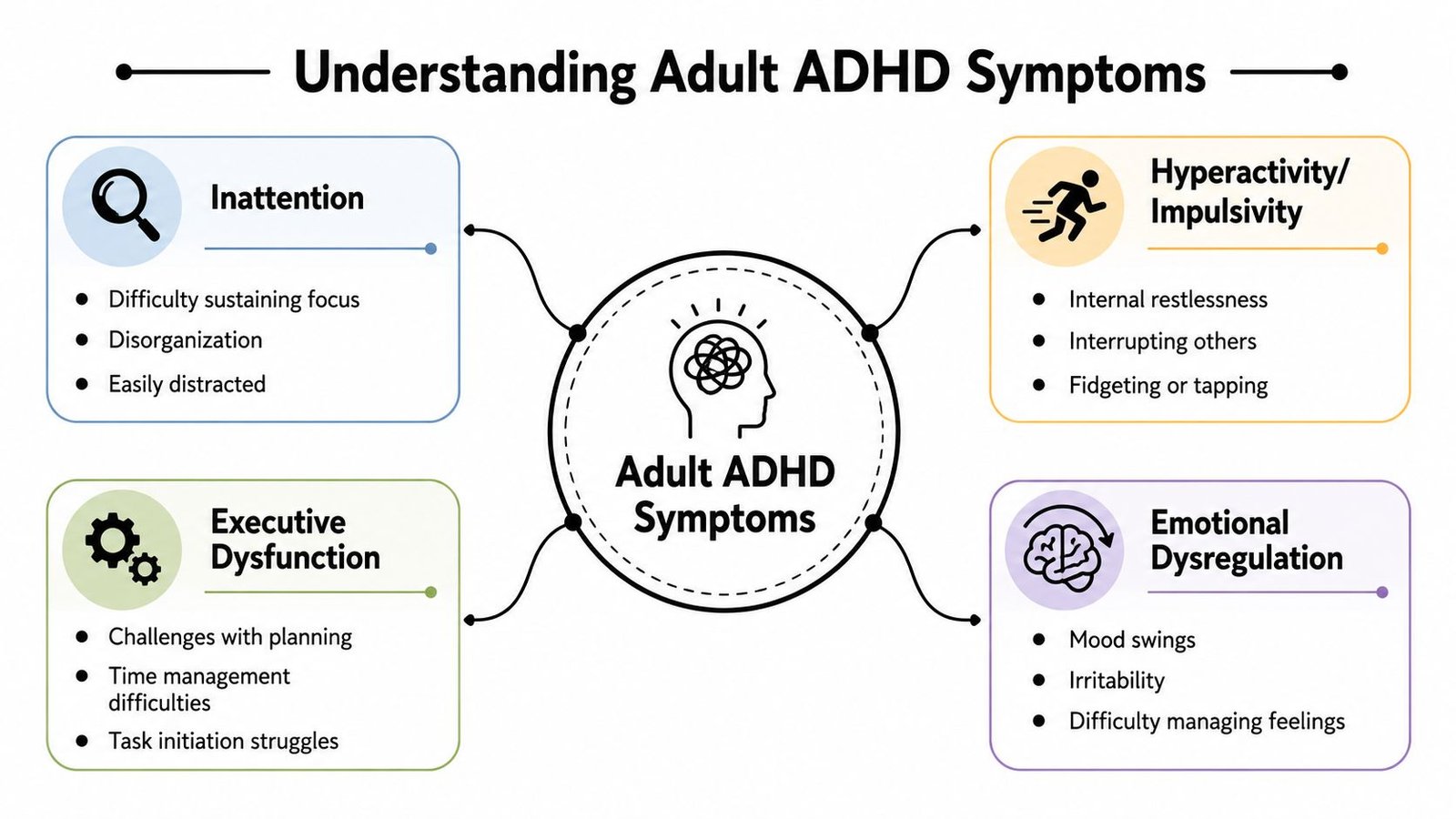
The public stereotype is still a restless schoolchild who can't sit still. Adult ADHD is usually less obvious and far more internal. By the time someone reaches adulthood, they may have learnt to suppress overt hyperactivity while still struggling with restlessness, distractibility, disorganisation, and impulsive decisions.
Inattention is more than poor focus
In adults, inattention often looks like executive dysfunction. I sometimes explain it as an orchestra without a conductor. The instruments are there. The intelligence is there. The intention is there. What's missing is reliable coordination.
That can show up as:
- Planning failures: difficulty breaking a task into steps or judging what should come first.
- Time blindness: repeatedly underestimating how long things take.
- Working memory problems: walking into a room and forgetting why, losing track mid-conversation, or failing to hold instructions in mind.
- Distractibility: not only by noise or notifications, but by one's own thoughts.
For some readers, a practical education-focused resource such as Queens Online School's expert ADHD guide can help translate these symptoms into real-world impact on learning and performance.
Hyperactivity and impulsivity often become internal
Adults may not be climbing furniture. They may be interrupting, overcommitting, shopping impulsively, changing plans suddenly, speaking before thinking, or feeling unable to switch off mentally. Hyperactivity can become internal restlessness. The body may appear still while the mind is racing.
Emotional control is another area many adults recognise immediately, even if they were never told it could relate to ADHD. Frustration can spike quickly. Minor criticism can feel disproportionately painful. Rejection sensitivity isn't part of the formal diagnostic criteria, but clinically it often sits close to the picture people describe.
Why adulthood doesn't make ADHD disappear
ADHD doesn't vanish because someone turns eighteen. Longitudinal studies tracking UK children with ADHD into adulthood show that approximately 50–65% continue to meet diagnostic criteria by age 25–30, and persistent inattention and executive impairment commonly show up as time-management failure, underachievement at work, and chronic relationship strain, as discussed in this adult ADHD evidence summary.
That persistence matters because adults often present late, not because symptoms are mild, but because they've compensated until life became too demanding.
A fuller symptom overview can be useful before assessment, especially if you're trying to distinguish occasional distraction from a wider pattern. This adult ADHD symptoms checklist gives a practical starting point.
Clinical point: ADHD in adults is rarely about “can you pay attention?” It's more often about “can you regulate attention, effort, time, and impulse consistently enough to function well?”
The Connection Between ADHD Autism and Mental Health
ADHD rarely travels alone. In adult practice, the more important question is often not “Is it ADHD or something else?” but “How many overlapping processes are present, and which of them are driving the current difficulties?”
Autism and ADHD can occur together. Anxiety and depression can sit on top of both. Trauma can complicate the picture further. Personality patterns can shape how symptoms are expressed, how relationships are affected, and how distress is managed. This is why brief, superficial assessments can miss the mark.
Why overlap causes diagnostic confusion
An autistic adult may seem inattentive because social situations are exhausting and cognitively demanding. An adult with ADHD may seem autistic because they interrupt, miss social cues, or struggle with conversational timing. Someone with chronic anxiety may look inattentive because worry is consuming their mental bandwidth. Someone with depression may appear slowed, forgetful, and unmotivated.
The overlap is real, but the mechanisms differ. That matters because treatment planning differs too.
UK-based clinical guidance emphasises that ADHD and autism commonly occur together, with a substantial minority of adults with either condition also meeting criteria for the other. That supports the case for integrated neurodevelopmental assessment rather than a narrow one-condition approach, as noted in this discussion of ADHD and autism in adults.
What a proper assessment needs to separate out
A useful assessment should explore more than a symptom checklist. It should look at:
- Developmental history: what was present in childhood, and how it changed over time.
- Functional pattern: work, study, relationships, home management, emotional regulation.
- Context: whether symptoms appear everywhere or only under stress.
- Comorbidity: anxiety, depression, mood instability, substance use, sleep problems, trauma history.
- Neurodevelopmental profile: whether autism traits, sensory differences, rigidity, or social communication differences are also present.
When adults read about both conditions and think, “I relate to all of this,” they aren't imagining it. Overlap is common, and distinguishing the strands usually requires a broader lens. That's why a combined view of ADHD and autism overlap is often more useful than reading about each condition in isolation.
A diagnosis should clarify the person's pattern. It shouldn't flatten it.
Mental health symptoms may be secondary, primary, or both
An adult who has spent years missing deadlines, disappointing themselves, masking social difficulties, and feeling misunderstood is more likely to develop anxiety or low mood. In that scenario, mental health symptoms may arise partly from the strain of unmanaged neurodevelopmental difficulties.
But it can also run the other way. Severe anxiety, depression, or trauma-related symptoms can impair concentration and organisation enough to resemble ADHD. Clinical judgement is essential in these cases. The aim isn't to force every problem into one box. It's to work out what belongs where.
How to Get an ADHD Diagnosis in the UK
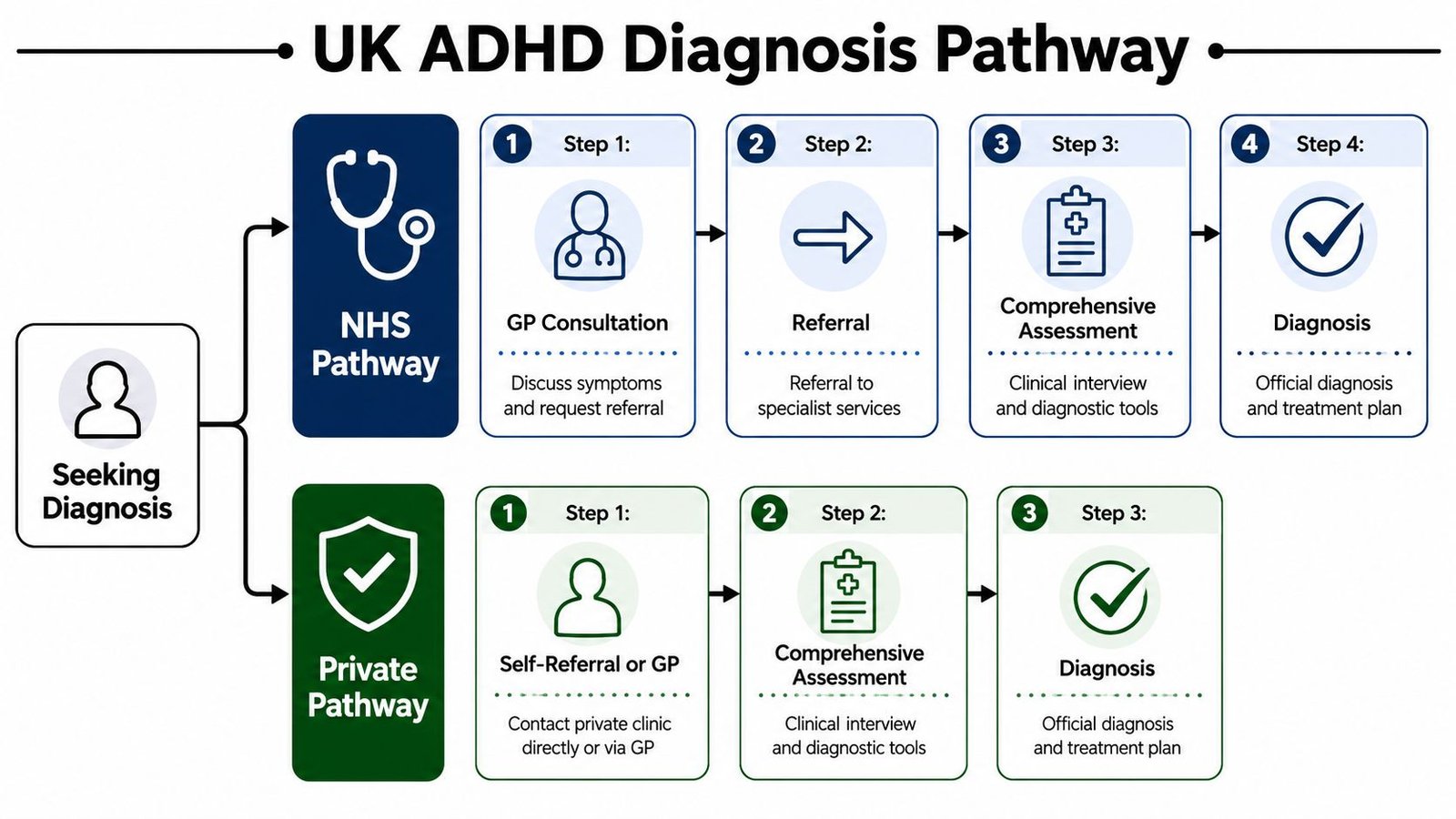
The UK system confuses many adults because it isn't a single pathway. In practice, there are two tracks. One is the NHS route. The other is the private route. Some people also explore Right to Choose, which sits between the two and can be useful depending on eligibility and local arrangements.
What clinicians are actually assessing
In the UK, adults aged 17 and over are assessed using criteria consistent with the DSM framework. Clinicians typically look for at least five symptoms of inattention and/or hyperactivity-impulsivity, present for at least six months, with impairment in at least two settings, and with symptoms dating back to before age 12, as described in this adult ADHD diagnostic summary.
A proper adult assessment usually includes a structured clinical interview, developmental history, review of current functioning, screening for other psychiatric conditions, and often collateral information from someone who knows you well or from school reports if available.
NHS pathway versus private pathway
The NHS route usually begins with a GP appointment. You explain your symptoms, their history, and the impact on work, study, home life, or relationships. If ADHD seems plausible, the GP refers you to an appropriate service. The main advantage is obvious. It is within the NHS system. The main disadvantage is also obvious. Waiting times can be long and inconsistent depending on region.
The private route allows direct self-referral or referral via a GP. The main benefit is speed and flexibility. The trade-off is cost, and patients also need to think ahead about prescribing arrangements and possible NHS handover later.
UK ADHD Assessment Pathways at a Glance
| Aspect | NHS Pathway | Private Pathway |
|---|---|---|
| How it starts | Usually through a GP referral | Often self-referral or GP referral |
| Main advantage | Within NHS care structure | Faster access and more flexible scheduling |
| Main drawback | Waiting times may be prolonged | Self-funded costs or insurer rules may apply |
| Assessment style | Specialist ADHD assessment | Specialist ADHD assessment |
| After diagnosis | NHS-led treatment planning where available | Private follow-up, with possible later NHS handover |
| Best for | Patients prioritising NHS route and able to wait | Patients needing earlier clarity or flexible appointments |
Where Right to Choose fits
For some NHS patients in England, Right to Choose can offer another route. In practical terms, it means asking your GP about referral options beyond the local service where applicable. It can be useful, but it isn't a universal fix. Availability, provider eligibility, and local processes can vary, so patients should ask specific questions rather than assume it will automatically shorten the process.
Useful questions to ask your GP include:
- Does Right to Choose apply in my case?
- Which providers are you able to refer to?
- What information do you need from me to support referral?
- If I seek a private assessment, how would future prescribing be handled locally?
What consultant-led assessment should feel like
A good assessment shouldn't feel like a hurried checklist. It should feel organised, curious, and clinically grounded. The clinician should ask about childhood, education, work history, driving, finances, relationships, emotional regulation, sleep, substance use, and other mental health symptoms. If autism, mood disorder, trauma, or personality factors are relevant, those should be explored too.
For adults seeking a structured explanation of the process, this guide on how to get an ADHD diagnosis in the UK can help you prepare before speaking to a GP or arranging an assessment.
Practical rule: Before booking anywhere, ask two questions. Who makes the diagnosis, and what documentation will you receive afterwards?
ADHD Treatment Medication and Psychological Support
A common UK scenario looks like this. An adult finally gets assessed, starts treatment, feels some improvement, then hits a practical barrier. Who will prescribe next, who will monitor side effects, and will the NHS accept the paperwork if care started privately?
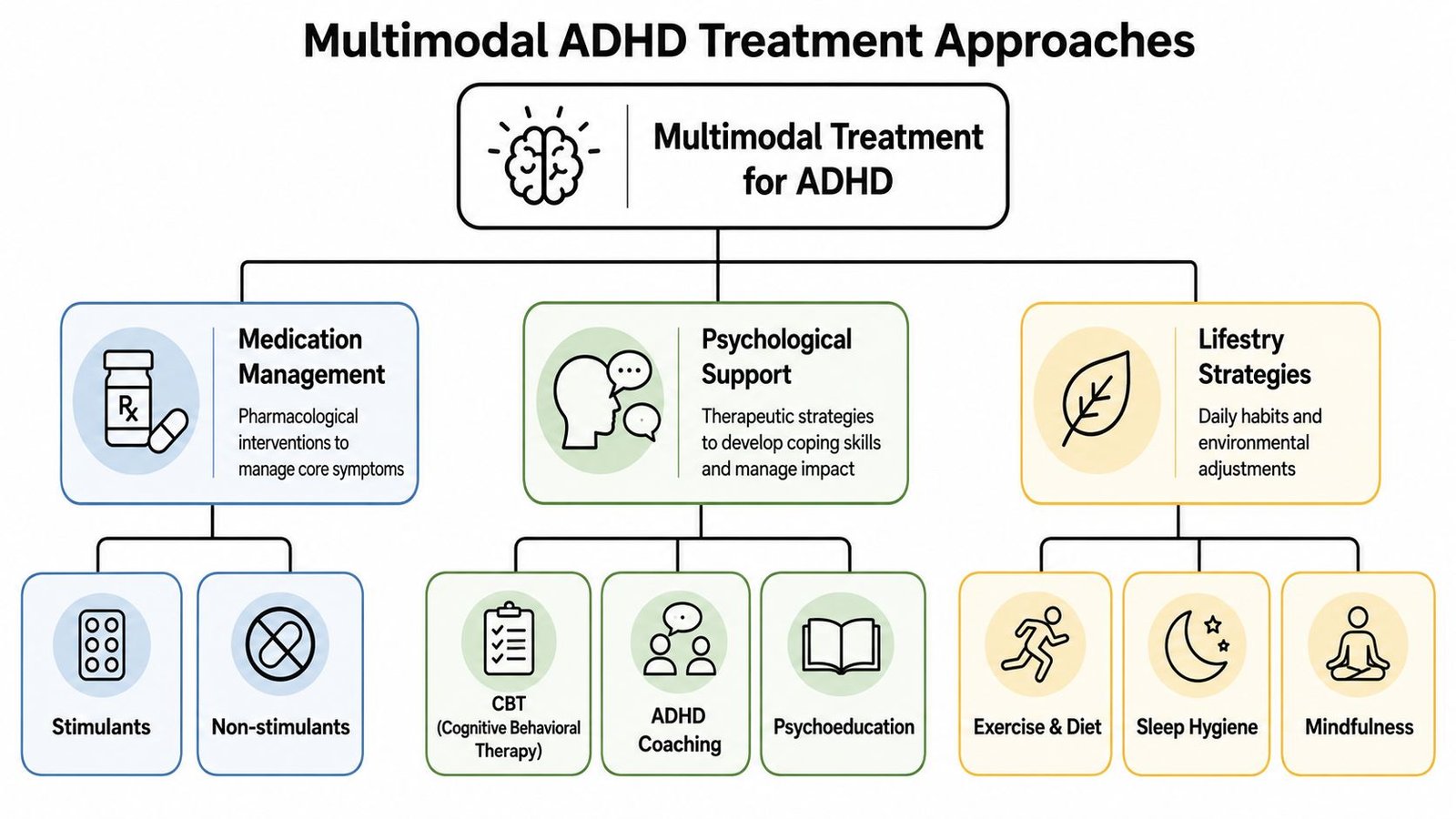
Treatment works best when it is planned around those real-world constraints. Medication can reduce core ADHD symptoms. Psychological support helps with habits, self-management, emotional regulation, and the accumulated strain that often comes from years of feeling disorganised or “behind”. Daily structure also matters, but it works best as part of a treatment plan rather than as a substitute for one.
Medication can help, with the right expectations
For many adults, stimulant medication improves attention regulation, reduces mental noise, and makes it easier to start or finish tasks. For others, the gains are modest, side effects get in the way, or another approach is preferred. The useful clinical question is simple. Does this treatment improve day-to-day functioning enough to justify continuing it?
Medication does not erase ADHD. It does not organise your inbox, repair a strained relationship, or replace a workable routine. What it can do is lower the effort needed to use the skills and systems that already make sense on paper but have been hard to apply consistently.
That distinction matters in practice.
Good prescribing depends on titration and monitoring
There is rarely one perfect tablet at one fixed dose. Adults usually need a period of titration to work out which medication, dose, and timing give the best balance of benefit and side effects. Appetite, sleep, anxiety, pulse, blood pressure, and duration of effect all need review, alongside the basic question of whether life is becoming more manageable.
Useful prescribing usually includes:
- A clear baseline: target symptoms and functional problems written down before starting
- Regular review: benefits and adverse effects tracked in a structured way
- Functional goals: progress judged by work, study, home life, driving safety, or emotional control
- A named prescriber: clarity about who is responsible for dose changes and monitoring
Problems tend to arise when patients are left to adjust doses informally, when records are incomplete, or when treatment starts without a clear plan for follow-up.
One provider in this space is Insight Diagnostics Global, which offers consultant-led adult ADHD assessment, medication titration, and monitoring. The practical point is the model of care. Adults need clear documentation, a monitoring plan, and a clinician who is accountable for prescribing decisions.
Psychological support often determines whether improvement lasts
Medication may reduce friction. It does not teach planning, prioritising, or self-compassion after years of criticism and underperformance. Many adults benefit from targeted psychological work alongside medication, or as the main treatment if medication is unsuitable.
The most useful supports often include:
- ADHD-focused CBT: for procrastination, avoidance, shame, and inconsistent routines
- Psychoeducation: to understand how ADHD affects memory, attention, time awareness, and emotion
- Coaching or skills-based support: to turn goals into repeatable systems and deadlines
- Treatment for coexisting problems: such as anxiety, depression, trauma, insomnia, or autistic burnout
I often find that adults improve once treatment matches the actual problem. Someone who has spent years blaming themselves for laziness may need education and practical strategies as much as symptom reduction.
For some people, external systems are part of treatment rather than an optional extra. An ADHD knowledge management system can help reduce the load on working memory by moving reminders, tasks, and planning into a trusted structure outside your head.
The NHS and private handover issue needs attention early
This is one of the most frustrating parts of the UK two-track system. An adult may be assessed privately because waiting times are long, complete titration privately, then discover that local NHS teams or GPs are not willing to continue prescribing without specific documentation, a shared care agreement, or a separate local review.
That does not mean private care was a mistake. It means handover planning should start before medication begins.
A handover file should usually include:
- Diagnosis summary: who assessed you, what history was taken, and what other conditions were considered
- Medication record: each drug tried, doses, dates, benefits, side effects, and reasons for changes
- Physical monitoring results: relevant pulse, blood pressure, weight, and other checks during titration
- Current prescribing plan: exact dose, timing, and the reason this regimen was chosen
- Clinic correspondence: assessment report, follow-up letters, and prescribing summaries
With clear paperwork, the discussion with NHS services is often easier. Without it, treatment can stall for weeks or months. In UK practice, that administrative gap causes as much distress as the symptoms themselves.
Practical Strategies for Managing Adult ADHD
Diagnosis and treatment matter. So do the daily systems that reduce friction. Adults with ADHD often improve not by “trying harder” but by reducing reliance on memory, motivation, and last-minute willpower.
Make the environment do more of the work
Start with your physical and digital setup.
- Landing zones: keep keys, wallet, badge, charger, and medication in one fixed place near the door.
- Visible cues: use open baskets, labelled trays, and wall hooks rather than hidden storage you'll forget exists.
- Calendar discipline: one calendar only. If it isn't in the calendar, it doesn't exist.
- Task capture: use one trusted place for ideas and obligations instead of scraps of paper and multiple apps.
If you want a more systematised external-brain approach, the ADHD knowledge management system from Iwo Szapar is a useful example of how adults can reduce cognitive overload by building structure outside their head.
Use techniques that match ADHD, not generic productivity advice
Many mainstream productivity methods assume steady attention and reliable task initiation. ADHD often requires more concrete tools.
Time-boxing
Don't aim to “finish the report”. Work on it from 10:00 to 10:25. Defined time is easier to enter than undefined effort.Visual timers
Time blindness improves when time is visible. A countdown timer on the desk often works better than a silent intention.Body doubling
Doing admin while another person is present, in person or remotely, can improve task initiation and reduce drift.Task entry rituals
Make starting smaller. Open the file. Write one heading. Set a five-minute timer. Friction at the start is often the main barrier.
Protect work and study functioning
Adults in employment or education often need formal adjustments, not just private coping strategies.
- At work: ask about reasonable adjustments such as written instructions, quieter workspace options, protected focus time, or meeting summaries.
- At university: explore disability support processes, deadline accommodations, note-taking support, or study-skills input.
- For admin-heavy roles: batch low-value tasks into set windows rather than switching constantly.
Reduce shame while increasing structure
A common trap is using self-criticism as fuel. It may produce occasional bursts of output, but it usually worsens avoidance. Better questions are practical ones:
- What am I repeatedly forgetting?
- What step is too vague?
- What can I make visible?
- What can I automate?
- Where do I need accountability rather than intention?
The goal is not perfect organisation. It is fewer preventable failures and less daily chaos.
Your Next Steps and When to Seek Urgent Help
If you've recognised yourself in this article, don't force yourself to decide everything today. You only need to decide the next sensible step. For many adults, clarity begins when they stop treating long-standing difficulties as a moral failing and start viewing them as a pattern worth assessing properly.

A simple way to move forward
- Reflect on the pattern: ask yourself whether these difficulties are recent, or whether versions of them have been present since childhood.
- Speak to your GP: especially if you want to explore the NHS route or Right to Choose.
- Gather evidence: school reports, examples from work, relationship history, and notes on day-to-day impairment can all help.
- Consider a thorough assessment: particularly if ADHD may overlap with autism, anxiety, depression, or personality factors.
For some adults, a specialist private assessment is the clearest route to diagnostic clarity. For others, the NHS pathway remains the preferred option despite delays. The right choice depends on urgency, budget, complexity, and what follow-up arrangements are realistic where you live.
Know when this is not an ADHD article problem
If you are in crisis, this is different. Assessment services are not emergency services. If you feel at immediate risk, call 999. If you need urgent mental health help, contact NHS 111. If you need someone to talk to in emotional distress, Samaritans can be contacted on 116 123.
Seeking an ADHD assessment is appropriate when life feels persistently unmanageable. Seeking urgent help is appropriate when safety is the issue.
Understanding ADHD in adults can be a turning point. Not because a label solves everything, but because accurate formulation leads to better decisions.
If you want a structured, consultant-led assessment for adult ADHD, autism, or related mental health concerns, Insight Diagnostics Global provides online and face-to-face evaluations for adults, with clear reports, treatment recommendations, and optional follow-up. It isn't a crisis service, but it can be a practical next step when you need diagnostic clarity and a plan you can use.