

You might be reading this after another missed deadline, another evening of half-finished chores, or another conversation where you lost the thread and then spent hours wondering why ordinary life seems to require so much more effort from you than it appears to require from everyone else. Many adults reach this point after years of being described as bright but inconsistent, capable but disorganised, sociable but easily overwhelmed.
That pattern often raises a sensible question. Is this stress, burnout, anxiety, Autism, ADHD, or a mix of several things? Executive function testing can help answer part of that question, but only part. That distinction matters, especially when NHS pathways are under pressure. As of December 2023, 172,022 people in England with suspected autism were waiting to see a specialist, the highest level recorded, according to the BMJ report on autism waiting lists.
For adults who need a clearer understanding of attention, planning, impulsivity, rigid thinking, or mental overload, a proper psychiatric assessment can bring order to what has often felt chaotic. If you’re living abroad or moving between countries, practical resources such as Expert ADHD guidance for expats can also help you think through how symptoms and systems interact across borders.
Struggling to Focus Is It Time for Executive Function Testing
A common story goes like this. You start the week with a clear plan. By Tuesday, your inbox is full, the washing is still in the machine, you’ve forgotten a form that mattered, and a small change to your schedule has derailed the whole day. You’re not lazy. You’re not lacking insight. You may be struggling with the set of mental skills that organise action.
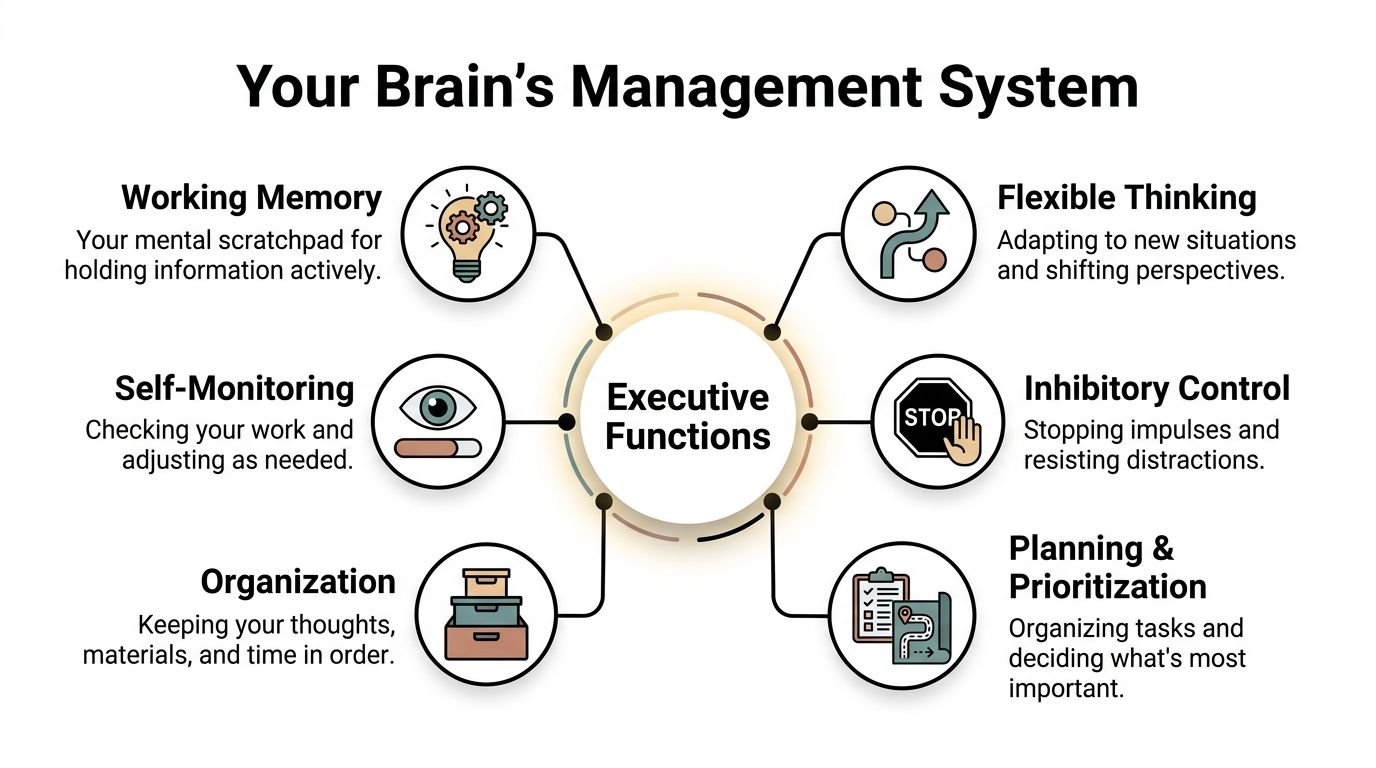
Clinicians often describe executive functions as the brain’s management system. I often explain them to patients as the air traffic control of daily life. They help you hold information in mind, shift between tasks, stop yourself acting too quickly, decide what matters now, and recover when plans change.
When daily life starts to narrow
Adults usually seek executive function testing when the cost of coping becomes too high. Work suffers. Relationships become strained. University deadlines pile up. Some people begin to suspect ADHD. Others wonder about Autism because routine changes feel disproportionately distressing, or because multitasking and social demands leave them depleted.
A proper assessment doesn’t start with a label. It starts with the pattern.
- Work problems: You can do the job, but not consistently. You miss steps, overfocus on the wrong task, or leave essential work until pressure is extreme.
- Home problems: Bills, forms, cleaning, and planning meals feel harder than they should.
- Social problems: You interrupt, lose track, forget plans, or feel overloaded by competing demands.
- Emotional impact: Repeated underperformance often leads to shame, anxiety, low mood, or all three.
For many adults, reading about the signs of ADHD in adults helps them recognise that what they’ve called “bad habits” may reflect a more consistent cognitive pattern.
Executive difficulties rarely show up as one dramatic problem. They usually appear as repeated friction across ordinary parts of life.
That’s why testing can be useful. Not because a task on a screen can tell you who you are, but because carefully chosen tests can show where your cognitive system is getting stuck.
Understanding Your Brains Management System
Executive function isn’t one skill. It’s a cluster of control processes that help you translate intention into action. When patients say, “I know what I need to do, I just can’t get myself to do it,” they’re often describing executive strain rather than lack of understanding.
Early in an assessment, I usually simplify this into a few core functions people can recognise in daily life.
Three pillars most adults notice first
Working memory is your brain’s temporary whiteboard. It holds information long enough to use it. If this is weak, you may walk upstairs and forget why, lose track in meetings, or miss the second half of a verbal instruction because the first half already occupied your mental space.
Inhibitory control is your impulse filter. It helps you stop, pause, and choose. If this is under strain, you may interrupt, click away from a task whenever a new thought appears, overspend, or react before thinking.
Cognitive flexibility is your gear shift. It lets you adapt when the plan changes. If flexibility is reduced, a cancelled appointment, altered route, or unexpected question can feel far more destabilising than other people expect.
This visual summary helps many adults put names to the mental processes they’ve been experiencing for years.
The broader management system
Executive function testing often looks beyond those three pillars.
- Planning and prioritisation: Deciding what to do first, what can wait, and how to break larger tasks into workable steps.
- Organisation: Keeping time, materials, information, and commitments in order.
- Self-monitoring: Noticing when you’ve drifted off task, misunderstood something, or made an avoidable error.
These problems can look different in ADHD and Autism. In ADHD, the person may know exactly what matters but struggle to sustain attention, inhibit distractions, or estimate time realistically. In Autism, the difficulty may lie more in switching, adapting, and managing cognitive load when routines or expectations shift. Of course, many adults have overlapping features.
A short explainer can be useful before a formal assessment:
What these difficulties look like in adult life
The reason executive function testing matters is that the impairments are often subtle from the outside and exhausting from the inside.
| Executive function | Everyday adult example |
|---|---|
| Working memory | Forgetting what was said halfway through a conversation or task |
| Inhibitory control | Replying too quickly, buying impulsively, or being pulled off task by minor distractions |
| Cognitive flexibility | Becoming stuck when plans change or when there are multiple possible ways to proceed |
| Planning | Underestimating how long tasks will take and starting too late |
| Organisation | Losing paperwork, misplacing essentials, struggling with routines |
| Self-monitoring | Missing mistakes until someone else points them out |
Clinical insight: Adults often arrive saying they have a motivation problem. What they’re describing is often a regulation problem.
Why EF Tests Are a Tool Not a Diagnosis
This is the point many people need stated plainly. Executive function testing does not diagnose ADHD or Autism on its own. It measures aspects of cognition. Those results then need interpretation within a full psychiatric and developmental assessment.
A poor score on an inhibition task doesn’t automatically mean ADHD. Difficulty with planning doesn’t automatically mean Autism. Anxiety, depression, trauma, sleep problems, burnout, medication effects, and other mental health conditions can all affect executive performance.
Why test scores need clinical context
Research confirms that EF tests are “not specific enough to differentiate” between various conditions, so they cannot independently confirm a neurodevelopmental disorder. The same research also notes that in the UK, 70% of adults awaiting ADHD assessment report comorbid anxiety or depression, which is exactly why careful interpretation matters in clinical practice, as described in this review of executive function screening and diagnostic limits.
That means a psychiatrist doesn’t read a score in isolation. We ask questions such as:
- When did these difficulties begin? ADHD and Autism usually involve longstanding patterns, not just recent decline.
- Where do they appear? Across work, relationships, education, and home, or mainly during periods of stress?
- What else is happening? Anxiety, depression, grief, trauma, sleep deprivation, and burnout can all mimic executive dysfunction.
- What was childhood like? Developmental history remains central when considering neurodevelopmental diagnoses.
What patients often misunderstand
Many adults hope testing will deliver a simple yes or no answer. In reality, testing is more like a scan of function than a diagnostic verdict.
A test can show that planning, shifting, or inhibition are weak. It cannot, by itself, tell you why.
That “why” comes from synthesis. The clinician brings together symptom history, developmental information, rating scales, mental state, differential diagnosis, and functional impact. Without that step, there’s a risk of giving someone a vague cognitive label when they need treatment for anxiety, depression, burnout, ADHD, Autism, or more than one of these at the same time.
What testing does well
Executive function testing is still very useful when used properly. It can:
- Identify patterns: Which cognitive processes are underperforming and which remain strong.
- Support differential thinking: Whether the pattern is broadly consistent with suspected ADHD or Autism, or whether another explanation needs more weight.
- Guide recommendations: What kind of support is likely to help at work, university, or home.
- Ground the conversation: It gives objective data, which can be reassuring for adults who’ve spent years being told they need to try harder.
Used well, executive function testing sharpens diagnosis. Used badly, it creates false certainty.
Common Neuropsychological Tests and What They Measure
Patients are often surprised by how ordinary some executive function tests look. Sorting cards, naming colours, connecting numbers and letters. The tasks can seem simple on the surface. What matters is how your brain manages speed, switching, inhibition, strategy, and errors under structured conditions.
The clinician’s toolkit
No single test captures the whole picture. Different tools sample different parts of executive function.
The Wisconsin Card Sorting Test (WCST) is commonly used to look at cognitive flexibility and problem-solving. It asks you to work out a sorting rule, then adapt when the rule changes. People who struggle with mental shifting may perseverate, meaning they continue with an old strategy after it has stopped working.
The Stroop Test examines inhibitory control. You may be asked to name the ink colour of a word rather than read the word itself. The task sounds easy until automatic responses compete with the instruction.
The Trail Making Test looks at speeded visual attention and mental shifting. It often involves connecting items in sequence while switching between categories. This can show whether someone slows significantly when the task demands become more complex.
The D-KEFS is particularly important in UK practice because it brings several executive tasks together within one framework.
Common Executive Function Tests at a Glance
The table below gives a practical overview.
| Test Name | Primary Skill Measured | What the Task Is Like |
|---|---|---|
| Wisconsin Card Sorting Test | Cognitive flexibility | You sort cards by a rule that changes, and you must detect and adapt to the new rule |
| Stroop Test | Inhibitory control | You suppress the automatic response and follow a competing instruction |
| Trail Making Test | Mental shifting | You connect items in order while switching between sets or rules |
| Verbal fluency tasks | Retrieval and flexibility | You generate words under specific rules, often with time pressure |
| Planning tasks | Planning and sequencing | You organise a route, structure, or set of moves to achieve a goal |
| Rating scales | Everyday executive functioning | You or someone who knows you well reports how difficulties show up in ordinary life |
For adults who struggle with emotional reactivity as well as planning and inhibition, it can also help to understand related patterns through tools such as an emotional dysregulation test overview, because emotional regulation and executive control often interact in clinical presentations.
Why standardisation matters in the UK
The Delis-Kaplan Executive Function System (D-KEFS) is the first nationally standardised set of tests in the UK to evaluate higher-level cognitive functions in both children and adults, providing a reliable benchmark for diagnosing executive dysfunction in ADHD and ASD contexts, according to Pearson Clinical’s D-KEFS information for the UK.
That matters because interpretation depends on comparing a person’s performance against an appropriate reference framework. If a tool is well standardised for the population being assessed, the results are more clinically useful.
What these tests don’t capture well on their own
Structured tests are powerful, but they have limits. Someone may perform reasonably well in a quiet testing room and still fall apart in real life when there are competing demands, emotional stress, sensory overload, or no external structure.
That’s why a good clinician uses tests as one part of a broader formulation. The question isn’t just “Can you do this task here?” It’s also “What happens when no one is organising the environment for you?”
The Assessment Journey From First Call to Final Report
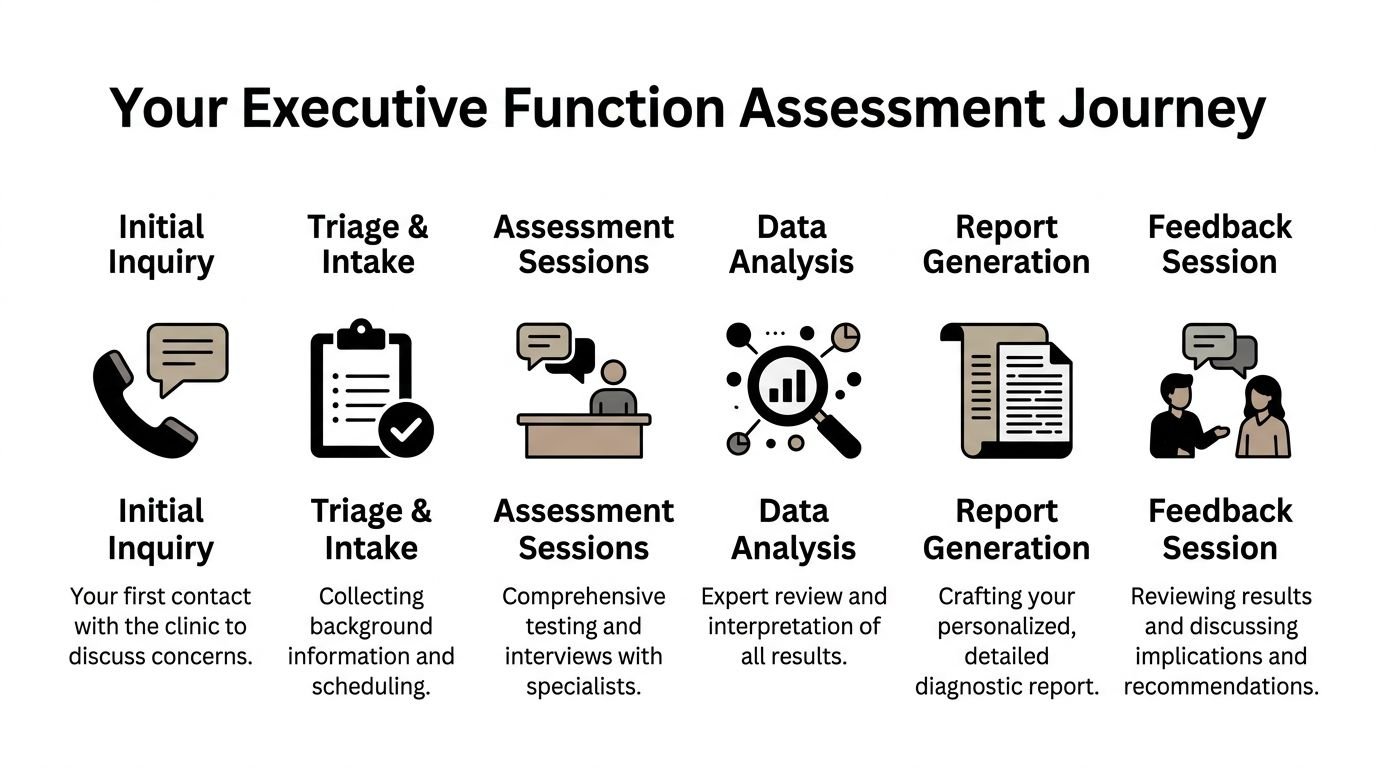
Many adults delay assessment because they fear the process will be awkward, exposing, or exhausting. In practice, the best assessments feel structured rather than intimidating. You’re not expected to arrive with perfect recall or polished language. The clinic’s job is to gather information carefully enough that the picture becomes clear.
What usually happens first
The journey often starts with triage. That means identifying the main concern, checking whether the presentation points toward ADHD, Autism, another mental health condition, or a combination, and making sure the right kind of assessment is booked. Patients who want a clearer sense of how this early stage works often benefit from reading about mental health triage assessments.
After that comes the detailed interview, during which a consultant psychiatrist explores current symptoms, childhood history, educational and occupational patterns, relationships, mental health history, and possible alternative explanations. If executive function testing is indicated, the testing session is then selected to answer specific clinical questions rather than used as a generic add-on.
Online and face-to-face testing
Remote assessment has become far more common, particularly because long waits have pushed many adults to look beyond standard in-person routes. But online executive function testing isn’t automatically equivalent to face-to-face testing.
According to guidance on remote executive function assessment validity, demand for online EF testing is high due to long waits, but validity depends on rigorous protocols. The same source notes that remote results can show reduced reliability without clinician-led measures such as building rapport and providing thorough instructions.
What works online: a quiet room, clear instructions, planned breaks, stable technology, and a clinician who knows when a result may have been distorted by the testing environment.
What a good process feels like on the day
A sound assessment process usually includes:
- Preparation before the session: You receive clear instructions about technology, timing, documents, and the testing environment.
- Structured clinical interview: The psychiatrist asks targeted questions, not random ones. Nuance often emerges from such questions.
- Focused testing: Tasks are selected to examine specific executive functions, not merely to create a long battery.
- Interpretation: Scores are reviewed alongside the interview, history, and behavioural observations.
- Feedback and report: You’re told what the findings do and do not mean, in plain language.
Some providers also offer prompt scheduling and fast report turnaround, which can be especially important when employment, university support, or treatment decisions can’t wait indefinitely. Speed only helps, though, if the process remains clinically careful.
Interpreting Your Report and Planning Next Steps
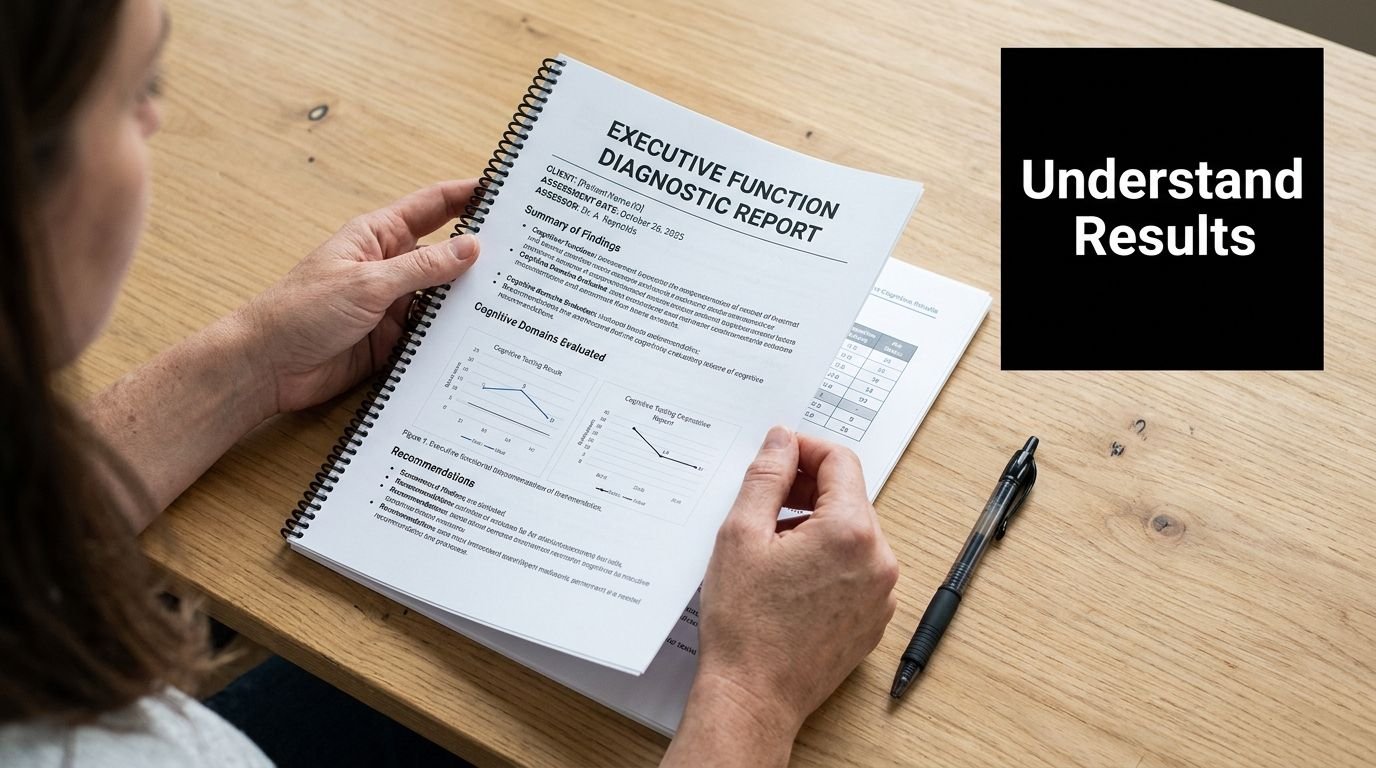
The report matters as much as the assessment. A weak report leaves people with labels and little direction. A good report explains the evidence, the clinical reasoning, and the practical implications.
What to look for in the report
A robust report usually includes several distinct parts.
- Background history: Development, education, work, mental health, and the reasons for referral.
- Test findings: Not just raw outcomes, but an explanation of what those outcomes mean in context.
- Diagnostic formulation: The clinician’s reasoning about whether the full picture supports ADHD, Autism, another condition, or a mixed presentation.
- Recommendations: Clear next steps for treatment, support, and adjustment.
Patients often get stuck on score summaries and miss the formulation. The formulation is the heart of the report. It connects data to your real life.
Why performance tests and rating scales both matter
Research confirms that performance tests and rating scales cannot be used interchangeably. Performance tests have stronger predictive validity for outcomes such as academic achievement, while ratings provide context about day-to-day difficulties. A complete assessment needs both, as outlined in this study on executive function performance tests and ratings.
That distinction is clinically useful.
| Part of the assessment | What it helps show |
|---|---|
| Performance tests | What you can do under structured conditions |
| Rating scales | How difficulties appear in ordinary life |
| Clinical interview | Why the pattern may be occurring and how it fits diagnostically |
Some adults perform better in testing than they do in life because the room is quiet, the task is clear, and someone else is setting the structure. That doesn’t mean their real-world difficulties aren’t genuine.
Turning findings into practical support
A good report should lead somewhere. Depending on the outcome, next steps might include medication review, psychological therapy, coaching, occupational strategies, workplace adjustments, university support, or further assessment where the picture remains mixed.
For work, recommendations often need translating into practical behaviour. Resources on neurodiversity-aware work strategies can be useful when you’re trying to convert abstract findings into changes that help with task management, communication, and routine.
Examples of sensible recommendations include:
- For ADHD-type difficulties: external deadlines, reduced multitasking, written follow-up after meetings, medication where appropriate.
- For Autism-related executive strain: predictability, reduced last-minute changes, clearer transitions, sensory load awareness.
- For mixed mental health presentations: treatment of anxiety or depression alongside support for executive weaknesses, rather than assuming one diagnosis explains everything.
The report shouldn’t just tell you what’s wrong. It should help you function better.
How to Choose a Qualified Assessment Provider in the UK
Not all executive function testing is clinically meaningful. Some services offer brief screening and present it as diagnosis. Others use cognitive tasks without proper psychiatric interpretation. That’s where adults can lose time, money, and confidence.
A sensible checklist
When choosing a provider, look for the following:
- CQC regulation: This tells you the service is operating within a regulated healthcare framework.
- Consultant psychiatrist leadership: The assessment should be led by a clinician who can diagnose, consider differential diagnoses, and plan treatment.
- GMC Specialist Register status: This is especially important for neurodevelopmental and complex mental health assessments.
- Adult expertise: Adult ADHD and Autism are not just childhood conditions carried forward unchanged.
- Clear reporting: Ask whether the final report includes formulation, diagnosis where appropriate, and recommendations.
- Transparent pathways: You should know what happens before, during, and after the assessment.
- Open pricing and timelines: Hidden steps often create confusion later.
A useful starting point for many adults is learning how to find a psychiatrist in the UK, because clinician quality shapes the entire experience more than branding does.
Why senior clinical expertise matters
For neurodevelopmental and personality-related complexity, senior medical oversight matters. Adults may present with ADHD traits, autistic traits, trauma, anxiety, depression, emotional dysregulation, or personality factors that overlap. That’s where an experienced consultant psychiatrist is essential.
Dr Sai Achuthan is an example of the level of expertise patients should look for: a leading Consultant Psychiatrist with extensive experience in neurodevelopmental conditions and personality disorder. In the best assessments, that experience shows up in the quality of the questions, the differential diagnosis, and the clarity of the final formulation.
The right provider won’t rush you into a label. They’ll work carefully enough that the label, if one is given, actually fits.
If you’re considering assessment, ask direct questions. Who conducts it? What tools are used? Is the service regulated? Will the report be suitable for treatment planning and support requests? Clear answers are a good sign. Vagueness usually isn’t.
If you want a consultant-led route to adult ADHD, Autism, and broader mental health assessment, Insight Diagnostics Global offers online and face-to-face evaluations for adults aged 18 and over. The service is CQC regulated, led by psychiatrists on the GMC Specialist Register, and provides structured triage, detailed reports, and personalised recommendations. If you’re weighing private assessment, using Right to Choose, or trying to separate burnout from a neurodevelopmental condition, getting in touch is a practical first step.