

You may be sitting with a GP note open on one tab, a private clinic website on another, and a growing sense that none of this should be so hard. You know something hasn't felt right for a long time. Perhaps it's attention problems that never quite fit the usual explanations. Perhaps social exhaustion, sensory overload, shutdowns, or years of being told you're “just stressed”. By the time many adults start trying to find a psychiatrist in the UK, they're already tired of explaining themselves.
That exhaustion matters. People seeking ADHD, autism, and broader mental health assessment often arrive at the system after years of compensating, masking, or being misread. The problem isn't just getting an appointment. It's finding the right clinician, through the right route, with the right level of diagnostic care.
Navigating the First Steps to Mental Health Support
A common starting point looks like this. An adult has struggled since school, held things together through routine and overwork, then reaches a point where work, study, parenting, or relationships become much harder to manage. They ask for help and discover that the system has several doors, each with different rules.

For ADHD in particular, the delays can feel defeating. In the UK, adult ADHD assessments are frequently delayed by 2–5 years on NHS waiting lists, with over 700,000 adults in England awaiting diagnosis. The Right to Choose policy allows patients to bypass those delays by requesting referral to private providers, and some consultant-led services state they can offer assessments within 7 working days and reports within 5 working days through that route or privately funded care, as outlined by Insight Diagnostics Global's mental health assessment guidance.
Three routes most people weigh up
Finding a psychiatrist often involves choosing between:
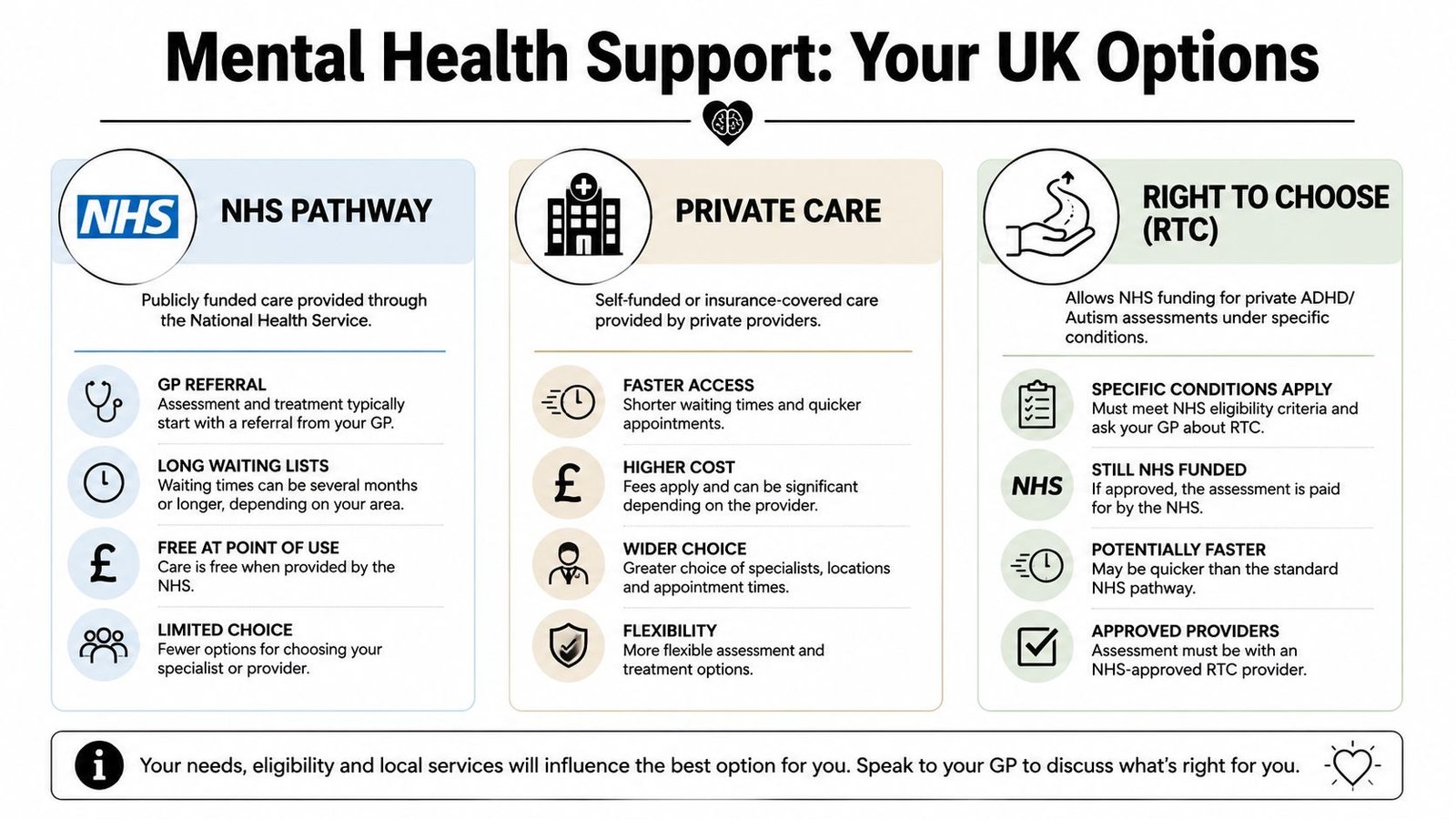
- Standard NHS referral: Free at the point of use, but often slow and less flexible in choice of assessor.
- Private care: Faster access and broader clinician choice, but you must check credentials carefully and sort payment or insurance.
- Right to Choose: NHS-funded in England for eligible referrals, often the most strategic middle ground if you want speed without fully self-funding.
Practical rule: Don't choose a route based only on speed. Choose based on diagnostic quality, follow-up options, and whether the service can actually support what happens after the assessment.
Why the process feels harder than it should
Part of the frustration is administrative, not clinical. Patients often need forms, referral wording, insurer approval, and clarity on who is qualified to assess ADHD, autism, anxiety, depression, or overlapping conditions. That's especially true when symptoms don't fall neatly into one box.
Access also isn't only about waiting time. It's about whether the process itself excludes people who are already struggling with concentration, executive function, anxiety, or sensory overload. That's one reason broader conversations about healthcare accessibility matter. A service can be clinically strong and still hard to use if its booking, documents, and communication aren't accessible.
Understanding Your Options NHS vs Private vs Right to Choose
The simplest version is this. The NHS route costs less but may take much longer. Private care can move quickly but asks more of you upfront. Right to Choose sits between the two, but only works well when patients and GPs use it correctly.
A practical comparison
| Route | What works well | Main trade-off | Best fit for |
|---|---|---|---|
| Standard NHS | No direct private fee, integrated with usual NHS care | Long waits, less control over who assesses you | People who can wait and prefer local NHS pathways |
| Private | Faster booking, wider choice of specialist, more flexibility | Cost, insurance admin, need to vet credentials carefully | People who want quicker access and can self-fund or use insurance |
| Right to Choose | NHS-funded assessment with more choice than standard NHS referral | Paperwork matters, GP knowledge varies, provider waits differ | Adults in England seeking ADHD or autism assessment without full private cost |
The Right to Choose paradox
Many patients hear “you have the right to choose” and reasonably assume that means a short wait. It doesn't always. Some providers still report 10–12 month waits for adult ADHD assessments under Right to Choose, which is why provider selection matters as much as the legal pathway itself, as shown by Psychiatry UK waiting information.
That catches people off guard. They've done the hard part by asking for help, but they still need to compare providers rather than assuming every Right to Choose route moves at the same pace.
A legal right doesn't remove queue pressure. It gives you more control over where you join the queue.
How patients usually choose badly
People often choose on a single factor. Speed. Cost. A polished website. One glowing review. That isn't enough if you're dealing with possible ADHD, autism, burnout, anxiety, depression, or personality-related difficulties that may overlap.
A better way to decide is to rank these in order:
Clinical fit
Does the service assess the condition you suspect, and does it look equipped to separate overlap from mimicry?Consultant-level oversight
Is the assessment clearly psychiatrist-led where medical diagnosis or prescribing may matter?Aftercare
Can the service support medication decisions, reports for workplace or university use, and follow-up if the diagnosis is not straightforward?Administrative reliability
Can they explain referral paperwork, timelines, and next steps in plain English?
For adults weighing broader support alongside neurodevelopmental assessment, it also helps to read a service's approach to mental health services for adults. The strongest services don't treat ADHD or autism as isolated labels. They look at the whole picture.
How to Use Your Right to Choose for Faster Assessment
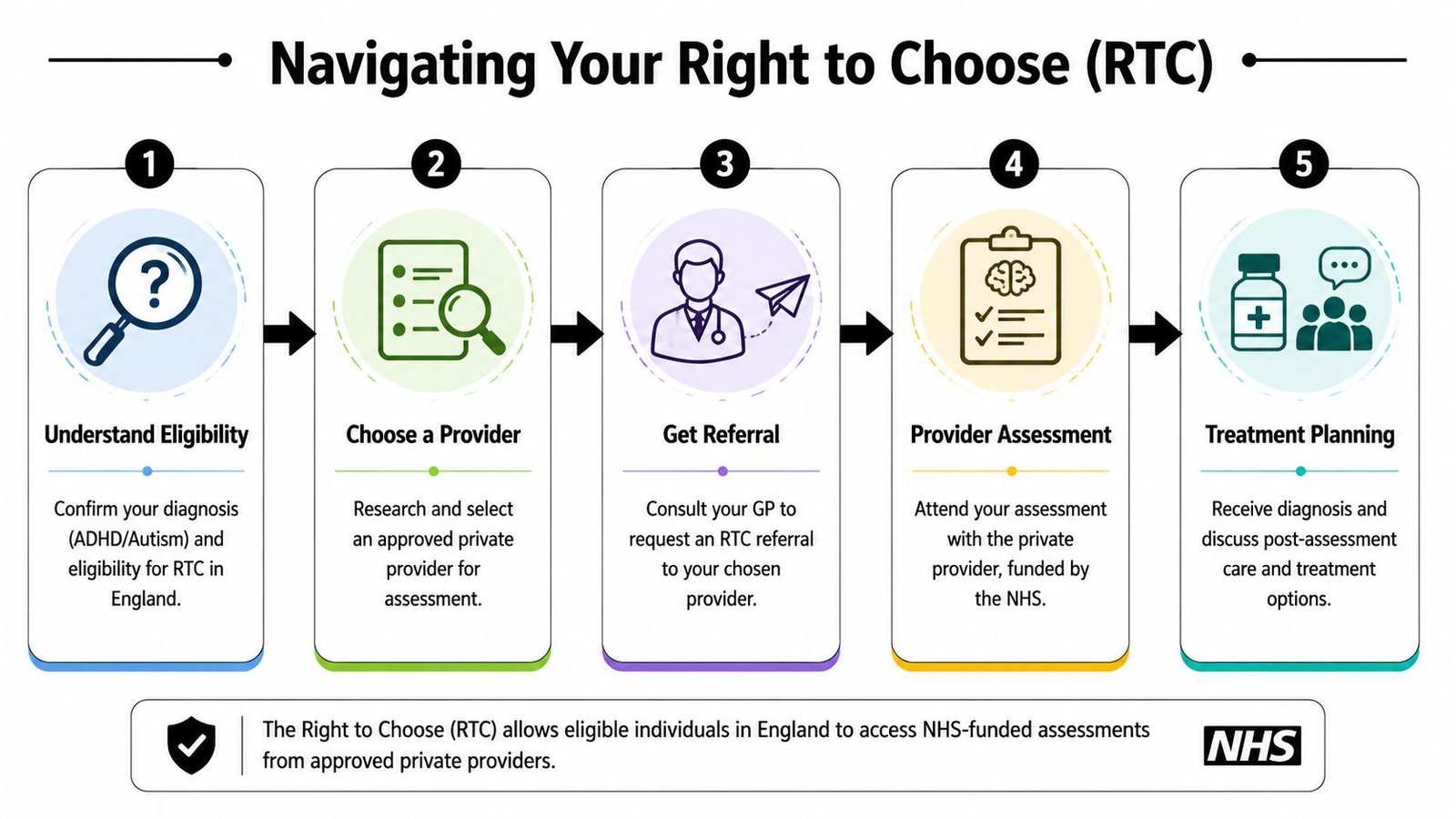
Right to Choose works best when you treat it as a process, not a phrase. Patients often know they're entitled to ask. Fewer know exactly what to say, what to bring, or what tends to delay the referral.
The steps that usually make the difference
Confirm that Right to Choose applies to you
In practice, this is most often discussed for NHS-funded ADHD and autism assessment in England. Your GP remains the referral gatekeeper.Choose the provider before the GP appointment
Don't attend the appointment saying you want “somewhere faster”. Attend knowing which provider you want referred to and why.Take the provider's referral paperwork with you
Many referrals often stall at this point. The Right to Choose pathway has a documented 95% success rate in securing an appointment within 12 weeks when followed correctly, bypassing the average 3-year NHS waiting list for neurodevelopmental disorders. A key step is presenting the provider's specific Right to Choose referral letter to the GP, as explained in Insight Diagnostics Global's Right to Choose guide.Be concise about symptoms and impairment
Your GP doesn't need a life story in that moment. They need enough information to justify referral clearly.Follow up in writing
If the referral hasn't been sent, a polite written message through the practice system often helps keep things moving.
Later in the process, some people also find it useful to hear a visual explanation before speaking to the GP.
What to say to your GP
You don't need perfect language. You need clear language. Something like this is usually enough:
I'd like to be referred for an ADHD or autism assessment under Right to Choose. I've identified a provider and brought the referral paperwork. My symptoms are affecting work, daily functioning, and mental health, and I'd like the referral sent through this pathway.
Common problems and what usually helps
- GP unfamiliarity: Some GPs know the process well. Others don't use it often. Bringing the provider paperwork makes the conversation easier.
- Verbal requests only: Patients sometimes leave the appointment assuming the referral will happen. If the paperwork wasn't attached, delays are common.
- Choosing on name recognition alone: A well-known provider may still have a long queue. Confirm current practical timelines before requesting referral.
- No plan for after diagnosis: Before you choose, ask what happens if medication, shared care discussion, or workplace evidence is needed later.
Bring a short symptom summary, examples of impairment, and the referral form. That usually works better than trying to explain everything from memory.
How to Vet and Choose a Private Psychiatrist
Private care can be excellent. It can also be uneven. The title on a website isn't enough. If you want a psychiatrist for ADHD, autism, or complex mental health assessment, the key factor is whether the clinician is operating at consultant level and within a regulated service.
What to verify first
Start with two essentials:
GMC Specialist Register
This is the strongest public sign that a psychiatrist is recognised at consultant level in their specialty area.CQC oversight
This tells you the service itself is regulated, not just the individual doctor.
For neurodevelopmental work, training depth matters. Consultant Psychiatrists in the UK specialising in neurodevelopmental disorders must complete 3 years of core training plus up to 3 years of specialist training. Dr Sai Achuthan, a leading Consultant Psychiatrist with extensive experience in neurodevelopmental and personality disorder work, holds GMC Specialist Register certification and practises within CQC oversight, reflecting the standard patients should look for in any consultant-led service.
The questions worth asking before booking
A good private assessment should tolerate scrutiny. If a service doesn't answer these clearly, pause.
Who leads the assessment?
Ask whether the assessment is consultant-led and whether a psychiatrist is directly involved in diagnosis.What conditions do they differentiate?
ADHD and autism can overlap with anxiety, depression, trauma, personality difficulties, sleep problems, and burnout. Ask how they sort that out.What does the report include?
You want more than a label. You want a usable report with reasoning, recommendations, and next steps.What follow-up is available?
If medication, titration, or diagnostic clarification is needed, can the same service continue care?
One practical way to prepare is to review a checklist of questions to ask your psychiatrist before booking an assessment. Patients who do this tend to spot weak services much earlier.
What usually signals trouble
| Good sign | Warning sign |
|---|---|
| Clear consultant credentials | Vague wording like “specialist team” without naming qualifications |
| Regulated service | No visible mention of regulation or governance |
| Transparent assessment pathway | Unclear process, unclear report contents |
| Willingness to discuss complexity | Pushes one diagnosis before hearing the full history |
A proper psychiatric assessment should feel thorough, not scripted. If the clinic seems more interested in processing bookings than understanding your history, keep looking.
Managing Costs Insurance and Preparing for Your First Session
Paying for private psychiatric care can be stressful even when you've decided it's the right route. The mistake I see most often isn't choosing private care. It's assuming the financial side will sort itself out afterwards.
Insurance problems usually start before the first appointment
If you're using insurance, don't book first and ask permission later. A critical financial pitfall is that 70% of successful private engagements require pre-authorisation from health insurers like Vitality or Aviva using a specific Letter of Guarantee template. If that isn't secured before the initial consultation, there is an 85% rejection rate of claims.
That single administrative step can determine whether the appointment is covered.
Financial check: Ask your insurer what authorisation document they require, whether psychiatric assessment is covered, and whether they need the clinician or clinic details in advance.
What to organise before you attend
Bring order to the information before the session. That reduces anxiety and improves diagnostic clarity.
A symptom timeline
Note when problems began, not just when they became unmanageable. Childhood patterns matter in ADHD and autism assessments.Examples of functional impact
Missed deadlines, relationship strain, academic difficulties, sensory issues, burnout cycles, impulsive spending, or emotional dysregulation all help a psychiatrist understand the pattern.Past treatment history
Include therapy, medication, previous diagnoses, and anything that helped or didn't.Collateral information if available
School reports, family observations, or old records can be useful where relevant.
Burnout can cloud the picture
Many adults seek assessment during a period of collapse. That makes sense, but it can also blur the clinical picture. Burnout, especially in students and professionals, can look like ADHD or autism from the outside. Equally, undiagnosed ADHD or autism can drive repeated burnout.
That's why the first session should not focus only on how bad the last few months have been. It should look at the pattern across years, settings, and life stages.
Ask yourself:
- Were these difficulties present before the recent period of stress?
- Do the same patterns show up at work, at home, socially, or in education?
- What have you had to do to compensate, mask, or over-prepare?
A careful psychiatrist won't rush to label distress that is better explained by burnout alone. Equally, they won't dismiss longstanding neurodevelopmental traits just because you're exhausted now.
Your Journey After Diagnosis Treatment and Support
A diagnosis should bring direction, not just relief. The report ought to explain how the clinician reached their conclusion, what else was considered, and what support makes sense next. That may include medication discussion, psychological strategies, workplace adjustments, educational evidence, or a plan for further assessment if the picture is mixed.
What good follow-up usually looks like
The strongest post-diagnostic care is structured. It doesn't end with a PDF and a brief letter to the GP.
A solid plan often includes:
- Clear recommendations for treatment and support
- Practical adjustments for work, study, or home life
- Follow-up reviews if symptoms, risk, or functioning need monitoring
- Medication pathways where appropriate and clinically indicated
For ADHD, medication work should never feel casual. In the UK, ADHD medication titration requires monitoring every 3–6 months under NICE guidelines, with 68% of patients achieving stable therapeutic doses after 4 titration cycles. Structured titration with follow-up consultations is an important part of safe ongoing care.
Diagnosis is a beginning, not a finish line
Some people feel immediate clarity after assessment. Others need time to absorb it. That's normal. An autism or ADHD diagnosis can reframe years of self-criticism. It can also raise new questions about identity, relationships, work, and support.
The value of diagnosis isn't the label alone. It's what the label allows you to do next, more accurately and with less self-blame.
If you're trying to find a psychiatrist in the UK, aim for more than speed. Look for a clinician and service that can assess carefully, distinguish burnout from disorder, understand overlap with anxiety or depression, and stay involved after the result is given. That's what makes the process clinically useful rather than merely efficient.
If you want a consultant-led route with assessments for ADHD, autism, and broader adult mental health, Insight Diagnostics Global offers online and face-to-face care for adults aged 18 and over. Their service is CQC regulated, led by psychiatrists on the GMC Specialist Register, and includes structured psychological assessment, diagnostic reports, and ongoing support such as ADHD titration and follow-up when needed.
One Response