

You’re often not starting with a clinic appointment. You’re starting with a search bar.
It’s late, the house is quiet, and you’ve typed in “adult ADHD test online” because something has felt off for years. Maybe you miss deadlines you care about. Maybe your mind races but routine tasks still stall. Maybe you’ve spent years being told you’re disorganised, lazy, overcommitted, too sensitive, or bad at “adulting”.
That search is understandable. It’s also common. In England, 13.9% of adults, or one in seven, scored at or above the clinical threshold on the Adult ADHD Self-Report Scale (ASRS), the point at which a formal assessment for ADHD may be warranted, according to the Adult Psychiatric Morbidity Survey 2023 to 2024.
If you’re still working out whether your experiences fit the pattern, it helps to first understand adult ADHD symptoms in practical, day-to-day terms rather than relying on social media shorthand. And if you’ve already completed a screener, a useful next read is this overview of an online ADHD test and how it fits into proper assessment.
That Late Night Search for an Adult ADHD Test Online
A typical story goes like this. Someone does reasonably well on the outside, perhaps even very well, but only through intense effort, panic, masking, overcompensation, and exhaustion. They start seeing descriptions of inattentive ADHD, or perhaps Autism and ADHD together, and suddenly years of difficulty begin to make sense.
That moment can bring relief, but also a dangerous shortcut. A score from an online quiz can feel like an answer when it’s really the start of a much bigger clinical question.
What people are usually trying to answer
Most adults searching for an adult ADHD test online aren’t asking a purely academic question. They’re asking things like:
- Why do simple tasks feel disproportionately hard
- Why have I always needed crisis pressure to finish things
- Why do relationships suffer because I interrupt, forget, or mentally drift
- Why does work look manageable for others but chaotic for me
- Could this be ADHD, Autism, anxiety, burnout, depression, or a mixture
That last question matters. In practice, neurodevelopmental conditions and mental health conditions often overlap. A proper psychological assessment doesn’t just ask whether ADHD traits are present. It asks what else may be going on around them.
A useful online test can help you decide whether to seek an assessment. It cannot tell you, on its own, what diagnosis is driving your difficulties.
What actually helps after the search
What helps next is clarity. Not hype. Not a “3-minute diagnosis”. Not the false reassurance that a high score means medication is inevitable, or the false dismissal that a low score means nothing important is happening.
The fundamental task is to map the route from screener result to a proper UK assessment, then to a treatment and support plan that fits your life. That’s where consultant-led psychiatry, careful developmental history, and broader mental health assessment become far more valuable than any online result screen.
Screener vs Diagnosis Understanding Your Online Test
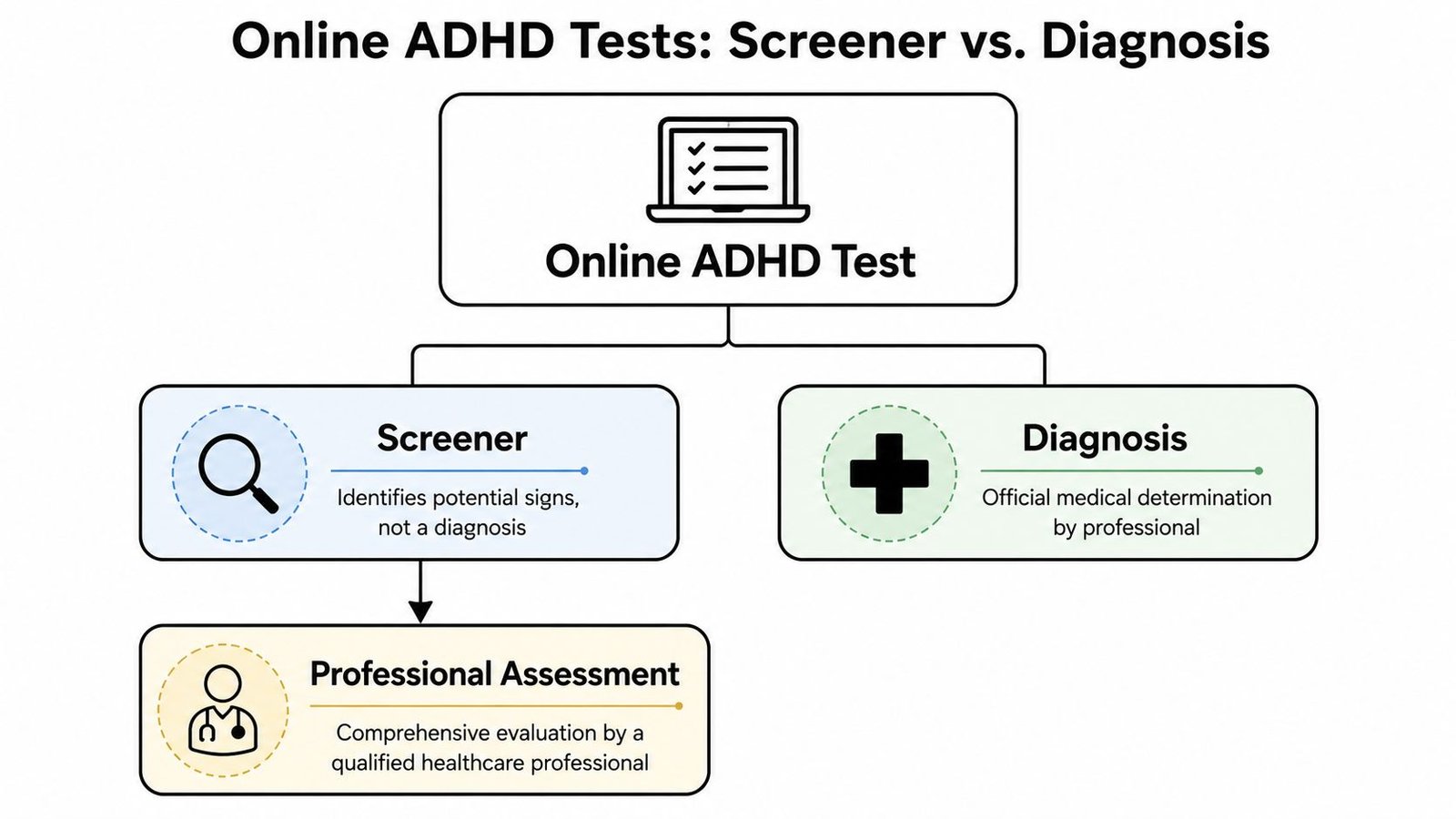
Most online ADHD tests are not diagnostic tests. They are screeners.
The common one is the World Health Organisation’s Adult ADHD Self-Report Scale, ASRS v1.1. It’s widely used for a reason. It helps identify whether someone’s symptoms are strong enough to justify further review. But it was never designed to replace a full assessment.
What the ASRS is for
According to ADHD UK’s explanation of the adult ADHD screening survey, the most common online tests use the WHO’s Adult ADHD Self-Report Scale (ASRS v1.1), a validated screening tool. Scoring 4 or more on its first 6 questions suggests a high likelihood that a clinical review is needed, but it does not replace a full assessment by a qualified professional, which is required to confirm a diagnosis.
That’s the key distinction. Needed review is not the same as confirmed diagnosis.
If you want a broader plain-English overview of terms people still use, including the older label “ADD”, this guide to ADD and ADHD for adults can help untangle the language. For a related clinic explainer, this article on a quiz for ADD in adults is also useful.
What a diagnosis actually requires
A diagnosis is a clinical judgement made by a qualified professional after looking at much more than symptom ticks on a screen.
A proper diagnostic process asks:
- Did symptoms begin in childhood or is this a newer change better explained by stress, trauma, mood, sleep, or illness?
- Do symptoms show up in more than one setting, such as work, home, relationships, and daily routines?
- Is there real functional impairment, not just personality style?
- Could another condition explain the picture more accurately
- Are there co-existing conditions, including Autism, anxiety, depression, trauma-related difficulties, or personality factors?
Why online quizzes hit a limit
An online screener can’t probe context. It can’t challenge inconsistencies. It can’t ask follow-up questions when an answer could mean three different things. It can’t separate lifelong inattentiveness from recent cognitive overload.
Clinical rule: Use a screener to decide whether to seek help. Don’t use it to self-prescribe a diagnosis.
That’s why people often feel confused after taking an adult ADHD test online. The quiz may be useful, but the meaning of the result still needs interpretation.
What a High Score Really Means and What It Can Miss
A high score often means one thing clearly. Your symptoms deserve proper attention.
It doesn’t always mean ADHD is the final answer.
Why false confidence is risky
One of the biggest mistakes I see is treating a high screener score as a verdict. It’s understandable. If you’ve struggled for years, a result that seems to explain everything can feel deeply validating.
But symptoms associated with ADHD overlap with several other presentations. Difficulty concentrating, mental restlessness, forgetfulness, poor task completion, irritability, and emotional dysregulation can also appear in anxiety, low mood, trauma-related states, poor sleep, and prolonged burnout.

What online screeners can’t sort out
Recent UK mental health data suggests that up to 30% of adults who self-refer for a private ADHD assessment are experiencing burnout or anxiety disorders, which can mimic ADHD symptoms and require different treatment, as noted by Xyla Health’s adult ADHD test page.
That matters because the treatment pathway changes completely depending on the underlying cause.
A few examples:
- Burnout can look like inattention, poor memory, and task paralysis, but the pattern often sits within chronic stress and depletion.
- Anxiety can produce racing thoughts, procrastination, and poor concentration, especially when fear of failure is driving avoidance.
- Autism can overlap with executive function difficulties, sensory overload, rigidity, and social fatigue.
- Depression can flatten motivation and slow thinking in ways people misread as inattentive ADHD.
The question a clinician asks differently
A screener asks whether you relate to a symptom. A clinician asks what that symptom means.
For example, “I can’t focus” could mean several different things:
| Presentation | What a clinician explores |
|---|---|
| ADHD | Lifelong pattern of distractibility, disorganisation, impulsivity, and executive dysfunction |
| Anxiety | Attention pulled away by worry, threat scanning, panic, or rumination |
| Burnout | Reduced concentration after prolonged overload, overwork, and exhaustion |
| Autism | Focus difficulties shaped by sensory strain, switching demands, or mismatched environments |
The right assessment doesn’t just confirm ADHD. It also protects you from the wrong label.
That’s especially important if you’re also wondering about Autism and ADHD together, or if your difficulties intensified after a period of stress. A high score is useful. It’s just one piece of evidence.
When a Formal Assessment Is the Right Next Step
The strongest reason to seek a formal assessment isn’t the number on the screener. It’s the impact on your life.
Look at impairment, not just traits
Many adults recognise ADHD traits in themselves. Fewer stop to ask the more clinically important question. Are these difficulties repeatedly impairing work, study, relationships, finances, health, or self-esteem?
You should think seriously about a formal assessment if your pattern includes problems such as:
- Work disruption. Missing deadlines, losing track of tasks, underperforming despite effort, or relying on last-minute adrenaline to function.
- Home strain. Chronic clutter, forgotten bills, unfinished paperwork, missed appointments, or daily routines that feel unmanageable.
- Relationship friction. Interrupting, tuning out unintentionally, forgetting important details, acting impulsively, or appearing inconsistent.
- Emotional cost. Shame, self-criticism, exhaustion from masking, or the sense that life takes more effort than it seems to for other people.
Clues that it’s time to stop wondering
A formal assessment is particularly worthwhile when the same difficulties have followed you across different life stages. School, university, work, parenting, relationships, and daily administration may all show the same pattern, even if the surface details changed.
What matters isn’t whether you’ve managed to cope. Many adults do cope. What matters is the cost of coping.
If your life works only when you’re overcompensating, panicking, masking, or burning out, that’s not “fine”. It’s a sign that proper assessment may be overdue.
The purpose of diagnosis
A good diagnosis should do more than give a label. It should clarify what’s driving the problem and what treatment or support would help.
Sometimes that does lead to an ADHD diagnosis. Sometimes it leads to a different answer. Either outcome is valuable if it gets you closer to the right intervention.
Navigating UK Assessment Pathways NHS vs Private
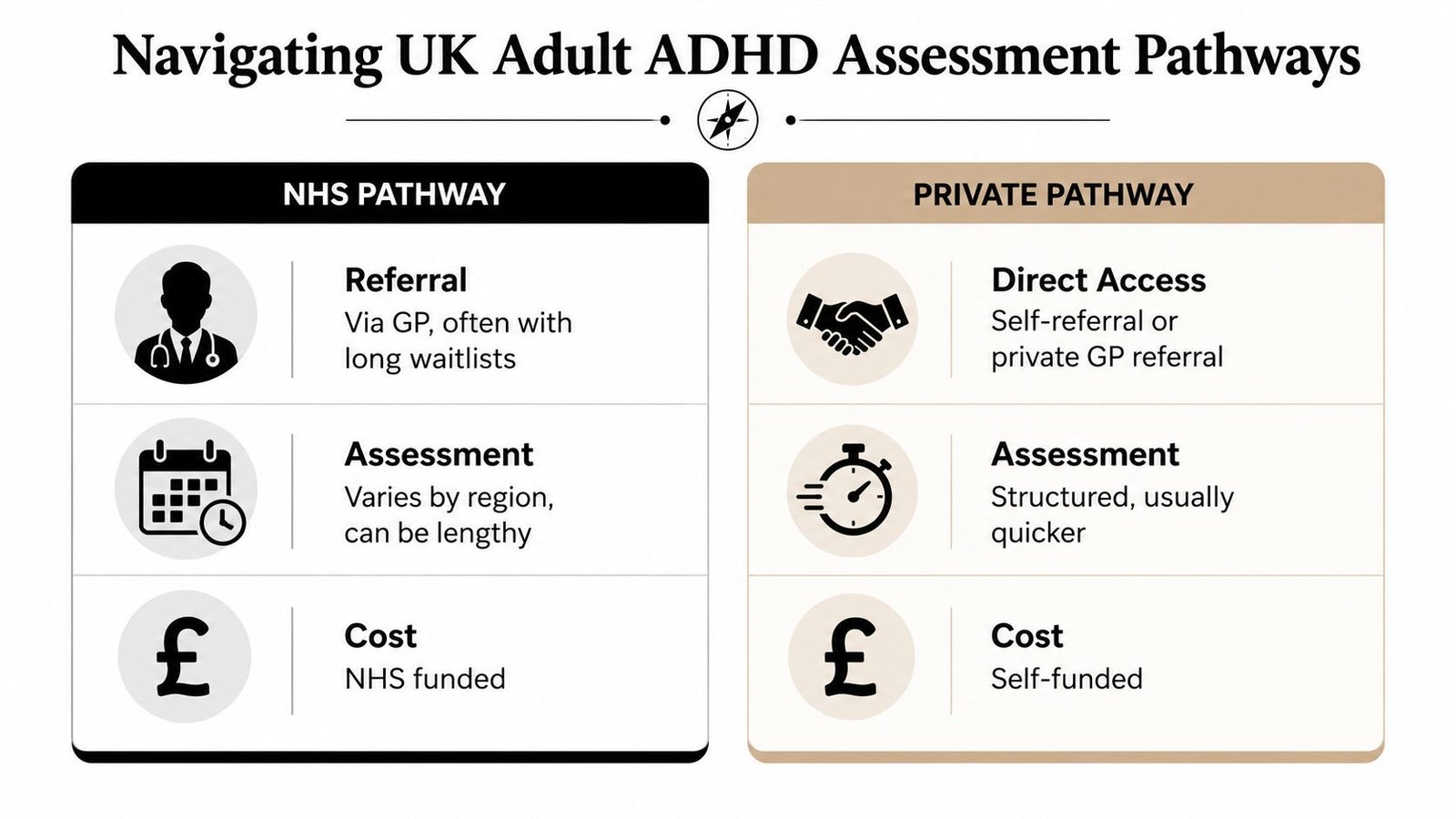
In the UK, adults usually move forward through one of two routes. The NHS pathway, sometimes including Right to Choose, or the private pathway.
Each has benefits and drawbacks. The right choice depends on urgency, budget, local availability, and how much support you need with the process.
The NHS route
The NHS route is usually the first route people consider, and understandably so. It’s NHS funded. Your GP is typically the starting point, and your online screener can be helpful as part of that conversation.
The main difficulty is access. According to BBC reporting on UK ADHD waiting lists, at least 196,000 adults are currently on a waiting list for an ADHD assessment across the UK. Demand has quadrupled since 2019, and some services estimate it could take eight years or longer to clear their backlogs at current rates.
That scale of backlog changes the practical meaning of “I should get assessed”. In many areas, it means preparing for a long wait even when the need is genuine.
Right to Choose and the reality behind it
In England, some adults explore the Right to Choose route to access an alternative provider through the NHS. This can be useful, but it isn’t automatic. A high online score alone may not be enough for a GP referral to proceed smoothly.
GPs often want a fuller picture of impairment, developmental history, and supporting evidence. School reports, workplace examples, partner observations, and a clear account of day-to-day difficulties can all make the referral discussion more grounded.
If you’re weighing that route, it helps to read a clear guide on NHS Right to Choose before speaking to your GP.
The private route
The private route is usually chosen for speed, flexibility, and direct access to specialist input. It can suit people whose work, study, family life, or mental health is being significantly affected and who don’t want to remain in prolonged uncertainty.
A simple comparison looks like this:
| Pathway | Main advantage | Main drawback |
|---|---|---|
| NHS | Funded care | Long waits and regional variation |
| Right to Choose | Potentially quicker NHS-funded alternative in some cases | Still requires GP engagement and supporting evidence |
| Private | Faster access and more scheduling flexibility | Self-funded cost |
Private assessment doesn’t mean lower standards. It should mean the same clinical rigour, just without the same delay.
The Private ADHD Assessment Process with a Consultant Psychiatrist
A good private assessment should feel structured, careful, and clinically grounded. It should not feel like a box-ticking exercise built around confirming what an online screener already suggested.
For adults exploring neurodevelopmental conditions, this matters even more. ADHD can overlap with Autism, anxiety, depression, trauma-related difficulties, and sometimes personality factors that shape mood, behaviour, relationships, and coping style. That’s why consultant-led psychiatry and thoughtful psychological assessment are so important.
The standard that matters
The UK’s Adult ADHD Assessment Quality Assurance Standard is clear on this point. As summarised on Psychology Tools’ ASRS page, a formal diagnosis relies on a minimum 2-hour semi-structured diagnostic interview, and cognitive tests or self-report scales like the ASRS are insufficient for diagnosis on their own.
That’s the benchmark worth understanding. If an assessment feels rushed, overly simplistic, or based mainly on questionnaire scores, it isn’t meeting the level of depth that adult diagnosis requires.
What typically happens before the appointment
A well-run private process usually begins with triage and paperwork. You may be asked to complete questionnaires, provide a summary of your concerns, list current medication, and share relevant mental health history.
The clinic may also ask for supporting information such as:
- School or college reports if available
- Examples of current impairment at work, home, or university
- Collateral information from a partner, parent, sibling, or someone who knows you well
- Previous assessments for mental health, Autism, or learning difficulties
This preparation helps the psychiatrist use the appointment time properly. It also reduces the risk of a narrow or premature conclusion.
What the diagnostic interview explores
The core appointment is usually a detailed semi-structured interview with a Consultant Psychiatrist. In a strong service, that means a doctor on the GMC Specialist Register, with experience in adult ADHD and broader mental health assessment.
Someone with deep neurodevelopmental and personality disorder expertise, such as Dr Sai Achuthan, will go beyond asking whether you’re forgetful or restless. The discussion usually explores your full developmental and psychiatric picture.
That commonly includes:
- Childhood history. Early behaviour, school patterns, family observations, reports, and when traits first appeared.
- Current symptoms. Inattention, impulsivity, hyperactivity, emotional dysregulation, executive function problems, and coping strategies.
- Functional impact. Work, education, relationships, finances, driving, routines, parenting, and self-care.
- Mental health review. Anxiety, depression, trauma, sleep, burnout, substance use, and whether another diagnosis fits better.
- Neurodevelopmental overlap. Autism traits, sensory issues, social communication style, rigidity, and the possibility of co-occurring ASD.
For people considering online consultations, this guide to a private psychiatrist online is a practical starting point.
A short explanation can also help demystify what a consultant-led mental health assessment looks like in practice.
What you should receive afterwards
At the end of a proper process, you should receive more than a yes-or-no answer.
You should expect:
- A clear diagnostic opinion based on the full assessment
- A written report that explains the reasoning, not just the conclusion
- Recommendations for treatment, workplace or university support, and psychological strategies
- Medication discussion where appropriate, including benefits, risks, and monitoring needs
- Follow-up planning if the picture is complex or if more than one condition is involved
If ADHD is confirmed, the next step may involve medication titration, psychoeducation, and support around routines, sleep, and function. If ADHD is not confirmed, a good psychiatrist should explain what does seem to account for your difficulties and what treatment path makes more sense.
The value of assessment is not in being told what you hoped to hear. It’s in getting an answer you can trust.
Practical Next Steps and Frequently Asked Questions
If you’ve taken an adult ADHD test online and you’re still unsure what to do, keep it simple. Move from score to evidence, then from evidence to assessment.
A practical checklist
Review your day-to-day impairment
Write down where the difficulties show up. Work, home, study, money, timekeeping, driving, emotional regulation, relationships, or burnout.Gather useful background information
Old school reports, university feedback, occupational issues, and observations from someone who knows you well can all help.Note any overlapping mental health concerns
Anxiety, low mood, trauma, sleep disruption, sensory overload, and autistic traits all matter. Don’t hide them for fear they’ll “complicate” the picture. They are the picture.Decide which pathway fits your situation
For some people, that means speaking to the GP and pursuing NHS or Right to Choose routes. For others, private assessment is the more realistic route because uncertainty itself has become too costly.
Frequently asked questions
Can I be assessed for Autism and ADHD at the same time
Often, yes. That can be especially helpful when your difficulties don’t fit neatly into one category. Autism and ADHD frequently overlap in real clinical practice, and some adults seek assessment only after years of feeling that neither anxiety nor depression fully explains their experience.
A combined or coordinated approach is often more useful than assessing one condition in isolation, particularly if sensory issues, social communication differences, rigidity, masking, or chronic overwhelm are part of the picture.
What should I bring to my assessment
Bring examples, not polished theories. A brief written summary of your main struggles is often more useful than trying to remember everything in the moment.
Helpful material may include:
- School reports or educational records
- A list of current medication and past diagnoses
- Examples of work or study impairment
- Notes from a partner, parent, or sibling
- Questions about treatment, medication, or support needs
Is a private diagnosis recognised by the NHS
A properly conducted private diagnosis from a qualified specialist may be recognised in many contexts, but NHS follow-on arrangements can vary. Shared care for medication, local prescribing policies, and what your GP is comfortable accepting may differ by area and by individual practice.
That’s why it’s sensible to ask practical questions early. Not just “Can I get diagnosed privately?” but also “What happens afterwards?” and “How will treatment be managed?”
What if my online result was low but I still struggle
A low result doesn’t automatically close the case. Some adults under-report symptoms, interpret questions narrowly, or have learned to mask difficulties so thoroughly that questionnaires miss the depth of the problem.
If your functioning is suffering, seek a proper assessment anyway. The issue may still be ADHD, or it may be another condition that deserves attention.
Final point
The best use of an online screener is not to prove a diagnosis. It’s to help you decide whether to stop guessing and get assessed properly.
If you want a consultant-led route that looks carefully at ADHD, Autism, and wider mental health, Insight Diagnostics Global offers online and face-to-face assessments for adults, with structured evaluations by psychiatrists on the GMC Specialist Register, including experienced neurodevelopmental clinicians such as Dr Sai Achuthan. The service is CQC regulated, provides clear triage, detailed reports, and ongoing support options including medication titration where appropriate. It isn’t a crisis service. For emergencies, call 999 or contact NHS 111.