

You may be reading this because numbers have followed you like a quiet source of stress for years. You can read well, speak clearly, do your job, and still freeze when splitting a bill, estimating how long something will take, checking change, or making sense of spreadsheets. Many adults describe the same pattern. They've spent years calling themselves “bad at maths” when the problem may be something much more specific.
That question becomes even more important if you're also managing ADHD, autism, anxiety, low mood, burnout, or long-standing shame about school. Number difficulties rarely sit in isolation. They affect work, study, money, confidence, and day-to-day independence. In complex cases, a careful psychological assessment matters because it helps separate dyscalculia from attentional problems, executive dysfunction, educational gaps, or the emotional effects of repeated struggle.
This is where experienced neurodevelopmental clinicians matter. In consultant-led assessment work, especially where autism, ADHD, mental health, and learning differences overlap, a broad view is essential. Clinicians such as Dr Sai Achuthan, a leading Consultant Psychiatrist with extensive experience in neurodevelopmental and personality disorder assessment, reflect the kind of joined-up thinking many adults need when their difficulties don't fit neatly into one box.
Is It More Than Just Being Bad at Maths
You are in a meeting. A colleague asks you to sense-check a percentage change, or work out a rough cost on the spot. You know your job. You can explain complex ideas, remember detailed information, and handle responsibility. Yet the moment numbers enter the conversation, your mind seems to stall. Later, you may blame yourself and decide you are "bad at maths".
For some adults, that description misses the true issue. Dyscalculia is a specific learning difficulty that affects how the brain understands number, quantity, calculation, and mathematical relationships. It can interfere with very basic tasks, such as judging which bill is larger, estimating time, following a timetable, or holding several number steps in mind at once. The problem is less about effort and more about how numerical information is processed.
A useful comparison is this. Poor maths teaching can leave gaps in knowledge. Dyscalculia often feels more like trying to read a map with the symbols constantly shifting. You may know you are trying hard, yet the quantities never become stable or intuitive.
In adults, this is often missed for years. Many people develop clever workarounds. They rely on calculators for simple sums, avoid roles with figures, rehearse routes to avoid platform changes, or ask others to check prices and dates. From the outside, that can look like anxiety, disorganisation, or lack of confidence. Underneath, there may be a long-standing number-processing difficulty that was never properly identified.
The UK picture adds another layer of confusion. Adult dyscalculia is not recognised within NHS diagnostic pathways in the same way as ADHD or autism. In practice, adults who want a formal assessment usually need an independent specialist service, especially if the question overlaps with attention problems, autism traits, school history, or mental health symptoms. That gap is one reason so many adults reach private clinics after years of being overlooked.
Overlap is common, and it matters. ADHD can affect working memory and concentration, so a person may lose track mid-calculation. Autism can affect flexibility, sequencing, and how someone copes with time, money, or change in everyday tasks. Anxiety can make any number-based situation feel threatening, which then makes performance worse. The same outward difficulty can arise for different reasons.
That is why careful assessment matters.
A clinician needs to ask a more precise question. Is the difficulty mainly about attention? Is it a specific and long-standing problem with numerical understanding? Is it both? Adults with mixed profiles often recognise this pattern after reading about ADHD with dyslexia and overlapping learning differences, then noticing that number-based tasks have followed the same frustrating script across school, work, money, and daily life.
At Insight Diagnostics, that distinction is taken seriously. Adults are often referred because the picture is not neat. They may have traits of ADHD or autism, a history of academic struggle, or years of shame that have made the original difficulty harder to see. A specialist adult assessment helps separate these threads, so you are not left with another vague explanation for a problem that has had real effects on your life.
Recognising the Signs of Dyscalculia in Adulthood
Adult dyscalculia doesn't always look like failing maths exams. Often it shows up as friction in ordinary life. The person may look capable in most settings, yet keep running into trouble whenever numbers, quantity, time, or sequencing enter the picture.
Signs in money and practical tasks
Financial tasks are one of the clearest areas where adults notice a pattern. This isn't just disliking admin. It's difficulty understanding numerical relationships quickly and reliably.
You might recognise yourself in some of these experiences:
- Bills and budgeting feel unusually confusing. You can read the words on a statement but still struggle to judge what the figures mean in practice.
- Mental arithmetic breaks down under pressure. Working out totals, discounts, or change feels slow or error-prone.
- Estimating quantity is hard. You may overspend, under-order, or misjudge how much something costs altogether.
- Cooking and measurements become stressful. Recipes with quantities, timings, and conversions feel harder than they should.
Signs at work and in study
In adulthood, dyscalculia often becomes visible in professional settings rather than classrooms. Someone may cope by using calculators, avoiding certain tasks, or relying on colleagues to sense-check figures.
Common workplace signs include:
- Difficulty reading tables, graphs, or numerical summaries
- Trouble estimating time for tasks or organising deadlines
- Frequent mistakes with dates, times, or sequences
- Avoidance of expenses, invoices, rotas, or data-heavy tasks
- Slow progress when learning software that depends on numbers
These difficulties can affect confidence sharply. Adults often blame themselves long before they consider a learning difference.
Dyscalculia in adults often presents as repeated practical difficulty, not a dramatic single symptom.
Dyscalculia versus maths anxiety
This is one of the biggest areas of confusion. Maths anxiety is the fear, dread, or panic linked to maths tasks. Dyscalculia is a learning difference affecting number processing. One can exist without the other, but they frequently occur together.
A useful way to think about it is this:
| Experience | More suggestive of dyscalculia | More suggestive of maths anxiety alone |
|---|---|---|
| Lifelong trouble understanding basic number relationships | Yes | Sometimes |
| Panic when asked to calculate in public | Sometimes | Yes |
| Difficulty with time, quantity, and sequencing in daily life | Yes | Sometimes |
| Avoidance because of past embarrassment | Often | Often |
Questions worth asking yourself
A short self-check can help you decide whether a formal dyscalculia assessment is worth exploring.
- Has this been present for years rather than appearing only during stress?
- Do the problems go beyond school maths into money, time, directions, or practical organisation?
- Does your difficulty seem out of step with your general abilities in reading, language, or work?
- Have you developed anxiety or avoidance around number-based tasks because they repeatedly go wrong?
If the answer is yes to several of these, an assessment can help separate a specific learning difference from stress, poor teaching in the past, or the cognitive effects of ADHD and autism.
What a Comprehensive Dyscalculia Assessment Involves
A proper dyscalculia assessment is much more than sitting a maths test. It's a structured process designed to answer a precise clinical question. Are the person's difficulties best explained by dyscalculia, by another condition, or by a combination of factors?
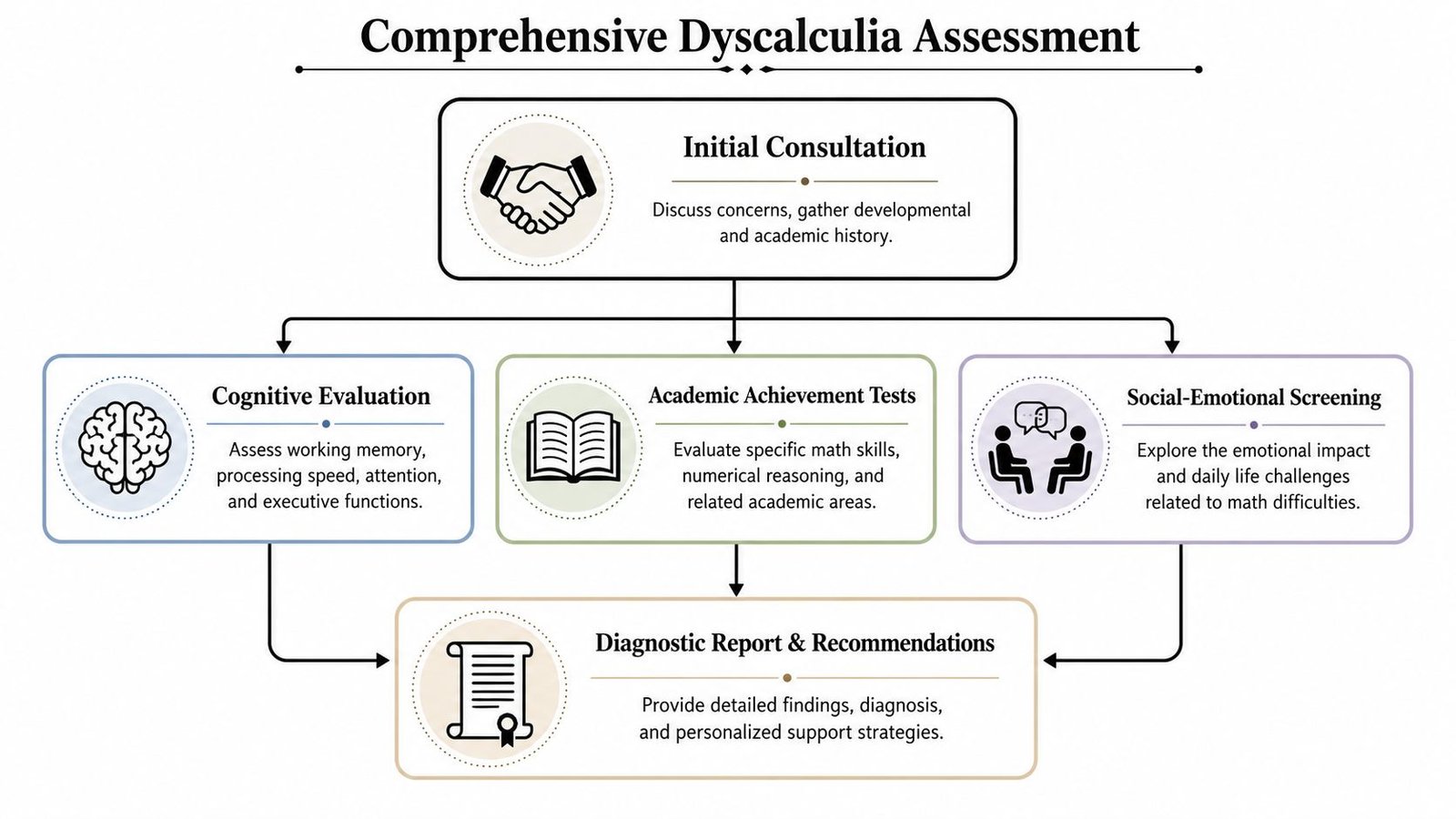
The assessment starts with history, not scores
The first stage is usually a detailed conversation. The assessor asks about early development, school experience, everyday difficulties, work demands, emotional reactions to maths, and any existing diagnoses such as ADHD or autism.
That history matters because test results never stand alone. Patterns over time help the clinician judge whether the difficulty is specific, lifelong, and functionally important.
Standardised testing has several parts
A strong assessment follows recognised UK standards. SASC guidance requires a dyscalculia assessment to include timed basic calculation tests, untimed procedural tests, cognitive assessment of areas such as working memory and processing speed, and evaluation of emotional factors such as mathematics anxiety, as described in SASC's assessment guidance for dyscalculia and maths difficulties.
That mix is important because each part answers a different question.
| Assessment Component | Purpose |
|---|---|
| Timed basic calculation tests | Looks at automatic recall and fluency with basic operations |
| Untimed procedural tests | Shows how the person solves maths problems when speed pressure is reduced |
| Cognitive assessment | Examines working memory, processing speed, and related thinking skills |
| Emotional screening | Identifies maths anxiety, avoidance, confidence issues, and motivational factors |
| Developmental and educational history | Places test findings in the context of lifelong functioning |
Why cognitive testing matters
Adults are often surprised that a dyscalculia assessment includes broader cognitive measures. The reason is simple. If attention is poor, processing is slow, or working memory is overloaded, maths performance may fall for reasons that are not specific to dyscalculia.
This is also why related areas such as executive functioning may need closer review, especially in people with ADHD traits. A broader understanding of planning, working memory, and cognitive control can be helpful, particularly when executive function testing in adults is relevant to the overall picture.
Practical rule: The best assessment doesn't just ask, “Did you get the answer right?” It asks, “How did you approach the task, what got in the way, and does that pattern fit dyscalculia?”
Differential diagnosis matters
A careful clinician also considers alternative explanations. Difficulties may stem partly from interrupted education, untreated ADHD, very high anxiety, sensory issues, or broader learning needs. A good assessment doesn't force everything into one label. It separates what belongs to dyscalculia from what belongs elsewhere.
In UK clinical practice, the threshold for diagnosis also depends on context. According to ICD-10-aligned clinical guidance discussed in this review article, mathematical performance below the 16th percentile can support diagnosis when there is corroborating clinical or developmental evidence, while a stricter 7th percentile threshold is used when that supporting evidence is absent. For adults, that's another reason history-taking is not optional. It directly affects interpretation.
UK Assessment Pathways NHS Versus Private
You finally decide to ask for help. You speak to your GP, explain that numbers have been a lifelong struggle, and expect a route similar to ADHD or autism assessment. Then the process becomes unclear. That confusion is common, and in adult dyscalculia it reflects a real gap in the UK system, not a failure on your part.
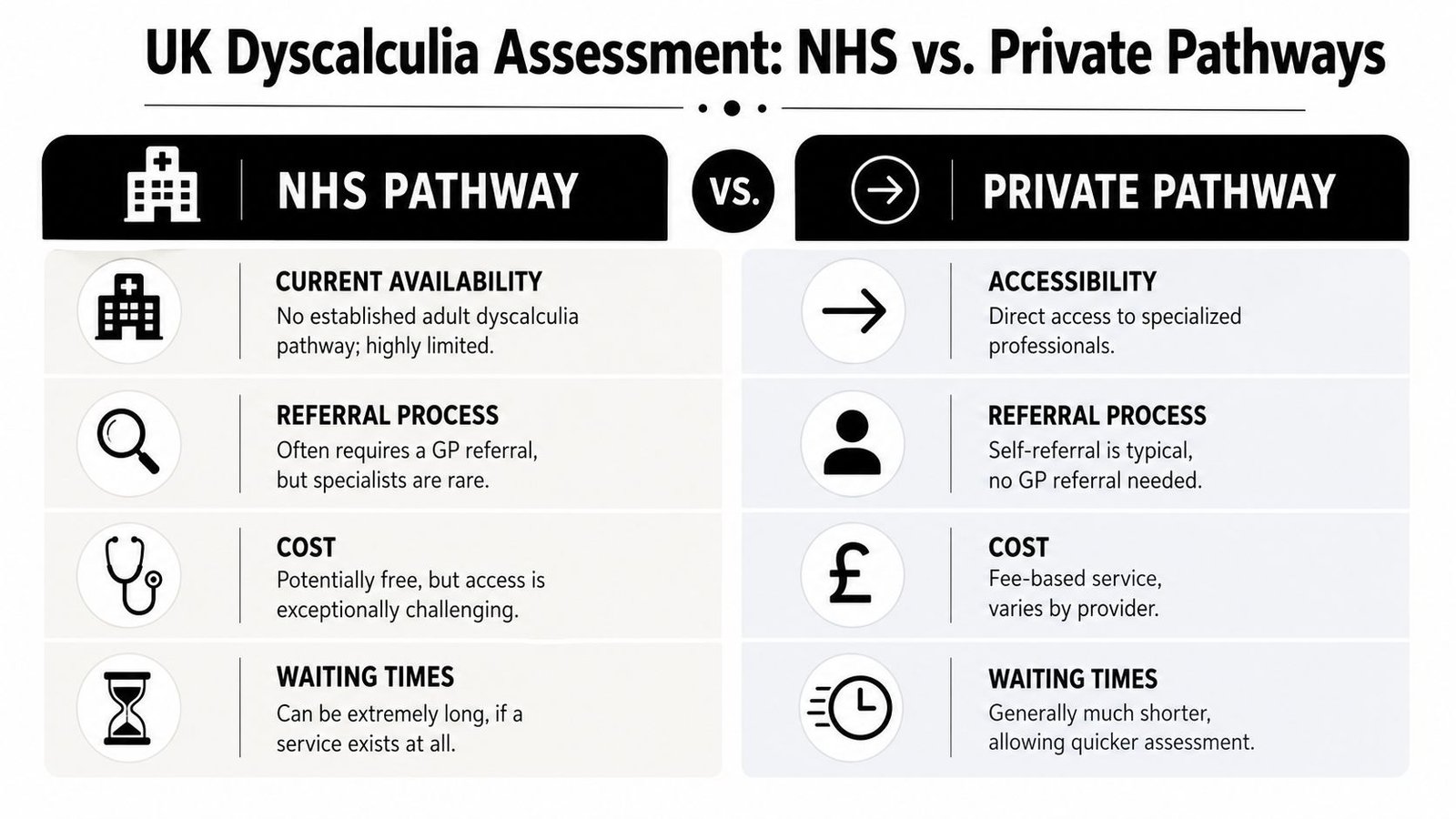
Why the pathway feels so unclear
Adult dyscalculia does not usually have a standard NHS diagnostic route in the way many adults expect from other neurodevelopmental conditions. The practical result is simple. Adults are often passed between services, told to ask education providers, or advised to seek an independent specialist.
That is one of the most missed points in online guidance. People read about NHS referrals and assume the same system applies to maths-related learning difficulties. In reality, dyscalculia is often handled outside mainstream NHS diagnostic pathways, so private assessment becomes the route many adults use.
For adults comparing this with ADHD or autism services, the difference matters. A guide to the NHS Right to Choose pathway for adult assessment helps explain why some neurodevelopmental conditions may have a clearer referral structure while dyscalculia usually does not.
NHS and private routes compared
A practical way to understand the difference is to picture two doors. One door is labelled NHS, but for adult dyscalculia it may not open onto a defined service. The other is private assessment, where the route is clearer but self-funded.
| Pathway | What adults usually encounter |
|---|---|
| NHS route | No consistent adult dyscalculia pathway, uncertainty about referral options, and variable local knowledge |
| Private route | Direct booking with a specialist assessor, a defined assessment process, and a formal report for support or adjustments |
This is why private assessment is not merely a faster option. For many adults, it is the only realistic way to get a formal answer.
What private assessment usually looks like
A private assessment is usually structured in stages. First comes background history. Then there is standardised testing of number skills and related cognitive processes. After that, the assessor interprets the pattern and writes a formal report.
The British Dyslexia Association explains that specialist assessment for dyscalculia is carried out through trained assessors rather than a routine NHS medical diagnosis, which helps explain why adults are commonly directed toward independent services for formal identification and documentation. See the British Dyslexia Association's overview of dyscalculia assessment and support.
That distinction matters in real life. Universities, employers, and training providers often need a clear written report from an appropriately qualified specialist before they can consider reasonable adjustments.
Why some adults need more than a maths-only assessment
Difficulties with numbers rarely sit in isolation. An adult may also have ADHD, autistic traits, anxiety, depression, trauma, or severe performance shame built up over years. In that situation, a dyscalculia assessment answers one part of the question, but not always the whole question.
A good service recognises that overlap early. Insight Diagnostics is often sought for this reason. Adults do not always need a narrow maths assessment alone. Some need a broader neurodevelopmental evaluation that can separate dyscalculia from attention problems, burnout, emotional distress, or a combination of these.
That wider view can prevent a very common problem. Someone receives a label for one area of difficulty, yet the daily struggles at work, in study, or in finances still do not fully make sense because the rest of the picture was never examined.
Who Is Qualified to Diagnose Adult Dyscalculia
You may have reached the point where you are ready to be assessed, then hit a confusing question. Who can diagnose dyscalculia in an adult, and whose report will be accepted by a university, employer, or training provider?
In the UK, that question matters more than many adults expect. Dyscalculia does not sit within a standard NHS adult diagnostic pathway in the same way as ADHD or autism, so people are often looking to independent specialists rather than waiting for a medical service to provide a formal answer.
The professionals who can assess dyscalculia
For adults, formal dyscalculia identification is usually carried out by an educational psychologist or a specialist assessor with advanced training in specific learning difficulties in maths, alongside current professional certification to assess and write diagnostic reports.
The practical point is simple. Ask what qualification the assessor holds, what body recognises that qualification, and whether their report is suitable for adult education or workplace adjustments.
A useful report is not merely a note saying you struggle with numbers. It should show how the assessor reached their conclusion, using your history, standardised testing, and clinical judgement. In other words, the assessor needs both subject knowledge and the authority to write a report that other organisations can rely on.
Where psychiatrists fit
Psychiatrists do not usually carry out the specialist cognitive testing used to identify dyscalculia itself. Their role is different, but often highly important.
Many adults do not present with a single, tidy difficulty. Number problems may sit alongside ADHD, autistic traits, anxiety, depression, trauma, sleep problems, or years of avoidance caused by repeated failure. In that situation, a psychiatrist helps sort out the wider clinical picture, much as a senior doctor helps separate several overlapping causes of chest pain rather than assuming there is only one explanation.
That matters because attention problems can affect mental arithmetic. Anxiety can make timed tasks collapse. Depression can slow processing. Autism can shape learning style and coping patterns. Without careful interpretation, one problem can be mistaken for another.
If you are unsure which professional does what, this guide to the difference between a psychologist and psychiatrist in the UK explains the distinction clearly.
Why many adults choose a specialist private service
Because adult dyscalculia is not routinely diagnosed through a standard NHS route, many people need a private pathway if they want a formal assessment within a realistic timeframe. This is one of the least understood parts of the process.
For some adults, a standalone maths learning assessment is enough. For others, it is only one part of the answer. Someone may need to know whether their difficulty is dyscalculia on its own, dyscalculia with ADHD, or a broader neurodevelopmental profile complicated by anxiety or low mood.
That is where a specialist service such as Insight Diagnostics can be especially helpful. The value lies in being able to look at the whole person, not just the arithmetic score. For adults with overlapping neurodevelopmental or mental health concerns, that broader clinical lens can prevent a partial explanation from being mistaken for the full picture.
A short video can help make that distinction easier to grasp.
The right assessor should do more than assign a label. They should explain whether your number difficulties reflect dyscalculia, another condition, or a combination, and set that out in a report that is useful in everyday adult life.
From Diagnosis to Daily Life Your Report and Next Steps
When adults finally receive a diagnosis, many feel relief before anything else. Not because a report solves every problem overnight, but because it replaces a vague sense of failure with a specific explanation.
A well-written report should do more than state whether you meet criteria. It should describe your cognitive profile in plain language, show where the evidence came from, and recommend practical next steps for study, work, and everyday life.
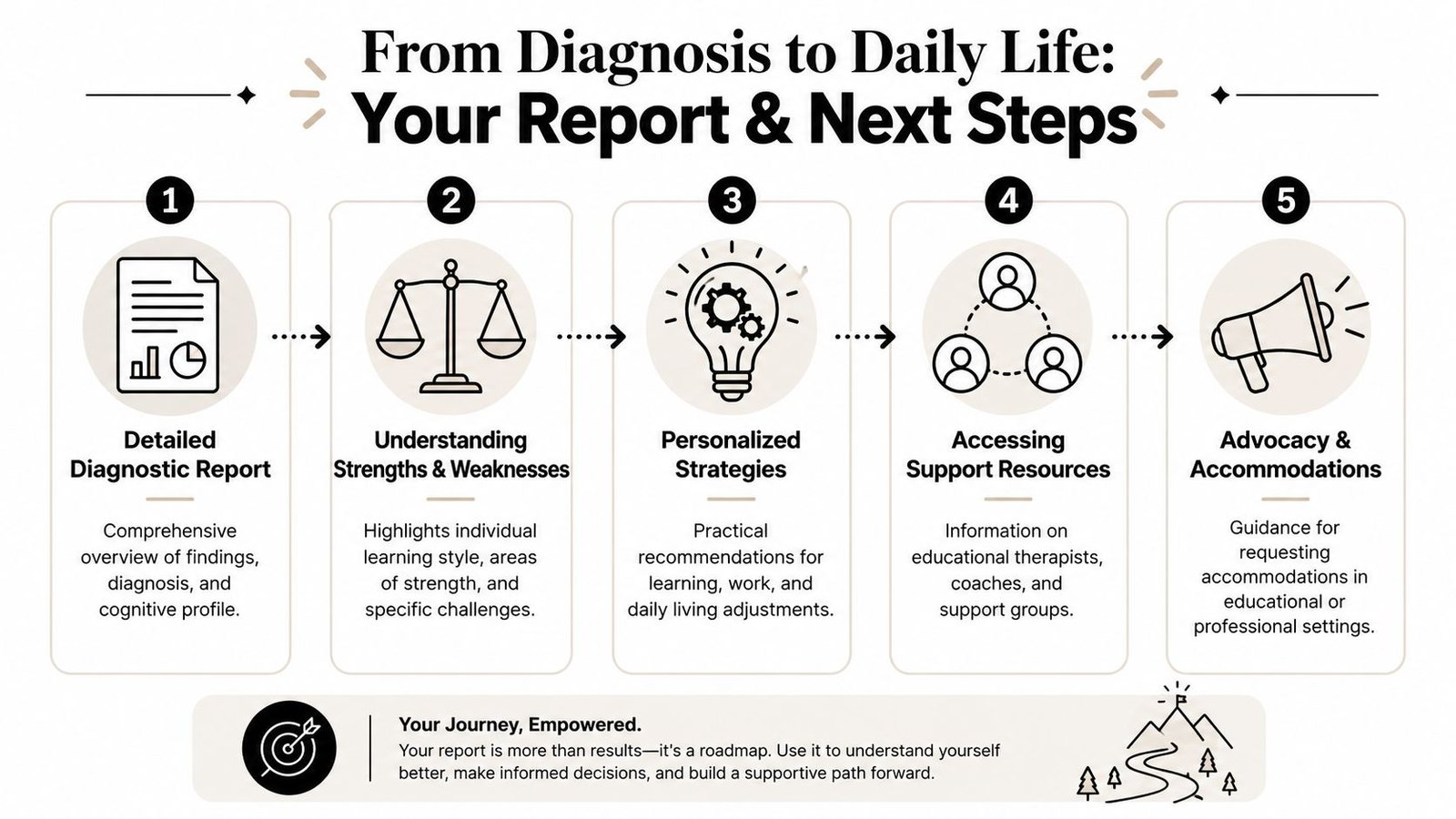
What your report usually gives you
Most adults want three things from a report. First, a clear answer. Second, an explanation that makes sense of their history. Third, recommendations they can use.
Useful reports often include:
- A summary of findings that explains whether the pattern is consistent with dyscalculia
- A description of strengths and weaknesses so the diagnosis doesn't reduce you to deficits
- Recommendations for support in education, work, and independent living
- Guidance on adjustments that can reduce the impact of numerical difficulty
- Clinical context if ADHD, autism, anxiety, or low mood also affect functioning
Practical supports after diagnosis
The next step depends on where dyscalculia affects you most.
For university students, a report may support applications for study-related help, specialist tuition, or adjustments in timed assessments. In the workplace, it can support conversations about reasonable accommodations, such as using calculators, written instructions, extra time for number-heavy tasks, software supports, or reduced reliance on mental arithmetic.
At a personal level, support might involve:
- Using digital tools for budgeting, reminders, and step-by-step calculations
- Building routines around money, dates, and appointments rather than relying on mental estimation
- Reducing shame-based avoidance by naming the difficulty openly where appropriate
- Linking therapeutic work to the diagnosis if anxiety, self-esteem, or burnout have built up around repeated struggle
Why mental health support may still matter
A diagnosis often explains the learning profile, but it may also uncover the emotional cost of years spent coping. That's especially relevant for autistic adults. According to NHS England's update on learning disability and autism services, approximately 70% of autistic people in the UK have at least one mental health condition. In real life, that means many adults need both neurodevelopmental understanding and mental health support at the same time.
A good report is a toolkit, not a verdict. Its value lies in what it helps you change next.
What to do with the result
Once you have the report, don't leave it in a drawer. Read the recommendations carefully. Highlight what applies to work, study, and home life. If you already have treatment or therapy in place, share the report with the relevant professional so support becomes more targeted.
For many adults, the most powerful shift is internal. They stop treating every numerical mistake as evidence that they're careless, incapable, or not trying hard enough.
Your Questions Answered and Booking Your Assessment
By the time adults reach this point, they usually want straightforward answers. The most useful takeaway is this. If number difficulties have been persistent, out of proportion to your general abilities, and tangled up with ADHD, autism, or mental health strain, a formal dyscalculia assessment can bring real clarity.
Common questions
Can dyscalculia be diagnosed online
Parts of the process may begin remotely, such as screening, history-taking, or an initial clinical discussion. But for a formal diagnostic assessment, you should always check the provider's current method and whether the final report meets the standard required for your purpose.
Is it too late to be diagnosed as an adult
No. Adults are diagnosed every year. In fact, many people are only identified once work, university, parenting, or independent finances expose the extent of the difficulty.
Will a diagnosis affect my driving licence or mortgage application
A dyscalculia diagnosis is not the same as a criminal record or driving restriction. In ordinary circumstances, it's used to understand support needs and request reasonable adjustments, not to block ordinary civic or financial processes.
What if I already have ADHD or autism
That makes assessment more important, not less. Overlapping conditions can blur the picture. A thorough evaluation helps identify what belongs to attentional or autistic differences, what belongs to dyscalculia, and what support should be prioritised first.
How do I know whether I need dyscalculia testing or a broader psychological assessment
If your main concern is numbers alone, a specialist dyscalculia route may be enough. If you also struggle with attention, organisation, sensory overload, burnout, anxiety, mood, or long-standing diagnostic uncertainty, a broader neurodevelopmental and mental health assessment may be the better starting point.
Taking the next step usually starts with one practical action. Write down the situations where number difficulties affect you most. Include examples from work, study, money, deadlines, travel, or home life. That brief record makes the first consultation much more useful.
If you're ready to move from uncertainty to clarity, Insight Diagnostics Global offers consultant-led assessments for adults aged 18 and over, with expertise in ADHD, autism, and mental health. Their team includes GMC Specialist Register psychiatrists and provides structured, compassionate evaluations online and face to face, with clear reports and personalised recommendations. If your number difficulties sit alongside burnout, anxiety, executive dysfunction, or broader neurodevelopmental questions, their integrated approach can help you understand the full picture.