

You’ve finally decided to ask for help. Maybe it’s anxiety that’s become impossible to keep squeezing around work and family life. Maybe you’ve spent years wondering whether ADHD explains the constant exhaustion, missed deadlines, and feeling of working twice as hard as everyone else. Maybe you’re seeking an autism assessment because burnout, masking, or sensory overwhelm no longer feels manageable.
Then comes the next problem. The NHS route may feel too slow, but private care is expensive, and your insurer’s handbook seems designed to answer the wrong question.
That’s where many people get stuck. They have private medical insurance, or they’re thinking of buying it, and they assume “mental health cover” means broad support for diagnosis, treatment, medication, and follow-up. In practice, private mental health insurance is useful, but it’s also full of limits that catch people out, especially when Autism, ADHD, and longer-term care are involved.
The Growing Need for Private Mental Health Support
A common scenario looks like this. Someone speaks to their GP about concentration problems, emotional dysregulation, burnout, panic, or longstanding social difficulties. They’re referred, then told the wait may be very long. While they wait, work suffers, relationships strain, and self-doubt deepens.

That pressure helps explain why so many people start looking at private routes. Some already have workplace cover through Aviva, AXA Health, Bupa, or Vitality. Others are considering paying for a policy because they need faster access to assessment or therapy than the NHS can currently offer.
The wider shift is visible in the insurance market. In the UK, mental health claims through private medical insurance have surged by over 60% in just three years, and by 2025 mental health claims accounted for 13% of all private insurance payouts, up from 8% in 2022, according to reporting on Broadstone’s analysis.
Why this matters to patients now
Rising demand doesn’t make the system simpler. It does the opposite. More people are using private mental health insurance, but many still don’t know what a policy is built to fund.
Practical rule: If you’re considering private cover because you need an ADHD or autism assessment, treat the policy as something to verify line by line, not something to trust at headline level.
At clinic level, this confusion shows up repeatedly. People arrive expecting their insurer to cover the whole pathway, only to discover the policy may support an initial consultation but not the ongoing part they care about most. Others delay seeking help because they assume private care is out of reach when they may have some funded options available.
If you’re weighing therapy, psychiatric review, or neurodevelopmental assessment, it helps to start with the plainest possible explanation of the system. A clear guide to adult mental health services can help you map the routes before you commit to one.
How Private Mental Health Insurance Works in the UK
Private medical insurance in the UK is built around one distinction that affects almost everything else. Insurers usually separate acute conditions from chronic conditions.
An acute condition is something the insurer sees as treatable, stabilisable, or limited in duration. A chronic condition is something ongoing, recurrent, or requiring long-term management. If you understand that distinction, most policy wording starts to make more sense.
The rule most people miss
Think of private mental health insurance as a system designed more for episodes than for lifelong patterns. It tends to work better for short-term intervention than for open-ended care.
That doesn’t mean policies are useless. Far from it. They can fund psychiatric consultations, short-term talking therapy, and treatment linked to an acute deterioration in mental health. But they’re not usually built to underwrite indefinite support.
The market is large enough that this matters to a lot of people. As of the end of 2023, 4.68 million individuals in the UK were enrolled in private medical insurance, representing 11.8% of the UK population, and the private medical insurance market alone reached £6.15 billion, a 12.2% increase from the previous year, according to LaingBuisson figures reported by The Guardian.
Two underwriting terms worth knowing
You don’t need to become an insurance specialist, but you do need some vocabulary.
- Moratorium underwriting means the insurer may automatically exclude conditions you’ve had symptoms of, medication for, advice about, or treatment for before the policy began, at least initially.
- Full medical underwriting means you disclose your medical history upfront and the insurer decides what to exclude before cover starts.
Neither model guarantees mental health cover in the way patients often imagine. They only change when and how exclusions are applied.
Policies are often easiest to understand when you ask one question: “What exactly counts as eligible treatment under this contract, and what is excluded as ongoing care?”
Why policy wording matters more than the brochure
The brochure sells reassurance. The schedule of benefits decides what gets authorised.
That’s why terms such as “out-patient psychiatric treatment”, “consultant-led care”, “pre-existing condition”, and “chronic condition” matter so much. They determine whether you can use private mental health insurance for a first step only, or for a more complete pathway.
If you’re trying to work out whether a policy is worth using for assessment, it helps to compare that route against direct payment. A realistic view of private mental health assessment costs in the UK often makes the trade-offs clearer.
What Your Policy Covers for Mental Health and What It Excludes
The biggest misconception is simple. People see “mental health cover” and assume it includes all mental health conditions, all treatment stages, and all follow-up.
It usually doesn’t.
What private mental health insurance often does cover
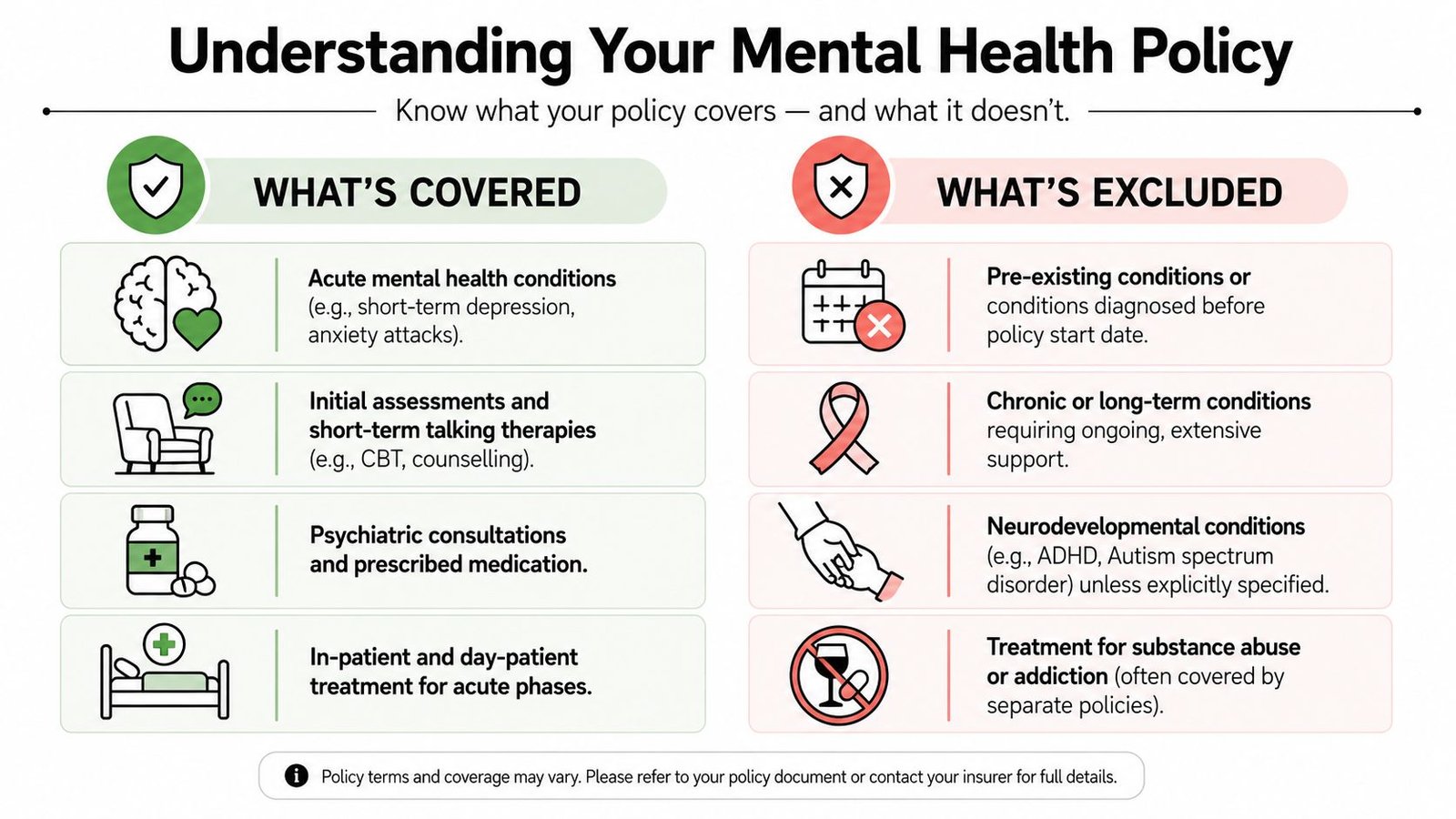
Many policies are at their strongest when the issue is seen as acute and medically necessary within the insurer’s framework. That can include:
- Consultant assessment for a current mental health problem such as anxiety, depression, or mood symptoms where the policy allows out-patient psychiatric care
- Short-term therapy such as counselling or CBT, often subject to provider rules and benefit limits
- Medication-related review where a psychiatrist is assessing or stabilising an acute presentation
- Hospital-based care for a severe acute phase, if your level of cover includes in-patient or day-patient psychiatric treatment
Coverage still depends on authorisation, provider recognition, and your policy wording. “Mental health included” is never the same as “everything clinically useful is covered”.
The exclusion that causes most confusion around ADHD and autism
For neurodevelopmental conditions, the gap between expectation and reality is sharp. In the UK private medical insurance market, Autism Spectrum Disorder and ADHD are systematically excluded from coverage as ongoing treatment because insurers classify them as “chronic developmental conditions” rather than “acute mental health illnesses”, as explained in Forbes Advisor UK’s overview of mental health insurance.
That classification matters. It’s why many people can sometimes get part of a pathway considered, but not the long-term management they expected.
What this looks like in real life
A patient may be told that an initial psychiatric review is potentially eligible for consideration. They then assume medication titration, review appointments, monitoring, autism follow-up, or broader long-term support will also be funded. Later, the insurer says no because the condition falls into a chronic or developmental category.
That isn’t a rare misunderstanding. It is one of the central practical problems in this area.
If you need an ADHD or autism assessment, ask separately about diagnosis, report writing, medication titration, follow-up reviews, and ongoing management. Insurers often treat those as different funding questions.
Other exclusions that regularly trip people up
Pre-existing conditions are another major source of disappointment. If you had symptoms, treatment, medication, or a diagnosis before the policy started, the insurer may exclude related claims. This can apply to anxiety, depression, trauma-related difficulties, and other mental health concerns even when the patient assumed the cover would help.
A few common pressure points are worth checking early:
- Previous diagnosis means the insurer may view the condition as pre-existing, even if symptoms have changed.
- Prior treatment or medication can trigger an exclusion, even where there has been a long gap in care.
- Open-ended care needs are often where cover narrows sharply.
- Neurodevelopmental follow-up is where many patients discover the difference between an assessment route and a treatment route.
What tends not to work
Trying to argue from fairness usually doesn’t work on its own. Insurers decide against the contract, not against what feels clinically obvious or personally reasonable.
What does work is reading the policy through the insurer’s lens. Ask what category the condition falls into. Ask whether the clinician must be consultant-led. Ask whether the insurer requires pre-authorisation. Ask whether the benefit is for assessment only, or includes treatment.
That approach doesn’t remove the frustration. It does stop expensive surprises.
Using Your Insurance for an Assessment at Insight Diagnostics
When patients use insurance for a psychiatric or neurodevelopmental assessment, the process is usually more administrative than clinical at the start. The assessment itself may be thorough and straightforward. The hard part is often getting the approval lined up correctly before the appointment is booked.
Private mental health insurance providers in the UK, including Vitality and Aviva, often use authorisation-based cover for consultant-led autism and ADHD assessments. In practice, that means the patient must obtain prior approval before a diagnostic evaluation with a psychiatrist on the GMC Specialist Register goes ahead.
Step one is checking the right part of your policy
Don’t start by asking, “Do I have mental health cover?” That question is too broad to be useful.
Ask whether your policy allows:
- Out-patient psychiatric assessment
- Consultant-led neurodevelopmental assessment
- Autism assessment for adults
- ADHD assessment for adults
- Pre-authorisation for diagnostic work
- Any exclusions relating to chronic developmental conditions
This is also the point where many people review whether the insurance route is worth pursuing at all. A neutral overview of private mental health assessments in the UK can help clarify the pathway before you start phoning your insurer.
Step two is getting referral details in order
Most insurers want a GP referral or at least clear clinical context before they consider authorisation. Keep the referral focused and accurate. It should describe the symptoms and the reason an assessment is being sought, without trying to over-negotiate the outcome.
If the referral is for ADHD or autism, it helps when the wording is specific about diagnostic assessment rather than vague “mental health support”. Administrative teams can only seek approval for what is requested.
Step three is matching the clinic to insurer expectations
Insurers typically look for consultant-led care, proper clinical governance, and clearly defined assessment pathways. In this context, patients are often reassured by services that are CQC regulated, use psychiatrists on the GMC Specialist Register, and provide structured interviews, triage, robust reports, and follow-up options.
That’s also why named consultant expertise matters. Leading Consultant Psychiatrists with extensive experience in neurodevelopmental and personality disorder assessment, including Dr Sai Achuthan, give both patients and insurers confidence that the evaluation is clinically rigorous and appropriately led.
Clinical reality: A strong assessment pathway is more likely to be authorised when the insurer can see exactly who is providing it, what the appointment is for, and what documentation will follow.
Later in the process, seeing the pathway in action can be useful:
Step four is confirming what the approval actually covers
An authorisation isn’t enough on its own. You need to know what it applies to.
Check whether approval covers:
- The initial assessment only
- The diagnostic report
- A feedback appointment
- Any follow-up review
- Medication titration or ongoing monitoring
Patients often hear “approved” and assume the pathway is complete. Sometimes only the first appointment has been approved. That distinction matters most in ADHD care, where diagnosis and treatment are frequently separated for insurance purposes.
A Practical Guide to the Insurance Authorisation Process
Authorisation calls are stressful because individuals often make them when they’re already overwhelmed. A little structure helps.
Start with paperwork in front of you. Have your policy number, membership details, GP information, referral wording, and the clinician or clinic details ready before you ring. If you call without those basics, you’re more likely to get vague answers and be told to ring back.
What to ask the insurer
Use direct questions. Keep them narrow.
- Ask about the exact service rather than general cover. “Is an adult consultant-led ADHD assessment eligible for pre-authorisation under my policy?”
- Ask who must provide it. Some insurers require a consultant psychiatrist rather than another clinician type.
- Ask what documents they need. That may include a GP referral, symptoms summary, or provider details.
- Ask what is excluded. Specifically check follow-up reviews, report fees, and medication titration.
A short primer on understanding prior authorizations can also help if the process feels opaque. It explains the logic behind insurer approval systems in plain language.
What not to do on the call
Don’t rely on broad reassurance. If the call handler says, “Yes, mental health is covered,” that still doesn’t answer the actual question.
Don’t leave the conversation without asking for the approval in writing, or at least by email or portal message if the insurer offers that. Verbal assurances are a weak foundation for a claim.
Write down the date, the name of the person you spoke to, and any reference number. If there is a dispute later, those notes matter.
The checklist that prevents most problems
Some patients make authorisation harder than it needs to be by giving the insurer too little information. Others give too much and muddy the issue. The goal is clarity.
| Item to prepare | Why it matters |
|---|---|
| Policy and membership details | Confirms eligibility and plan type |
| GP details and referral | Supports the clinical reason for assessment |
| Clinic and consultant information | Helps the insurer verify provider status |
| The exact assessment requested | Prevents approval for the wrong service |
| A written authorisation reference | Reduces billing disputes later |
What happens after approval
Once the insurer authorises the assessment, billing may be handled directly between clinic and insurer, or the patient may need to pay first and reclaim, depending on the arrangement. Don’t assume direct settlement. Ask.
Also ask what happens if the assessment identifies a condition that falls outside ongoing cover. Such situations often reveal the practical ceiling many patients encounter with private mental health insurance. Approval for diagnosis doesn’t always translate into funded treatment afterwards.
Comparing Your Assessment Options NHS Insurance and Self-Pay
Most adults choosing an assessment route are balancing three things. Speed, cost, and control. No pathway gives you all three equally.
For ADHD and autism in England, there’s one option that deserves much more attention than it usually gets. The NHS Right to Choose pathway legally allows adults to request referral to an NHS-contracted provider for a first outpatient ADHD or autism assessment, letting patients bypass local waiting lists of up to 7 years by choosing private providers paid by the NHS, as outlined in this Right to Choose ADHD guide.
If you’re considering that route, a practical explanation of NHS Right to Choose can make the process easier to work through with your GP.
Assessment Pathways Compared NHS vs Insurance vs Self-Pay
| Factor | NHS (Standard) | NHS (Right to Choose) | Private Insurance | Self-Pay (Private) |
|---|---|---|---|---|
| Cost | Usually funded through the NHS | Funded through the NHS if eligibility and referral criteria are met | May be partly funded if authorised and within policy terms | Paid directly by the patient |
| Wait times | Can be very long depending on local service | Often quicker than local NHS pathways | Can be quicker if authorisation is approved | Usually the fastest route when appointments are available |
| Choice of provider | Limited to local pathway | Broader choice among NHS-contracted providers | Limited by policy rules, authorisation, and recognised providers | Broadest practical choice |
| Process complexity | Administratively simple but slower | Requires GP cooperation and correct referral pathway | Requires policy checks, pre-authorisation, and careful paperwork | Usually simplest once you choose a provider |
How to think about the trade-offs
The standard NHS route works best when cost is the overriding concern and waiting is manageable. For many people, that isn’t the case.
Right to Choose is often the strongest middle path for adults who want NHS funding but can’t tolerate a local wait. It can be particularly useful for first ADHD or autism assessments, though the route depends on being in England and meeting pathway requirements.
Private insurance can be excellent when your policy clearly supports consultant-led assessment and you’re comfortable managing authorisation. It becomes less attractive when the policy language is vague, exclusions are broad, or your likely needs extend beyond diagnosis.
Self-pay offers the cleanest control over timing and provider choice. The downside is obvious. You absorb the cost yourself.
The best route is the one that fits your actual bottleneck. If your biggest problem is delay, choose the pathway with the least friction. If your biggest problem is affordability, choose the one with the strongest funding certainty.
Choosing the Right Path for Your Mental Health Journey
What’s needed isn’t more information, but less confusion.
The key point is straightforward. Private mental health insurance can be very useful for access to assessment and short-term intervention, but it is often a poor fit for long-term management of ADHD and autism. That isn’t because the need is unclear. It’s because the insurance model often treats neurodevelopmental conditions differently from acute mental health episodes.
A simple decision framework
If you’re deciding what to do next, start with the question that matters most to you:
- If speed matters most, self-pay or an authorised private route may be the quickest path.
- If cost matters most, standard NHS care or Right to Choose may be the better fit.
- If continuity matters most, check not just how to get diagnosed, but who will manage follow-up afterwards.
- If certainty matters most, avoid assumptions and get every funding point confirmed before booking.
People often focus heavily on the assessment itself. In practice, the better question is what happens after the assessment. Will you need medication titration, monitoring, therapy, workplace evidence, university support documentation, or autism-informed follow-up? The funding route should match the whole journey, not just the first appointment.
What a good next step looks like
A good next step is specific. Ring your insurer with the exact service in mind. Ask your GP whether Right to Choose is suitable. If you’re self-funding, compare pathway clarity, consultant credentials, and aftercare rather than shopping on headline price alone.
You don’t have to solve everything at once. You just need to stop moving forward on false assumptions.
The most expensive mistake in this area isn’t always the fee. It’s losing months on a pathway that was never going to meet your actual needs.
For adults seeking clarity around ADHD, autism, anxiety, depression, burnout, or broader psychological assessment, expert guidance makes a real difference. A consultant-led service with experienced psychiatrists, including specialists such as Dr Sai Achuthan in neurodevelopmental and personality disorder work, can help make the process clinically rigorous and easier to understand.
If you want a clear route into adult ADHD, autism, or mental health assessment, Insight Diagnostics Global offers consultant-led online and face-to-face assessments for adults aged 18 and over. The service is CQC regulated, uses psychiatrists on the GMC Specialist Register, and provides structured evaluations, detailed reports, and optional follow-up support with a practical understanding of insurance, self-pay, and Right to Choose pathways.