Figuring out the cost of a private ADHD assessment is often the first, and sometimes most daunting, step for adults looking for answers. In the UK, you can generally expect a comprehensive private ADHD assessment to cost somewhere between £950 and £1,950. The final figure often depends on the clinic's reputation, how in-depth the evaluation is, and whether it also screens for co-occurring conditions like autism and other mental health concerns.
This isn't just a fee; it's an investment in a detailed diagnostic process designed to bring you much-needed clarity for your mental health.
Your Guide to Adult ADHD Assessment Costs

Trying to navigate the path to a potential ADHD diagnosis can feel overwhelming, especially when it comes to the financial side of things. For many adults, the journey begins with a lightbulb moment—the realisation that lifelong struggles with focus, organisation, or impulsivity might actually be signs of a neurodevelopmental condition like ADHD or Autism.
This guide is here to cut through the confusion around ADHD assessment costs. We'll give you a transparent breakdown of what to expect when paying for a private assessment in the UK, looking at everything from initial price ranges to the key differences between going through the NHS versus a private clinic for your mental health needs.
The Two Main Pathways Explained
One of the biggest decisions you'll face is how to get assessed. In the UK, adults have two main options, and they offer vastly different experiences when it comes to speed, personal control, and, of course, cost.
- The NHS Pathway: This route is funded by the NHS, so there's no direct cost to you. However, it usually starts with a GP referral and often involves very long waiting lists for ADHD and Autism assessments that can stretch out for years.
- The Private Pathway: Choosing to go private means you pay a fee directly for the service. The huge advantage here is speed—you can often book an assessment within weeks and have more say in when it happens and which clinician you see.
To make this choice clearer, here’s a quick comparison of what each pathway looks like.
ADHD Assessment Pathways at a Glance
| Factor | NHS Pathway | Private Pathway |
|---|---|---|
| Cost | Free at the point of service. | Typically costs between £950 and £1,950. |
| Waiting Times | Extremely long, often years for ADHD and Autism. | Very short, often just a few weeks. |
| Referral | Requires a GP referral to get started. | You can usually self-refer directly to the clinic. |
| Choice of Clinician | Limited to no choice; you see who is available. | You can research and choose your preferred specialist. |
| Process Control | The process is standardised with little flexibility. | Offers more control over scheduling and the overall timeline. |
Ultimately, whether you choose the slower, free NHS route or the faster, paid private option depends on your personal circumstances, urgency, and budget. Our goal here is to give you all the information you need to make a confident, well-informed decision about investing in your mental health and future. By understanding what's included in an assessment and why the prices vary, you can find the path that feels right for you.
Comparing NHS and Private ADHD Assessments
If you’re looking for an ADHD diagnosis in the UK, you’re essentially at a crossroads with two very different paths ahead: the NHS route and the private sector. Each has its own set of trade-offs involving cost, speed, and how much say you have in the process. Figuring out which is right for your mental health starts with understanding exactly what each path entails.
For most people, the first port of call is the National Health Service. The biggest draw here is that it’s free. Your journey usually starts with a chat with your GP. If they agree your symptoms warrant a closer look, they can refer you to a specialist mental health service for a proper ADHD assessment.
The major stumbling block with the NHS, however, is time. And lots of it. Waiting lists for adult ADHD and Autism assessments have become incredibly long, with many people waiting several years to be seen. When you're struggling day-to-day, that kind of delay can feel impossible and puts crucial support and treatment frustratingly out of reach.
The Private Pathway: An Investment in Speed
This is where the private route comes in as a much faster alternative. By paying for an assessment yourself, you can skip the long NHS queues entirely. Most private clinics can get you an appointment within weeks, not years. For anyone who feels they urgently need answers and help for their mental health, this speed can make all the difference.
Going private also hands you back a bit of control. You get to do your own research, pick a clinic, and even choose a specific consultant psychiatrist who might have expertise in adult ADHD or related conditions like Autism Spectrum Disorder (ASD). It gives you the chance to find someone whose approach feels right for you.
You can think of a private ADHD assessment not just as a cost, but as a direct investment in your own well-being and mental health. What you're really paying for is certainty and speed—the ability to get clarity and start on treatment or support strategies without the crushing uncertainty of a years-long wait.
Understanding the Financial Commitment
Of course, that speed and control come at a price. The demand for private assessments for conditions like ADHD and Autism has skyrocketed, and costs have risen to match. A recent survey of 401 UK clinics found that the average cost for a private adult ADHD assessment now sits at around £1,200. This reflects the huge number of people seeking a diagnosis while NHS services are stretched to their limits—with 177,404 people waiting for an assessment in a year where only 21,011 were actually completed.
It's important to remember that this price tag covers a comprehensive clinical process. It’s not just one chat. The fee pays for a specialist's time to conduct in-depth interviews, review detailed questionnaires, gather information from others (like a partner or parent), and write up a thorough diagnostic report.
While the NHS covers this process for free, the private ADHD assessment cost is essentially what you pay to fast-track that entire, meticulous procedure. It's also worth knowing about a middle-ground option: the NHS Right to Choose ADHD assessment pathway. If available in your area, it can sometimes offer a quicker, NHS-funded assessment through an approved private provider.
What Your ADHD Assessment Fee Actually Covers
When you see the price for a private ADHD assessment, it’s easy to focus on the number itself. But it’s helpful to look beyond that single figure and understand the detailed, multi-stage clinical process it funds. The ADHD assessment cost isn't for a quick chat; it's an investment in a thorough evaluation led by a specialist consultant psychiatrist, all designed to give you an accurate and helpful diagnosis for your mental health.
Think of it like commissioning a detailed architectural blueprint for your brain. The final report needs to be robust, clear, and built on a solid foundation of evidence. Each step in the process adds another essential layer of detail, ensuring the conclusions are reliable enough to guide your future.
Breaking Down the Clinical Process
A high-quality assessment isn't a single event. It's a series of distinct stages, each demanding considerable clinical time and expertise. This is what you’re really paying for:
- Initial Triage: Before you even get started, a clinician reviews your initial enquiry and screening forms. This is a crucial first step. It makes sure a full ADHD evaluation is the right direction for you, and helps identify if other conditions like Autism or anxiety should also be considered.
- Deep-Dive Clinical Interview: This is the heart of the assessment. You’ll spend a significant amount of time, often 1-2 hours, with a consultant psychiatrist. They’ll guide you through your personal history, symptoms, and the real-world challenges you face. This isn't just a conversation; it's a structured diagnostic interview shaped by years of clinical experience.
- Psychometric Testing and Rating Scales: You, and sometimes a partner or close family member, will be asked to complete standardised questionnaires. These evidence-based tools provide objective data, helping the psychiatrist measure your symptoms against established diagnostic criteria for ADHD and rule out other mental health conditions.
This flowchart shows the typical journey through the NHS compared to a private pathway, highlighting the different stages involved.
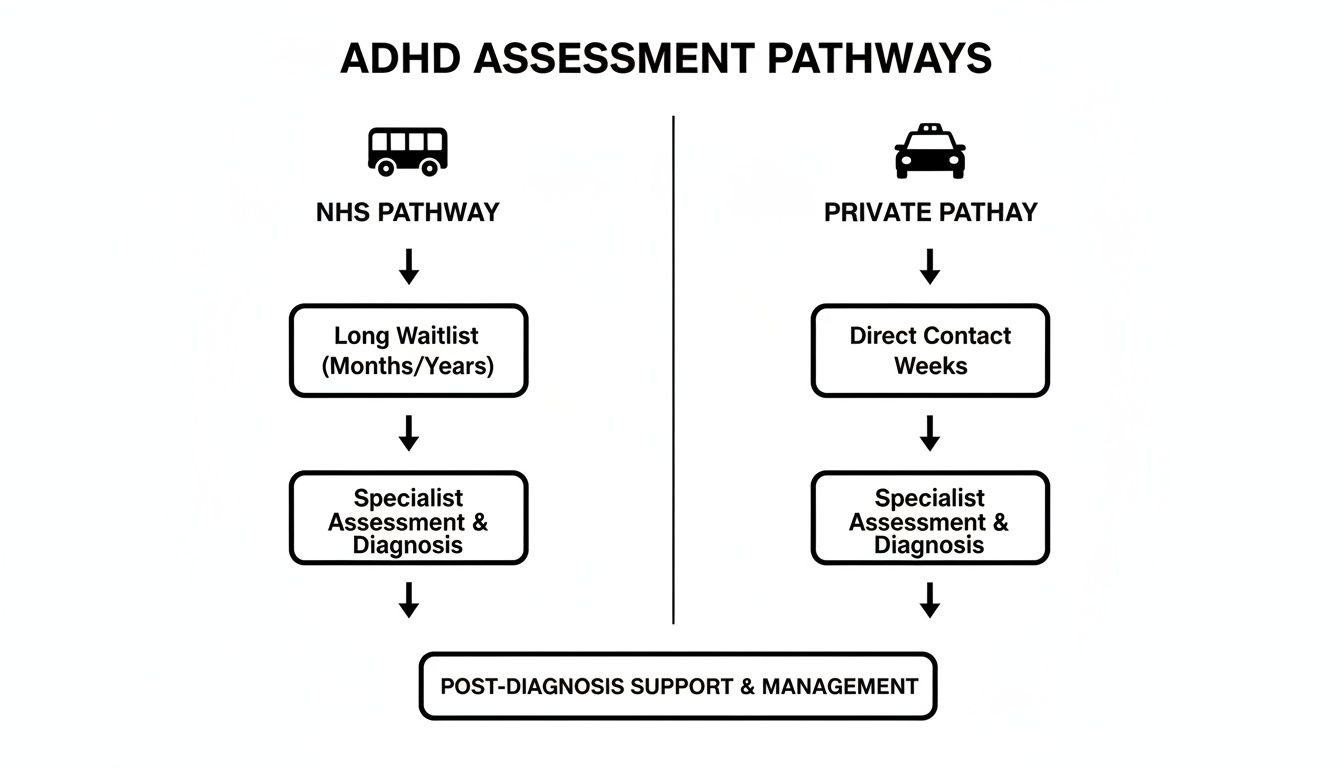
As you can see, both routes involve similar clinical steps to reach a diagnosis. The main difference with the private pathway is the significantly shorter timeline.
From Information Gathering to Final Report
After the main interview, the clinician’s work is far from over. A huge part of the process happens behind the scenes, and this is another vital component covered by your assessment fee.
A thorough diagnostic report is so much more than a simple confirmation of ADHD. It should offer a clear formulation of your difficulties, rule out other potential causes like Autism or anxiety, and provide personalised recommendations for treatment, support, and lifestyle adjustments that can genuinely improve your quality of life.
The psychiatrist then gets to work analysing everything they've gathered. This involves:
- Review of Collateral Information: The specialist will carefully go through any supporting documents you’ve provided—things like old school reports, performance reviews from work, or letters from family. This helps build a complete, lifelong picture of how your symptoms have shown up over time.
- Detailed Report Creation: This is a time-intensive task. The psychiatrist dedicates several hours to writing a comprehensive diagnostic report that synthesises all the evidence, explains the diagnostic conclusion, and lays out a clear plan for what comes next. You can learn more about how the components of our private ADHD assessment cost contribute to a quality outcome.
- Feedback Session: Finally, you'll have a follow-up session to go through the report's findings. Your psychiatrist will explain the diagnosis, answer all your questions, and discuss potential treatment options like medication or therapy. The goal is to ensure you leave with a clear and actionable path forward for your mental health.
To get a broader sense of how professional services are priced, it can be useful to look at general principles. While it’s not about healthcare, this guide on the factors influencing service pricing offers a helpful perspective on what goes into a professional fee.
Planning for Post-Diagnosis Follow-Up Care
Getting an ADHD diagnosis can be a huge, life-changing moment. But it's important to remember that it's the start of a new chapter, not the end of the story. When you’re budgeting for your mental health journey, it’s crucial to understand that the initial ADHD assessment cost is entirely separate from the fees for treatment and ongoing care.
For many people, medication is a key part of managing ADHD effectively. This kicks off a process called medication titration—a careful, step-by-step period where you and your psychiatrist work together to find the right medication and the perfect dose for you. This isn’t just a single appointment; it's a dedicated phase of care that usually unfolds over several months.
Understanding Titration Costs
During the titration period, you'll have regular check-ins with your psychiatrist. These appointments are for monitoring how you're getting on, discussing any side effects, and making tiny, precise adjustments to your treatment. It’s a vital and highly personalised stage of your care.
Clinics typically charge for this as a package deal or on a per-consultation basis. These costs are on top of your initial assessment fee and cover the psychiatrist's time and expertise throughout this extended period.
The goal of titration isn't just to start you on a medication. It’s to stabilise your treatment safely and effectively, making sure you get the maximum benefit with minimal side effects. This really sets you up for long-term success with your mental health.
Private Prescriptions and Follow-Up Fees
While you’re under the care of a private psychiatrist, any prescriptions will be private ones. This means you’ll pay the full cost of the medication at the pharmacy, which is different from the standard NHS prescription charge. The price of ADHD medication can vary quite a bit, so it's smart to factor this into your monthly budget during titration.
Even after titration, you'll likely need review appointments with your psychiatrist from time to time to make sure your treatment plan is still working well. These follow-up consultations also have their own fees. You can find more useful information on this in our guide on how to get a private prescription in the UK.
Working Towards a Shared Care Agreement
A common long-term goal for many is to set up a Shared Care Agreement with their NHS GP. Once you’re settled on a stable and effective dose of medication, your private psychiatrist can work with your GP to hand over the prescribing responsibility to the NHS.
If your GP agrees to the arrangement, they’ll start issuing your prescriptions, and you'll only have to pay the standard NHS charge. This makes a huge difference to long-term medication costs. To help this process go smoothly, understanding the top medical documentation guidelines can be really helpful.
By planning ahead for these follow-up stages, you get a much clearer financial picture, allowing you to budget for the entire journey, not just the first step.
The Hidden Costs of Undiagnosed ADHD

While it's natural to focus on the upfront ADHD assessment cost, it's crucial to consider the alternative: the price of not knowing. Living with undiagnosed neurodevelopmental conditions like ADHD or Autism often means navigating a lifetime of accumulating challenges, each with its own significant financial and emotional weight.
These hidden costs frequently surface at work. Think of it as a constant uphill battle – perhaps you've experienced job instability, been overlooked for promotions, or just felt that nagging frustration of not quite reaching your professional potential, no matter how hard you try.
Beyond your career, managing personal finances can become a real struggle. When things like impulse control and organisation are difficult, it can easily lead to missed payments, mounting debt, and an inability to save. Over time, these seemingly small issues compound, creating a cycle of financial stress that quietly erodes your well-being.
The Broader Economic and Personal Impact
The strain of navigating the world with an unmanaged condition runs deep, often affecting both mental and physical health. The constant effort of just trying to "keep up" can lead to burnout, anxiety, and depression. This creates a whole new layer of costs, from lost income due to poor health to the expense of seeking other mental health treatments that may not address the root cause.
On a national level, the numbers are genuinely staggering. The economic burden of untreated ADHD in the UK is estimated to be over £17 billion every single year. This massive figure accounts for everything from lost tax revenue and increased reliance on benefits to greater spending on healthcare and social services. You can read the full report from the independent ADHD Taskforce to see the detailed breakdown.
When you look at the full picture, the cost of an ADHD assessment is reframed. It stops being just an expense and becomes a strategic investment in reclaiming your potential and building a more stable, productive, and fulfilling life.
A clear diagnosis isn't just about getting a label; it's about gaining access to the right tools and strategies to finally address the root cause of these lifelong challenges. It’s the first step toward improving your overall mental health.
Choosing a High-Quality Assessment Service
When you’re looking for a trustworthy diagnosis, it's easy to get fixated on the price tag. But the cheapest option rarely offers the best value. The real worth of an assessment service lies in its clinical depth and the genuine clarity it brings to your mental health journey. It’s far better to look beyond the initial ADHD assessment cost and focus on the quality of the service you’re investing in.
So, what does quality actually look like?
The Non-Negotiables: Regulation and Expertise
A brilliant starting point is checking for regulatory oversight. Make sure any clinic you consider is regulated by the Care Quality Commission (CQC). This isn't just a bit of admin; it's a critical sign that a provider meets national standards for safety and quality. It’s your assurance that you’re in safe hands.
Another vital element is a consultant-led model. This means your entire assessment process is overseen by a specialist psychiatrist who is on the General Medical Council (GMC) Specialist Register. This level of expertise is absolutely essential for an accurate diagnosis, particularly when symptoms can be complex or overlap with other conditions like Autism.
Looking Beyond the ADHD Diagnosis
Mental health is rarely neat and tidy. What might seem like classic ADHD could easily involve other co-occurring conditions. In fact, it’s quite common for individuals with ADHD to also have traits associated with Autism Spectrum Disorder (ASD), anxiety, or mood disorders.
A high-quality provider understands this complexity. They won't just tick boxes for ADHD; they'll assess for these other possibilities to build a holistic picture of your mental health. This approach stops you from ending up with a narrow or incomplete diagnosis, ensuring your final report is a full, accurate picture with a clear path forward. This is precisely where a consultant psychiatrist's expertise becomes invaluable.
The goal of an assessment shouldn't just be to get a label. It should be to gain a clear, comprehensive understanding of your challenges and a personalised roadmap for moving forward, whether that includes treatment for ADHD, autism, or other aspects of your mental health.
Ultimately, your choice should boil down to the provider’s expertise, the thoroughness of their reports, and their commitment to your care. To get a better sense of what a robust, consultant-led process looks like, it’s worth learning more about a private psychiatric assessment and what it involves. This ensures your investment leads to a genuinely helpful outcome for your long-term well-being.
Got Questions About Assessment Costs? We've Got Answers
Thinking about a private assessment naturally brings up a lot of practical questions. Let's walk through some of the most common ones we hear, giving you the straightforward answers you need to feel confident about taking the next step.
Will My Health Insurance Cover an ADHD Assessment?
This is a big one, and the honest answer is: it depends entirely on your specific policy. Many UK health insurance plans unfortunately have exclusions for neurodevelopmental conditions like ADHD or Autism Spectrum Disorder (ASD). Some might cover it, but only if you get a formal referral letter from your NHS GP first.
The single most important thing you can do is call your insurance provider before you book anything. Don't just assume. Ask them directly if your policy covers psychiatric evaluations for ADHD, find out what paperwork they require, and get clarity on any limitations or excess you might have to pay.
Are Online Assessments as Legitimate as In-Person Ones?
Absolutely, as long as they're done right. An online assessment with a GMC-registered consultant psychiatrist who adheres to the official NICE guidelines is every bit as clinically valid as meeting them in a physical clinic.
Properly regulated clinics, like us, are registered with the CQC (Care Quality Commission), which is the national watchdog for health and social care in England. This ensures we meet strict standards for safety and quality. The diagnostic report you receive is fully recognised by GPs, employers, and schools, carrying the same clinical weight as one from a face-to-face evaluation.
What Happens if the Assessment Says It Isn't ADHD?
Even if the outcome is that you don't have ADHD, a thorough assessment is still hugely valuable. A good psychiatrist isn't just ticking boxes for one condition; they’re trying to understand the root cause of the challenges you're facing. The process can uncover other things that might be going on, like anxiety, depression, or even co-occurring conditions such as autism.
A proper diagnostic assessment delivers clarity, no matter the result. The final report won't just be a "yes" or "no." It will provide a detailed explanation of the findings and give you personalised, actionable recommendations for what to do next to support your mental health.
At Insight Diagnostics Global, our consultant-led team provides CQC-regulated online assessments for ADHD, Autism, and a range of mental health conditions, giving you the clarity you need. Explore our assessment services and take the next step today.