

You may be here because life looks functional from the outside, but it doesn't feel manageable from the inside.
You meet deadlines, but only after panic. You start tasks and drift away from them. You forget simple things, lose track of conversations, overreact when overwhelmed, then blame yourself afterwards. Or perhaps you've always felt slightly out of step with other people and you're now wondering whether it's ADHD, autism, burnout, anxiety, or some combination of them.
That confusion is common in the UK system. It's also one reason people search for an ADHD therapist in the UK when what they need might be therapy, a formal assessment, medication advice, autism screening, or careful help untangling all of the above.
Are You Struggling with Focus or Burnout in the UK
A familiar pattern goes like this. Someone says, “I think I'm just tired.” Then the tiredness lasts months. Work takes twice the effort it used to. Home admin piles up. Noise feels sharper. Emotions feel closer to the surface. You keep trying productivity tips, better calendars, and endless lists, but the problem doesn't fully shift.
For some adults, that pattern reflects burnout. For others, burnout is sitting on top of undiagnosed ADHD or autism. For many, the hardest part is not knowing which it is.

Why so many adults are only asking questions now
The mismatch between likely ADHD and recorded diagnosis in the UK is large. The King's Fund notes that ADHD is suspected to affect 3–4% of adults, while only 0.32% of GP records show a diagnosis, which helps explain why so many adults may still be struggling without support (King's Fund analysis of adult ADHD assessment and diagnosis data).
That gap matters emotionally as much as clinically. If you've spent years thinking you were lazy, disorganised, “too sensitive”, or just bad at adult life, learning that neurodevelopmental differences are often missed can be profoundly relieving.
Many adults don't arrive at ADHD or autism questions through curiosity alone. They arrive because their coping strategies have stopped working.
Burnout, ADHD, autism, and overlap
People often get stuck on one question: “Is this burnout or ADHD?” Sometimes the answer is neither. Sometimes it's both. Autism can also sit in the picture, especially where sensory overload, masking, shutdown, social exhaustion, or a lifelong sense of difference are involved.
A few practical clues can help:
- If problems feel lifelong, ADHD or autism becomes more relevant.
- If things worsened after chronic stress, burnout may be playing a major role.
- If concentration changes with sleep, stress, and recovery, that still doesn't rule out ADHD. It just means the picture needs careful assessment.
- If relationships, work, or study keep showing the same pattern, it's worth looking deeper rather than assuming a character flaw.
If you're trying self-help while you figure things out, a practical guide on how to improve focus and concentration can be useful, but it works best alongside proper clinical thinking when symptoms are persistent.
If burnout feels central right now, it may also help to read about recovering from burnout before deciding your next step.
Who Can Diagnose ADHD and Autism in the UK
One of the biggest sources of confusion is professional titles. People use “therapist”, “psychologist”, “psychiatrist”, and “coach” as if they mean the same thing. They don't.
If you're searching for an ADHD therapist UK provider, it helps to separate two different needs. One is formal diagnosis. The other is ongoing support.
The simple version
It's like a car.
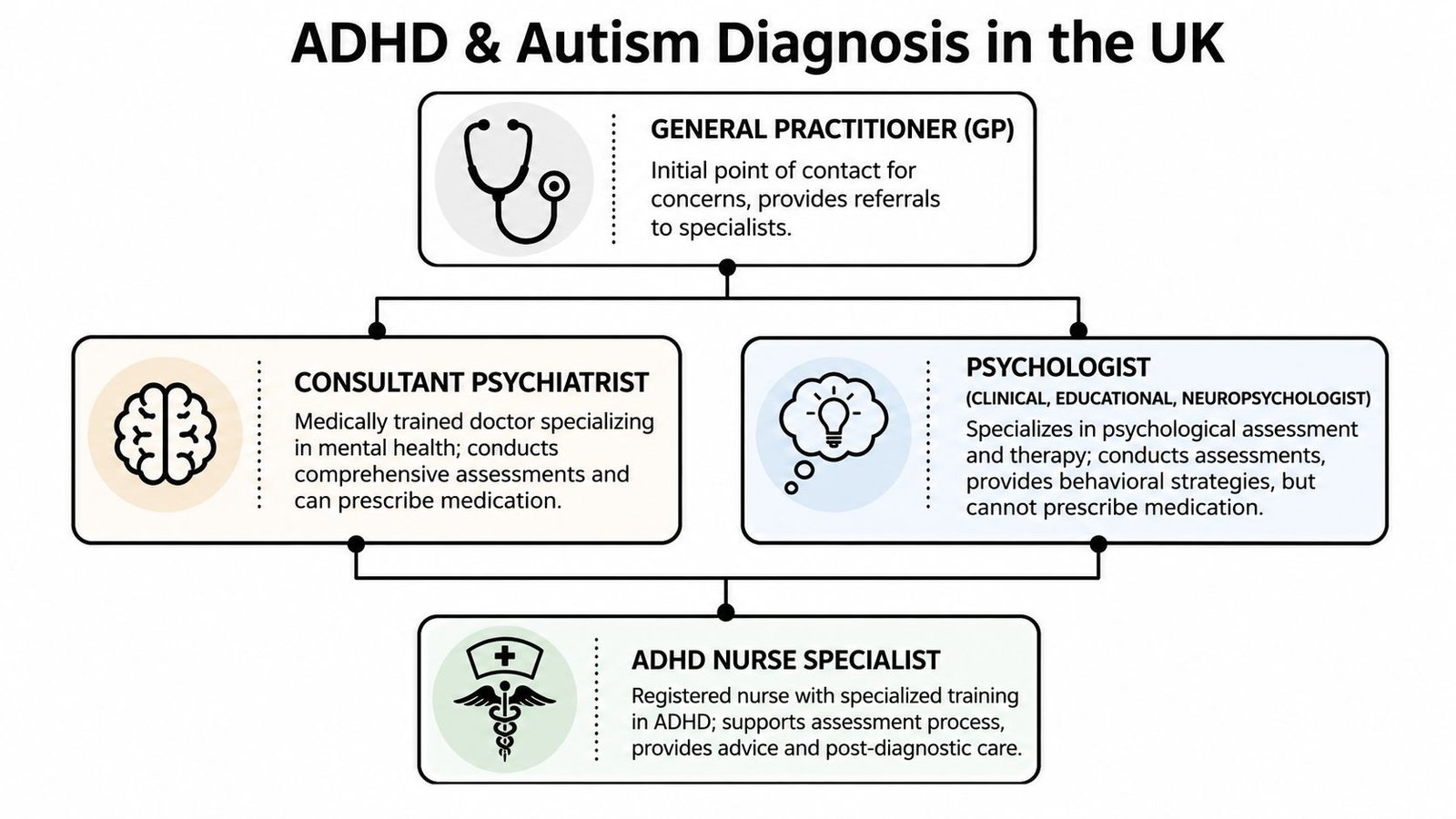
A Consultant Psychiatrist is the clinician who can investigate the whole system medically, make a diagnosis in a medical framework, and prescribe where appropriate. A Psychologist can carry out psychological assessment and therapy. A Therapist helps with emotional and behavioural change. An ADHD coach focuses on practical strategies, structure, and accountability.
Those roles can overlap in useful ways, but they are not interchangeable.
What each professional actually does
GP
Your GP is often the first stop. They listen to your concerns, rule out obvious physical contributors, and can refer onward into NHS or Right to Choose pathways.Consultant Psychiatrist
This is the key clinician for formal medical diagnosis of ADHD and for medication decisions. In complex cases, especially where ADHD, autism, anxiety, depression, trauma, or personality factors may overlap, psychiatrist-led assessment is especially valuable because the job is not just to name symptoms. It's to work out what best explains them.Psychologist
A clinical, educational, or neuropsychologist may carry out structured assessment and can provide therapy. They are often very skilled at formulation, cognitive testing, and neurodevelopmental understanding. They do not prescribe medication.ADHD nurse specialist
These clinicians often support assessment, monitoring, psychoeducation, and follow-up care within a wider service.Therapist
A therapist can help you manage the impact of ADHD or autism, including shame, anxiety, low mood, burnout, relationship strain, and practical coping. Therapy is treatment support. It is not usually the same as a formal medical diagnostic pathway.Coach
Coaching can help with routines, planning, task initiation, and accountability. It can be useful, but it isn't a replacement for assessment when diagnosis is still unclear.
Why consultant-led assessment matters
When symptoms are straightforward, many people assume any ADHD-literate professional will do. But adults rarely present in a neat textbook way. They may have years of anxiety, depressive episodes, poor sleep, trauma history, autistic traits, or repeated burnout.
Practical rule: If you need clarity about diagnosis, medication, or overlapping conditions such as autism, look for a clinician who can assess the full psychiatric picture, not just ADHD traits in isolation.
That's why consultant-led services set an important standard in private care. A psychiatrist with specialist neurodevelopmental experience can weigh ADHD, autism, mood symptoms, and personality factors together, rather than treating them as separate silos.
Comparing Your Pathways NHS Private and Right to Choose
Individuals often don't choose between NHS, private, and Right to Choose in an ideal calm moment. They choose because they're exhausted, under pressure, and unsure how long they can keep waiting.
That context matters. A review of UK adult ADHD services described them as being “in crisis”, and earlier Freedom of Information findings showed waiting times ranging from 4 weeks to nearly 4 years for assessment (review of UK adult ADHD service access problems). That's a major reason many adults start looking beyond the standard local NHS route.
The three routes in plain English
The NHS pathway usually starts with your GP referring you into local adult ADHD or autism services. It may cost nothing directly, but choice of provider is limited and waiting times can be long.
The private pathway means you pay directly for assessment and often get faster scheduling, more choice of clinician, and a clearer service structure. The downside is cost and the need to check exactly what is included.
The Right to Choose pathway sits in the middle for many people in England. It can offer access to alternative providers through the NHS, but the process still needs GP involvement and can be confusing if you don't know what to ask for.
ADHD Assessment Pathways in the UK Compared
| Feature | NHS Pathway | Private Pathway | Right to Choose RTC Pathway |
|---|---|---|---|
| How you access it | Usually via GP referral | Self-referral or direct booking with clinic | Usually via GP referral to an eligible provider |
| Cost to patient | Usually NHS funded | Self-funded or sometimes insurance-authorised | NHS funded if accepted |
| Choice of clinician | Often limited by local service | Greater choice | More choice than local NHS, but not unlimited |
| Speed | Can involve long waits | Usually faster | Often used by people seeking an alternative to local NHS waits |
| Medication pathway | Usually integrated within NHS service | Must check whether prescribing and follow-up are included | Varies by provider |
| Good fit for | People who prefer fully NHS care and can wait | People who want speed, flexibility, or a specific clinician | People in England who want NHS funding with a different provider route |
Questions that matter more than speed
People often focus only on how fast they can be seen. Speed matters, but it isn't the only issue.
Ask yourself:
- Do I need medication advice, or only diagnostic clarity?
- Do I suspect autism as well as ADHD?
- Do I have anxiety, depression, trauma, or burnout that could complicate the picture?
- Do I want one service that can assess, diagnose, report, and advise on treatment?
- Can I manage the financial cost of private care if I choose it?
One practical option for people weighing NHS-funded alternatives is to learn how the NHS Right to Choose pathway works.
When private care makes sense
Private care can be reasonable when the delay itself is causing harm to work, study, relationships, or mental health, and when you want a structured clinician-led process with clearer continuity.
A consultant-led private service may be particularly useful when you suspect more than one thing is going on, for example ADHD plus autism, or ADHD plus recurrent anxiety and burnout, because a narrow single-issue assessment may leave important questions unresolved.
What a High-Quality Assessment Process Looks Like
A proper ADHD assessment should not feel like a quick personality quiz followed by a label. If it does, something is missing.
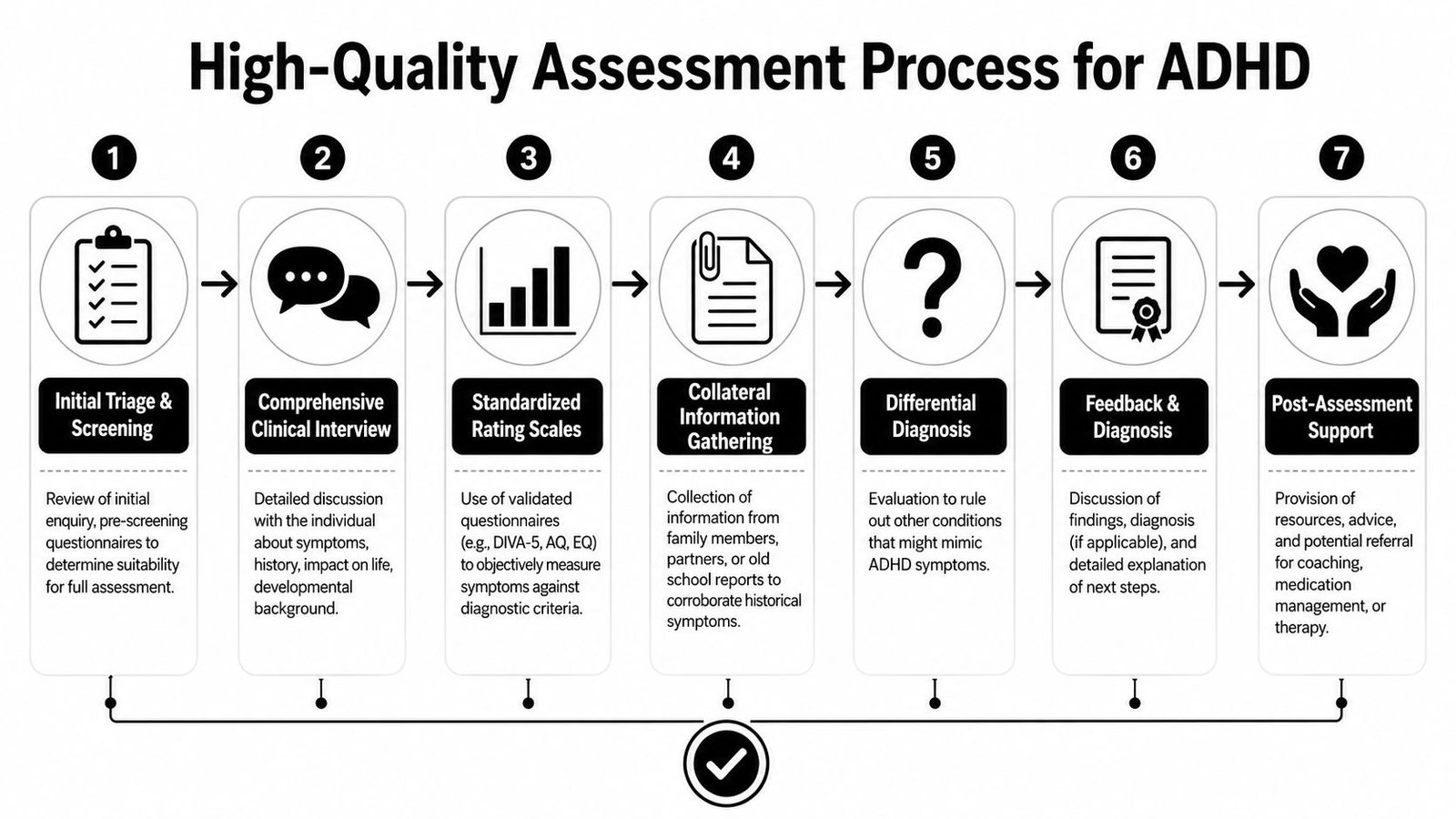
The Royal College of Psychiatrists recommends that adult ADHD diagnostic assessments usually take 2–3 appointments of 1 hour each, with validated screening tools and evidence of significant impairment, rather than relying on a single interview (Royal College of Psychiatrists adult ADHD guidance).
What should happen before diagnosis
A careful service usually begins with triage. That means someone reviews your concerns, checks whether ADHD or autism is a reasonable line of enquiry, and looks for urgent mental health issues that may need attention first.
Then comes the clinical interview. This is not small talk. It should explore childhood patterns, school history, work functioning, relationships, emotional regulation, daily organisation, sensory issues, sleep, substance use, and any history of anxiety, depression, trauma, or other psychiatric symptoms.
Evidence matters
ADHD traits are common. Diagnosis depends on the pattern, persistence, and impact.
A strong assessment usually looks for:
Symptoms from earlier life
The clinician will usually ask whether the pattern goes back to childhood, even if no one recognised it at the time.More than one setting
Difficulties should not appear only at work or only at home. The pattern usually needs to show up across different parts of life.Functional impairment
The question is not just “Do you relate to ADHD traits?” but “Have these traits caused meaningful difficulty?”Differential diagnosis
Anxiety, depression, burnout, sleep problems, and trauma can all affect concentration. A good clinician actively tests those possibilities rather than ignoring them.
A diagnosis should explain your difficulties better than the alternatives. If it doesn't, it isn't a strong diagnosis.
What the report should give you
By the end, you should receive more than a yes-or-no answer. A useful report usually includes the clinician's reasoning, the diagnosis if criteria are met, conditions considered and ruled in or out, and practical recommendations for next steps.
That might include medication review, therapy, workplace adjustments, coaching, autism assessment, or support for co-occurring anxiety and depression.
If you want to see what an adult pathway typically involves, adult ADHD assessment information can help you compare services.
Reducing the risk of a superficial assessment
Be cautious if a provider:
- Promises a diagnosis quickly
No ethical clinician can guarantee the outcome before the assessment. - Doesn't ask about childhood
That leaves a major gap in ADHD evaluation. - Ignores other conditions
This is one of the commonest ways adults get misleading answers. - Offers a very thin report
A short letter may not be enough for future treatment planning.
One factual example of a structured private option is Insight Diagnostics Global, a consultant-led service for adults that offers ADHD and autism assessments, wider mental health evaluation, and follow-up options including medication titration.
Therapy Medication and Post-Diagnosis Support
Once someone receives a diagnosis, they often feel two things at once. Relief. Then uncertainty about what happens next.
That's where the phrase ADHD therapist UK can become confusing again. A therapist is important, but therapy is only one part of post-diagnostic support.
What therapy can help with
Therapy is often most useful for the consequences of living with undiagnosed or poorly supported neurodivergence. That may include shame, chronic self-criticism, anxiety, low mood, emotional swings, relationship conflict, or repeated burnout.
CBT-based work can help with planning, procrastination, routines, and unhelpful beliefs. ADHD-informed therapy can also help you understand sensory overload, task paralysis, rejection sensitivity, and masking. If autism is part of the picture, therapy may need adapting to communication style, sensory needs, and recovery time after social demands.
Where medication fits
The Royal College guidance states that management should combine pharmacological, psychological, educational, and skills-based interventions, with CBT and coaching used as adjuncts when medication is contraindicated or not tolerated. In plain language, that means good care is often combined care.
Medication isn't right for everyone. Therapy alone isn't right for everyone either. The useful question is not “Which one is best?” but “What combination fits my presentation, goals, risks, and daily life?”
Practical support beyond treatment labels
Some adults mainly need help with executive function. Others need sleep stabilisation, workplace adjustments, or support telling family members what the diagnosis means. If sleep is a major problem, practical guidance on melatonin-free sleep solutions for ADHD may be a helpful adjunct while you're building a broader treatment plan.
After diagnosis, it also helps to understand the medical pathway for getting ADHD medication, especially if you're moving between private and NHS care.
The diagnosis is not the finish line. It's the point where treatment choices become more precise.
How to Choose Your Clinician and Spot Red Flags
A good assessment can change how you understand your whole life. A poor one can leave you confused, overcharged, and still unsure what's true. That's why choosing the clinician matters as much as choosing the pathway.
Questions worth asking before you book
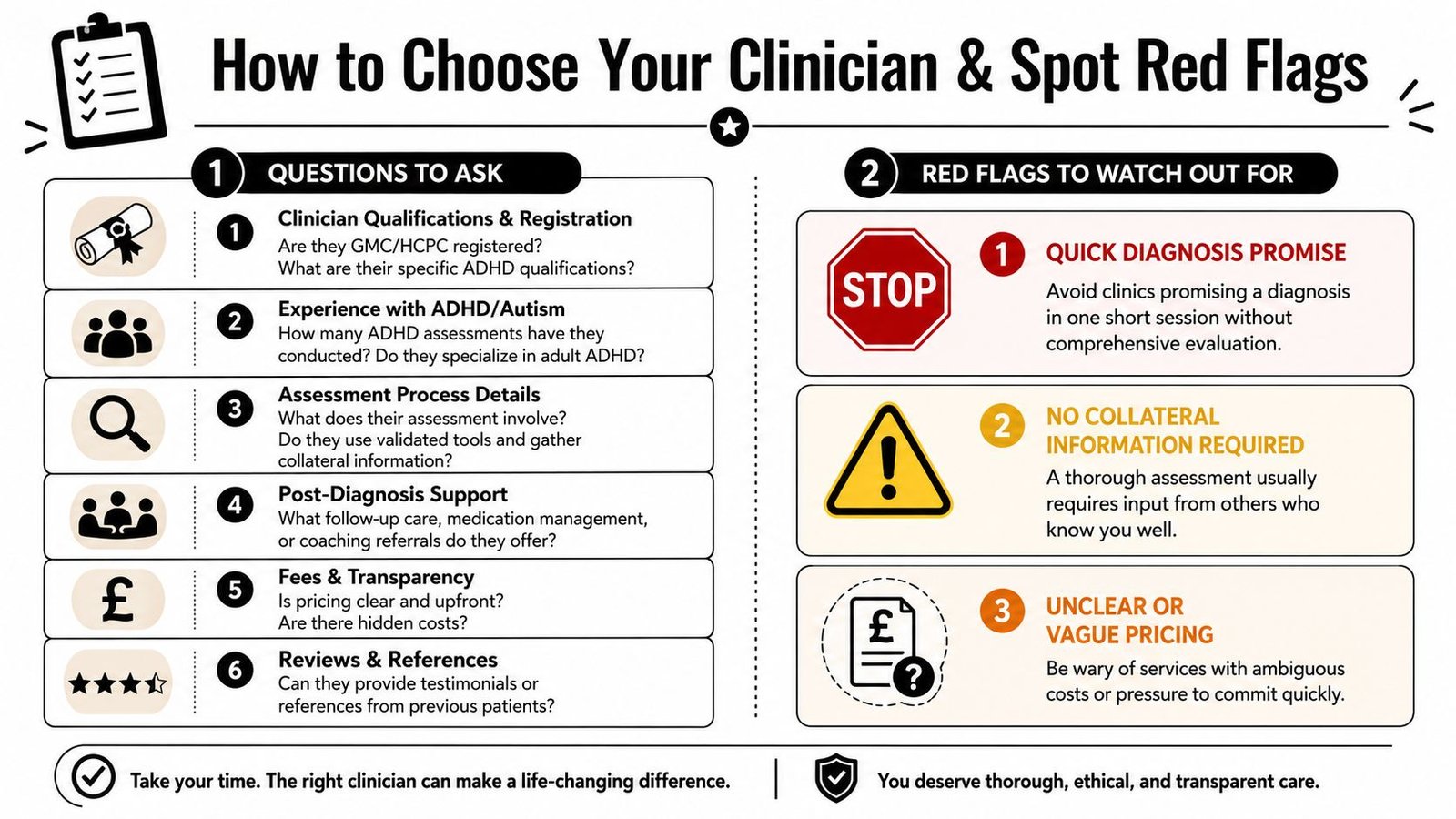
You don't need to interrogate a provider aggressively. But you do need clear answers.
Who is assessing me
Ask whether the clinician is a Consultant Psychiatrist, Psychologist, or another professional, and what their neurodevelopmental experience is.What does the assessment include
Ask whether it involves more than one appointment, structured tools, developmental history, and consideration of co-occurring conditions.Will I receive a full written report
A strong report should be clinically useful, not just confirm attendance.What happens after diagnosis
Check whether the service offers follow-up, prescribing support, letters for GPs, or onward referral advice.How transparent are fees
You should know what is included before you commit.
This video may help you think through the process more carefully:
Red flags that should make you pause
Some warning signs are subtle. Others are not.
Red flag: Any service that implies a diagnosis is likely before properly assessing you is prioritising conversion over clinical care.
Other concerns include:
Very rushed appointments
If the process sounds too brief to explore history and differential diagnosis, be cautious.No interest in autism or mental health overlap
Adults rarely present as a single neat condition.Unclear clinician identity
If you can't work out who is assessing you, that's a problem.No explanation of what happens if you don't meet criteria
Ethical services prepare for both outcomes.Pressure to book quickly
Good healthcare should allow informed decisions.
A useful mindset
Try not to shop for reassurance alone. Shop for accuracy.
The clinician's job is not to validate every suspicion automatically. It's to give you the clearest answer possible, even when the answer is more complex than expected.
Your First Step Towards Getting Clarity
If you've read this far, you probably don't need more generic advice. You need a next move that feels manageable.
Start with one question. Do I need NHS-funded access, faster access, or the most thorough diagnostic clarity I can reasonably obtain? Your answer will usually point you towards your first route.
If cost is the main issue, speak to your GP about NHS referral and ask specifically about Right to Choose if that applies to you. If delay is the main issue, compare private services carefully and check who assesses, what the report includes, and what follow-up exists. If your picture includes autism, burnout, anxiety, depression, or long-standing complexity, prioritise thoroughness over convenience.
You are not “behind” because you're only working this out now. Many adults reach this point after years of coping, masking, and mislabelling themselves.
Clarity can change treatment. It can also change self-understanding.
If you want a structured adult assessment pathway with online and face-to-face options, Insight Diagnostics Global provides consultant-led evaluations for ADHD, autism, and related mental health concerns, along with diagnostic reports and follow-up options for adults aged 18 and over. It is not a crisis service. For emergencies, call 999 or contact NHS 111 for urgent support.