
So, what exactly is an adult ADHD diagnosis? In simple terms, it's a structured clinical assessment carried out by a specialist—usually a psychiatrist—to see if your lifelong struggles with things like focus, organisation, and impulse control fit the clinical criteria for Attention Deficit Hyperactivity Disorder. It’s a deep dive, involving a detailed interview about your life experiences, a review of your personal history, and sometimes gathering insights from people who know you well. The goal is to bring clarity to your mental health and map out a path forward.
Starting Your Journey to an Adult ADHD Diagnosis

If you've spent years wondering why staying focused, organised, or managing your emotions feels like an uphill battle, you’re certainly not alone. For many adults, these persistent challenges aren't just personality quirks. They could be signs of Attention Deficit Hyperactivity Disorder (ADHD), a condition that deeply impacts overall mental health. Pursuing an adult ADHD diagnosis is the first real step towards understanding the 'why' behind so many of your experiences.
Think of this guide as your roadmap for the entire diagnostic process here in the UK. We'll break down each stage, from recognising the symptoms to knowing what to expect from a formal assessment, paying close attention to the important connections between ADHD, Autism, and mental health. The aim is to help you feel prepared and empowered, not overwhelmed.
Understanding the Shifting Landscape of ADHD
In the last few years, awareness of adult ADHD has exploded, largely because we now realise it looks very different from the outdated stereotypes of a hyperactive child. It’s often not about bouncing off the walls. It’s about the internal chaos of executive dysfunction, the challenge of regulating emotions, and the toll this can take on your mental wellbeing.
This shift in understanding has led to a huge increase in people seeking answers. A study from UCL, for example, found that diagnoses among men aged 18-29 shot up twenty-fold between 2000 and 2018. This surge shows just how many people have been struggling without support, highlighting the urgent need for accessible diagnostic services.
An ADHD diagnosis isn't about getting a label. It's about gaining a framework to finally make sense of yourself and your mental health. It opens the door to effective, evidence-based strategies that can genuinely improve your quality of life.
The Connection Between ADHD, Autism, and Mental Health
It's also really important to know that ADHD symptoms can often overlap with other conditions, especially Autism Spectrum Disorder (ASD) and general mental health challenges like anxiety. Both ADHD and Autism can impact social interactions and sensory processing, which is why a specialist assessment is so vital for getting an accurate picture of your unique neurotype. This guide will touch on these connections, helping you start to untangle your own experiences.
As you start looking into an adult ADHD diagnosis, even the initial steps like filling out forms can be made easier with tips for efficient patient registration and intake. Understanding the diagnostic process will prepare you for what’s ahead, letting you approach the process with confidence. Thankfully, modern consultant-led online services now offer a clear and timely way to get the answers you've been looking for.
What Does ADHD Actually Look Like in an Adult?
When we hear “ADHD,” most people still picture a young boy bouncing off the walls. But for adults, the reality is often a world away from that stereotype. Adult ADHD is rarely about being visibly hyperactive; it's much more likely to be an invisible, internal battle with chaos, missed deadlines, and intense, overwhelming emotions that significantly affect mental health.
For many, the core of the struggle is something called executive dysfunction. This isn't just about being a bit forgetful or disorganised. It’s a chronic, often debilitating problem with the brain’s management system – the very skills we all rely on to plan our day, get started on a task, manage time, and generally keep life on track.
Think of your brain as a busy office. Executive function is the boss who delegates tasks, prioritises projects, and makes sure everything runs smoothly. With ADHD, it’s like that boss has gone on an indefinite holiday. Messages get lost, projects are half-finished, and crucial deadlines sail by unnoticed. That’s what it can feel like, day in, day out.
It's More Than Just Inattention
While problems with focus and organisation are tell-tale signs, they’re only one piece of the puzzle. Some of the most disruptive symptoms of adult ADHD are emotional and relational, putting a huge strain on careers, relationships, and overall well-being.
These lesser-known but equally important aspects often include:
- Emotional Dysregulation: This is when you experience emotions that feel far too intense for the situation. A tiny frustration can explode into overwhelming anger, or a small setback can feel like a devastating catastrophe. It’s a constant emotional rollercoaster that can be mistaken for a mood disorder.
- Rejection Sensitive Dysphoria (RSD): A term for an extreme sensitivity to the perception of being criticised or rejected. A neutral comment from a manager or a friend cancelling plans can trigger intense emotional pain, often leading to people-pleasing behaviour or avoiding social situations altogether.
- Time Blindness: This is a genuine inability to perceive the passing of time accurately. It’s why you might always be running late, wildly underestimate how long tasks will take, and struggle to meet deadlines no matter how hard you try.
If any of this is ringing true, using an adult ADHD symptoms checklist can be a really helpful way to gather your thoughts before you speak to a professional. Simply seeing these patterns written down is often the first step towards understanding why certain parts of your life have always felt like such an uphill climb.
For many adults, finally getting a diagnosis is a moment of profound relief. It's the realisation that they aren't lazy, careless, or a failure—their brain is just wired differently.
The Diagnostic Maze: Overlaps with Autism and Anxiety
One of the biggest challenges in diagnosing ADHD in adults is how much its symptoms can overlap with other conditions, especially Autism Spectrum Disorder (ASD) and anxiety. It’s perfectly possible to have both ADHD and Autism (a profile often referred to as AuDHD), and a skilled clinician is crucial for carefully teasing apart the different threads of your mental health.
For instance, both ADHD and Autism can make social interactions tricky, but for very different reasons. Someone with ADHD might interrupt others impulsively, while an autistic person might struggle to read the subtle social cues that signal when it's their turn to speak. Both might be sensitive to loud noises, but for the person with ADHD, it’s a distraction, whereas for the autistic person, it can be a physically painful sensory overload.
This is where a good diagnostic assessment proves its worth. A specialist won’t just tick off a list of ADHD symptoms. They’ll explore why you’re experiencing them and consider whether they might be better explained by anxiety, autism, or a combination of conditions.
Differentiating ADHD, Autism, and General Anxiety in Adults
To help clarify these differences, this table highlights how a single area of difficulty can show up very differently depending on the underlying neurotype or mental health condition.
| Symptom Area | Typical ADHD Presentation | Typical Autism (ASD) Presentation | Typical General Anxiety Presentation |
|---|---|---|---|
| Social Challenges | Interrupts due to impulsivity; zones out of conversations; may overshare or miss social nuances due to inattention. | Difficulty interpreting non-verbal cues (body language, tone); preference for structured, predictable interactions; may have highly focused interests. | Avoids social situations due to fear of judgment; over-analyses past conversations; physical symptoms (e.g., sweating, racing heart) in social settings. |
| Difficulty with Tasks | Procrastinates due to feeling overwhelmed or bored; struggles to start and finish projects; easily distracted from the task at hand. | Becomes distressed if routines are disrupted; may get "stuck" on one part of a task; struggles with unexpected changes to a plan. | Avoids tasks due to fear of failure or perfectionism; constant "what if" thinking paralyses action; seeks excessive reassurance before starting. |
| Emotional Intensity | Quick, intense flashes of frustration or anger; mood swings that are often reactive to immediate events; feels emotions deeply but they can pass quickly. | Intense distress when routines change; meltdowns or shutdowns due to sensory or emotional overwhelm; difficulty identifying and expressing emotions (alexithymia). | Persistent, excessive worry about multiple things (health, work, family); feelings of dread and being on-edge; physical tension and restlessness. |
| Sensory Issues | Seeks sensory input (fidgeting, music) to stay focused; can be easily distracted by external stimuli (noise, movement). | Can be over-sensitive (overwhelmed by bright lights, loud noises, textures) or under-sensitive (high pain threshold, seeks deep pressure). | Physical hypersensitivity linked to a "fight or flight" state; easily startled; physical symptoms like nausea or dizziness caused by worry. |
Understanding these nuances is the key to an accurate diagnosis. It ensures you don't just get a label, but a clear understanding of your unique brain wiring, which is the essential first step toward finding the right support and strategies that will genuinely work for you.
What to Expect from a Clinical ADHD Assessment
Getting an ADHD assessment is much more than just a quick chat about your symptoms. Think of it as a deep, structured investigation into your life experiences, designed to give you absolute clarity. While stepping into this process can feel a bit daunting, knowing what a proper clinical assessment involves helps take the fear out of the unknown. It’s a careful, evidence-based process designed to get you the right answers about your mental health.
The journey usually kicks off with some initial screening tools. These are typically questionnaires, like the Adult ADHD Self-Report Scale (ASRS), that give a preliminary look at what you’ve been going through. They aren't a diagnosis in themselves, but they’re the first flag that helps a clinician see if a full diagnostic assessment is the right next step.
This screening phase is really important. It makes sure that the more intensive parts of the assessment that follow are genuinely needed, helping to filter out experiences that might be better explained by other mental health conditions, like anxiety or depression, before you commit to the main event.
The Comprehensive Clinical Interview
The heart of any adult ADHD diagnosis is the comprehensive clinical interview with a specialist psychiatrist. This is a guided conversation, usually lasting about 90 minutes, that digs deep into your life story. The aim is to build a complete timeline of your challenges, looking for those tell-tale patterns that have been there since childhood and have followed you into adult life.
Your psychiatrist will ask about your experiences in all sorts of different settings – school, work, home, and in your relationships. They want to see how symptoms of inattention, hyperactivity, or impulsivity have actually impacted you over the years. They’ll also carefully explore how these challenges might overlap with other things, like mood swings, anxiety, or social difficulties, which is especially important when considering co-occurring conditions like Autism.
Gathering a Complete Picture with Collateral History
One of the most crucial parts of a really solid assessment is what we call 'collateral history'. It sounds formal, but it just means getting input from someone who knew you well when you were a child, like a parent, an older sibling, or even a long-term family friend. This isn't about checking up on you; it’s about establishing the developmental history that a diagnosis requires.
Because ADHD is a neurodevelopmental condition, its signs have to have been present before the age of 12. You might not remember your behaviour as a seven-year-old with perfect clarity, but a parent often will. Their memories of school reports that called you a "daydreamer" or a "chatterbox" provide invaluable evidence.
A thorough diagnosis is a collaborative process. By combining your self-reported experiences with historical accounts and clinical observation, the psychiatrist pieces together a complete and accurate picture of your life.
This process helps to separate ADHD from other mental health conditions that can look very similar in adulthood. If this is a path you're thinking about, you can get more reassurance and detail on what to expect by exploring the steps involved in an ADHD assessment for adults.
Using Rating Scales and Other Clinical Tools
Alongside the interview and collateral history, clinicians use standardised rating scales. These are questionnaires that you, and sometimes a partner or close friend, will fill out. They provide objective, measurable data on how often you experience certain symptoms and how severe they are.
These tools are scientifically validated and help put a number on challenges in areas like executive functioning, emotional regulation, and attention. This data helps the psychiatrist confirm that your experiences line up with the specific criteria laid out in diagnostic manuals like the DSM-5 or ICD-11.
The chart below shows the internal process that many people with ADHD go through, from the core issues with executive dysfunction to the emotional difficulties that often result.
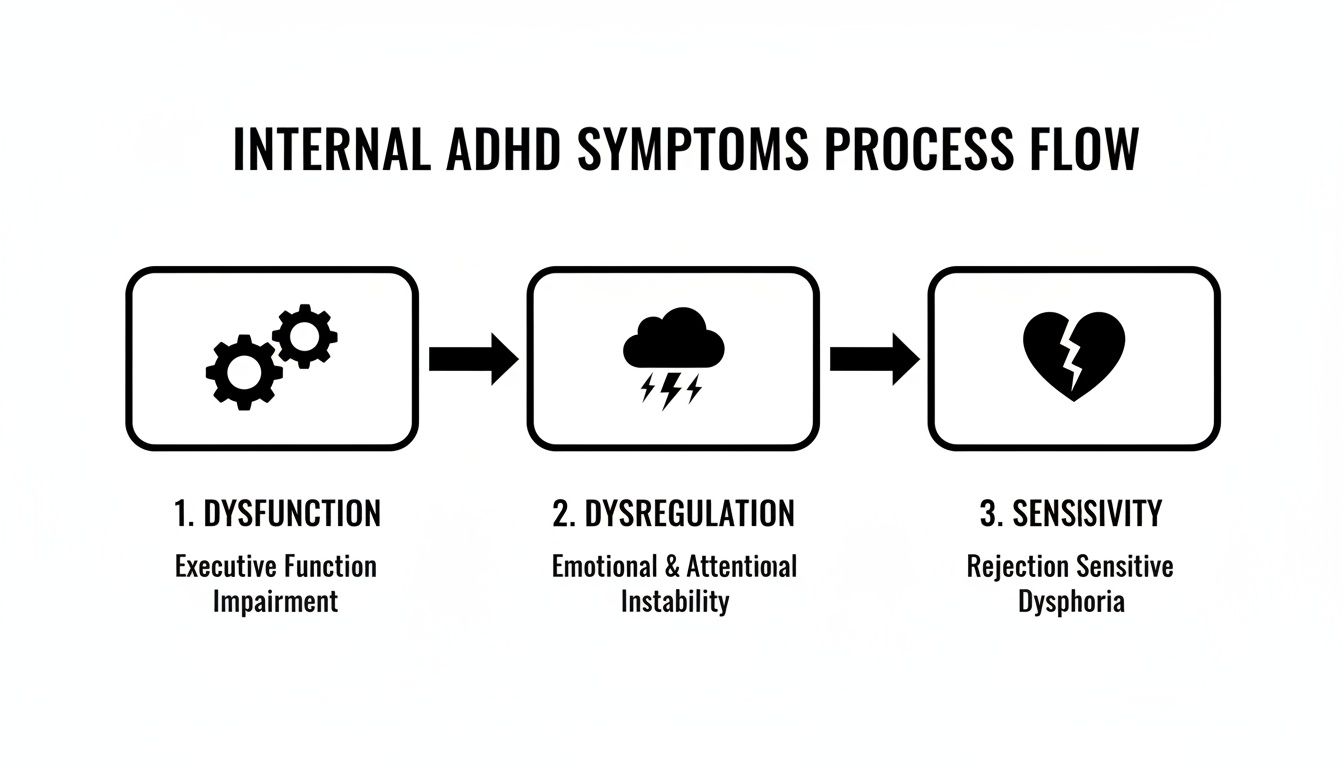
As you can see, difficulties with planning and organisation (dysfunction) can lead to intense mood swings (dysregulation) and a powerful sensitivity to criticism. By weaving all these elements together—the interview, the history, and the objective data—the assessment becomes a powerful tool for understanding your unique brain wiring and finally getting the clarity you deserve.
Choosing Your Path: Private vs. NHS Assessments
So, you've decided to explore an adult ADHD diagnosis. You're now at a fork in the road. In the UK, you essentially have two options: go through the National Health Service (NHS) or choose a private provider. Getting to grips with what each path involves is the key to making a choice that feels right for you and your situation.
The NHS is a cornerstone of UK healthcare, but when it comes to neurodevelopmental assessments, the reality for many is a long, often frustrating wait. As awareness of adult ADHD has grown, so has the demand for assessments, and public services are struggling to keep up. This has led to waiting lists that can stretch on for months or, in some parts of the country, even years.
This isn't just a minor inconvenience. When you're dealing with the daily hurdles of undiagnosed ADHD, that kind of delay can feel like your life is on hold. The wait can take a toll on your job, your relationships, and your mental health, making a timely diagnosis feel more like an urgent necessity than a simple appointment.
The Reality of NHS Waiting Lists
There's a significant gap between the number of adults who need help and the resources available. Studies estimate that ADHD affects 3-4% of UK adults, yet the NHS infrastructure simply hasn't kept pace with the sheer volume of people coming forward for assessment. This shortfall leaves many people feeling stuck, without the answers or support they need. You can read a more in-depth look at the state of UK adult ADHD services in this detailed analysis from PMC.
This is exactly where private healthcare steps in, offering a much faster route to getting the clarity you're looking for.
The Private Assessment Pathway
Choosing to go private means you get to sidestep those long NHS queues. Reputable providers, particularly those regulated by the Care Quality Commission (CQC), have a well-oiled process run by seasoned specialists. That’s the main draw of the private route: you get speed without compromising on clinical quality.
At a clinic like ours, the whole journey is designed to be as straightforward and efficient as possible. Instead of waiting years, you can often book a consultant-led assessment within a matter of days or weeks. For many, that accelerated timeline is a complete game-changer, allowing them to get answers and start a treatment plan far sooner.
A typical private assessment journey looks something like this:
- Initial Triage: A quick chat to make sure the service is a good match for what you need.
- Comprehensive Assessment: A deep-dive clinical interview with a GMC-registered consultant psychiatrist who specialises in adult neurodevelopmental conditions like ADHD and Autism.
- Detailed Reporting: You'll receive a full medico-legal report that clearly explains the diagnosis, offers personalised recommendations, and can be shared with your GP.
Weighing Up Your Options
The decision between the NHS and a private service really boils down to balancing a few key things. What works for one person might not for another, so it’s all about what fits your personal circumstances.
A private assessment is an investment in your mental health. It gives you timely access to specialist expertise so you can move forward with the clarity and support you deserve.
Here are a few points to mull over when making your choice:
- Speed and Urgency: If your symptoms are seriously impacting your life and you need answers sooner rather than later, the speed of a private assessment is a huge plus.
- Cost: NHS assessments are free, while private services are paid for out-of-pocket. It’s important to be clear on the financial side of things. To give you a better idea, we’ve put together a guide on the cost of an ADHD assessment.
- Level of Expertise: Both routes are staffed by qualified professionals. However, with a private service, you often have more choice in finding a specialist with experience in complex cases, like co-occurring ADHD and Autism.
Choosing your assessment path is a big step. By weighing up the pros and cons of both the NHS and private options, you can pick the one that aligns with your needs and take that next step with confidence.
Building Your Life After an ADHD Diagnosis

Getting an adult ADHD diagnosis isn't the end of the road. Far from it. Think of it as finally being handed the right map after years of navigating with the wrong one. This is your chance to start building a life that genuinely works with your brain's unique wiring, not against it. A diagnosis unlocks a whole toolkit of effective treatments and strategies, helping you not only manage the challenges but also harness your inherent strengths.
The first step is always a conversation. You and your psychiatrist will work together to build a treatment plan that feels right for you. This isn't just a clinical exercise in ticking boxes; it's about creating a solid foundation for a more balanced, satisfying life. For most people, this journey involves a blend of medication and powerful non-medical strategies.
Understanding Your Medication Options
Medication can be a game-changer for managing the core symptoms of ADHD. It works by helping to regulate the neurotransmitters in your brain, which in turn can sharpen your focus, dial down impulsivity, and quieten that constant internal chatter.
There are two main types of ADHD medication your specialist might discuss:
- Stimulants: These are the most common and often the first port of call. They work by increasing the levels of key brain chemicals like dopamine and norepinephrine, which are essential for attention and executive function.
- Non-Stimulants: A great alternative for people who don’t get on well with stimulants or can't take them for other health reasons. They work differently but can be just as effective at improving concentration and reducing impulsivity.
Finding the right medication and dose is a careful process called titration. It’s a bit like tuning an old radio; you and your psychiatrist will make small, gradual adjustments over a few weeks to find that perfect frequency where you get mental clarity without any unwelcome side effects.
The Power of Strategies Beyond Medication
While medication is incredibly helpful, it’s only one piece of the puzzle. Real, lasting change comes from building practical skills and strategies that support your ADHD brain day in and day out. This is where non-pharmacological approaches truly shine, especially for managing the complexities of co-occurring conditions like Autism and anxiety.
There's a significant treatment gap that highlights just how vital these strategies are. It's estimated that 2.5 million adults in England live with ADHD, yet only 15.6% receive medication. This statistic underscores the massive need for accessible, practical strategies that empower people to manage their condition effectively.
Some of the most powerful non-medical supports include:
- ADHD-Specific Coaching: A coach isn't a therapist; they're a strategist. They work with you to build tangible skills in the areas you find toughest—things like planning, managing time, and getting organised. They provide the accountability and guidance to create personalised systems that actually stick.
- Cognitive Behavioural Therapy (CBT): This isn't your standard CBT. It’s been specifically adapted for the ADHD brain to help you unpick and reframe the negative thought patterns that often build up after years of feeling misunderstood or being called "lazy." It also gives you practical tools for tackling procrastination and emotional dysregulation.
A diagnosis gives you a user manual for your brain. The next step is learning the techniques that will help you operate it effectively, moving from a place of struggle to one of proactive management.
Creating a Supportive Environment at Work
Your workplace can either be a source of constant friction or a place where you can thrive. Asking for reasonable adjustments isn't about getting special treatment; it's about levelling the playing field so you can do your best work. Understanding and supporting neurodiversity benefits everyone.
Simple, practical adjustments at work can make a world of difference:
- Noise-cancelling headphones to block out distractions in a busy office.
- Flexible working hours to align your workday with your natural energy cycles.
- Written instructions and summaries of meetings to support memory and clarity.
- Regular, brief check-ins with a manager to help you stay on track with priorities and deadlines.
Beyond these practical supports, it's also empowering to know your rights. Understanding the specifics of things like mental health leave and workplace support in Ontario, for instance, is vital for navigating your professional life. An adult ADHD diagnosis gives you the clarity and confidence to start these conversations, armed with a clear understanding of what you need to succeed.
Your Questions Answered: Navigating the Adult ADHD Diagnosis Process
Thinking about getting an adult ADHD assessment often brings up a whole host of practical questions. It's completely normal to wonder about the timeline, the cost, what the outcome might be, and what it all means for you.
We get it. You've likely been wrestling with these questions for a while. So, we've put together some straightforward answers to the things people ask us most often, from co-occurring conditions like Autism to what happens after the assessment is complete. Our aim is to demystify the process and give you the confidence to take the next step.
How Long Does a Private Adult ADHD Assessment Take?
Let's be honest, one of the biggest worries is the waiting time. After years of struggling and looking for answers, the last thing you want is to be stuck on another long list. This is where a private assessment really makes a difference compared to the NHS pathway.
While NHS waiting lists for adult ADHD can stretch on for years, the private route is much quicker. You can typically get an appointment with a specialist within a week or two of getting in touch.
The main part of the assessment – the in-depth interview with a consultant psychiatrist – usually takes about 90 minutes. Afterwards, you’ll receive a comprehensive diagnostic report with personalised recommendations, typically within another week. That means you can go from questioning to having clear answers in just a few weeks.
Is It Possible to Have Both ADHD and Autism?
Yes, absolutely. It’s now widely understood that ADHD and Autism Spectrum Disorder (ASD) very often overlap. Many people feel they don't fit neatly into one diagnostic box, and a good clinician will appreciate that complexity. In fact, a skilled assessment will always consider the possibility of co-occurring conditions.
Our consultant psychiatrists are highly experienced in assessing for both conditions, alongside a wide range of other mental health presentations. A thorough assessment involves looking closely at your unique combination of traits and life experiences.
The goal isn't just to tick boxes; it's to build a complete picture of how your brain works. The final report will give you a clear, nuanced understanding of whether you meet the criteria for ADHD, Autism, or both, with recommendations tailored specifically to your neurotype.
This careful, holistic approach is key to getting the right support for you.
What Happens If It Turns Out I Don’t Have ADHD?
This is a really common fear: "What if I go through the whole process and I'm told it's not ADHD?" It’s helpful to remember that a good assessment provides clinical clarity, no matter the outcome. The process itself is valuable for your mental health journey.
If the consultant concludes that you don't have ADHD, you won't be left in the dark. They will take the time to walk you through exactly why your experiences don't fit the diagnostic criteria.
More importantly, they'll offer alternative clinical explanations for the difficulties you're facing. Your report will still provide a detailed psychological profile and point you towards more suitable support or treatment. Whether it's an anxiety disorder, Autism, a mood disorder, or something else, you’ll leave with a clear, helpful path forward.
Will My GP Accept a Diagnosis From a Private Clinic?
This is a crucial question, especially when thinking about ongoing care and medication. We work hard to make sure our assessments meet the highest clinical standards to make this part as seamless as possible.
Every assessment is conducted by a GMC Specialist Registered Consultant Psychiatrist, and the reports they produce are robust, evidence-based, and fully compliant with NICE guidelines.
We write these reports specifically so they can be shared with your GP. They include all the clinical details needed to support a Shared Care Agreement – the formal arrangement that allows your GP to take over prescribing your medication based on our specialist's recommendation. While the final decision is always up to the individual GP, our reports are created to make that collaboration straightforward and are widely accepted.
At Insight Diagnostics Global, we offer a clear, consultant-led path to understanding your mental health. If you feel ready to get the answers you deserve, our team is here to support you with a CQC-regulated, evidence-based assessment. You can explore our services and book an initial consultation at https://insightdiagnostics.co.uk.