

You may be here because life has become harder to explain.
You've always coped, often by working longer, preparing more carefully, or hiding how exhausted you feel after ordinary social demands. You may have spent years being described as anxious, overly sensitive, intense, disorganised, blunt, distracted, or burnt out. Then, at some point, the question becomes difficult to ignore. Is this autism, ADHD, both, or something else affecting your mental health?
For many adults in the UK, the search term autism treatment uk is really a search for clarity. Not a cure. Not a promise that a lifelong neurodevelopmental difference can be removed. What people usually want is an accurate explanation for their experiences, a proper assessment, and a support plan that is suitable for adult life.
Are You Autistic An Introduction for UK Adults
A common adult presentation is not dramatic. It's cumulative.
Someone holds down a job, meets deadlines, appears capable, and still ends each week depleted. Conversations feel effortful. Noise, change, and unclear expectations create disproportionate stress. Friendships have often involved masking. Work has been possible, but only at a personal cost. Some adults notice repetitive patterns from childhood only when burnout, anxiety, low mood, or relationship strain make them pause and look back.

Why the question often appears in adulthood
Adults rarely come saying, “I think I have autism” with complete certainty. More often they say:
- “I'm exhausted by normal life” and can't understand why everyday demands seem harder for them than for others.
- “I miss things other people seem to catch automatically” in conversation, workplaces, or relationships.
- “I've always felt different” but haven't had a framework that makes sense of it.
- “I'm wondering if it's ADHD as well” because focus, organisation, impulsivity, and mental restlessness are part of the picture.
That overlap matters. Autism, ADHD, and mental health difficulties can interact in ways that blur the clinical picture. An autistic adult may present with chronic anxiety because the environment is persistently overwhelming. An adult with ADHD may look emotionally dysregulated when the core problem is untreated attention dysregulation. Some people have both.
A diagnosis doesn't create the difficulty. It explains it, and that explanation often changes what support becomes useful.
If you're still at the stage of questioning, a screening tool can be a sensible first step before deciding what kind of formal assessment to pursue. A useful place to start is this autism self-check questionnaire for adults.
What a good starting point looks like
The right first step isn't to ask, “How do I treat autism?” It's to ask, “What's going on for me?”
That shift matters. In clinical practice, the most helpful outcomes come when adults move away from self-criticism and towards structured understanding. Once the picture is clearer, support becomes more practical. It can include diagnostic clarification, ADHD assessment where relevant, mental health treatment, workplace adjustments, and a more realistic way of managing energy, relationships, and sensory load.
Rethinking What Autism Treatment Actually Means
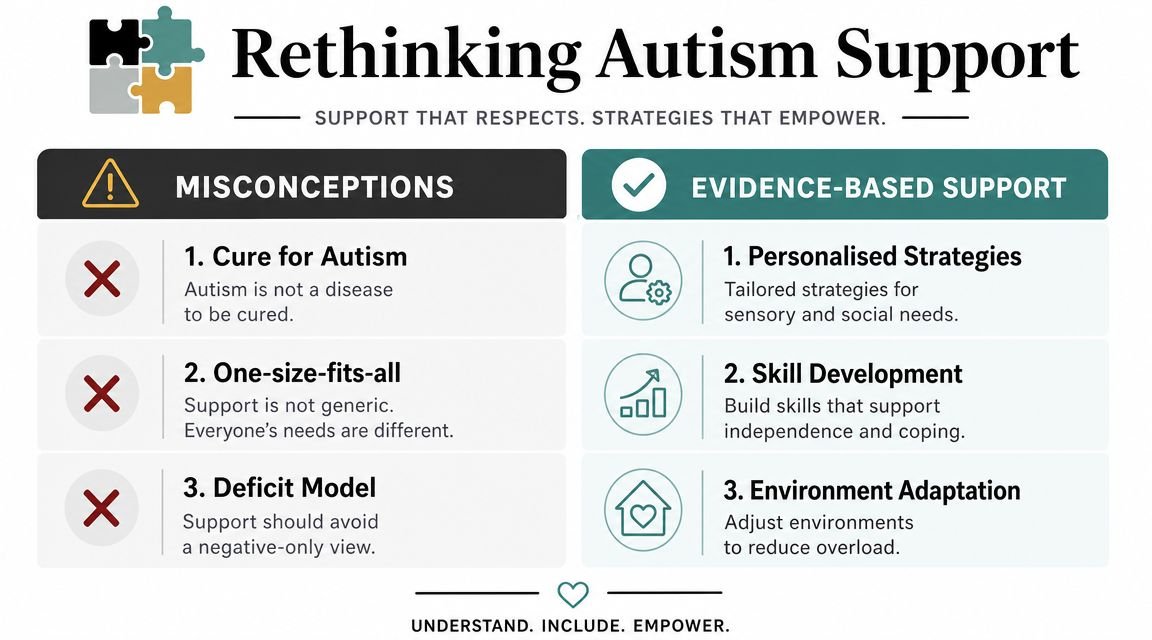
The phrase autism treatment uk causes confusion because it suggests autism should be treated like an illness. That isn't how current UK guidance approaches it.
The National Autistic Society's summary of NICE guidance is clear that autism should not be “treated” as a disease. Instead, evidence-based care focuses on personalised adjustments, structured support, and treatment of coexisting conditions where present. The same guidance rules out several non-evidence-based approaches, including chelation, restrictive diets such as gluten-free and casein-free diets, hormone therapies, hyperbaric oxygen, and secretin as autism treatments, as outlined in NICE-aligned autism strategies and interventions guidance.
What does work in practice
A useful support plan is usually built around function. What's getting in the way of daily life, work, study, relationships, emotional regulation, or health?
For adults, that can include:
- Environmental adjustments such as reducing sensory overload, changing work patterns, or making communication clearer and more predictable.
- Structured interventions including social skills support, employment support programmes, or structured leisure activity where clinically appropriate.
- Mental health treatment for anxiety, depression, obsessive symptoms, trauma-related difficulties, or sleep problems when these are present in their own right.
- ADHD assessment and treatment if attention, impulsivity, restlessness, or executive dysfunction are contributing to impairment.
What doesn't work, even if it is marketed persuasively
Adults are often vulnerable to poor advice when they've waited a long time for answers. If someone is exhausted, distressed, and searching online late at night, the promise of a simple fix becomes very attractive.
That's exactly why it matters to separate evidence from marketing. Interventions that claim to cure autism, detox the body, or reverse autistic traits should be approached with caution. They don't match UK clinical guidance, and they can distract from the work that improves quality of life.
Practical rule: if a treatment claims to remove autism itself, that's usually a sign to step back and look critically at the evidence.
A better clinical question is whether an intervention improves daily functioning, reduces distress, and respects the person's neurodevelopmental profile.
This short explainer gives a useful overview of that reframing:
The adult perspective matters
Adult autism support is often less about a single therapy and more about joining up several parts of life properly. The person may need workplace adjustments, a better understanding of sensory overload, treatment for co-occurring ADHD, and a therapist who understands neurodivergence rather than pathologising every coping style.
That's why a consultant-led approach tends to produce better plans than a generic one. The question isn't “What autism treatment uk option is best for everyone?” It's “What support is indicated for this specific adult, with this pattern of strengths, difficulties, and mental health needs?”
Why a Comprehensive Assessment Is Your First Step
A brief online screener can tell you whether autism is worth exploring. It can't tell you whether autism is the best explanation, whether ADHD is also present, or whether anxiety, depression, trauma, personality factors, or longstanding burnout are shaping the picture.
That difference is important. A poor assessment creates confusion that can last for years. A thorough assessment gives you a clinical formulation that makes the next decision much easier.
The scale of need is obvious in UK data. The British Medical Association estimates around 700,000 people in the UK have an autism diagnosis, and about 1 in 100 children in the UK are diagnosed with autism. It also notes that diagnostic targets are commonly missed across UK systems, which helps explain why so many adults look beyond standard routes for answers, as set out in the BMA overview of autism spectrum disorder in the UK.
What a comprehensive assessment should answer
A proper adult assessment should do more than decide yes or no to autism. It should clarify several questions at once.
- Is autism present? The clinician should assess lifelong patterns, not just current stress.
- Is ADHD also present? Untreated ADHD can worsen anxiety, burnout, occupational difficulty, and self-esteem.
- What is mental health, and what is neurodevelopment? Panic, depression, obsessive symptoms, emotional dysregulation, or trauma can coexist, and each may need its own treatment plan.
- What else needs excluding? Some traits overlap with personality difficulties, social anxiety, or chronic stress. Good practice involves differential diagnosis, not assumption.
Why consultant leadership matters
In adult work, nuance matters more than speed alone. The strongest assessments look at developmental history, current functioning, collateral information where available, and the pattern across settings over time.
A consultant psychiatrist or similarly experienced specialist is trained to think diagnostically across categories. That matters when someone presents with mixed features. In practice, many adults aren't simple cases. They may have autistic traits, clear ADHD symptoms, longstanding anxiety, episodes of depression, and years of compensatory masking.
The best assessment doesn't just hand over a label. It explains why that label fits, what else was considered, and what to do next.
If you want to explore structured pre-assessment questions before booking, this adult autism screening questionnaire PDF can help organise your thinking.
How to Get an Adult Autism Assessment in the UK
For most adults, there are three realistic routes. The NHS route, the NHS Right to Choose route where applicable, and a private self-funded route.
The practical reason this matters is simple. In England, 236,225 people had an open referral for suspected autism by June 2025, with 89% waiting longer than the 13 weeks recommended by NICE, and the average wait was over 17 months, according to England waiting list data summarised here. When diagnosis is the gateway to support, delays affect far more than the label itself.
UK Autism Assessment Pathways Comparison
| Pathway | Typical Wait Time | Cost to Patient | Choice of Provider |
|---|---|---|---|
| NHS standard referral | Often prolonged and variable by area | Usually no direct assessment cost | Limited |
| NHS Right to Choose | Can be faster than local NHS pathways, depending on provider and eligibility | Usually no direct assessment cost if approved | More choice than standard local referral |
| Private or self-funded | Usually fastest | Patient pays directly | Highest degree of choice |
The standard NHS route
This starts with your GP. If the GP agrees a referral is appropriate, you're referred into the local autism assessment pathway.
The advantage is clear. There's usually no direct cost for the assessment itself. The trade-off is waiting time, variability between areas, and less control over which provider assesses you.
This route suits adults who can wait and who prefer to stay within local NHS systems for the whole process.
The Right to Choose route
Right to Choose can be a practical middle path for eligible patients in England. Your GP refers you to an approved provider rather than only to the local service.
For many adults, the key benefit is not merely speed. It's also having more control over the pathway. That matters if you want a provider experienced in adult autism, co-occurring ADHD, or complex psychiatric presentations. If you're exploring that route, this guide to a Right to Choose autism assessment pathway explains the process in straightforward terms.
The private route
Private assessment is often chosen by adults who need clarity quickly for work, university, therapy planning, or ADHD treatment decisions. It offers the most flexibility over appointment times and provider choice.
The obvious trade-off is cost. The less obvious trade-off is that quality varies. A private route is only worth paying for if the assessment is thorough, consultant-led or specialist-led, and produces a report strong enough to support ongoing care, adjustments, and shared understanding with other professionals.
How to decide between them
The best route depends on your situation, not on ideology.
- If budget is the main issue, start with the NHS and ask specifically about local waiting times.
- If you're in England and waiting is a major concern, ask your GP about Right to Choose.
- If you need rapid clarification, private assessment may be more proportionate, especially where ADHD, university support, work impairment, or active mental health treatment decisions depend on diagnostic clarity.
One practical point is often missed. The pathway is not just about getting assessed quickly. It's about getting assessed well enough that the result helps you make better decisions afterwards.
Your Assessment Journey from Booking to Report
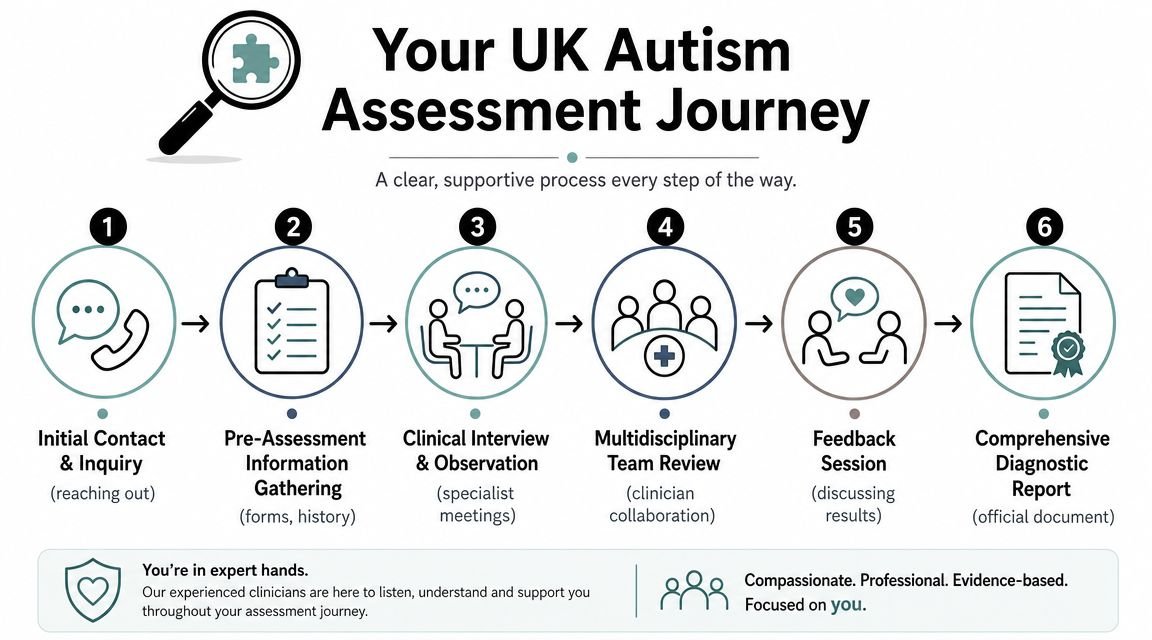
Many adults delay assessment because they fear a cold, interrogative process. Good assessment practice doesn't feel like that. It should be structured, careful, and respectful. The aim is to understand your developmental history and current functioning, not to catch you out.
What usually happens first
The first stage is usually triage and information gathering. You'll often complete questionnaires and provide background information about childhood, education, work, relationships, mental health, and current difficulties. If a relative or someone who knew you well in childhood can contribute, that can be helpful, though adults don't all have access to collateral history and clinicians should work realistically with what is available.
At this stage, the clinician is already asking an important question. Does the presentation suggest autism, ADHD, both, or another explanation that needs consideration?
The assessment itself
A complete adult pathway often includes structured clinical interviews and standardised tools where appropriate. In autism work, clinics may use tools such as ADOS and ADI-R. If ADHD is also being assessed, DIVA-5 may be part of the process.
What matters most is not the existence of a tool on its own. It's how the specialist integrates the results with clinical judgment, developmental history, observation, and differential diagnosis.
A high-quality assessment often includes:
- Pre-assessment review of forms, screening results, and relevant records.
- Detailed interview covering childhood development, education, social communication, routines, interests, sensory profile, and daily functioning.
- Assessment of overlap with ADHD and common mental health conditions.
- Clinical synthesis in which the specialist reviews whether the full pattern supports diagnosis.
A diagnosis should follow a formulation. If the clinician cannot explain the reasoning clearly, the report is unlikely to be useful later.
What the report should contain
The final report should do more than state a conclusion. It should describe your presentation in plain clinical language and make practical recommendations.
A useful report usually includes:
- Diagnostic outcome with rationale
- Strengths and difficulties rather than deficits alone
- Consideration of co-occurring conditions
- Recommendations for work, study, therapy, sensory support, and further treatment where needed
The feedback appointment matters as much as the paperwork. Many adults need space to process the result. Some feel relief. Some feel grief for years missed. Some feel both at once. A good clinician leaves room for that and helps translate the diagnosis into next steps.
Building Your Personalised Post-Diagnosis Support Plan
The diagnosis is not the endpoint. It is the point at which support can become more specific.
The phrase autism treatment uk often becomes most useful if it is understood properly. Adult support is often fragmented. The NHS and the National Autistic Society both make the key point that support should focus on daily living and co-existing needs, not on “treating autism” itself, as described in NHS guidance on autism support for adults. That distinction matters because many adults leave assessment knowing the diagnosis, but not knowing what to do on Monday morning.
The plan should reflect your actual life
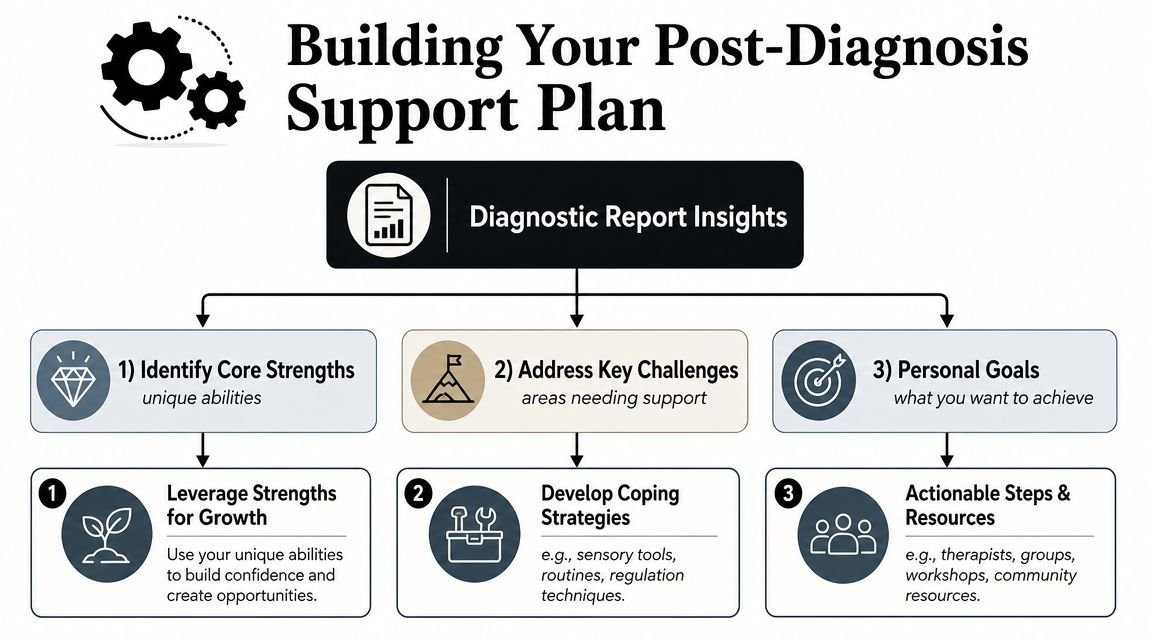
A useful post-diagnostic plan usually draws from three areas at once. Your strengths, your pressure points, and your goals.
For one adult, the priority is workplace survival. For another, it's understanding chronic shutdown, sensory overload, and social fatigue. For someone else, the underlying issue is that untreated ADHD has sat beside autism for years and made daily functioning much harder than it needed to be.
Core areas to build from
Work and study adjustments
Many adults benefit from clear written instructions, quieter work environments, reduced unpredictability, flexible scheduling, or changes to meeting structures. A diagnosis can help frame reasonable adjustments more clearly.Psychological support
Therapy works best when the therapist understands neurodivergence. Generic therapy can fail if it mistakes autistic communication style for resistance, or misses the role of sensory overload, masking, and chronic invalidation.ADHD treatment where indicated
If assessment identifies co-occurring ADHD, this can materially change the plan. Medication, titration, and monitoring may become relevant, alongside behavioural strategies and executive function support. One option adults sometimes consider for integrated assessment and follow-up is what happens after an autism diagnosis and related next-step care, particularly where autism, ADHD, and mental health need to be considered together.Social care and community support
Some adults need local authority input, occupational therapy, carer support, or charity-based guidance. This part of the system often requires persistence because it isn't presented as a single package.
Support plans fail when they stay abstract. They work when each recommendation can be turned into a real action, with a person, service, or change attached to it.
Mental health still needs direct attention
A diagnosis can be relieving, but it doesn't automatically resolve anxiety, depression, trauma, shame, or years of burnout. Adults often need a parallel mental health plan that respects neurodivergence rather than treating it as secondary.
That may include better sleep routines, sensory boundaries, reduced masking demands, and practical emotional regulation strategies. Some people also benefit from reflective resources outside formal treatment. For example, gentle reading on insights for cultivating inner peace can complement therapy when negative thought patterns have become entrenched through years of misunderstanding.
The right support plan is always individual. The diagnosis informs it, but your day-to-day reality should shape it.
Your Practical Next Steps for Getting Help
If you've read this far, you probably don't need more theory. You need a clear next move.
The UK government's autism strategy recognises poor mental health among autistic people and aims to improve diagnostic pathways and earlier identification, as set out in the national autism strategy for children, young people and adults. That's important, but most adults still need to act proactively rather than waiting for the system to become simpler.
A sensible sequence is:
Write down your pattern
Note lifelong social differences, sensory issues, burnout, routine needs, attention problems, and mental health symptoms.Use a screening tool carefully
Screening doesn't diagnose, but it can help you judge whether a formal assessment is worth pursuing.Book a GP appointment
Ask directly about adult autism referral options and, if relevant, ADHD assessment too.Check whether Right to Choose applies to you
If you're in England, this may offer a more workable path than the standard local queue.Choose assessment quality over speed alone
A fast but superficial report can create more problems than it solves.Plan beyond the diagnosis
Think about work, study, therapy, ADHD treatment, and mental health support from the outset.
You don't need to solve everything at once. You need a sound assessment and a plan built around what affects your life.
If you're looking for a consultant-led adult assessment pathway, Insight Diagnostics Global provides online and face-to-face assessments for adults aged 18 and over, including autism, ADHD, and broader mental health evaluation, with diagnostic reporting and follow-up options where appropriate.