

When seeking an ADHD referral form, you’re likely already stuck at the most frustrating stage. You know something isn’t right. You may have spent years patching over missed deadlines, chaotic routines, forgotten appointments, burnout, anxiety, or relationship strain. Then you hit the NHS system and realise the form isn’t just admin. It’s the gatekeeper.
That catches people out. Many patients think the hard part is the assessment. In practice, the first hurdle is getting a referral accepted, directed to the right pathway, and written in language that shows real clinical impairment rather than a general feeling of “I struggle to focus”.
The UK system is under pressure, with BBC reporting on adult ADHD waits finding at least 196,000 adults waiting for NHS evaluations, that the backlog has quadrupled since 2019, and that in some areas it could take eight years or more to clear. A weak referral costs individuals time they don’t have.
Patients usually have three routes. The standard NHS pathway. Right to Choose in England, if eligible. Or a private assessment. Each route has its own rules, trade-offs, and failure points. The form often looks simple. The pathway behind it isn’t.
Starting Your ADHD Diagnosis Journey in the UK
It is common for those initiating this process not to feel organised and confident. They begin after a long run of problems that don’t quite fit together until ADHD is mentioned. For some, it’s work that keeps slipping despite effort. For others, it’s university deadlines, repeated job changes, emotional overload, or a lifetime of being told they’re bright but inconsistent.
The first useful shift is this. Stop thinking about the ADHD referral form as a box-ticking document. Think of it as a clinical summary of impairment. That’s what determines whether a GP refers, whether triage accepts the referral, and whether the chosen pathway is even open to you.
The three routes people usually consider
A referral can lead into one of three broad pathways:
| Pathway | What it usually means | Main trade-off |
|---|---|---|
| NHS local service | Standard GP referral into local ADHD assessment service | No direct cost, but often the slowest route |
| Right to Choose | NHS-funded referral to an eligible provider in England | Faster in many cases, but strict eligibility rules apply |
| Private | Self-funded assessment outside NHS waiting lists | Fastest access, but onward NHS prescribing isn’t guaranteed |
Each route can work. None is perfect.
Practical rule: The best pathway isn’t the one that sounds fastest on paper. It’s the one you’re actually eligible for and can follow through from assessment to treatment and support.
What a good referral actually does
A strong referral answers three questions clearly:
- Why is ADHD suspected?
- How long has the pattern been present?
- What harm is it causing now across daily life?
That last point is where many forms fail. A patient may describe distractibility, restlessness, procrastination, or disorganisation, but not explain the consequences. Clinicians and triage teams need the impact. Missed rent payments. Repeated lateness. Unsafe driving habits. Relationship conflict. Underperformance despite effort. Exhaustion from masking. Academic collapse. These are the details that move a referral from vague concern to clinically useful evidence.
This applies not only to ADHD. Adults often present with overlap between Autism, ADHD, and broader mental health difficulties, including anxiety, depression, trauma responses, emotional dysregulation, and personality-related difficulties. An experienced clinician will look at the whole picture rather than forcing everything into one label. That’s especially important if you’re seeking a psychological assessment and suspect more than one condition may be involved.
Leading with extensive experience, top consultant psychiatrists make a difference here, especially in neurodevelopmental and personality disorder work. That includes clinicians such as Dr Sai Achuthan, whose kind of specialist expertise is often most useful when the presentation is mixed, longstanding, or complicated by mental health symptoms.
How to Prepare for Your GP Appointment
Preparation changes the quality of the referral more than people realise. The GP appointment is often short. If you arrive with only a broad statement like “I think I might have ADHD”, the discussion can stay broad. If you arrive with a clear symptom history, examples of impairment, and a completed screening tool, the conversation becomes much easier to act on.

NHS England guidance on the ADHD taskforce report states that referrals are frequently rejected if they don’t include the “nature and severity of ADHD symptoms” and associated “impairment.” It also notes that completing a validated tool such as the ASRS beforehand is a key step in meeting that threshold.
What to gather before the appointment
Bring enough evidence to show pattern, duration, and impact.
- Childhood clues: Old school reports, comments about daydreaming, lateness, disorganisation, poor homework completion, being disruptive, or “not working to potential”.
- Adult examples: Job reviews, repeated issues with deadlines, missed emails, forgotten meetings, frequent switching between tasks, financial disorganisation, relationship conflict.
- Informant input: A partner, parent, sibling, or close friend can often describe patterns you’ve normalised.
- Mental health history: Anxiety, depression, burnout, panic, sleep problems, substance use, trauma history, and previous treatment all matter.
- A completed ASRS: Don’t leave this to memory in the appointment if you can avoid it.
How to describe impairment properly
“I’m easily distracted” is too thin on its own.
A better version is specific and functional:
“I lose track of tasks at work unless I write everything down immediately. I’ve missed deadlines because I start several things at once and don’t complete the priority item. This has happened across different jobs, not just in my current role.”
Another example:
“At home I routinely forget bills, appointments, and messages unless someone reminds me. It’s caused conflict in my relationship because important tasks are left half-done even when I intended to do them.”
That language works because it links symptom to consequence.
Exact wording for the GP conversation
You don’t need a speech. You do need clarity. These phrases usually help.
- Opening the discussion: “I’d like to discuss a referral for an ADHD assessment because I’ve had longstanding problems with attention, organisation, and follow-through that are affecting work and daily life.”
- Showing duration: “These difficulties didn’t start recently. Looking back, there were signs in childhood and they’ve continued into adulthood.”
- Showing impairment: “The issue isn’t just that I find some tasks boring. It’s causing repeated functional problems in work, home life, and relationships.”
- Requesting a referral directly: “I’d like a formal assessment pathway considered, and I’ve brought examples of symptoms and impairment to support that referral.”
If you think autism may also be relevant, say so plainly:
- Dual concern wording: “I also wonder whether Autism may be part of the picture because of longstanding differences in social communication, rigidity, sensory issues, or overwhelm, and I’d like that considered alongside ADHD rather than separately dismissed.”
What doesn’t work well
Patients often sabotage a valid concern by minimising it. Common examples include:
- Joking it away: “I’m just a bit scatterbrained.”
- Overexplaining online content: “I saw ten videos and all of them sounded like me.”
- Focusing only on emotion: “I feel overwhelmed all the time.”
That’s relevant, but it isn’t enough without examples of behaviour and impairment. - Leaving out childhood history: Adult ADHD assessment still depends on developmental context.
Choosing Your Pathway NHS vs Right to Choose vs Private
The pathway matters as much as the form. A beautifully completed ADHD referral form can still fail if it’s sent into the wrong system, aimed at a provider you’re not eligible to use, or built on assumptions about treatment that don’t hold up later.
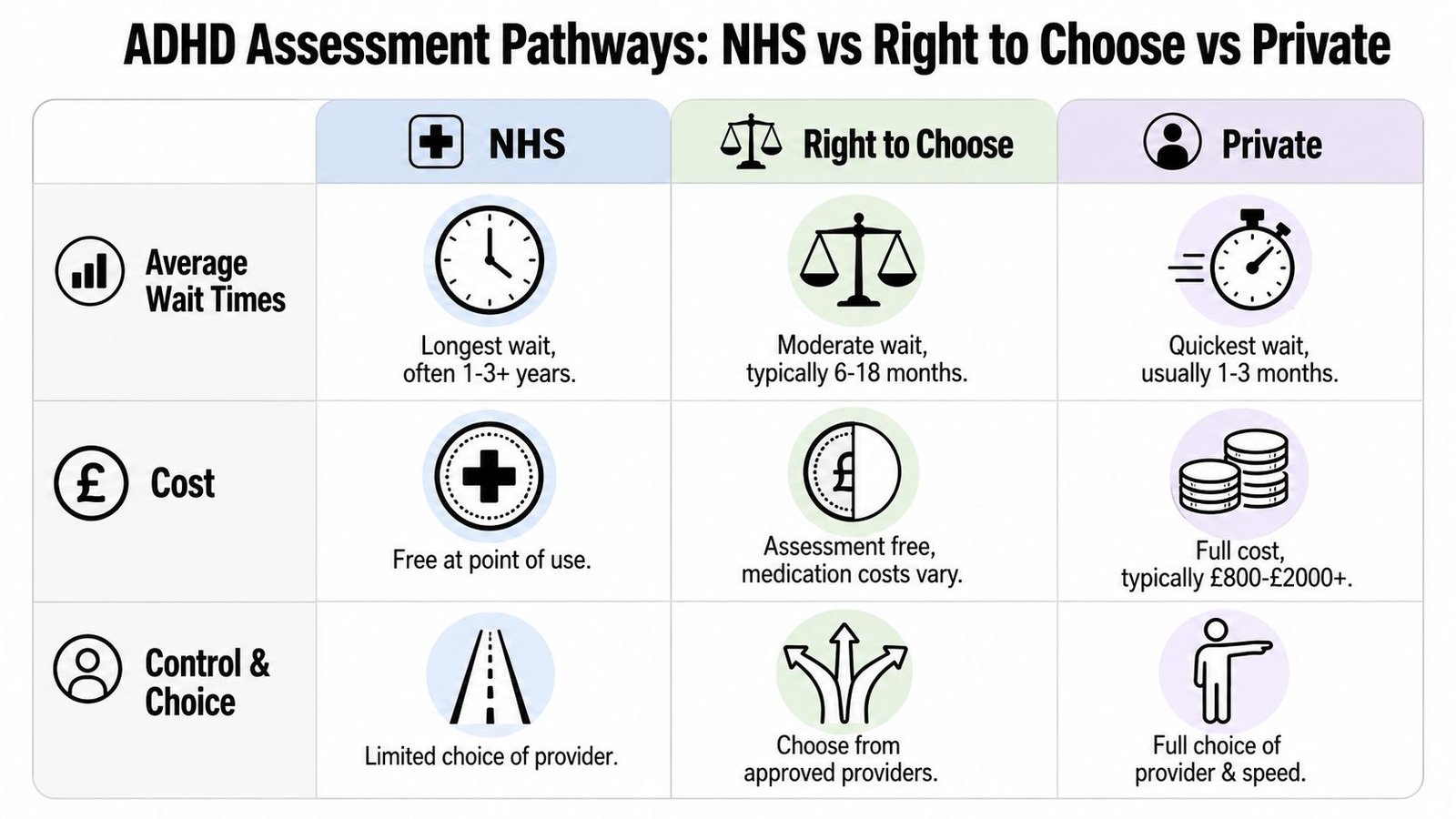
Standard NHS referral
The standard NHS route is usually the most familiar. You speak to your GP, they refer into the local service, and you wait for triage and assessment.
The advantage is obvious. It’s NHS-funded.
The drawbacks are also obvious. Local variation is wide. Communication can be patchy. Some areas use strict triage thresholds. If the referral lacks clear evidence of impairment or developmental history, it may be returned or redirected.
This route suits people who want to stay entirely within their local NHS pathway and are prepared for a long process.
Right to Choose in England
ADD UK’s explanation of Right to Choose for ADHD states that patients in England have a legal right to select any provider with an NHS contract for their first assessment, which can bypass local waiting lists that may run for years. The same guidance also makes clear that this right doesn’t apply if you’re already receiving care from another NHS mental health service.
That single rule causes a lot of confusion. People hear “legal right” and assume automatic access. It isn’t automatic.
Right to Choose usually works best when:
- You’re registered with a GP in England
- The referral is for a first outpatient assessment
- Your GP agrees the referral is clinically appropriate
- You’re not already under another NHS mental health service that blocks eligibility
- The provider you choose has an active NHS contract for that service
A practical line to use with your GP is:
“I’d like to request a referral under Right to Choose to a specific provider for a first ADHD assessment, if I’m eligible under the current rules.”
That wording helps because it shows you understand this is a pathway request, not just a symptom discussion.
Private assessment
Private assessment is usually the quickest route. It gives you the most control over scheduling, clinician choice, and speed of completion. For many adults, that’s the deciding factor, especially if work, study, or day-to-day functioning is already under strain.
But private assessment has real trade-offs. A private diagnosis doesn’t automatically secure NHS prescribing or shared care. Hampshire and Isle of Wight ICB’s Right to Choose FAQ page notes that NHS-funded treatment after a private diagnosis isn’t guaranteed, that shared care depends on individual GP agreement, and that there is no formal, standardised prioritisation criteria held centrally by the Integrated Care Board for ADHD or Autism services.
That means private can be excellent for diagnosis and clarity, but patients should ask two questions before booking:
- If medication is recommended, who will prescribe initially?
- Will my GP consider shared care later, and what would they need to see?
A clear decision framework
| If your priority is… | Best fit is often… | Reason |
|---|---|---|
| Lowest direct cost | NHS local pathway | No private fees |
| NHS-funded but more choice | Right to Choose | More control if eligible |
| Speed and flexibility | Private | Fast access and direct booking |
| Complex picture involving ADHD, Autism, and mental health | Whichever route gives you specialist assessment access soonest | Diagnostic quality matters more than route alone |
A good pathway is one you can complete from referral to diagnosis, and then from diagnosis to treatment planning.
How to Fill Out an ADHD Referral Form
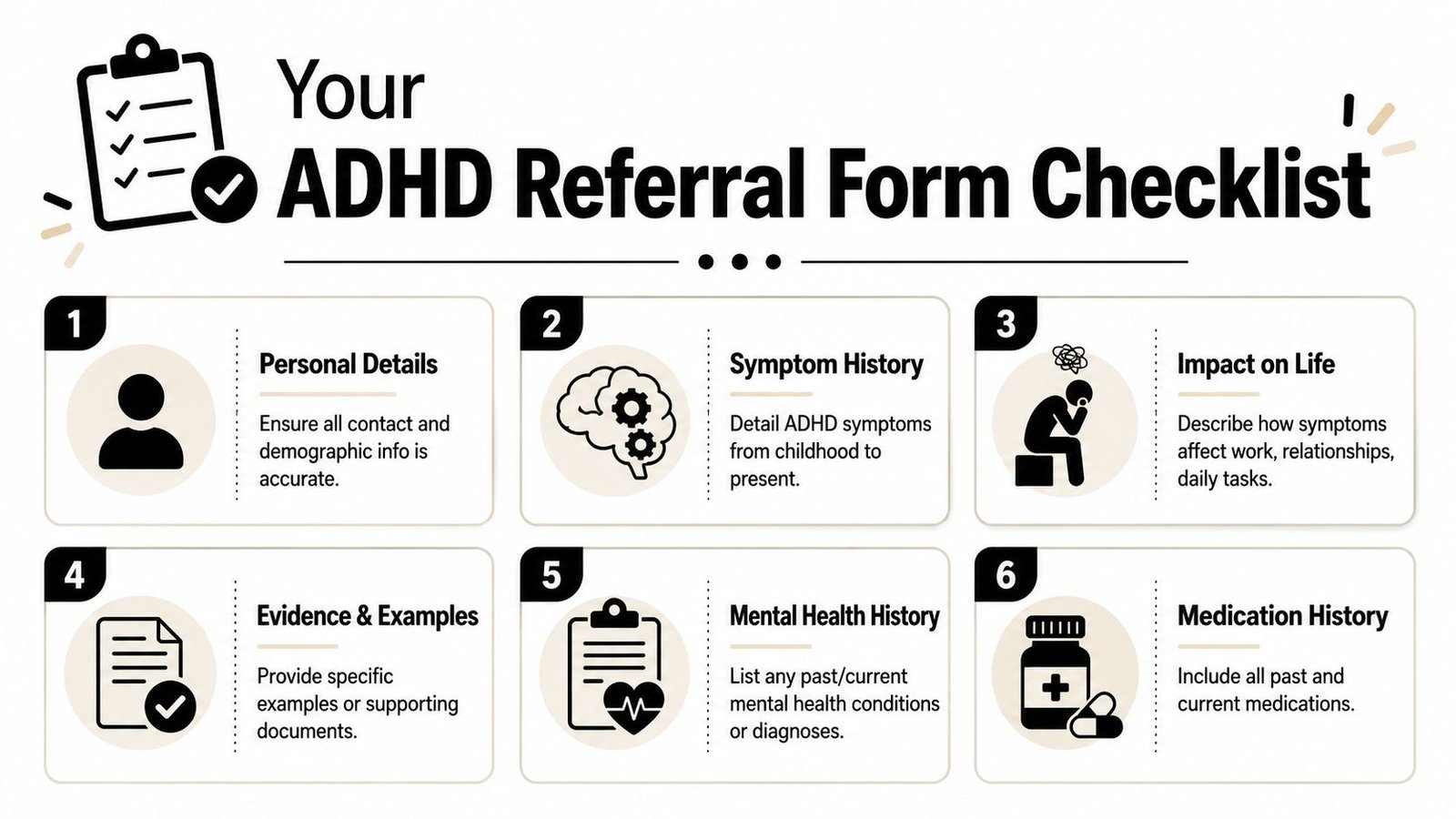
Most forms ask for the same core material, even when the layout differs. Personal details. Symptom history. Current difficulties. Childhood pattern. Mental health background. Medication history. Supporting information. The mistake people make is answering these sections too briefly or too generally.
ADHDUK’s summary of UK diagnosis rates reports that only 1 in 9 adults with ADHD are estimated to have a formal diagnosis on their health records, with diagnosis rates at 0.32%. That underdiagnosis is one reason the referral needs to be precise. You don’t need dramatic wording. You need usable detail.
Childhood history
This section often matters more than patients expect. Adult ADHD isn’t diagnosed from current stress alone. Clinicians are looking for a pattern that reaches back into earlier life.
Weak version:
- “I’ve always been a bit disorganised.”
Strong version:
- “At school I regularly forgot homework, lost equipment, and needed repeated reminders to stay on task. Reports described me as daydreaming, not listening, and failing to finish work despite ability.”
If you don’t have reports, use observed examples:
- “My parent recalls that I needed constant prompting for routines, often lost things, interrupted frequently, and struggled to complete tasks unless someone sat with me.”
Current symptoms
Don’t list every possible symptom. Prioritise the ones that disrupt your functioning now.
Useful wording examples:
- “I start tasks quickly but struggle to sustain attention when the work is repetitive or detailed.”
- “I make careless mistakes in admin and written work because I skim rather than fully process instructions.”
- “I underestimate time, run late, and miss deadlines unless I build multiple reminders.”
- “I interrupt in conversation and answer before people finish, which has caused tension at work and home.”
- “My environment becomes disorganised very quickly, and I spend a lot of time trying to recover from that.”
Impact on work, study, home, and relationships
This is the heart of the form. If a section asks how symptoms affect your life, don’t write “everything” or “a lot”. Break it down.
| Area | Better example to adapt |
|---|---|
| Work | “I miss steps in routine processes and need colleagues to check my work more than expected.” |
| Study | “I can understand material in class, but I struggle to plan assignments and often submit late after working in a last-minute rush.” |
| Home | “Bills, appointments, laundry, and household tasks pile up unless I use multiple prompts.” |
| Relationships | “People close to me say I don’t listen properly, forget agreed plans, and leave practical tasks unfinished.” |
A referral form improves when every symptom is paired with an example of harm, friction, delay, or repeated failure in real life.
Mental health and medication history
Don’t hide other mental health problems because you’re worried they’ll “cancel out” ADHD. They won’t. They help clinicians work out what else may be contributing, overlapping, or co-occurring.
Include:
- Past diagnoses: anxiety, depression, PTSD, eating disorder, bipolar concerns, personality difficulties, Autism, or learning differences
- Current treatment: counselling, CBT, medication, occupational support
- Previous medication: antidepressants, sleep medication, stimulants if any, and whether they helped or caused problems
Wording patients can adapt directly
If you’re writing a statement to attach or taking notes for your GP, this structure usually works well:
Reason for referral
“I am requesting assessment for possible ADHD due to longstanding difficulties with attention, organisation, time management, impulsivity, and task completion.”Developmental pattern
“These difficulties were present in childhood and have continued into adult life.”Current impairment
“They now affect my work, daily responsibilities, emotional wellbeing, and relationships.”Supporting evidence
“I have completed the ASRS and can provide examples from education, employment, and family observations.”
That is concise, clinical, and far more useful than a long emotional narrative with no structure.
After Submission Common Pitfalls and Next Steps
Once the referral has been sent, people often assume the difficult bit is over. It isn’t. This is the stage where admin problems, pathway mistakes, and missing documents tend to stall progress.
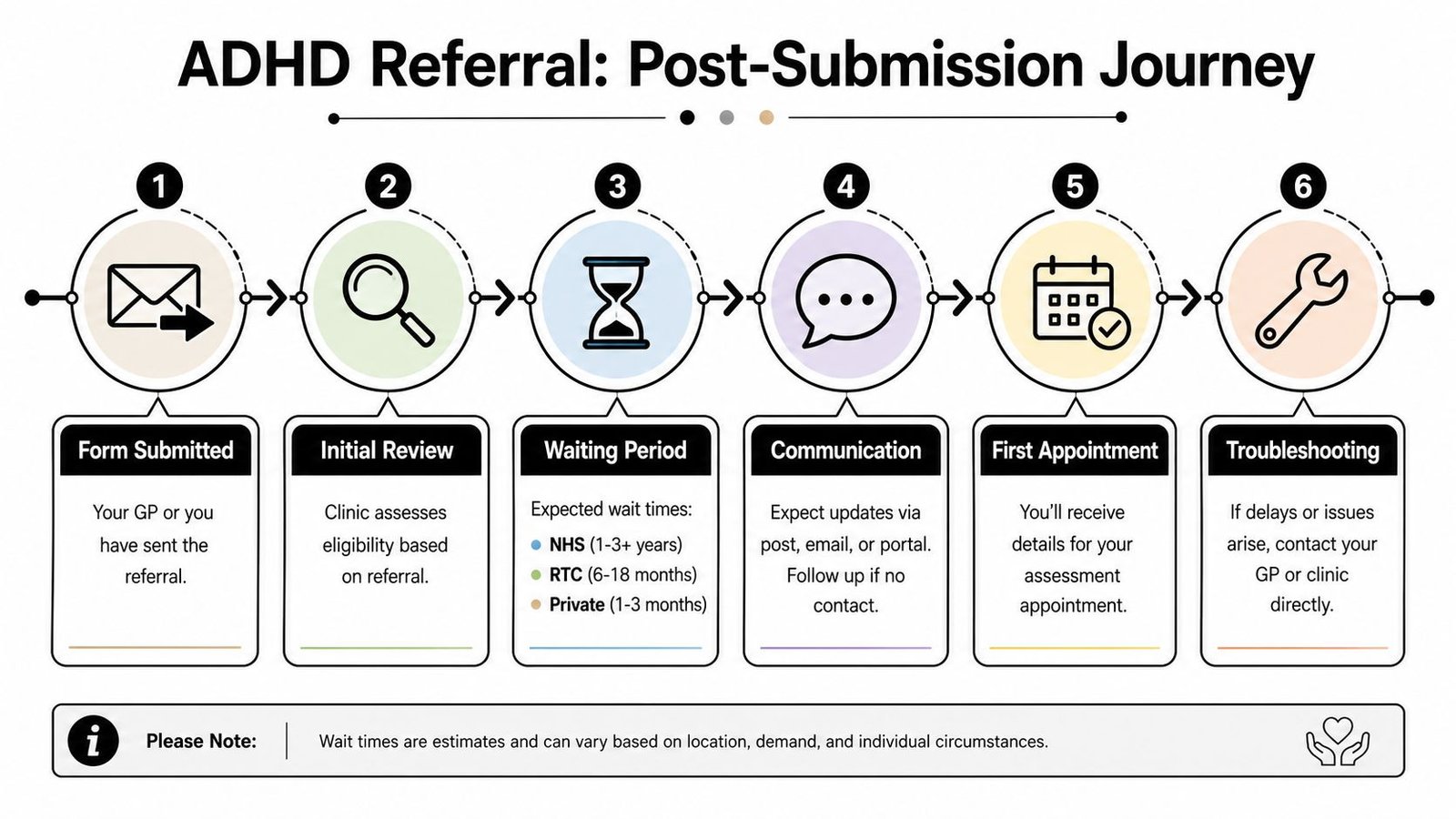
ADHD 360’s guide to Right to Choose issues highlights a common but poorly explained problem. The “form vs. pathway” gap. A patient may submit an excellent form and still be rejected because they don’t meet pathway rules, such as trying to use Right to Choose while already under the care of a local mental health team.
What usually causes delay or rejection
The pattern is usually one of these:
- The form is clinically thin: Symptoms are listed, but impairment isn’t described clearly.
- The wrong pathway was chosen: The referral asks for a route the patient isn’t eligible to use.
- The provider paperwork is incomplete: Self-report forms, GP letter templates, or care summary documents are missing.
- The patient is already in a conflicting service arrangement: This can block first-assessment pathways.
- The referral sits in limbo: The GP thinks it was sent. The provider hasn’t accepted it yet. The patient assumes waiting means progress.
What to do after you submit
Don’t chase every few days. Do keep a clean paper trail.
- Ask for confirmation that the referral was sent and note the date.
- Check which provider it was sent to, especially for Right to Choose.
- Keep copies of self-report forms, cover letters, and any symptom summary you supplied.
- Follow up if there’s silence for an extended period.
- Ask specifically whether it was accepted for triage, not just “sent”.
If a referral is rejected, ask for the reason in plain language. “Not accepted” isn’t enough. You need to know whether the problem was clinical content, missing paperwork, or pathway eligibility.
If your GP refuses to refer
Stay calm and specific. Ask what information is missing. If the issue is lack of evidence, offer a symptom summary, ASRS, and examples of impairment. If the issue is pathway confusion, clarify whether you’re asking for local NHS referral, Right to Choose, or discussion of private options.
If a service rejects the referral after the GP has sent it, ask whether resubmission is possible and what exactly needs to be added or corrected.
For people using a consultant-led service outside standard local waits, a clearer triage model can reduce this uncertainty. Some services offer rapid scheduling, structured assessment, and detailed reports from GMC-registered consultant psychiatrists, which can make the pathway easier to understand from the start. In consultant-led neurodevelopmental work, clinicians such as Dr Sai Achuthan are valued because they look not only at ADHD symptoms, but also at Autism, personality factors, and broader mental health presentations that often complicate referrals.
Your ADHD Referral Questions Answered
Can my GP refuse to refer me
Yes, a GP can decline if they don’t think the referral is clinically indicated yet, or if they think more information is needed. In practice, refusals often improve when the discussion is more specific. Bring a completed ASRS, examples of impairment across settings, and a short written summary. Ask what evidence would help them make the referral.
I think I may have Autism as well as ADHD. Can I raise both
Yes. You should raise both if both are relevant. Adults often present with a mixed neurodevelopmental picture, and anxiety or low mood may sit on top of that. If social communication differences, sensory sensitivity, routine dependence, or shutdowns are part of the picture, say so. A good psychological assessment should consider the overlap rather than forcing one explanation.
Are online assessments valid
They can be, if the provider uses a structured, clinically sound process and the patient is suitable for online assessment. Some patients still need in-person review. Suitability, diagnostic method, and clinician expertise matter more than whether the appointment happens online or face to face.
Can I use Right to Choose if I’m already on another ADHD waiting list
Be careful here. The Owl Centre’s Right to Choose guidance states that a critical rule is that patients must not already be on another ADHD waiting list for the same assessment under a different provider, because that conflicts with the “first outpatient appointment” requirement. This is one of the less obvious reasons referrals fail.
What if I already have a private diagnosis and want NHS medication
That can be difficult. Some GPs accept shared care and some don’t. Some NHS clinicians want their own assessment before prescribing. Before paying privately, ask in advance how treatment, titration, and monitoring would work afterwards.
Who should assess complicated cases
When symptoms overlap with Autism, trauma, anxiety, depression, burnout, or possible personality disorder, the best assessments are usually consultant-led and diagnostically broad. That kind of expertise is particularly important when the question isn’t just “Is this ADHD?” but “What combination of neurodevelopmental and mental health factors explains the whole presentation?”
If you’re looking for a clear next step, Insight Diagnostics Global offers consultant-led assessments for ADHD, Autism, and adult mental health with online and face-to-face options. The service is built for adults who need a thorough psychological assessment rather than a rushed opinion, including complex presentations involving neurodevelopmental conditions and personality-related difficulties. Assessments are led by experienced consultant psychiatrists, including Dr Sai Achuthan, with structured interviews, thorough reports, medication titration options for ADHD, and a practical focus on what happens after diagnosis.