
Private adult autism assessments in the UK usually cost £900 to £2,500, and a combined autism and ADHD assessment can reach £1,600 to £4,000. If you’re weighing up whether to book now, wait, or explore funding, the hardest part is often not the decision itself. It’s understanding what you’re paying for.
You might be reading this after another long day at work, wondering why social situations feel exhausting, why routines matter so much, or why burnout keeps returning no matter how organised you try to be. Many adults reach this point after years of self-management. Then the practical question lands. How much will an assessment cost, and why do quotes vary so much?
Clear answers matter, especially when Autism, ADHD, personality patterns, and wider mental health concerns can overlap. A thorough psychological assessment should help untangle that picture rather than add more confusion. That’s why many adults look for consultant-led services with experience across neurodevelopmental and mental health presentations, including the work led by Dr Sai Achuthan, a leading Consultant Psychiatrist with extensive experience in neurodevelopmental and personality disorder assessment.
Introduction to Autism Assessment Costs
For many adults, the search starts in a very ordinary moment. You notice a pattern. Meetings drain you more than they seem to drain everyone else. Changes in plan feel disproportionately stressful. You’ve learned to mask, compensate, and push through, but it’s getting harder.
Then you type one phrase into Google. Autism assessment cost.
The confusion begins quickly. One clinic lists a simple fee. Another mentions a longer process. A third refers to ADHD, mental health, and psychological formulation in the same pathway. At first glance, they can look similar. In practice, they often aren’t.
Some services assess only autism. Others look more broadly at Autism, ADHD, and mental health, which can matter when symptoms overlap. A consultant psychiatrist may approach the picture differently from a single-clinician screening model, particularly where differential diagnosis is important. That’s one reason adults often compare provider experience, report depth, and whether the service is online, face to face, or both.
A low headline price can feel reassuring at first. It’s less reassuring if key parts of the assessment appear later as extras.
Insight Diagnostics Global is one example of a consultant-led service working across adult Autism, ADHD, and broader mental health assessment, with online and face-to-face options. Its work is led by Dr Sai Achuthan, and the wider model reflects what many adults want from private assessment: transparent pricing, structured triage, and a clear diagnostic report from experienced clinicians.
Understanding Assessment Cost Fundamentals
The baseline matters because it gives you a realistic starting point before you compare clinics.
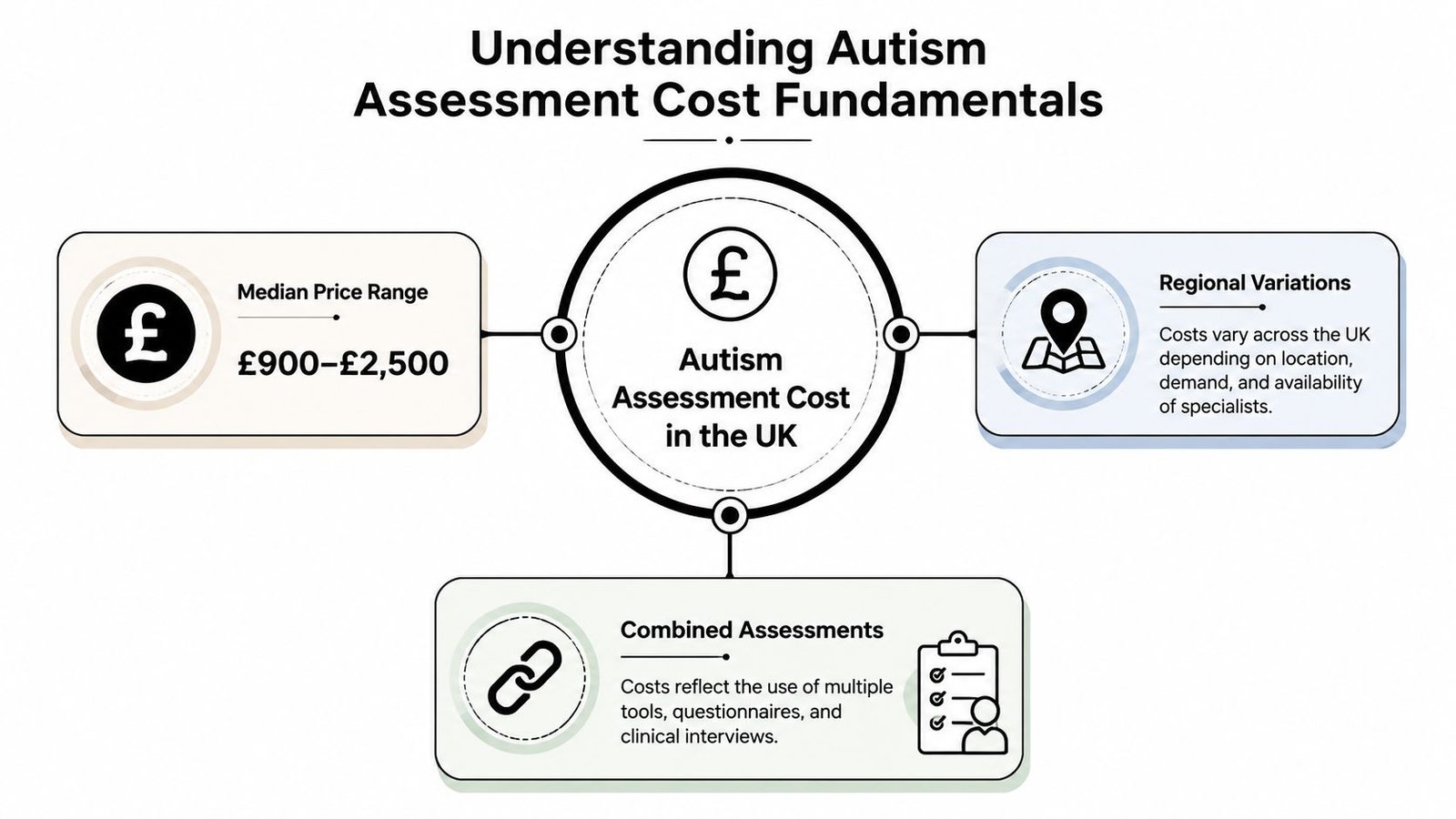
According to UK private autism assessment market data, private adult autism assessments in 2025 to 2026 typically cost between £900 and £2,500, with regional median pricing around £1,200 to £2,000 and London-specific rates reaching £1,800 to £3,500 depending on provider complexity and multi-disciplinary involvement. The same market overview notes that combined autism and ADHD assessments usually add £400 to £800 to the base autism fee, bringing total costs to £1,600 to £4,000.
What the baseline price usually reflects
Think of assessment pricing like booking a legal consultation. You’re not only paying for the meeting itself. You’re paying for preparation, professional judgement, documentation, and the final written outcome.
A typical autism assessment fee often covers:
- Clinical interview time with the assessing clinician
- Developmental history review where available
- Use of structured tools where the provider includes them
- Diagnostic formulation rather than a brief opinion
- A written report suitable for personal, workplace, or education use, depending on the provider
Why geography changes the quote
Location affects cost in a straightforward way. London clinics often face higher clinician fees and operating costs, while regional services can sometimes offer lower fees, especially where an individual chartered psychologist runs the assessment rather than a larger centre.
That doesn’t mean higher cost always equals better assessment. It usually means the service model is different. Some adults want the simplest route to diagnostic clarity. Others need a broader review because Autism may sit alongside ADHD, anxiety, depression, trauma, burnout, or long-standing personality-related difficulties.
Useful rule: Compare like with like. A quote only makes sense when you know who is assessing you, what’s included, and what report you’ll receive at the end.
Key Factors That Influence Cost
Two clinics can both say they offer an autism assessment and still be pricing very different services.
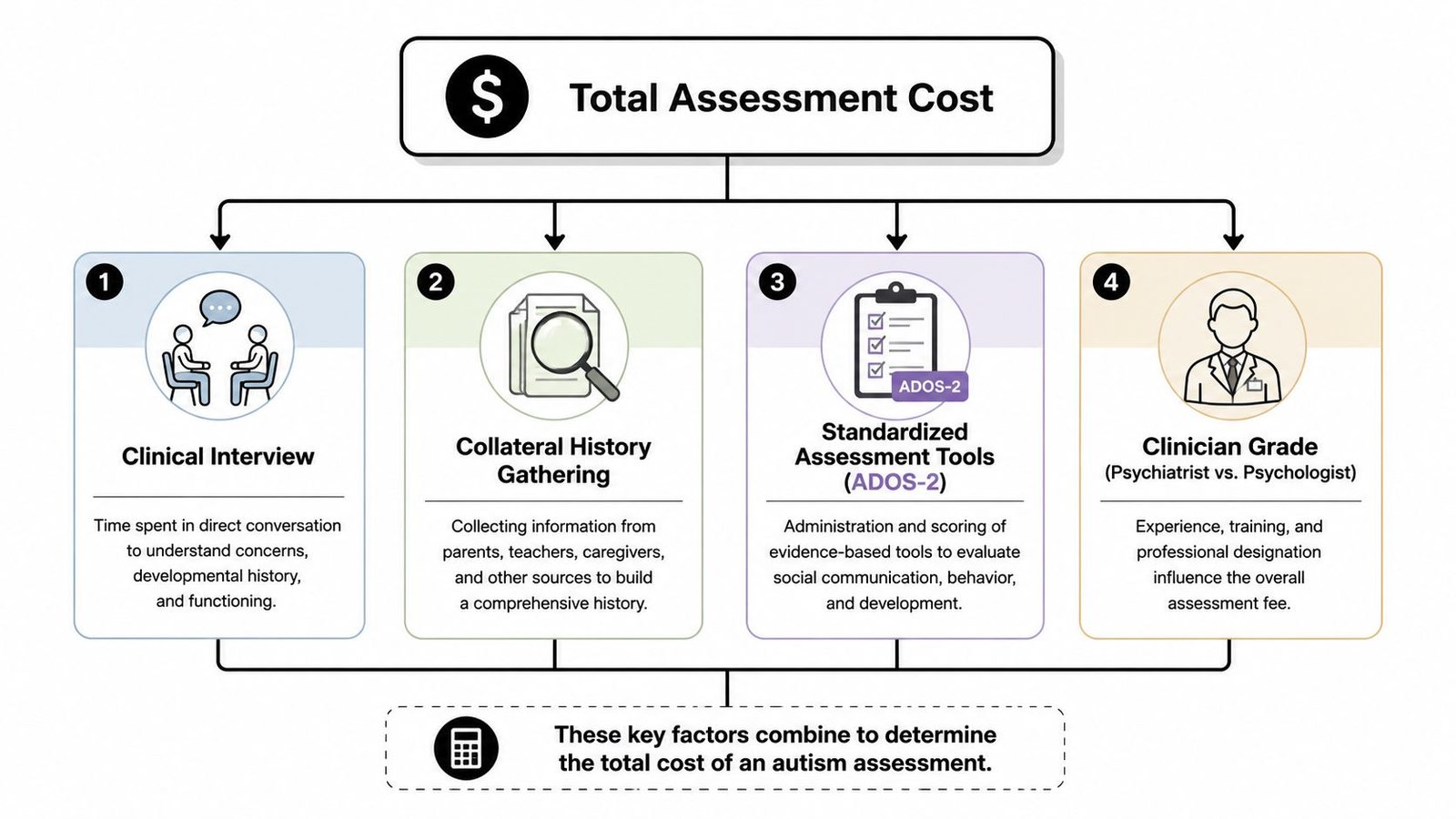
According to analysis of UK autism assessment pricing structures, a full adult private autism assessment typically costs £1,200 to £2,500, with regional clinics averaging £800 to £1,200 and London practices charging £1,500 to £2,500. That same analysis explains why. Autism assessments often involve multi-stage protocols, including clinical interviews, collateral history gathering, and structured tools such as ADOS-2 or AQ, and costs rise 20 to 30% for multi-disciplinary teams and additional standardised tools.
The assessment process itself
Autism assessment is usually not one long conversation. It’s more like building a case file. The clinician gathers history, explores current traits, checks developmental patterns, and weighs whether Autism best explains the picture or whether something else fits better.
That extra depth affects cost because it takes more time and more judgement. A brief screening may identify possible traits. A formal diagnosis requires a stronger process.
Clinician grade and team structure
A psychiatrist, psychologist, or multi-disciplinary team won’t price the same way because their roles differ.
Some adults need a straightforward autism-only evaluation. Others need a consultant-level view because the presentation is less tidy. For example, someone might have social communication differences, emotional regulation problems, trauma history, and possible ADHD. In that situation, the cost may reflect a more senior clinician’s time or a broader team discussion.
Report detail and intended use
The variation in assessment reports often causes confusion for many. One report may state whether diagnostic criteria are met. Another may include formulation, differential diagnosis, recommendations, and follow-up guidance.
If you’ve ever compared solicitors’ quotes or looked at a guide to UK accounting costs for 2026, you’ll know the same pattern appears in many professional services. The headline fee is only part of the picture. What matters is scope. A short document and a detailed clinical report aren’t the same product.
Why “combined” often costs more
If a clinic offers combined Autism and ADHD assessment, the fee often rises because the clinician isn’t just adding a label. They’re separating overlapping features.
A few examples help:
- Attention problems: These might relate to ADHD, anxiety, sleep issues, burnout, or mood.
- Social difficulties: These could fit Autism, trauma responses, depression, or personality-related patterns.
- Sensory overload and shutdown: These may sit within Autism, but they can also appear alongside wider mental health strain.
When the assessment has to answer more than one diagnostic question, the cost usually reflects the extra clinical reasoning involved.
Comparing Private NHS and Right to Choose Options
For many adults, the decision isn’t only about price. It’s about speed, eligibility, and how much uncertainty they can tolerate.
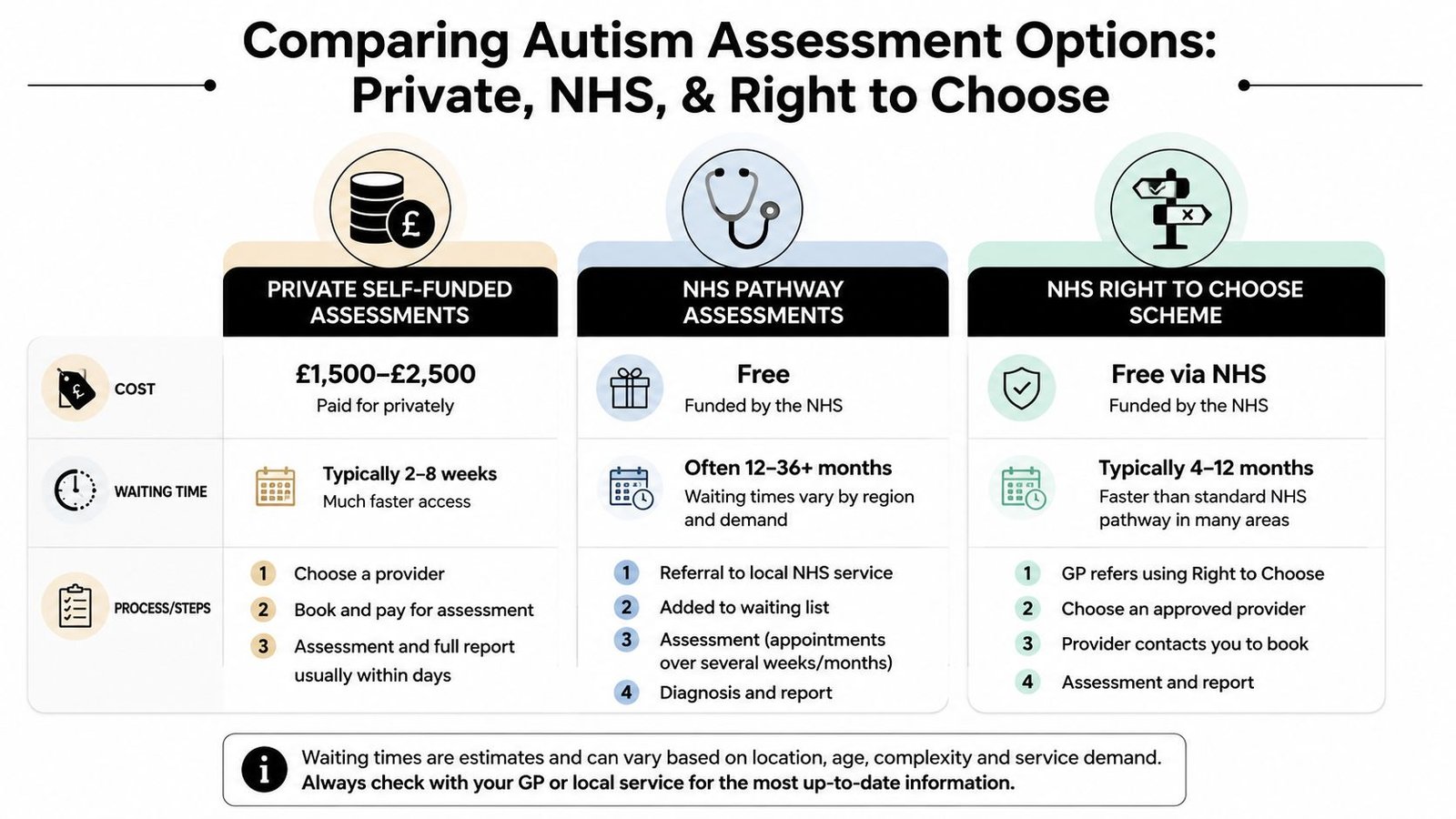
A useful comparison from UK guidance on private, NHS, and Right to Choose autism routes sets out the broad trade-off clearly. Private autism assessments cost £850 to £3,500 in the UK, while NHS assessments are free but often involve adult waits of 3 to 5 years. The same source notes that NHS Right to Choose in England can reduce waits to about 5.5 months with no direct patient charges.
Here’s the side-by-side picture.
A simple comparison
| Route | Cost | Waiting pattern | Best fit for |
|---|---|---|---|
| Private self-funded | £850 to £3,500 | Fast access compared with NHS pathways | Adults who need speed and can self-pay |
| NHS pathway | Free | Often very long waits for adults | Adults who can wait and prefer no direct cost |
| NHS Right to Choose | Free via NHS | Around 5.5 months in England | Adults eligible in England who want a middle ground |
Private assessment suits people who need clarity quickly for work, university, burnout, or treatment planning. NHS assessment suits people who aren’t under immediate pressure and want to avoid private fees. Right to Choose often sits in the middle.
A brief overview of the process can also help:
What Right to Choose means in practice
Right to Choose can be especially helpful if you’re in England and your local NHS pathway feels unworkably long. It allows referral to certain independent providers funded by the NHS, which changes the cost question completely.
If you want a practical explanation of how that pathway works, this Right to Choose autism assessment guide gives a useful overview.
Free doesn’t always mean simple, and private doesn’t always mean excessive. The right route depends on urgency, budget, and whether your GP referral options are available where you live.
Funding Options and Insurance Coverage
Some adults pay directly. Others use private medical insurance if their policy allows it. Others pursue NHS-funded options. The key is to confirm the route before you book, not after.
A pricing overview from UK adult private autism assessment cost data states that adult private autism assessments typically cost between £1,800 and £3,500, with London’s average price reaching £2,344, reflecting regional variation and provider expertise. That range helps frame what self-funding can mean in practice when insurance isn’t available.
Funding Route Comparison
| Funding Route | Coverage Details | Typical Wait | Out-of-Pocket Cost |
|---|---|---|---|
| Self-pay | You pay the full clinic fee directly | Usually depends on provider availability | Highest direct cost, but often the quickest to arrange |
| Private medical insurance | Some policies may cover parts of assessment subject to authorisation and provider recognition | Depends on insurer approval and appointment availability | May reduce direct payment, but exclusions are common |
| NHS Right to Choose | NHS-funded assessment through eligible providers in England | Usually shorter than standard NHS pathways | No direct patient charge where approved |
| Standard NHS referral | NHS-funded assessment through local services | Can be significantly longer | No direct patient charge |
If you’re insured, ask very specific questions before assuming cover applies. Autism and ADHD assessments may be handled differently from general psychiatric consultations. Insurers may also distinguish between diagnosis, treatment, and follow-up work.
For readers exploring that route, this private mental health insurance guide is a useful starting point for checking authorisation and cover terms.
Questions worth asking an insurer
- Is autism assessment covered: Some policies exclude neurodevelopmental assessment even when they cover mental health consultations.
- Do I need pre-authorisation: Many insurers won’t reimburse without approval in advance.
- Is the clinician recognised: Coverage can depend on the assessor’s status within the insurer’s network.
- What is excluded: Follow-up reviews, medication work, or longer reports may fall outside the approved benefit.
Preparing for Assessment and Saving on Costs
The cheapest quote isn’t always the lowest final bill. Preparation is where adults can avoid some of the most frustrating extra costs.
One often-overlooked issue is developmental history. The National Autistic Society explains the importance of childhood informant input, and its assessment guidance is often cited, particularly as many clinics charge an additional £200 to £400 for separate informant interviews and £150 to £300 for professional letters of support. These extras are easy to miss when you’re focused on the main assessment fee.
What to gather before you book
Bring together anything that helps the clinician understand your developmental story and current difficulties.
- Childhood information: A parent, sibling, or another person who knew you well when you were young can be important.
- Current examples: Notes about work stress, social misunderstandings, sensory overload, shutdowns, or routines can make interviews clearer.
- Past records: School reports, CAMHS letters, or previous mental health summaries can help if you have them.
- Questionnaires completed carefully: Rushing forms often creates avoidable back-and-forth later.
Where hidden costs often appear
A clinic may advertise one core fee while charging separately for tasks many adults assume are included.
Watch for:
- Separate informant interview charges
- Charges for letters supporting workplace or university adjustments
- Extra fees for combined Autism and ADHD pathways
- Longer or more customized reports
If you’re preparing for an adult pathway, this autism assessment for adults guide can help you think through what documents and history are usually useful.
Practical ways to keep costs manageable
You can’t always reduce the main fee, but you can often reduce unnecessary add-ons.
- Ask for a full inclusion list in writing. Check whether the quote includes the report, informant interview, and post-assessment feedback.
- Clarify whether a combined pathway is needed. If both Autism and ADHD are realistic questions, a combined route can sometimes be more efficient than booking separate assessments later.
- Use a willing informant if possible. That may avoid later administrative work or extra paid support letters.
- Ask whether remote appointments are available. Some adults find them easier logistically and less disruptive.
Case Examples and Key Takeaways
The easiest way to understand autism assessment cost is to look at realistic scenarios.
Example one in London
An adult in London wants a broad evaluation because they suspect both Autism and ADHD, and they also have a complex mental health history. They choose a more senior, multi-disciplinary route. In that situation, total pricing can sit toward the higher end of the verified ranges already covered, especially because combined Autism and ADHD assessments can reach £1,600 to £4,000 in the UK market and London fees tend to run higher than regional ones.
Example two in the Midlands
Another adult has a clearer autism-only question, a willing childhood informant, and no need for a broad multi-disciplinary review. They choose a single-clinician regional service. That kind of case may sit much closer to the lower end of the private ranges already discussed.
The difference between those two examples isn’t just geography. It’s complexity, report requirements, and whether the clinic is answering one question or several.
Five takeaways that matter most
- Know who is assessing you: A consultant psychiatrist, psychologist, and multi-disciplinary team won’t price the same way.
- Ask about hidden extras early: Informant interviews and support letters are common places where costs rise.
- Check what the report includes: Diagnostic confirmation alone is not the same as a detailed formulation with recommendations.
- Think carefully about combined assessment: If Autism and ADHD both look relevant, one joined-up pathway may be more practical.
- Don’t ignore funded options: Right to Choose can change the cost picture completely if you’re eligible in England.
The most useful quote is the one you can actually compare. If two clinics define the job differently, their prices won’t tell you much on their own.
Frequently Asked Questions
Can NHS funding cover follow-up consultations
Sometimes follow-up support is available within NHS pathways, but it depends on the local service and what they offer after diagnosis. A diagnosis and ongoing treatment planning aren’t always bundled together in the same way across providers. If you’re unsure who can formally diagnose Autism and what follow-up might look like, this guide on who can diagnose autism is helpful.
What if I don’t have a childhood informant
That doesn’t always stop the process, but it can make assessment more complicated. Some clinics will look for alternatives such as school reports, historical records, or other people who knew you in childhood. It’s important to ask this before booking because some services charge separately for the extra administrative or support work needed.
How long does the whole process usually take
Timing depends on the route. NHS and standard referral pathways can be much longer, while private services are usually quicker. Some consultant-led private services aim for assessment within seven working days and a report within five working days after that, though timelines vary by clinic and availability. The safest approach is to ask for the booking timeline, report timeline, and whether those are standard or estimated.
If you’re looking for a consultant-led adult service that covers Autism, ADHD, mental health, and psychological assessment, Insight Diagnostics Global offers online and face-to-face assessments for adults aged 18 and over. The service is led by experienced clinicians, including Dr Sai Achuthan, a leading Consultant Psychiatrist with extensive expertise in neurodevelopmental and personality disorder assessment. Adults who value transparent pricing, structured triage, and clear diagnostic reports can explore the available pathways directly on the site.