

You may be trying to work out why food feels so difficult when the difficulty doesn’t sit neatly in one box. Perhaps meals are chaotic because your attention drifts, shopping is disorganised, and eating happens only when hunger becomes urgent. Perhaps eating feels rigid instead. Certain textures are unbearable, change is exhausting, and social eating leaves you tense long before the plate arrives. Many adults also carry years of being told they are “fine” because they don’t look unwell enough, or because one problem keeps obscuring another.
That overlap matters clinically. An adult can present with restrictive eating, bingeing, guilt, burnout, anxiety, sensory discomfort, executive dysfunction, and social strain all at once. If the assessment only asks about weight, or only asks about mood, or only screens for one diagnosis, the result is often partial and frustrating. Good assessment work is broader than that.
At Insight Diagnostics, the clinical standard for this kind of work is led by extensive experience from top, leading Consultant Psychiatrists in neurodevelopmental and personality disorder practice, including Dr Sai Achuthan. The key principle is simple. Adults deserve a careful psychological assessment that looks at Autism, ADHD, mental health, and eating difficulties together, rather than treating each as an isolated concern.
Your Guide to an Eating Disorder Assessment
A lot of adults come to assessment after months or years of trying to manage privately. They may have searched for help because eating has become secretive, rigid, or exhausting. At the same time, they’ve begun to wonder whether longstanding problems with focus, organisation, emotional regulation, or social communication could point to ADHD or Autism as well.

That uncertainty can be isolating. People often ask whether they are “ill enough” for an eating disorder assessment, whether sensory issues count, whether bingeing linked to impulsivity is a separate problem, or whether years of masking have hidden an autistic pattern underneath. Those are sensible questions. They’re also why a proper assessment should never feel like an exam you pass or fail.
What makes the first assessment so important
An eating disorder assessment is the point where scattered symptoms start to form a coherent clinical picture. It looks at eating behaviour, body image where relevant, compensatory behaviours, medical risk, mood, anxiety, trauma history, daily functioning, and the possibility that neurodevelopmental features are shaping the whole presentation.
Practical rule: Assessment should clarify the pattern, not force your experience into the wrong label.
The wider UK picture shows why thorough assessment matters. Hospital admissions for eating disorders in the UK have surged by 84% over the last five years, reaching 24,268 admissions, according to the Royal College of Psychiatrists update on rising eating disorder admissions. In practice, that means more adults are reaching services when problems are already entrenched or medically risky.
Why a broad mental health lens works better
A narrow approach misses too much. If a clinician focuses only on calorie intake, they may miss autistic sensory restriction. If they focus only on impulsive eating, they may miss ADHD-related disorganisation, shame, and cycles of under-eating followed by bingeing. If they focus only on anxiety, they may miss both.
A better route is a joined-up evaluation that considers psychology, physical health, and day-to-day function. In parallel, healthcare systems are increasingly thinking about how technology supports triage, documentation, and service design. For readers interested in that wider shift, AI adoption in healthcare gives useful context on how digital tools are being integrated into care environments without replacing clinical judgement.
The Link Between Eating Disorders ADHD and Autism
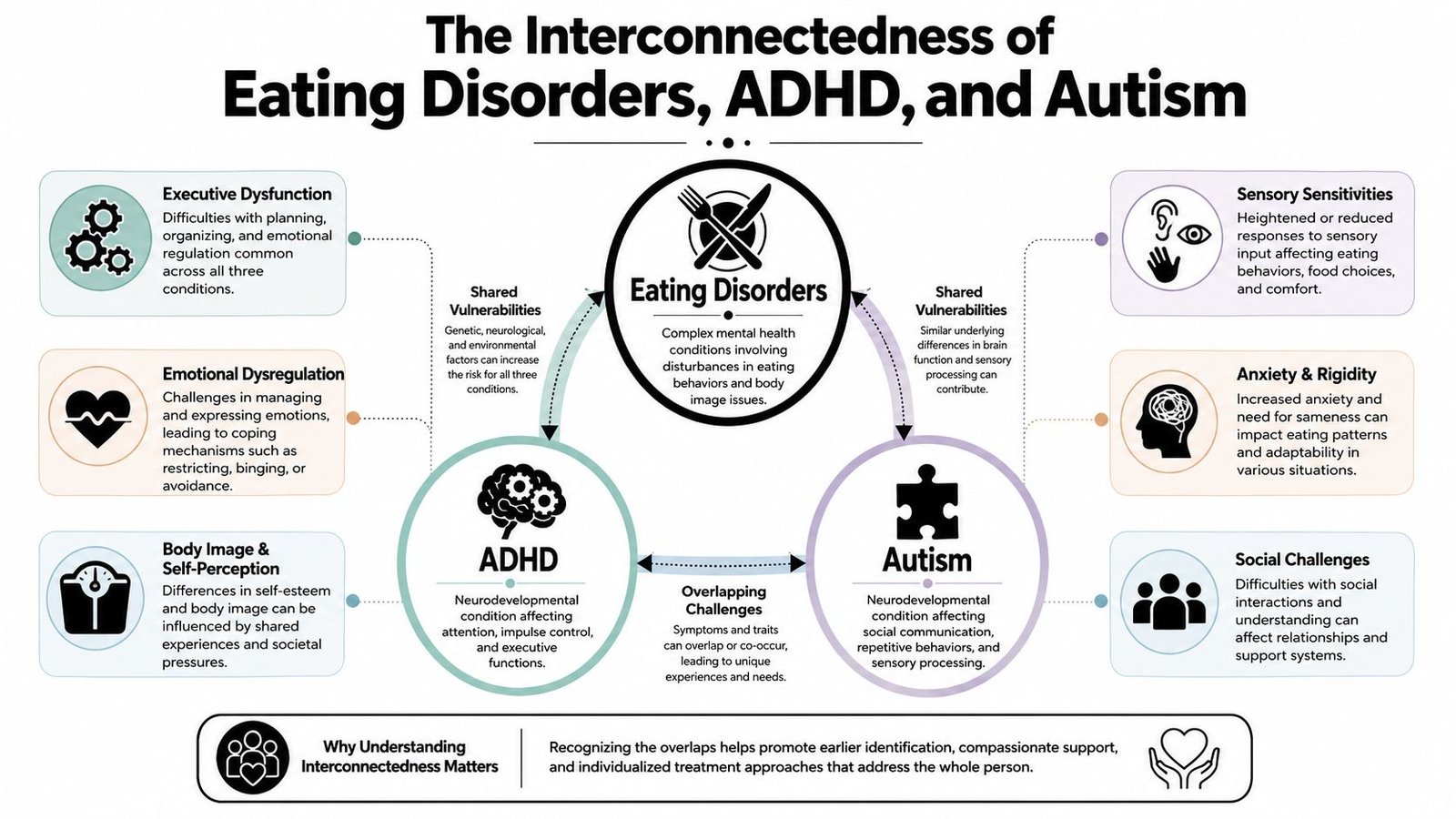
The most useful way to think about overlap is this. Eating behaviour is never just about food. It is shaped by attention, planning, sensory processing, emotional regulation, routine, social experience, and stress tolerance. That’s why ADHD, Autism, and eating disorders so often intersect in clinical practice.
How ADHD can shape eating patterns
With ADHD, the issue isn’t just “poor self-control”. The pattern is usually more complicated. Executive dysfunction can disrupt shopping, meal planning, remembering to eat, and noticing hunger cues early enough. Some adults under-eat through the day because they are hyperfocused, disorganised, or overwhelmed, then binge later when hunger becomes urgent and emotional control is lower.
Impulsivity also matters. Fast shifts from intention to action can make binge-purge cycles more likely in some people, especially where shame, low mood, or chronic criticism are already present.
Common ADHD-linked contributors include:
- Irregular structure: meals are missed because time slips or tasks pile up
- Urgency eating: food is taken quickly once hunger finally registers
- Emotional reactivity: distress can trigger bingeing or compensatory behaviour
- All-or-nothing attempts at control: strict rules are adopted, then collapse
How Autism can shape eating patterns
Autistic presentations are different. Restriction may come from sensory sensitivity, intolerance of uncertainty, rigid routines, interoceptive differences, or intense anxiety around unfamiliar food. In some adults, eating becomes very narrow but highly patterned. In others, social eating is so stressful that intake drops when they are around other people.
The key clinical point is that not all restriction is driven by weight and shape concerns. Some autistic adults avoid food because of texture, smell, temperature, fear of gagging, or a need for sameness. If an assessment ignores that distinction, it can produce the wrong formulation and the wrong treatment plan.
A restrictive diet can look similar from the outside while being driven by completely different mechanisms underneath.
Why integrated care matters
Services also need to recognise that these concerns rarely arrive one at a time. In December 2023, the number of patients with an open referral for suspected autism in England reached 172,022, a record high reported by the Nuffield Trust analysis of growing autism and ADHD assessment waiting lists. That pressure makes fragmented care even harder for adults who need one clinician to see the whole picture.
A combined formulation is usually more useful than multiple isolated labels. It can explain why previous treatment felt mismatched, why standard meal plans were hard to follow, or why CBT aimed at body image didn’t touch the main problem because the barrier was sensory and executive, not motivational.
What Happens During a Clinical Assessment
Most adults feel less anxious once they know what happens in the room. A good assessment is structured, but it shouldn’t feel mechanical. The psychiatrist is building a timeline, testing diagnostic possibilities, and checking safety at the same time.
The psychiatric interview
The first part is usually a detailed history. That includes your current eating pattern, when the difficulties started, what seems to maintain them, and whether there are bingeing, purging, fasting, over-exercise, or restrictive behaviours. The clinician also asks about mood, anxiety, obsessive traits, self-harm thoughts, trauma, alcohol or drug use, sleep, and functioning at work or university.
If ADHD or Autism may be relevant, the interview broadens. The psychiatrist asks about childhood history, sensory experiences, routines, concentration, impulsivity, social communication, burnout, and how these features affect eating in everyday life. The point isn’t to gather trivia. It’s to see whether one condition is driving another, or whether several are interacting.
Questionnaires and collateral information
Standardised questionnaires can help organise information, but they don’t replace clinical judgement. They’re most useful when interpreted alongside a proper interview. Previous records, school reports, GP letters, or input from a partner or family member can also be valuable if you consent to share them.
That matters especially when longstanding masking has blurred the picture. Some adults describe high achievement alongside private chaos. Others have adapted so thoroughly that their difficulty only becomes visible under stress, burnout, or nutritional deterioration.
For anyone worried about who sees what, clear processes matter. Good services are explicit about consent, record handling, and information sharing, and it helps to understand the basics of confidentiality in healthcare before attending any mental health assessment.
The medical risk assessment
This part is not optional. Eating disorders can affect the heart, circulation, hydration, kidneys, and electrolyte balance even when someone doesn’t appear obviously underweight.
Clinical priority: Medical stability has to be checked alongside psychological symptoms, not afterwards.
UK clinical guidance is specific here. A FREED medical risk assessment guide used in UK practice states that patients with BMI below 15 kg/m² should have an ECG, and it also recommends blood tests including liver function, electrolytes, and renal function to detect risks such as dehydration or circulatory and renal failure. The same guide identifies heart rate below 40 bpm as a red flag requiring immediate specialist referral.
A clinician also looks at blood pressure, pulse, peripheral circulation, temperature, muscle strength, fainting, and the pace of deterioration. This is one reason casual online screening isn’t enough when eating problems are persistent or medically concerning.
A short explainer can make the process feel less abstract:
Understanding Your Diagnosis and Report
A diagnosis should bring clarity, not reductionism. In psychiatry, the most useful outcome isn’t a label on its own. It’s a formulation that explains how your symptoms developed, what is maintaining them, what risks need attention, and which supports are most likely to help.
What a good report should contain
A strong report usually does several things at once:
- Names the relevant conditions: this may include an eating disorder, disordered eating pattern, ADHD, Autism, mood or anxiety disorder, or a combination
- Describes your actual presentation: not just the textbook criteria, but how symptoms show up in daily life
- Explains functional impact: work, study, relationships, self-care, routines, and emotional strain
- Sets out recommendations: treatment options, risk management, medication considerations where relevant, and what to share with your GP
That final document often matters as much as the appointment itself. It gives you language for what has been happening. It also helps other professionals respond more accurately.
Why BMI alone is not enough
One of the biggest shifts in eating disorder practice is the move away from simplistic thresholds. NICE guideline NG69, summarised by Beat, states that physical measures such as BMI must never be the sole indicator for treatment. That is the right approach clinically.
Many adults have been told they are not serious enough for help because they don’t fit a narrow physical stereotype. That delays treatment and increases distress. A proper report considers the full picture, including behaviour, cognition, mood, risk, sensory issues, and the effect on functioning.
The most helpful diagnosis is one that explains your lived reality and changes what happens next.
How diagnostic frameworks are used
Psychiatrists use formal systems such as DSM-5 or ICD-11 because they provide shared clinical language. That standardisation matters when writing reports, advising GPs, planning treatment, or making referrals. But no experienced clinician should stop there.
The report has to translate criteria into practical meaning. If you have autistic sensory restriction rather than classic weight-driven restriction, that difference belongs in the formulation. If ADHD-related disorganisation is amplifying binge eating, that belongs there too. Good reports don’t flatten complexity. They organise it.
Your Assessment Pathway at a Private UK Clinic
Private assessment is most useful when it adds structure, speed, and clinical depth. It shouldn’t feel rushed or transactional. Done well, it gives adults a clear route from first enquiry to diagnostic clarity, particularly when NHS pathways are delayed or split across different teams.
What the pathway usually looks like
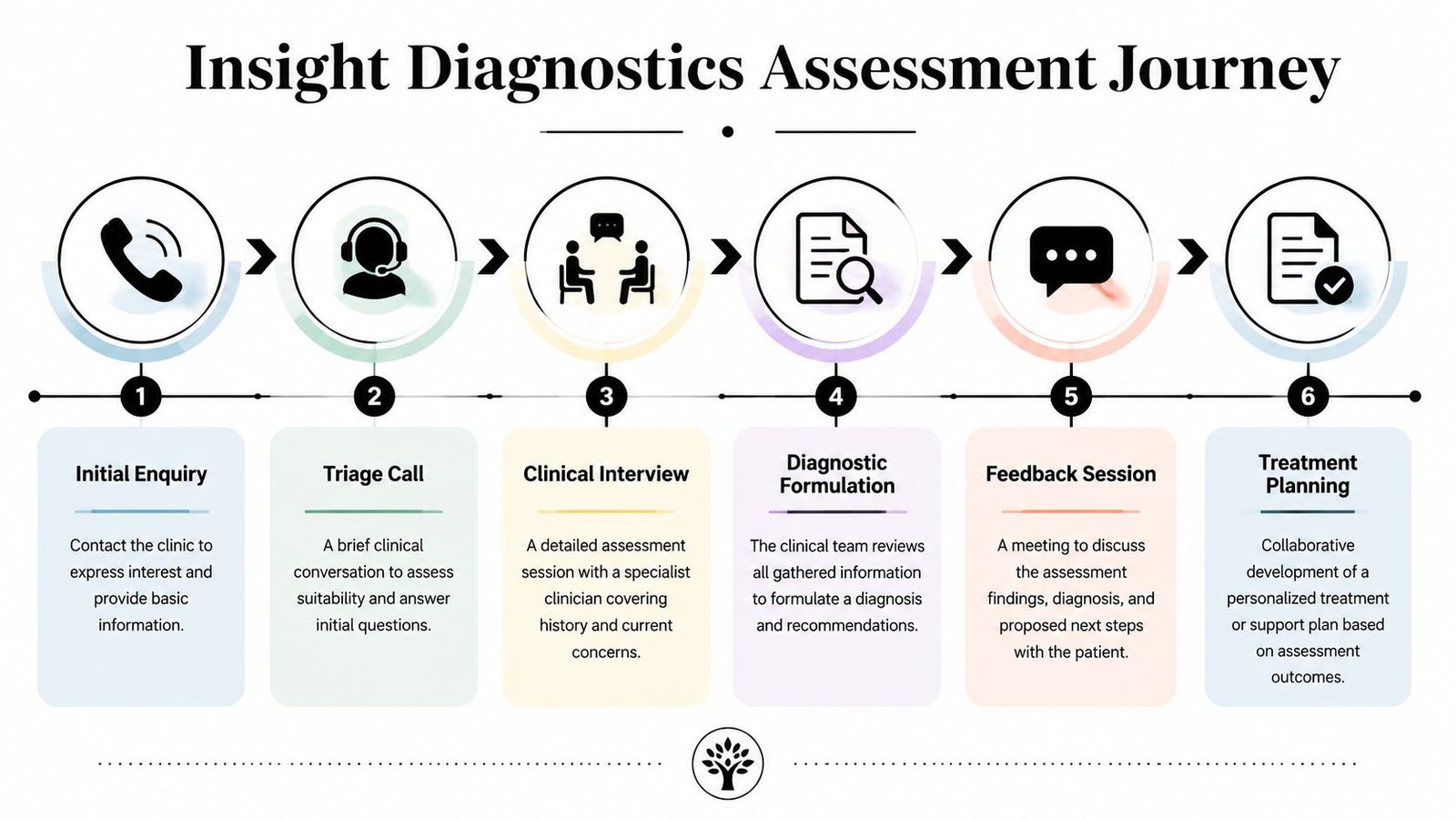
At a specialist UK clinic, the pathway often starts with self-referral or a GP referral. Basic information is gathered first so the team can decide what type of appointment is most appropriate. If there are signs of significant medical risk, the advice may be to seek urgent NHS or acute medical support before a routine psychiatric assessment proceeds.
After triage, the next stage is the main clinical interview. For adults with overlapping concerns, this works best when carried out by a senior psychiatrist with experience in neurodevelopmental conditions, personality structure, and broader mental health assessment. That’s where expertise from clinicians such as Dr Sai Achuthan becomes particularly relevant. The assessment can then hold multiple possibilities in mind at once rather than chasing one narrow diagnosis.
Why specialist assessment changes the quality of the outcome
The value of specialist work is not speed alone. It is the ability to separate similar-looking presentations. Restriction caused by autistic sensory distress needs a different plan from restriction driven by body image fear. Chaotic binge eating related to ADHD and emotional dysregulation needs a different plan from binge eating that sits within a different psychiatric picture.
A clinic also needs to identify people who don’t fit strict categories neatly but are still significantly impaired. Up to 40% of adults with severe eating difficulties do not meet strict diagnostic thresholds yet still experience marked daily impairment, as noted within NICE NG69 recommendations on assessment and treatment. That gap is one reason experienced clinicians look at functional impairment, not only whether every criterion is technically met.
Timelines and practical expectations
A good private pathway is transparent. For Insight Diagnostics Global, assessments are typically scheduled within seven working days, and reports are usually completed within five working days thereafter, according to the clinic’s published service information on Insight Diagnostics Global. That kind of clarity helps people plan around work, university, or family responsibilities.
It also helps to know that consultant-led services may offer:
| Step | What you can expect |
|---|---|
| Triage | Initial review of suitability and urgency |
| Assessment appointment | Detailed psychiatric interview and psychological assessment |
| Diagnostic report | Written formulation with recommendations |
| Follow-up | Chance to discuss findings and next steps |
The strongest pathway is one that combines efficiency with careful reasoning. Fast is helpful. Accurate is essential.
How to Prepare for Your Assessment
Preparation doesn’t mean rehearsing the “right” answers. It means making it easier for the clinician to see the pattern clearly.
What to bring
A short folder of relevant information can make the appointment much more efficient:
- Previous letters or reports: GP summaries, therapy letters, old mental health assessments, university support documents
- Medication list: current medicines, recent changes, and any side effects you’ve noticed
- Timeline notes: when eating problems began, how they changed, and what else was happening at the time
- Questions you want answered: many adults forget these once the appointment starts
If you suspect ADHD or Autism, note the examples that affect your life. “I struggle with executive function” is less useful than “I forget meals until late afternoon, then overeat rapidly” or “I can only tolerate a narrow range of textures and avoid meals with other people”.
How to prepare mentally
Write down the parts you tend to minimise. Many adults become apologetic in assessment and accidentally downplay severity. If you binge, purge, restrict, hide food, avoid social eating, obsess over routines, or feel out of control around food, say so plainly.
It can also help to note patterns in these areas:
- Eating behaviour
- Mood and anxiety
- Attention and organisation
- Sensory issues
- Work, study, and relationship impact
Bring examples from ordinary life. Diagnosis is built from patterns, not from polished self-description.
Costs, insurance, and safety
If you’re using private care, check fees, report costs, and follow-up charges before booking. Insurance members should confirm authorisation in advance if they are using providers such as Vitality or Aviva, because cover often depends on policy terms and prior approval.
If there is immediate risk, private assessment is not the right first step. This is especially true if you are fainting, becoming medically unstable, unable to keep yourself safe, or having urgent thoughts of suicide or serious self-harm. In those situations, seek urgent help through NHS 111 or call 999 in an emergency.
After the assessment, the next practical step is usually to share the report with your GP and use it as a basis for treatment planning. That may include therapy, dietetic support, medical monitoring, medication review, workplace or university adjustments, or a separate neurodevelopmental assessment if one hasn’t already been completed.
If you want a consultant-led assessment that looks carefully at eating difficulties alongside ADHD, Autism, and wider adult mental health, Insight Diagnostics Global offers online and face-to-face evaluations for adults, with clear triage, detailed reports, and optional follow-up support.