

You may be reading this because something has never quite added up.
You've managed work, relationships, study, or family life, yet much of it has felt effortful in a way other people don't seem to notice. Social situations leave you depleted. Noise, lights, textures, or busy environments feel harder than they “should”. You may have learnt scripts, copied other people, rehearsed conversations, and pushed through. Then at some point, often under strain, the question appears: could this be autism?
As a consultant psychiatrist, I see this pattern often in adults. Recognition rarely arrives as a neat checklist. More often, it comes as a growing realisation that lifelong patterns of social communication differences, sensory differences, intense interests, and exhaustion from coping may share a common explanation. The challenge is working out what fits, what doesn't, and what kind of assessment will give a clear answer.
Understanding Adult Autism Beyond the Stereotypes
The stereotype most adults carry is still a child-focused one. It tends to involve obvious social withdrawal, visible repetitive behaviour, or a very narrow idea of what autism is supposed to look like. That picture misses a great many adults.
In the UK, the strongest national estimate for autistic adults comes from the Adult Psychiatric Morbidity Survey, which found that 1.1% of adults aged 16 to 64 met criteria for autism spectrum disorder, and recognition is often later because many adults, especially women, don't fit the classic childhood stereotype. NICE's adult guidance also reflects that adult recognition depends on a broad clinical assessment of developmental history, current presentation, and collateral information rather than a single test, as outlined in this UK overview of adult autism prevalence and recognition.
What adult autism often looks like in real life
A common presentation is not “I have never been able to speak to anyone”. It is, “I can speak to people, but I have to work out every rule manually.” Another is, “I seem competent from the outside, but ordinary days cost me far more energy than they cost other people.”
That difference matters. Many autistic adults are not socially absent. They are socially effortful.
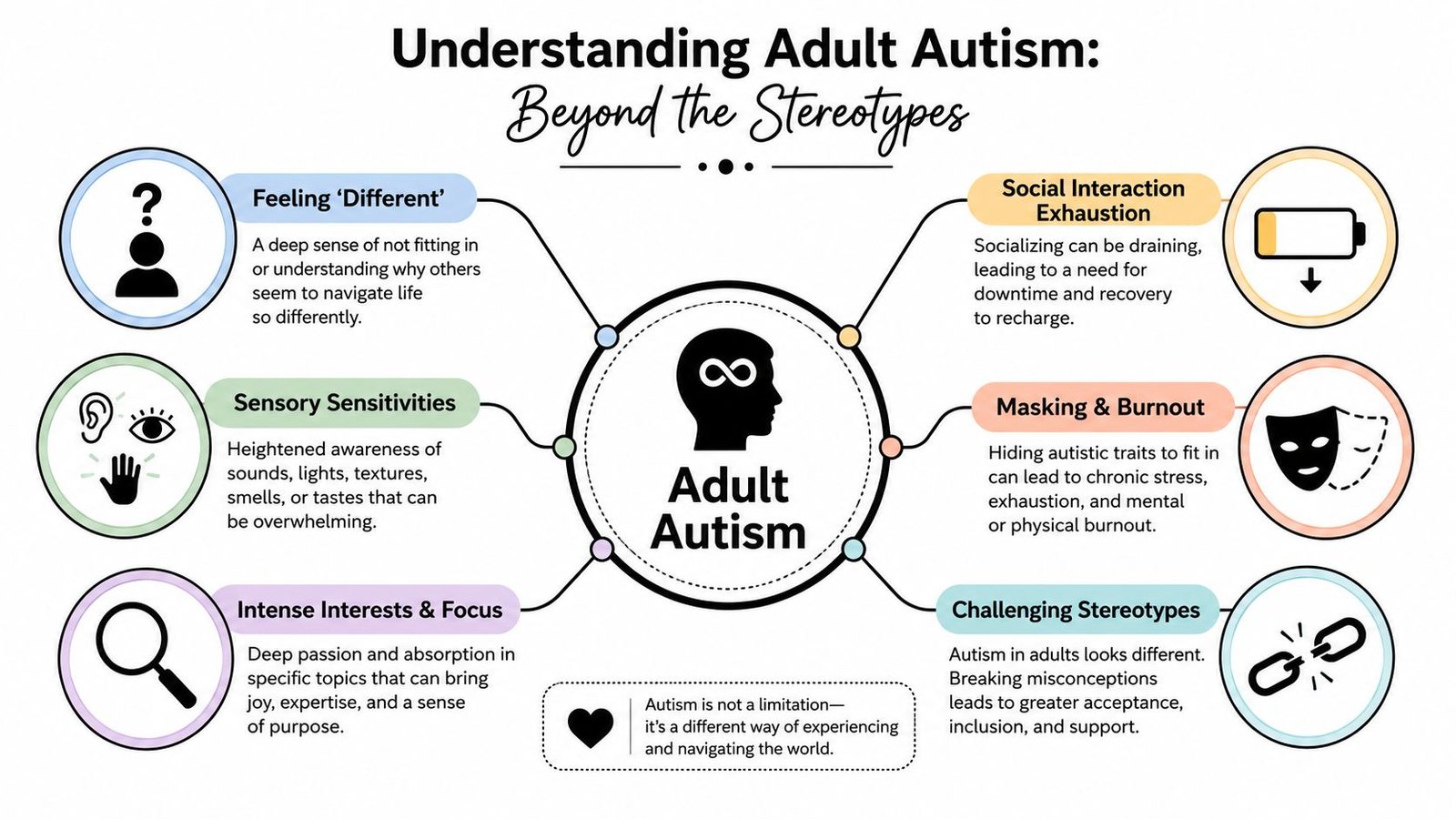
Here are patterns I listen for in assessment:
- Social exhaustion. You can interact well enough, but you need significant recovery time afterwards.
- Masking or camouflaging. You copy tone, facial expressions, conversational style, or social timing so you don't appear out of step.
- Sensory strain. Bright lighting, layered sound, clothing textures, smells, or crowded spaces are not minor irritations. They can shape your day.
- Intense interests. These are often deep, specialised, organising interests rather than casual hobbies.
- A strong need for predictability. Sudden changes, vague instructions, or shifting expectations can feel disproportionately stressful.
Practical rule: When you're trying to understand how to recognize autism in adults, look for lifelong patterns and hidden effort, not just outward behaviour.
Why women are often recognised later
Late recognition is especially common in women. Many have spent years learning social scripts, over-preparing, people-pleasing, or using perfectionism to avoid standing out. That can make autism far less visible in a brief conversation.
The National Autistic Society notes that many adults, particularly women, recognise their autistic traits only after a “breakdown, severe mental health difficulties or burnout”, which is why late recognition often starts in crisis rather than from a tidy list of signs, as described by the National Autistic Society's guide to signs before diagnosis.
A useful external read on this broader picture is identifying autism in grown-ups, especially if you're comparing your own experience against common adult presentations.
For a UK-focused explanation of what autism can look like in adulthood, this page on autism spectrum disorder in adults is also a helpful starting point.
Untangling Autism, ADHD, and Mental Health
Adults rarely arrive with one simple question. More often it's a knot of possibilities. Is this autism, ADHD, anxiety, burnout, depression, or some combination?
The confusion is understandable because there is overlap. People can have both autism and ADHD. Anxiety can grow around long-term social strain or sensory overload. Burnout can expose difficulties that were previously held together by routine and effort. The job in assessment is not to choose the first plausible label. It is to separate lifelong traits from later consequences and identify where conditions coexist.
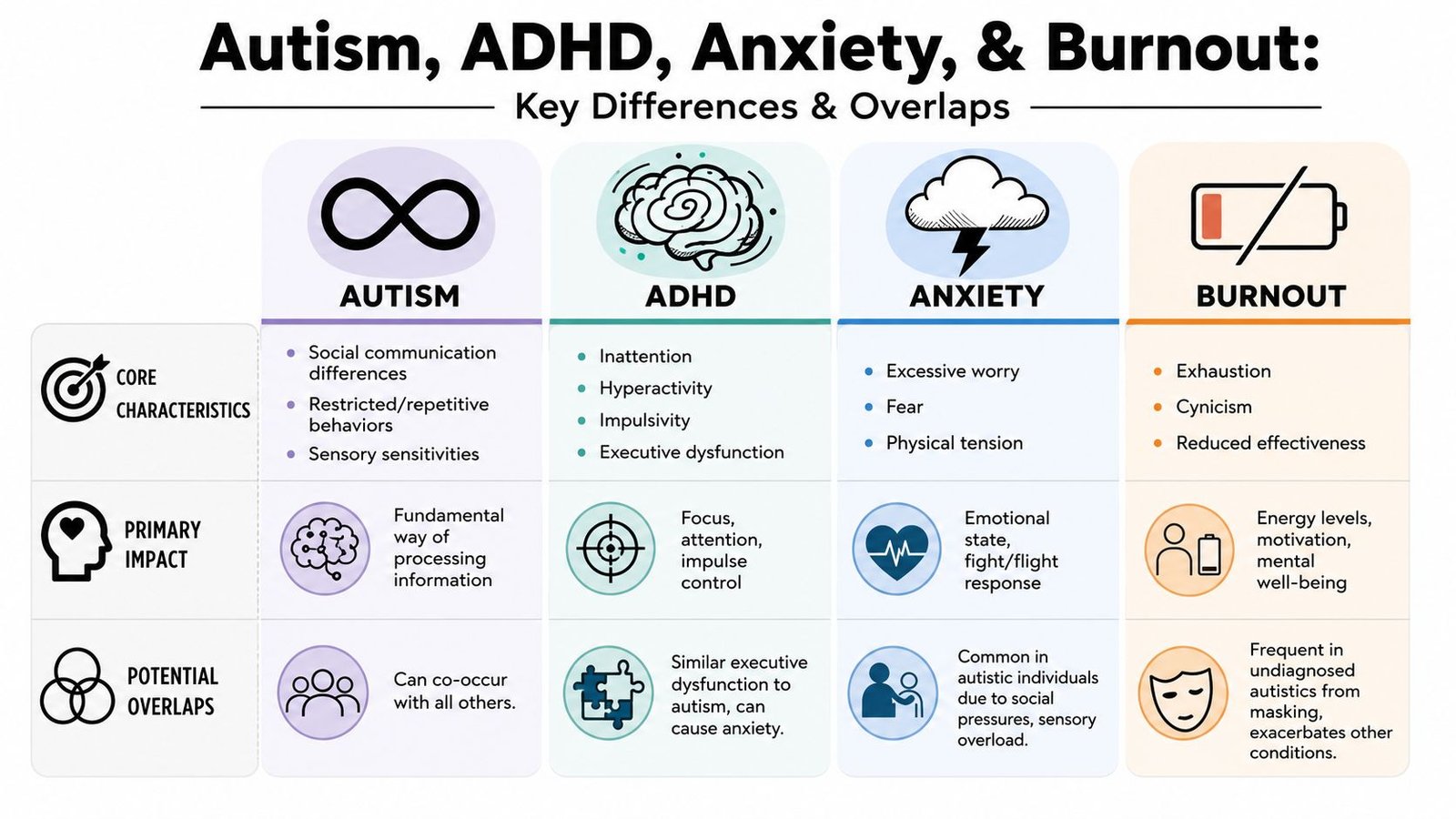
The key clinical difference
A major point in adult assessment is timing. Diagnostic standards require evidence that autistic traits were present from the early developmental period. Professional guidance also stresses differential diagnosis, because adults often present with anxiety, depression, ADHD, or occupational stress that can mask or mimic autistic features. That point is well summarised in this clinical discussion of autism in adults and differential diagnosis.
Here is the comparison I find most useful:
| Presentation | What often drives it |
|---|---|
| Autism | A consistent difference in social communication, sensory processing, and pattern of interests or routines across life |
| ADHD | Difficulties with attention regulation, impulsivity, task initiation, and sustaining organisation |
| Anxiety | Fear, apprehension, physiological tension, and avoidance driven by perceived threat or judgement |
| Burnout | A state of depletion, reduced capacity, and overwhelm after prolonged strain |
How overlap creates confusion
An autistic adult may struggle in conversation because unwritten social rules are hard to read. A person with social anxiety may understand those rules but fear getting them wrong. An adult with ADHD may miss details because attention shifts rapidly. An autistic adult may miss them because the social context itself is unclear or because sensory input is too much.
Executive function can be confusing too. ADHD often shows up as difficulty starting, sustaining, and organising tasks across the board. Autism can involve executive difficulties as well, but the pattern is often tied to transitions, changes in routine, uncertainty, or cognitive rigidity.
- If change derails you, autism may be part of the picture.
- If distraction and inconsistent focus dominate, ADHD may be more central.
- If fear of judgement drives avoidance, anxiety may be the main factor.
- If things worsened sharply after prolonged pressure, burnout may be amplifying everything.
People often ask, “Why does this feel so much worse now?” In adults, the traits may not be new. The coping system may have simply stopped covering them.
If you suspect both autism and ADHD, this guide on autism or ADHD gives a useful side-by-side framing of the question.
Practical support matters too. For adults who clearly identify with the ADHD side of the picture, resources like Time management for ADHD-prone learners can help with day-to-day structure while you're still working out the bigger diagnostic picture.
A Practical Guide to Self-Reflection
Before any formal assessment, the most useful thing you can bring is not a pile of online scores. It's a coherent personal history.
Screeners can sometimes help you organise your thoughts, but they don't diagnose autism. In practice, their best use is as a prompt for reflection. The more valuable task is building a timeline of your own pattern across childhood, adolescence, and adult life.
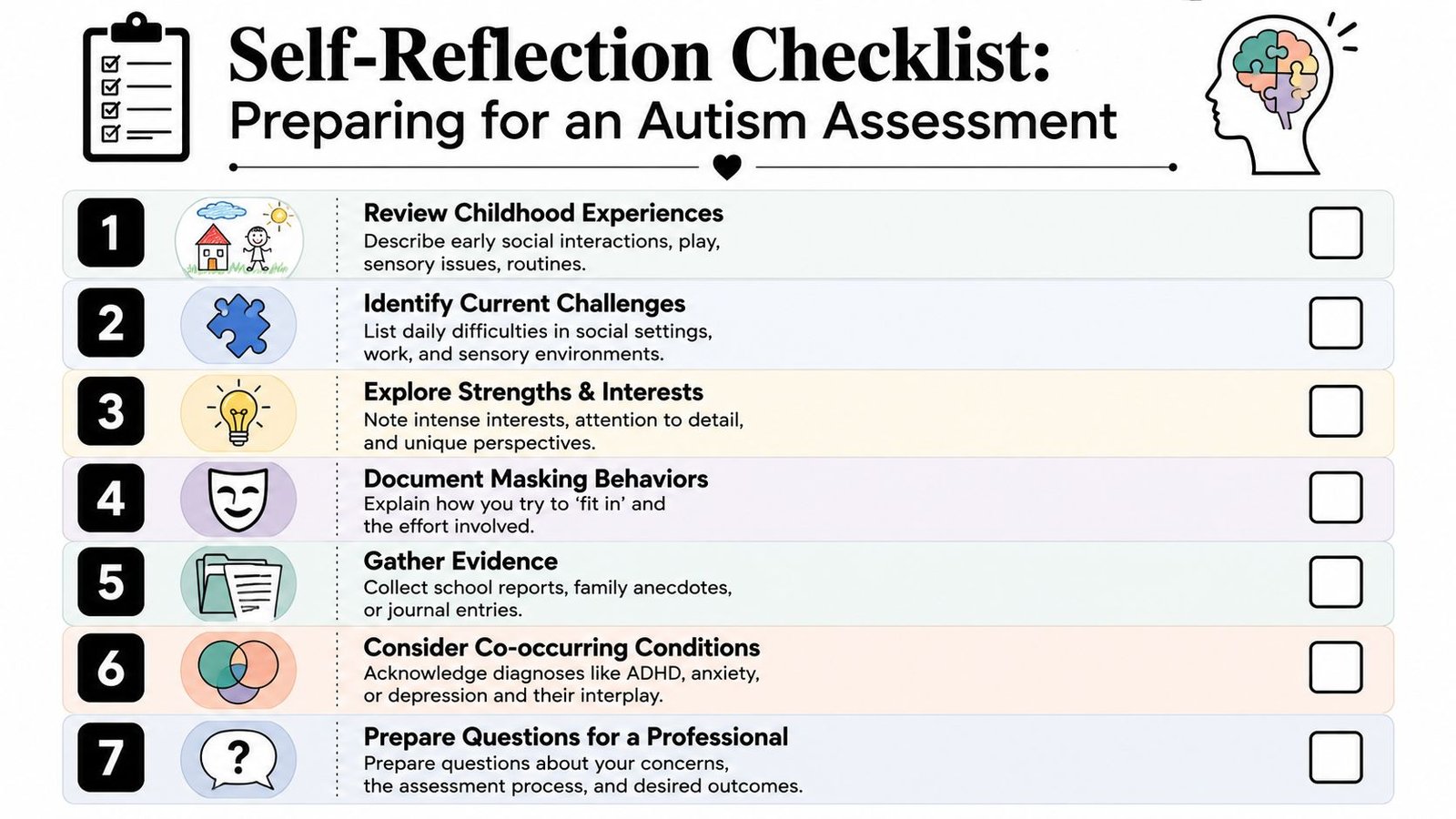
What to write down
Start with concrete examples, not interpretations. Instead of writing “I'm probably autistic”, write what happened.
Childhood social patterns
Think about friendships, play, group situations, school break times, and whether socialising felt intuitive or confusing.Sensory history
Note aversions or preferences that have been there for years. Clothing labels, food textures, busy shops, fluorescent lighting, strong smells, or loud communal spaces are common examples.Communication style
Ask yourself what feels natural and what feels performed. Do you rehearse? Do you prefer direct language? Do you struggle when people imply rather than say what they mean?Interests and focus
List the subjects, collections, routines, or areas of knowledge that have carried unusual intensity or consistency across life.
What evidence helps
You're looking for pattern, not perfection. Many adults worry that they can't prove anything because they don't have ideal records. That's common. Bring what you can.
- School material. Reports, comments about social style, perfectionism, isolation, distractibility, or being “bright but different”.
- Family recollections. Parents, siblings, or relatives may remember routines, sensitivities, or social habits you've forgotten.
- Your own notes. Journals, repeated life themes, and examples from work or relationships are all useful.
- Previous diagnoses. ADHD, anxiety, depression, or personality-related labels can be relevant in understanding overlap and misattribution.
A good assessment doesn't require a perfect childhood archive. It requires enough information to judge whether the pattern is longstanding.
If you want a brief screening tool to structure your thinking, the AQ-10 form can be used as a starting point. Treat it as a prompt, not a verdict.
Questions worth asking yourself
A short self-check can sharpen your picture:
- When do I feel most effortful around other people?
- What parts of daily life consistently overload me?
- What do I do to appear more socially typical?
- Which traits feel lifelong, rather than recent?
- What happens when I'm tired, stressed, or overloaded?
The strongest self-reflection is specific. It helps the clinician see your actual lived pattern rather than a borrowed list of traits from the internet.
Navigating the Path to a Formal Diagnosis in the UK
By the time most adults seek an assessment, they've usually spent a long time doubting themselves. A proper diagnostic process should reduce confusion, not add to it.
In the UK, there are different routes into assessment. The NHS route usually starts with a GP referral into a specialist pathway. Some adults also explore private assessment, particularly when they want a clearer timetable or more flexibility around appointments. Whichever route you take, the standard of the assessment matters more than the setting.
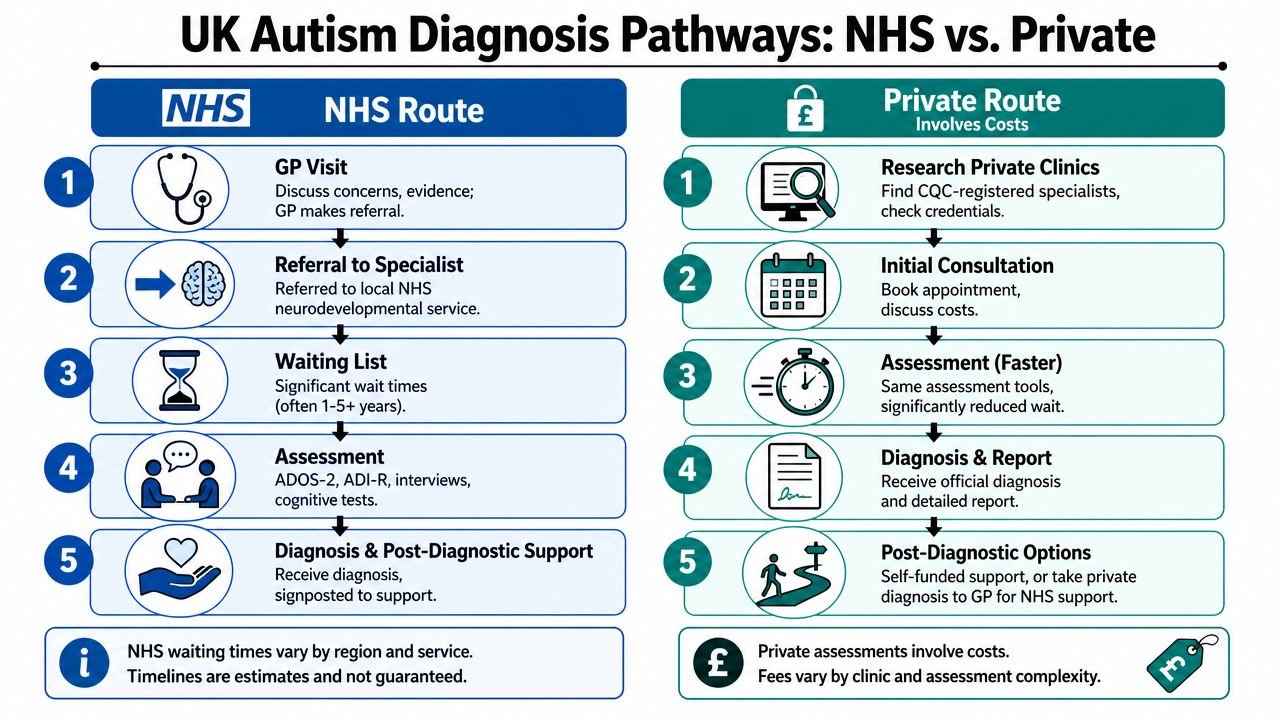
What a proper adult assessment should include
NICE-based practice is clear on this. A reliable adult autism assessment should be multi-informant and multi-session, led by a clinician, and built around current behaviour, a thorough developmental history, and collateral information from someone who knew the person in childhood if possible. Screening questionnaires can support the process, but they should not be used as stand-alone diagnostic tools. This is well explained in this guide to getting tested for autism as an adult.
That matters because many adults mask. A short appointment can miss the picture completely.
A good assessment usually includes:
- A detailed developmental interview. The clinician asks about early traits, school years, relationships, routines, sensory experiences, and how your profile has changed under stress.
- Current functional impact. Work, study, relationships, daily living, and mental health all matter.
- Collateral information. A parent, sibling, older relative, or sometimes another person who knows your history can add important context.
- Differential diagnosis. The clinician considers ADHD, anxiety, depression, trauma-related difficulties, learning profile, and other explanations.
Later in the process, some people also find it helpful to hear a clinician explain why autism does or does not fit. That reasoning matters as much as the label.
This overview of an ASD assessment in the UK gives a clear sense of what adults should expect from a structured pathway.
NHS route and private route
The NHS route is often the first port of call because it begins with your GP and fits naturally within existing records and onward support. Many adults also ask about Right to Choose, depending on eligibility and local arrangements, because they're trying to avoid prolonged uncertainty.
Private assessment can be a reasonable option when someone needs flexibility, wants consultant-led review, or doesn't want to wait through a long queue before the process even starts. The trade-off is straightforward. You gain speed and choice, but you need to check the service carefully.
Look for:
| What to check | Why it matters |
|---|---|
| Clinician credentials | Adult autism diagnosis should be completed by properly qualified specialists |
| Developmental history | Without this, the assessment is incomplete |
| Multi-session structure | Brief one-off opinions are weaker |
| Clear written report | You need a document that explains reasoning and recommendations |
| Post-diagnostic guidance | The result should help you function, not just name a condition |
A short explainer on the wider topic can help before appointments:
The best assessments don't hunt for a stereotype. They examine whether your life story shows a consistent neurodevelopmental pattern.
Immediate Support and Practical Accommodations
You may be reading this after another difficult week at work. Meetings felt too loud, plans changed without warning, you held it together in public, then crashed at home and wondered whether this was anxiety, burnout, ADHD, autism, or all three. In clinic, this is often the point where adults need something useful now, not only an answer months later.
A formal assessment can bring clarity, but it is not the starting gun for support. If your day-to-day pattern suggests autistic traits, practical adjustments are reasonable while you work through the UK diagnostic process. Good clinicians look at whether a change improves functioning and reduces distress. That matters more than waiting for paperwork.
Reduce sensory load first
Sensory strain is one of the commonest drivers of shutdown, irritability, and end-of-day exhaustion in autistic adults. It is also easy to mistake for poor stress tolerance or burnout. The first job is to reduce the load.
Try adjustments that are specific and repeatable:
- Lower noise exposure. Use noise-cancelling headphones, earplugs, quieter train carriages, or a less busy route to work.
- Change lighting. Softer lamps, screen filters, lower brightness, and avoiding harsh overhead lights can reduce cumulative strain.
- Simplify clothing. Choose fabrics, seams, and fits you can tolerate consistently.
- Create a recovery space. A quiet, low-demand area at home helps your system settle after work, travel, or social contact.
Small changes can have a large effect if the problem is sensory overload rather than low motivation.
Protect your social and cognitive energy
Adults who mask heavily often use up far more effort than other people realise. On the outside they may look capable. Inside, they are tracking cues, rehearsing responses, suppressing discomfort, and recovering from unpredictability. That pattern can resemble burnout, but the practical solution is often different.
Useful adjustments include:
- Space out demanding plans. Avoid clustering meetings, errands, and social events on the same day if each one drains you.
- Schedule decompression time. Quiet time after commuting, meetings, or family events is part of maintenance.
- Use scripts for predictable situations. Prepared phrases for appointments, work updates, or phone calls can reduce strain.
- Protect restorative interests. Focused time on an absorbing interest can regulate mood and attention.
I often tell patients to track effort, not just output. If a routine task leaves you wiped out for hours, that is clinically useful information.
If an adjustment reduces overload and helps you function safely, it is reasonable to keep using it before a diagnosis is confirmed.
Ask for concrete accommodations
Specific requests work better than broad disclosures. Employers, university staff, partners, and friends usually respond more clearly when they know what change would help.
Instead of saying, “I think I may be neurodivergent,” try:
- “I work best with written instructions.”
- “I need more notice before plans change.”
- “I concentrate better in a quieter space.”
- “After long meetings, I need a short reset before the next task.”
- “Please give me one task at a time if the situation is busy.”
This approach also helps separate autism from ADHD and burnout in practical terms. Someone with ADHD may need help with initiation, reminders, and task switching. Someone in burnout may need reduced demand and recovery. An autistic adult often needs predictability, sensory adjustment, and clearer communication. Many people need support in more than one of these areas, which is why a careful consultant-led assessment is useful.
Make support realistic
The right accommodation is the one you will use. A perfect strategy on paper is no help if it draws unwanted attention at work, creates conflict at home, or is too expensive to maintain. Start with the changes that give the biggest relief for the least friction.
That may mean asking for agendas before meetings rather than disclosing everything at once. It may mean choosing online appointments where possible. It may mean accepting that some social events need a shorter stay, a quiet exit plan, or a recovery day afterwards.
Practical support should make life more manageable now, while the bigger diagnostic picture becomes clearer.
Your Next Steps Toward Clarity and Support
Recognising autism in adulthood is rarely one dramatic moment. It's usually a pattern coming into focus.
You begin to see that what looked like social awkwardness, perfectionism, anxiety, overthinking, or repeated burnout may instead reflect a different way of processing the world. You also begin to see why self-doubt has lasted so long. Adult autism often hides behind competence, masking, and co-occurring mental health difficulties.
The most useful next step is not to force certainty on your own. It's to gather your history carefully and seek a thorough specialist assessment that can test the question properly. That is especially important when ADHD, anxiety, depression, or burnout may also be part of the picture.
If you're wondering how to recognize autism in adults, hold on to three principles.
- Look for lifelong patterns, not just current distress.
- Pay attention to effort, not only outward appearance.
- Value differential diagnosis, because overlap is common and quick assumptions are often wrong.
Clarity can bring relief, but it can also bring mixed feelings. Many adults feel validated and unsettled at the same time. That's normal. A good diagnostic process makes room for both.
Whether the outcome is autism, ADHD, another explanation, or a combination, the right assessment should leave you with a clearer map of yourself and a better idea of what support will help.
If you're ready to move from uncertainty to a clear, consultant-led opinion, Insight Diagnostics Global offers adult autism, ADHD, and broader mental health assessments with GMC Specialist Register psychiatrists in a CQC-regulated service. For adults who want a structured evaluation, clear triage, thorough reporting, and practical next steps, it's a strong place to seek clarity.