

You've probably landed here because daily life feels harder than it should. You miss deadlines you care about. You start five tasks and finish none. Your home, inbox, notes app, and calendar all look like half-built systems. Maybe you already have an ADHD diagnosis. Maybe you strongly suspect ADHD, autism, burnout, anxiety, or a mix of several things and you're trying to work out what kind of help is worth paying for.
That's where searches for a life coach for ADHD often begin.
The appeal is obvious. You don't want another vague conversation about “trying harder”. You want practical help. You want someone to help you plan, prioritise, follow through, and stop losing half your week to overwhelm. That's reasonable. But you also need to be careful. ADHD coaching can be useful. It can also be oversold, poorly delivered, and confused with services it is not qualified to replace.
Struggling with Focus and Feeling Overwhelmed
It starts in a familiar way. You open your laptop determined to catch up, then spend the next hour bouncing between messages, half-finished tasks, and reminders you were already supposed to handle last week. By the end of the day, you have worked hard, achieved very little, and feel worse than when you started.
That pattern pushes many people to search for an ADHD life coach. The appeal is obvious. You want practical help with focus, planning, follow-through, and the constant sense that daily life is slipping out of your hands.
The symptoms can be disruptive. The label is not always clear.
Problems with attention, time management, task initiation, and overwhelm can show up in ADHD. They can also show up in anxiety, depression, burnout, sleep problems, trauma, autism, or a combination of several issues. That is why paying for coaching before you have sorted out the underlying cause is often a mistake.
Why people start looking for coaching
People usually look for coaching when daily systems keep breaking down, even after repeated attempts to fix them.
You may recognise this pattern:
- Work keeps slipping: Important tasks get buried under easy, urgent, or noisy ones.
- Home life feels chaotic: Admin, bills, appointments, and household jobs pile up faster than you can clear them.
- Your systems never stick: A new planner, app, or routine helps briefly, then falls apart.
- Your confidence drops: Repeated missed deadlines and unfinished tasks start to feel like a character flaw.
If work is your main pressure point, a practical guide on how to prioritize tasks at work can help you cut through the noise and make better decisions about what needs attention first.
For many adults, the hardest part is not understanding what needs doing. It is starting, sequencing, and finishing it consistently, without exhausting yourself in the process.
The Core Question
The question is not whether you need support. You probably do. The question is whether coaching matches the problem in front of you.
If you already have a clear ADHD diagnosis and need help building workable routines, coaching can be useful. If you do not know whether ADHD is the right explanation, coaching should sit behind proper clinical assessment, not in front of it. A coach cannot tell you whether you have ADHD, rule out other conditions, or advise on medication. A regulated diagnostic service can.
That distinction matters because it protects both your money and your health. Coaching can improve day-to-day functioning. It cannot replace a formal assessment from a qualified, CQC-regulated provider such as Insight Diagnostics Global.
What an ADHD Life Coach Actually Does
An ADHD life coach works on practical functioning. Not diagnosis. Not trauma treatment. Not medication. The core job is helping you turn intentions into repeatable action.

Think of a coach as a co-driver for daily life systems. You still decide where you're going. The coach helps you notice roadblocks, choose a route, and stop making the same wrong turns every week.
What coaching usually targets
A decent ADHD coach tends to focus on executive function in ordinary life. That often includes:
- Planning and sequencing: Breaking a vague goal into next actions.
- Prioritisation: Choosing what matters now instead of reacting to everything.
- Task initiation: Getting started before avoidance grows.
- Time awareness: Using calendars, timers, and routines in ways that are realistic.
- Organisation: Creating systems you can maintain.
- Accountability: Checking what happened between sessions and adjusting quickly.
Some people also use coaching to improve work routines, study habits, meeting preparation, email management, and transitions between tasks. Others use it to reduce the daily friction around meals, bills, appointments, and household organisation.
What coaching looks like in practice
A useful session is usually specific. Not abstract. The coach might help you turn “sort my life out” into:
- clear work priorities for the next three days
- a calendar structure that protects deep work
- a visible reminder system
- a plan for starting one avoided task
- a simple end-of-day reset
That's why some people find executive-function focused resources helpful even before they hire anyone. Material that helps you unlock focus and follow-through can give you a good sense of the kinds of systems coaching often uses.
What coaching should not drift into
This matters. A coach can help you apply strategies. A coach should not try to act like a clinician.
Watch for boundary creep if a coach starts doing any of the following:
- Suggesting they can diagnose you
- Explaining away major mood symptoms without referral
- Advising on medication in place of a prescriber
- Treating trauma, severe anxiety, or self-harm risk as “mindset issues”
- Promising transformation without assessing whether you need medical care
Practical rule: If the problem is “How do I stick to a plan?”, coaching may help. If the problem is “What exactly is going on with my mental health and what treatment do I need?”, coaching is the wrong first step.
Coaching vs Clinical Care. A Critical Distinction
You book a coach because you cannot focus, miss deadlines, and feel constantly behind. Six weeks later, you still do not know whether you have ADHD, anxiety, burnout, a sleep problem, or a mix of several things. That is the risk of using coaching as your first stop.
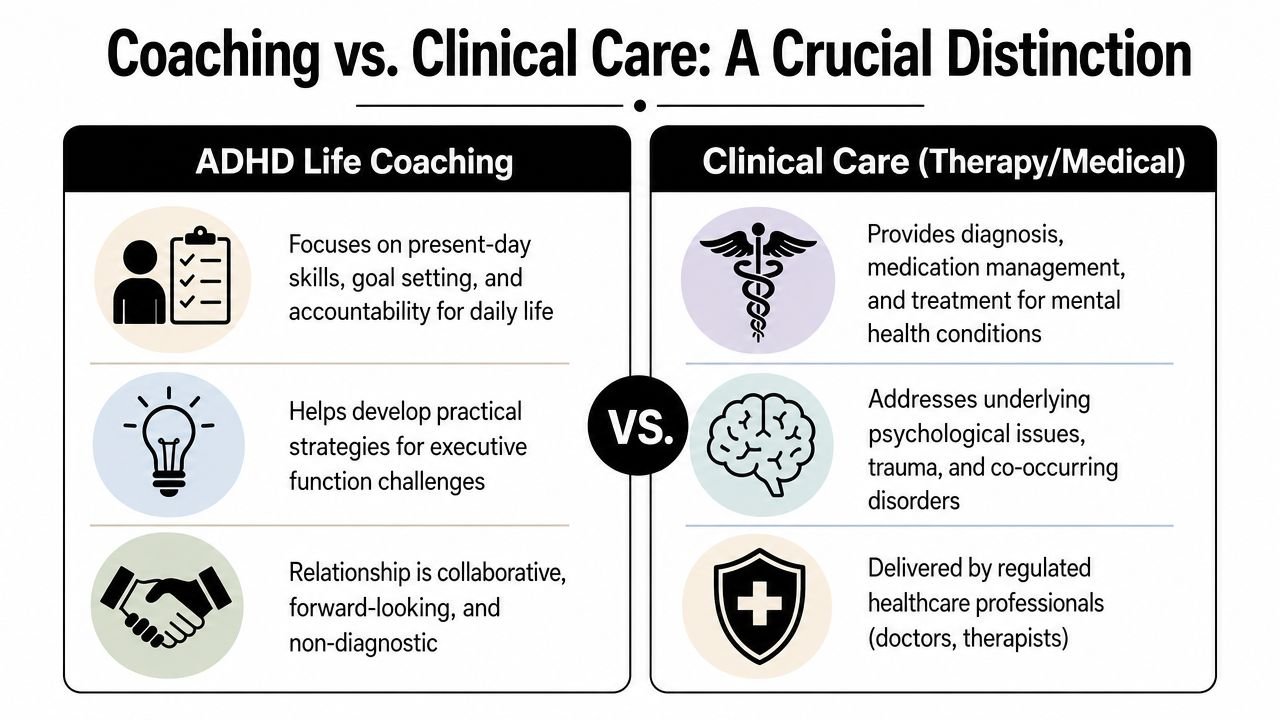
Here is the line that matters. Coaching helps with execution. Clinical care identifies the condition, rules out other causes, and sets treatment.
If you do not yet have a diagnosis, coaching is not the smart place to start. Poor concentration, disorganisation, restlessness, and emotional overload can also show up in anxiety, depression, trauma, sleep disorders, substance use, autistic burnout, and other psychiatric or neurodevelopmental conditions. A coach cannot sort that out safely. A regulated clinician can.
The difference in plain English
An ADHD coach works on habits, routines, planning, follow-through, and accountability.
A therapist or counsellor works on emotional distress, behavioural patterns, relationships, and coping. If you want that kind of support alongside ADHD care, this guide to counselling for ADHD explains where therapy fits.
A consultant psychiatrist assesses symptoms, considers overlap with autism and other mental health conditions, makes a diagnosis where appropriate, and manages treatment, including medication.
That is why coaching belongs after proper assessment, not before it.
ADHD support roles compared
| Aspect | ADHD Life Coach | Therapist / Counsellor | Consultant Psychiatrist |
|---|---|---|---|
| Main role | Skills, structure, accountability | Emotional and psychological treatment | Diagnosis, treatment planning, medication management |
| Can diagnose ADHD or autism | No | No | Yes |
| Can prescribe medication | No | No | Yes |
| Focus | Present-day routines and executive function | Thoughts, feelings, behaviours, relationships | Neurodevelopmental and mental health assessment and treatment |
| Regulation | Not a regulated medical role | Regulated professional role depending on registration and profession | Regulated medical specialist |
| Best use | Adjunct support for implementation | Psychotherapy and coping with emotional distress | Foundational assessment and medical care |
Where coaching fits safely
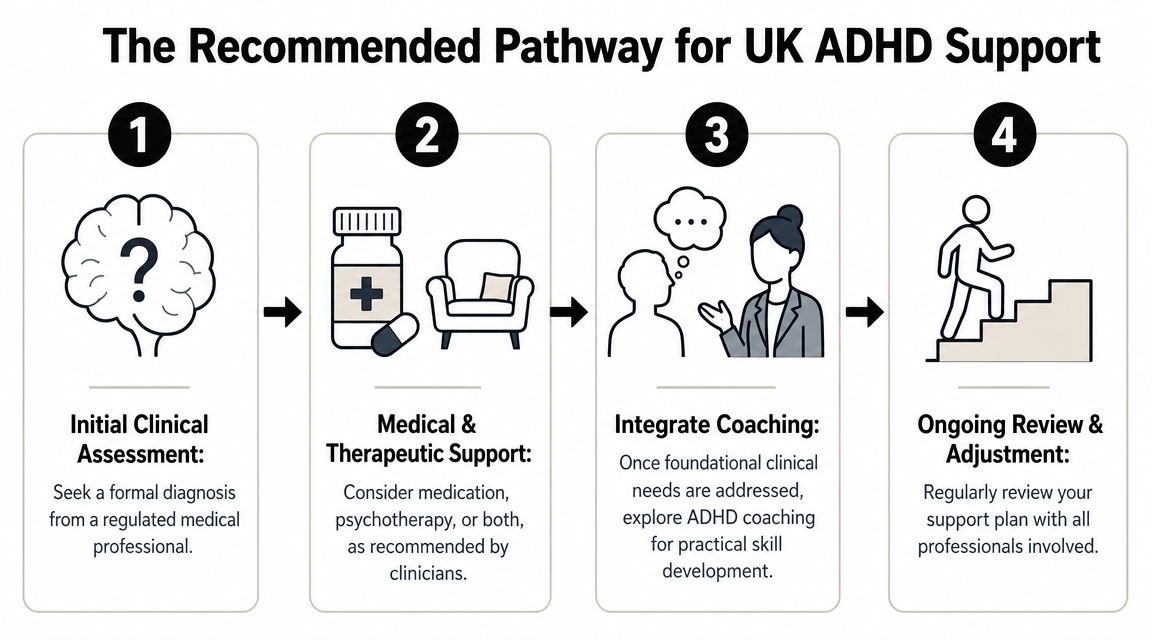
Use a simple order of operations. Get assessed first. Start the treatment plan that matches the diagnosis. Add coaching only if you need help applying that plan in daily life.
Here's a useful overview before you go further:
Paying for coaching before assessment can waste money and delay the right care.
The safest choice in the UK is a regulated clinical service, especially if your symptoms are complex, long-standing, or mixed with mood, trauma, sleep, or autism-related concerns. Coaching can be useful. It is support work, not diagnostic work. That distinction protects both your money and your health.
Evidence and Realistic Outcomes for ADHD Coaching
If you're asking whether ADHD coaching is worth it, ask a sharper question. Worth it compared with what?
If you already have a clear diagnosis, stable treatment plan, and specific executive function problems, coaching may be a sensible add-on. If you're still trying to work out whether you even have ADHD, it's not the best place to spend your money first.
The field is not tightly regulated
This is the biggest issue. ADHD coaching has grown, but it has done so without the kind of regulation patients often assume exists.
A survey reported by University of Washington researchers found that ADHD coaches charge a median of $150 per hour, and that there is no formal licensure, oversight, or standard training pathway for the field. The same report noted that many coaches use executive-function skills training, cognitive restructuring, motivational interviewing, and solution-focused approaches, and 90.5% reported sharing their own lived ADHD experience during sessions (ADHD coaching boom survey).
That doesn't make coaching useless. It does mean quality varies dramatically.
Why caution is justified
A key concern in the ADHD coaching field is the lack of clinical oversight. A JAMA Network Open study, summarised by CHADD, found that only 15% of surveyed coaches had a professional medical license, and over 90% lacked formal clinical supervision, which is exactly why coaching should not be mistaken for psychotherapy or diagnostic care from a regulated provider (clinical oversight concerns in ADHD coaching).
Here's the practical takeaway:
- Good coaching can improve execution: It may help you follow routines, use tools consistently, and reduce friction.
- Bad coaching wastes time: You get motivational talk, weak accountability, and no clear boundaries.
- Overconfident coaching can be risky: Especially if the coach minimises depression, trauma, substance use, or medication issues.
What realistic outcomes look like
Reasonable expectations are modest and practical. Coaching may help you:
- build a calendar system you'll use
- create accountability around deadlines
- reduce repeated lateness and forgotten tasks
- break large goals into manageable steps
- notice patterns that trigger avoidance
It probably won't solve underlying mood instability, untreated trauma, complex relationship patterns, severe anxiety, or diagnostic uncertainty. Those need clinical input.
Coaching is best judged by whether your week becomes more workable, not by whether someone sells you a dramatic identity transformation.
If a coach promises to “cure” ADHD, replace treatment, or tell you diagnosis doesn't matter, walk away.
Practical Coaching Strategies You Can Use
You don't need to hire a coach before trying ADHD-friendly systems. Some of the most useful coaching methods are simple, repeatable, and easy to test this week.
Start with external structure
ADHD often punishes invisible intentions. If a task only exists in your head, it's easy to lose.
Try these:
- Time blocking: Put one task into one calendar slot. Don't write “admin”. Write “reply to finance email”, “submit form”, or “review lecture notes”.
- Visual task capture: Use one trusted list, not scraps of paper, screenshots, and memory.
- A launch pad by the door: Keep keys, wallet, pass, charger, and medication in one fixed spot.
Use activation tools, not willpower
The hardest moment is often the start. Coaches know this, so they often build systems around activation.
A few examples:
Body doubling
Work alongside another person, in person or online, while you each do your own task. Presence can reduce drift.Pomodoro timing
Set a timer for a short work sprint, then stop and reset. The aim isn't perfection. The aim is starting.Task shrinking
If the task feels impossible, make the first step embarrassingly small. Open the document. Title it. Write one line.Friction reduction
Put tomorrow's gym clothes out tonight. Pre-open the form you need to complete. Remove extra steps.
For students or anyone managing revision overwhelm, tools that discover NEA Coach revision tools can be useful examples of how external structure supports follow-through.
Build a repeatable weekly reset
Individuals with ADHD don't need a perfect life system. They need a way to recover after things slip.
A basic weekly reset can include:
- checking appointments
- listing unfinished tasks
- identifying top priorities
- resetting your workspace
- deciding what gets dropped
For more everyday ideas, this guide to strategies for coping with ADHD offers practical starting points.
Short systems beat ambitious systems. If you can't maintain it during a bad week, it's too complicated.
How to Choose a Reputable UK ADHD Coach
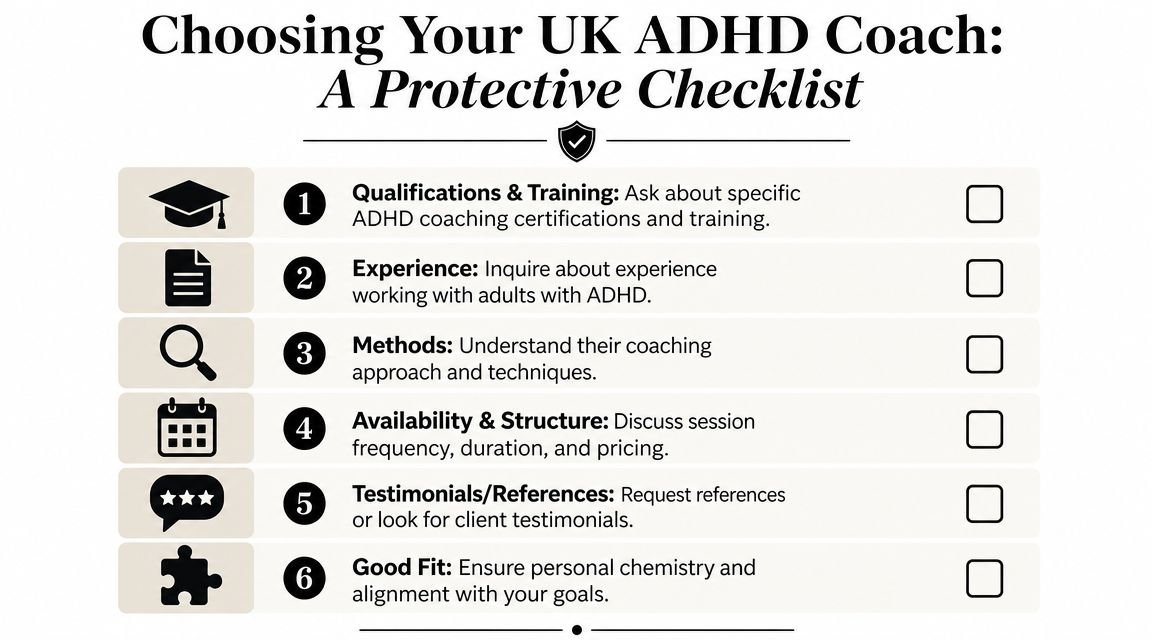
If you decide to try coaching, vet the coach properly. Don't choose based on branding, confidence, or social media relatability. Choose based on boundaries, method, and fit.
Questions you should ask before paying
Ask direct questions and listen for direct answers.
What training have you completed?
You're looking for specificity, not vague claims about being “experienced”.What do you do when a client may need diagnosis or mental health treatment?
A safe coach refers out. Quickly.How do you structure sessions?
Good coaches can explain their process clearly.What goals are realistic in coaching?
If they promise sweeping change, be sceptical.Do you work alongside clinicians when needed?
The right answer is yes.What are your boundaries?
They should be able to say what they do not treat.
If you want a local option to compare against these standards, this page on ADHD coaching in London is a useful reference point for what a structured service description should look like.
Red flags that should end the conversation
Some warning signs are immediate deal-breakers:
- They claim they can diagnose ADHD or autism
- They tell you medication is unnecessary or harmful across the board
- They dismiss therapy or psychiatry as inferior
- They promise a cure
- They encourage dependency rather than skill-building
- They can't explain when they'd refer you elsewhere
What a good fit feels like
A credible coach doesn't need to sound grand. They need to sound clear.
You should leave an initial conversation understanding:
| What to look for | Why it matters |
|---|---|
| Clear scope of practice | Shows they understand their limits |
| Practical structure | Means sessions are likely to produce action |
| Respect for clinical care | Protects you if symptoms are more complex |
| Collaborative style | Helps you use support without shame |
Buyer safeguard: The best ADHD coaches are comfortable saying, “This part is outside coaching and needs clinical input.”
The Right Pathway to ADHD Support
The most effective route is not complicated. It's just often ignored.
Start with clarity
If you suspect ADHD, autism, or another mental health condition, begin with formal clinical assessment. Don't build your whole support plan around assumptions. Plenty of adults spend years treating “poor discipline” or “bad focus” when the underlying cause is a neurodevelopmental condition, anxiety disorder, depression, trauma response, or a combination of several.
Follow the treatment plan properly
In the UK, NICE guidance recommends medication for adults with ADHD where appropriate, with regular clinical review. Coaching is most useful as an adjunct because it helps with planning, organisation, and goal-setting that medication alone does not teach. It supports the clinical pathway rather than replacing it (NICE-related adult ADHD treatment discussion).
That means treatment may include medication, psychological support, monitoring, or a combination. The exact mix depends on the assessment, not on a coach's impression of what is advantageous.
Add coaching only when it has a clear job to do
Coaching earns its place when there's an implementation gap. You know what needs doing, but you're still struggling to execute it in daily life.
That might mean using a coach to help with:
- work planning
- university deadlines
- routines around medication and appointments
- home organisation
- accountability for agreed goals
If you also want peer-based support alongside clinical care, exploring ADHD support groups near me can be a useful next step.
The right order is simple. Assessment first. Treatment next. Coaching after that, if needed. That sequence is safer, more efficient, and far more likely to help.
If you want clear answers rather than guesswork, Insight Diagnostics Global offers consultant-led adult assessments for ADHD, autism, and broader mental health concerns, with online and face-to-face options. The service is CQC-regulated, led by psychiatrists on the GMC Specialist Register, and designed for adults who need proper diagnostic clarity, treatment recommendations, and follow-up support. If you're weighing up a life coach for ADHD, start with the step that tells you what you're dealing with. That's the decision that makes every other one smarter.