

Poor focus. Missed deadlines. A mind that won't switch off at night. Social situations that feel harder than they seem to be for everyone else. Many adults reach a point where they stop asking, “Am I just stressed?” and start asking, “Could this be anxiety, depression, ADHD, autism, or something else entirely?”
That question often brings you to your GP first, and that's usually the right starting point. A GP can check for common mental health problems, look for physical causes, assess risk, and decide what needs to happen next. But it also helps to go in with realistic expectations. A GP appointment is an entry point into the system, not always the place where complex neurodevelopmental questions get fully answered.
If you're trying to work out whether your difficulties reflect burnout, a mood disorder, trauma, ADHD traits, autistic traits, or a mixture of several things, the most useful approach is to understand the pathway clearly. That includes what a GP can do well, where GP assessment reaches its limits, and when a specialist psychiatric assessment becomes the better next step.
Starting the Conversation About Your Mental Health
A common scenario goes like this. You've been holding things together for years. Outwardly, work may look fine. Inwardly, you're forgetting meetings, struggling to prioritise, overreacting to small frustrations, and feeling exhausted by basic daily demands. You may also notice a lifelong pattern: distraction, sensory overload, social masking, impulsive decisions, or feeling “different” without being able to explain why.
That's often when people book a GP appointment.
This isn't unusual. In UK primary care, Mind found that 41% of GP consultations involved a mental health element, and 66% of GPs said the proportion of patients needing mental health support had increased over the previous 12 months, according to Mind's GP mental health survey summary. Mental health isn't a side issue in general practice. It is part of ordinary, everyday GP work.
Why the first appointment still matters
A mental health assessment with a GP gives you something important even when it doesn't produce an immediate diagnosis. It starts a clinical record. It helps identify urgency. It opens routes to blood tests, medication review, sick notes where appropriate, talking therapy referrals, and specialist referral if your presentation suggests something more complex.
For some people, that first discussion confirms a fairly straightforward picture of depression or anxiety. For others, it reveals a messier overlap. Low mood may stem from chronic executive dysfunction. Panic may be secondary to autistic overwhelm. “Stress” may be the language someone has used for years to describe undiagnosed ADHD.
Many adults don't present saying, “I have ADHD” or “I'm autistic.” They present saying, “I'm failing at things that look easy for other people.”
The question beneath the symptoms
If that sounds familiar, it can help to read about the wider range of mental health services for adults before you book or attend your appointment. The aim isn't to self-diagnose. It's to recognise that a GP is often the start of the pathway, while diagnostic clarity for ADHD, autism, personality difficulty, or mixed presentations may require a more detailed specialist assessment.
That distinction matters because many patients leave a GP appointment feeling disappointed for the wrong reason. They expected a definitive answer. What they received was triage. In primary care, that is often exactly what the system is designed to provide.
What a GP Mental Health Assessment Involves
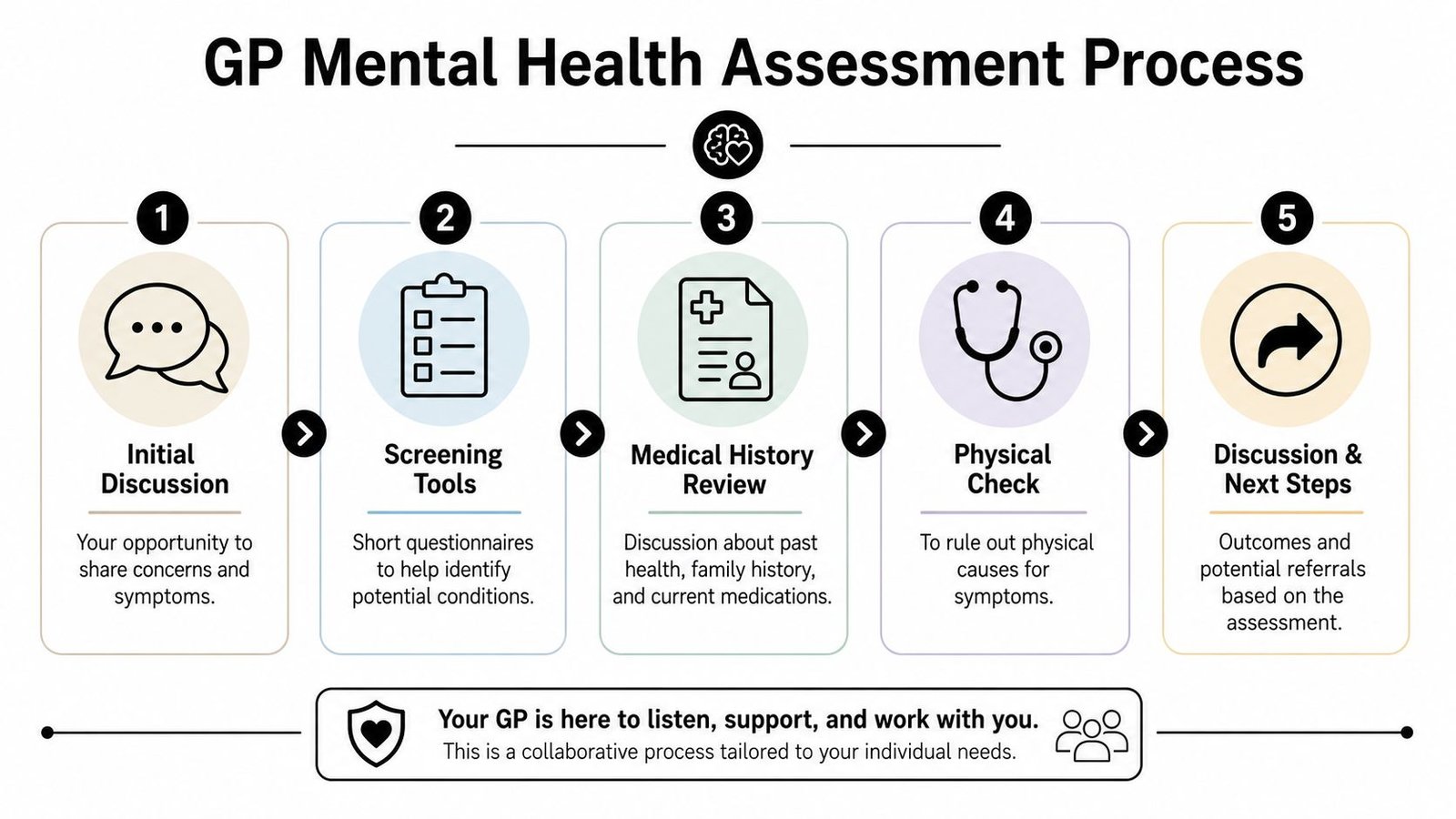
A GP mental health appointment is usually brief, focused, and practical. The GP is trying to understand what is happening, how severe it is, whether there is immediate risk, and what the safest next step is.
What usually happens in the consultation
Most appointments cover a mixture of the following:
Current symptoms
Your GP may ask about mood, worry, sleep, appetite, motivation, concentration, irritability, panic symptoms, and whether things are getting better or worse.Impact on daily life
They'll want examples. Can you work? Are you missing deadlines? Are relationships affected? Have you stopped doing ordinary tasks?Screening questionnaires
Some practices use tools such as PHQ-9 for depressive symptoms and GAD-7 for anxiety symptoms. These can be useful for structure and baseline monitoring, but they don't by themselves diagnose ADHD, autism, bipolar disorder, or personality disorder.Relevant background
Past mental health treatment, medication, alcohol or substance use, family history, and major life events often come up.Physical health review
A GP may consider whether blood tests, medication review, sleep issues, hormonal problems, or other medical factors might be contributing.
Why GPs focus on triage
The GP's role is central, but it isn't the same as a specialist psychiatric assessment. The reason is partly clinical and partly systemic. The RCGP states that 90% of people with mental health problems are cared for entirely within primary care, yet primary care accounts for less than 10% of total mental health expenditure, as summarised in the Nature Mental Health analysis referenced here.
That helps explain why your GP may be concise, selective, and careful about referrals. They're managing large volumes of mental health work inside a pressured system.
Practical rule: Go into a GP appointment aiming for clarity, not completeness. Your job is to describe the pattern accurately. Your GP's job is to decide the safest and most appropriate next step.
What a GP appointment does well, and what it doesn't
A GP assessment is good at identifying common mental health conditions, spotting risk, checking for physical contributors, and opening a pathway forward. It is less good at resolving nuanced diagnostic questions where symptoms overlap heavily.
That's one reason many patients later seek a fuller psychiatric assessment overview when the picture remains uncertain. If your main concern is adult ADHD, autism, or a complex mix of mood, trauma, and neurodevelopmental features, a short GP consultation may identify the need for more assessment without being able to complete that assessment itself.
What Clinicians Look For During the Assessment
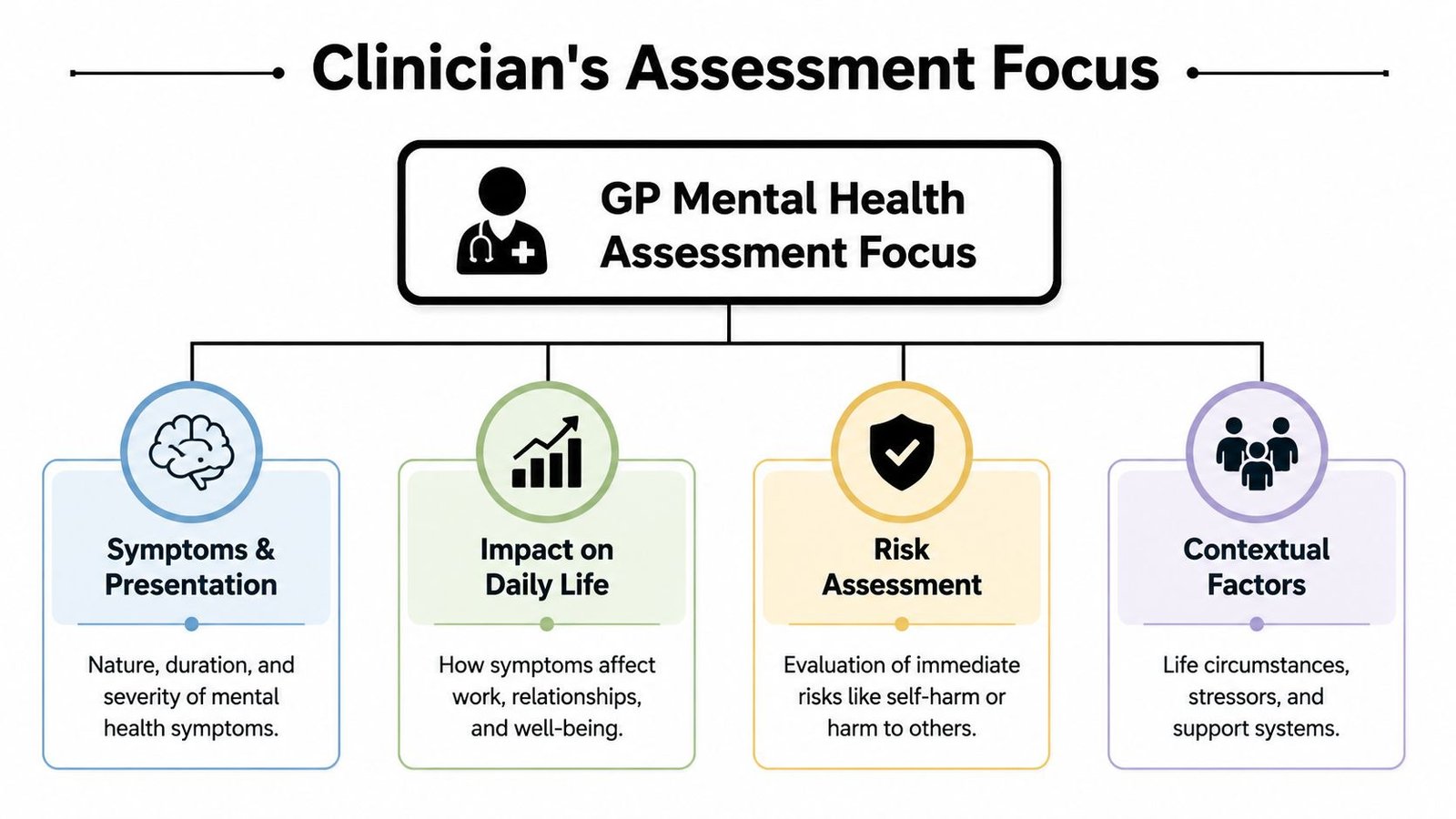
Clinicians are not merely matching symptoms to labels. They're trying to decide what kind of problem they're dealing with, how confident they can be, and what level of risk sits underneath the presentation.
Distress, disorder, or both
According to the RCGP curriculum, GPs must differentiate stress, distress, mood disorder, and diagnosable mental illness, use history and examination to reach a diagnosis, and assess risk while recognising that there are no validated scales that predict suicide, as set out in the RCGP mental health curriculum.
That matters because not every intense emotional state is a psychiatric disorder. Bereavement, burnout, relationship breakdown, workplace stress, financial pressure, trauma, alcohol misuse, and adverse childhood experiences can all shape presentation. Sometimes they are the main explanation. Sometimes they sit alongside ADHD, autism, depression, or another condition.
Why a GP may hesitate on ADHD or autism
From the patient side, it can feel frustrating if you say, “I think I may have ADHD,” and the conversation shifts to sleep, anxiety, or low mood. Clinically, though, that is often appropriate. A GP has to consider whether concentration problems reflect depression, chronic anxiety, poor sleep, substance use, thyroid dysfunction, stress overload, or a neurodevelopmental condition. They also have to ask whether these features are new or longstanding.
A careful clinician is usually asking questions like these:
- Onset: Did these difficulties begin in adulthood, or do they trace back to school years and childhood functioning?
- Pervasiveness: Do the problems affect work, home life, relationships, and organisation broadly?
- State versus trait: Is this a change from your usual self, or a lifelong pattern?
- Comorbidity: Could more than one condition be present at the same time?
Risk assessment is broader than a checklist
Risk assessment isn't only about asking whether you're suicidal. It includes self-neglect, impulsivity, substance misuse, vulnerability, aggression, safeguarding concerns, and whether you can get through the next few days safely.
A “low-risk” consultation still needs a follow-up plan if the story is unstable, the support is thin, or the diagnosis remains unclear.
That's one reason symptom scores can only go so far. They can support clinical reasoning, but they can't replace it. If you want a sense of the kinds of topics clinicians may ask about, this guide to mental health assessment questions is a useful way to think through your own pattern before the appointment.
How to Prepare for Your GP Appointment
Preparation makes a real difference, especially if you freeze under pressure or struggle to summarise years of difficulty in a short consultation. The best preparation is concrete, not polished.
Bring examples, not just labels
Don't only say, “I think I have ADHD,” or “I might be autistic.” Say what happens.
Useful examples include:
- Work problems such as missing deadlines, losing track of tasks, needing crisis pressure to start, or burning out from basic admin
- Home difficulties such as clutter you can't organise, unpaid bills, forgotten appointments, or sensory overwhelm
- Emotional patterns such as rejection sensitivity, fast frustration, shutdown, panic, or feeling constantly on edge
- Social issues such as masking, misunderstanding tone, exhaustion after interaction, or needing strict routines to cope
A GP can do more with examples than with a conclusion.
Make a brief timeline
Write down when you first noticed the problem, whether it was present in childhood, what has changed recently, and what is making you seek help now. If you suspect ADHD or autism, note any school reports, family observations, or long-term patterns that support a lifelong history rather than a recent stress response.
A simple structure works well:
| Area | Notes to bring |
|---|---|
| Main symptoms | What you're struggling with now |
| Duration | How long it's been happening |
| Functional impact | Work, study, home, relationships |
| Mental health history | Previous diagnoses, therapy, medication |
| Your question | What you want help clarifying |
Decide what you want from the appointment
Some patients want immediate support for anxiety or depression. Others mainly want a referral discussion for ADHD or autism. Some need both. If you don't say what outcome you're hoping for, the consultation can drift.
Write one sentence in advance: “By the end of this appointment, I want to know what you think is most likely going on and what the next step should be.”
If you tend to forget key points, bring notes and tell the GP you have them. That isn't difficult or demanding. It's sensible.
Understanding Your Options After the GP Assessment
What happens next depends on what the GP thinks is most likely, how severe the symptoms are, and whether the picture looks straightforward or mixed.
Common NHS outcomes
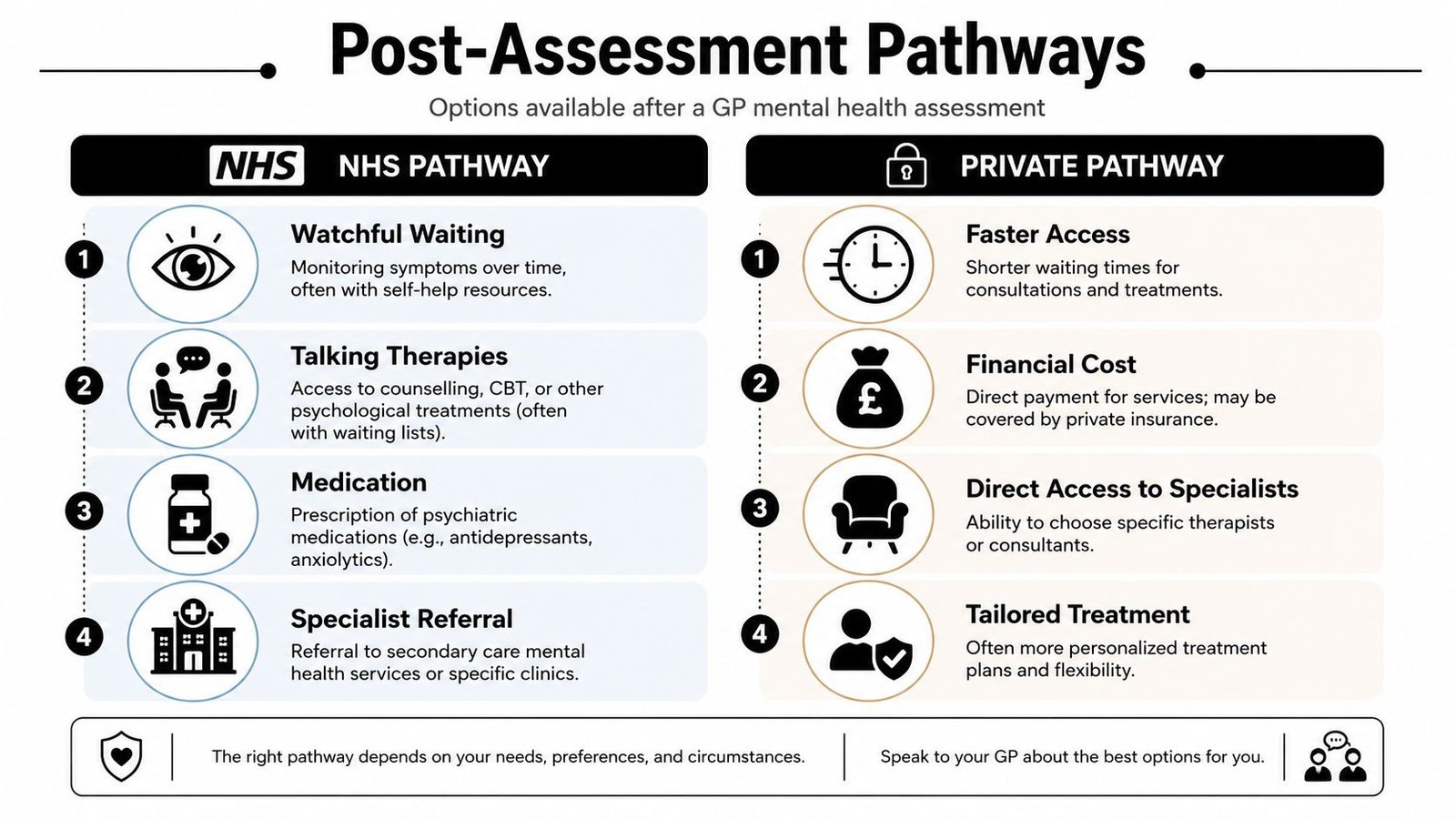
After a GP assessment, the outcome may be one or more of the following:
- Watchful waiting if symptoms are present but the diagnosis isn't yet clear
- Talking therapies referral for anxiety, low mood, trauma-related symptoms, or coping difficulties
- Medication in primary care where appropriate, often for anxiety or depression
- Specialist referral if risk is higher, the picture is complex, or a neurodevelopmental assessment is indicated
The difficult area is uncertainty. Adults with overlapping anxiety, low mood, burnout, executive dysfunction, and autistic traits often don't fit neatly into a single box. As discussed in this overview of barriers in mental health care, strained primary care systems often leave these patients with signposting rather than a definitive formulation.
NHS route, Right to Choose, or private assessment
These pathways differ less by principle than by speed, depth, and flexibility.
| Pathway | What it can offer | Trade-offs |
|---|---|---|
| Standard NHS referral | Lower direct cost to the patient, recognised route into local services | Waiting times and local thresholds can be difficult |
| Right to Choose in England | An NHS-funded route to certain providers if criteria are met | Administrative steps matter, and not every service or diagnosis fits neatly |
| Private specialist assessment | Faster access and more control over clinician choice | Direct financial cost, and follow-on NHS prescribing arrangements can vary |
If your presentation is mixed, private assessment can be useful because it allows more time for a fuller diagnostic formulation rather than a narrow screening exercise. That does not mean private is always necessary. It means it can be appropriate where uncertainty itself is the main problem.
Practical examples of when escalation makes sense
A more specialist route is often worth considering if:
- Your GP agrees something is going on, but can't tell what
- You've been treated for anxiety or depression and the core difficulties remain
- You suspect ADHD or autism because the pattern is lifelong, not recent
- You need a detailed report for work, study, treatment planning, or medication decisions
For some adults, the daily burden isn't just mood. It's the physical and cognitive strain of pushing through executive dysfunction, repetitive strain, and effortful workarounds. In that context, resources on combatting dictation fatigue can be helpful while you're waiting for formal assessment, especially if writing, typing, or task initiation has become draining.
What a Specialist Neurodevelopmental Assessment Involves
A specialist assessment for adult ADHD or autism is not merely a longer GP appointment. It asks different questions, uses a broader evidential base, and aims for a proper diagnostic formulation.
What makes it more thorough
The APA recommends that a robust psychiatric assessment should be biopsychosocial and measurement-based, reviewing psychiatric symptoms alongside medical factors that can mimic or worsen them, and using quantitative symptom measures to improve decision-making, as described in the APA-aligned review published by AAFP.
In practice, a proper adult neurodevelopmental assessment often includes:
- A structured clinical interview covering childhood history, education, work, relationships, coping style, sensory profile, emotional regulation, and coexisting mental health symptoms
- Rating scales or questionnaires used as part of the evidence base, not as a shortcut to diagnosis
- Collateral history from someone who knows you well, or historical information where available
- Differential diagnosis, meaning the clinician actively considers anxiety, depression, trauma, personality factors, sleep problems, and physical health contributors
- A written formulation and report that explains not just whether criteria are met, but why
Why adults often need this level of assessment
Adult presentations are rarely textbook. Someone may have inattentive ADHD with secondary low mood. Another person may have autism with chronic social exhaustion and recurrent anxiety. A third may have neither condition, but show executive dysfunction driven by trauma, burnout, or a mood disorder.
That's where specialist judgement matters. If executive dysfunction is central to your experience, this plain-language guide to executive dysfunction is a helpful way to understand the day-to-day pattern many adults describe before formal assessment.
A consultant psychiatrist with neurodevelopmental experience will usually focus on pattern recognition over time, not just current distress. That distinction is key. Current stress can intensify ADHD or autistic traits, but it doesn't create a lifelong neurodevelopmental history.
What the output should give you
A useful specialist assessment should leave you with more than a label. It should answer practical questions:
- What is the most likely diagnosis or formulation?
- What conditions have been considered and ruled in or out?
- What support makes sense now?
- Is medication relevant?
- What should your GP know?
- What adjustments may help at work or university?
This is the point of a consultant-led service. For example, Insight Diagnostics' autism and ADHD assessment pathway describes the kind of structured adult assessment many patients seek when primary care triage has identified the need for more depth. In services of this type, the assessment may be led by a consultant psychiatrist such as Dr Sai Achuthan where the presentation involves neurodevelopmental and broader psychiatric complexity.
A short video can help if you want to see the service context before booking.
Frequently Asked Questions About Mental Health Assessments
What if my GP doesn't think I need a referral?
Ask for the reasoning. A good response is calm and specific: explain the lifelong pattern, the impact on functioning, and why you believe a neurodevelopmental assessment is clinically relevant. If needed, book a follow-up and bring written examples. If you're in England, ask whether Right to Choose may be available for the service you're seeking.
Can a private diagnosis still be useful within the NHS?
Yes, but practical arrangements vary. A private diagnosis can clarify treatment, workplace adjustments, and your own understanding of what is happening. The more complicated question is follow-on prescribing, especially for ADHD medication, because NHS shared care arrangements depend on the GP practice and local systems. Ask about this before booking any private assessment.
Does a GP diagnose ADHD or autism?
Usually, the GP identifies concern, considers alternatives, and decides whether referral is appropriate. A formal adult diagnosis typically requires a more detailed specialist assessment.
What if I'm not sure whether it's ADHD, autism, anxiety, or burnout?
That uncertainty is common. You do not need to arrive with the right answer. You do need to describe the pattern clearly, especially what is lifelong, what is recent, and how your functioning is affected. The more overlapping the presentation, the more useful specialist assessment becomes.
The best referrals often begin with uncertainty that has been described well.
How does Right to Choose work in practice?
In England, Right to Choose can allow an NHS patient to ask for referral to an eligible provider rather than defaulting to a local pathway. The process depends on referral criteria, geography, and whether the provider accepts that route for the assessment in question. The practical point is simple: ask your GP directly whether your circumstances fit and what paperwork or wording is needed.
Should I seek help even if I'm functioning on paper?
Yes. Many adults with ADHD, autism, anxiety, or depressive disorders function at a high external level while paying a heavy internal cost. By the time they seek assessment, they are often exhausted, ashamed, or close to collapse. You do not need to wait until things become unmanageable.
If you want a clear next step after a GP appointment, Insight Diagnostics Global provides consultant-led adult assessments for ADHD, autism, and broader mental health concerns, with structured reports, treatment recommendations, and optional follow-up. It isn't a crisis service, so if you're at immediate risk call 999 or contact NHS 111 for urgent support.