

You've probably already lived the hard part, the waiting, the second-guessing, the private research at midnight, and the feeling that everyone else seems to know what “an assessment” means except you. An autism assessment in the UK can sound like a single appointment, but for most adults it's really a pathway, one that can feel confusing until someone breaks it into plain English.
That pathway usually runs through referral, triage, pre-assessment support, the assessment itself, and then feedback and post-assessment support. In the NHS, that can mean a long wait and several moving parts. In private or Right to Choose routes, it can mean faster access, more predictable scheduling, and in some services, a report turnaround that feels much more immediate. The trade-off is simple enough to say and hard enough to live through, speed, cost, detail, and continuity don't always travel together.
Why This Guide Feels Different From the Others
Many people looking up what happens in an autism assessment are not trying to pass an exam. They're trying to answer a quieter question, “Does this explain me?” That question often comes after years of masking, burnout, workplace strain, relationship friction, or the nagging sense that ordinary social life costs you more than it seems to cost everyone else.
A good assessment doesn't begin with a verdict. It begins with enough structure to make sense of a life story that may have been discounted, patched over, or mistaken for something else. In the UK, that structure is usually not a single clinic visit. It is a staged pathway that starts with referral and triage, moves through pre-assessment information gathering, continues into the diagnostic appointment, and ends with feedback and support planning, not just a label.
For many adults, the decision sits before the appointment is even booked. NHS routes can involve long waits and several contacts, while private or Right to Choose pathways can move much faster. That difference matters when you're exhausted, when work is suffering, or when you've already spent months wondering whether you can keep functioning without clarity.
Practical rule: if you're feeling overwhelmed, don't try to understand autism assessment as one event. Treat it like a pathway, because that's how UK services actually run it.
The rest of this guide follows that pathway from the patient's chair. It shows what each stage asks of you, what clinicians are trying to work out, and where the NHS, Right to Choose, and private options diverge in practice. By the time you reach the end, the process should feel less like a closed door and more like a sequence you can follow.
The Five Stages Every UK Autism Assessment Follows
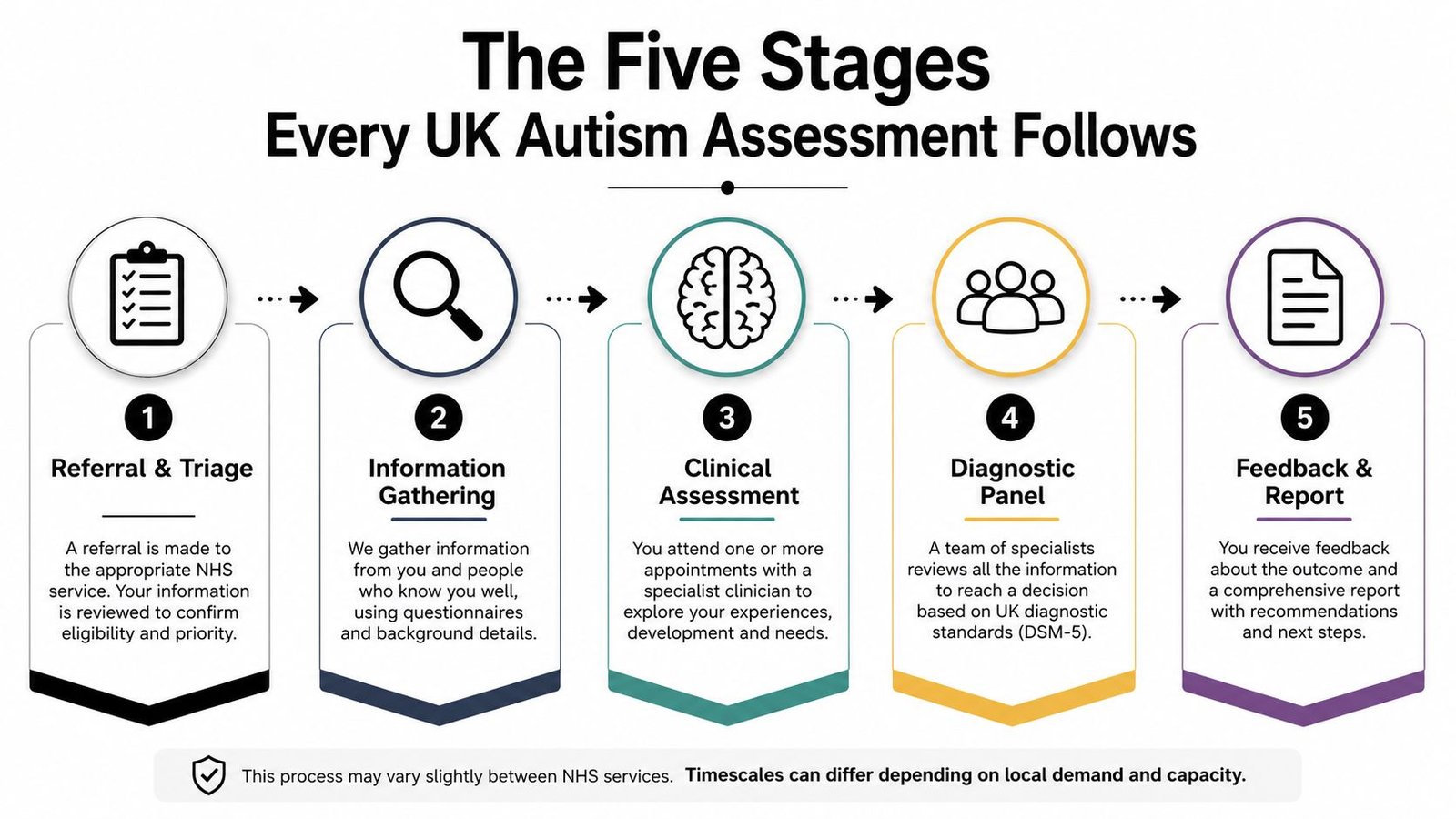
A UK autism assessment usually follows a pathway rather than a single appointment. NHS England describes five linked stages, identification and referral, screening and triage, pre-assessment support, the assessment itself, and post-assessment support, with screening information ideally reviewed within ten working days (NHS England operational guidance). For many people, that explains why the process starts with forms and background details before any diagnostic conversation is booked.
The route also looks different depending on how you access it. NHS pathways often involve waiting and several handovers, Right to Choose can move faster in some areas, and private assessment usually costs more but may give a quicker report. The distraction-free workflow quiz is not part of the clinical process, yet the need it points to is familiar to many adults seeking assessment, a desire to understand how they cope when ordinary routines keep breaking down.
Stage 1 Identification and referral
Someone notices a pattern, or you do. In some areas that starts with a GP referral. In others, self-referral is possible, or a local pathway sends you straight to a triage form.
From the patient's chair, this step can feel strangely underwhelming. You may have worked hard to ask for help, only to meet forms and administrative checks, but those checks decide whether the next step is a full diagnostic assessment, a different referral, or more information first.
Stage 2 Screening and triage
Triage is the sorting stage. A clinician or team member looks at the paper trail and decides whether there is enough evidence to continue to a full assessment, or whether more detail is needed first.
That can feel opaque if you are waiting on an answer. One person gets moved on quickly, another is asked for more history, and another is redirected. In practice, this stage is the service trying to avoid sending everyone through the same full appointment when the first questions can already clarify the likely route.
Stage 3 Pre-assessment support
This stage is usually forms, questionnaires, and background information. You may be asked to describe traits from childhood and adult life, list examples from work or relationships, or give permission for collateral information from a parent, partner, or another person who knew you well.
It can feel repetitive. That repetition serves a purpose, because autism assessments depend on developmental history as well as present-day difficulties. Clinicians need to compare what you report now with what has been there over time, much like fitting together pieces from different years to see whether the pattern is consistent.
Stage 4 The diagnostic assessment
This is the appointment where the evidence is brought together. Depending on the service, it may involve a clinical interview, direct observation, structured questionnaires, and review of developmental and medical history. The NHS says the assessment should also consider co-occurring and differential diagnoses, which is why the conversation can range beyond autism alone (NHS autism assessments).
For adults, this part often feels more conversational than people expect. There may be periods where you are just talking, followed by more pointed questions about communication, routines, sensory differences, or how you handle change. It is less like being tested on facts and more like being asked to show how different parts of your life fit together.
Stage 5 Post-assessment support
A useful service does not stop at a decision. It gives feedback, a written report, and recommendations that match the outcome. That may mean referral onward, advice on adjustments, signposting to support, or a plan for follow-up if another condition also needs attention.
This final stage matters because the result is only one part of the picture. The report should explain what was found in plain language and what happens next, so you are not left holding a label without guidance on how to use it in daily life.
What the Assessment Appointment Itself Looks Like
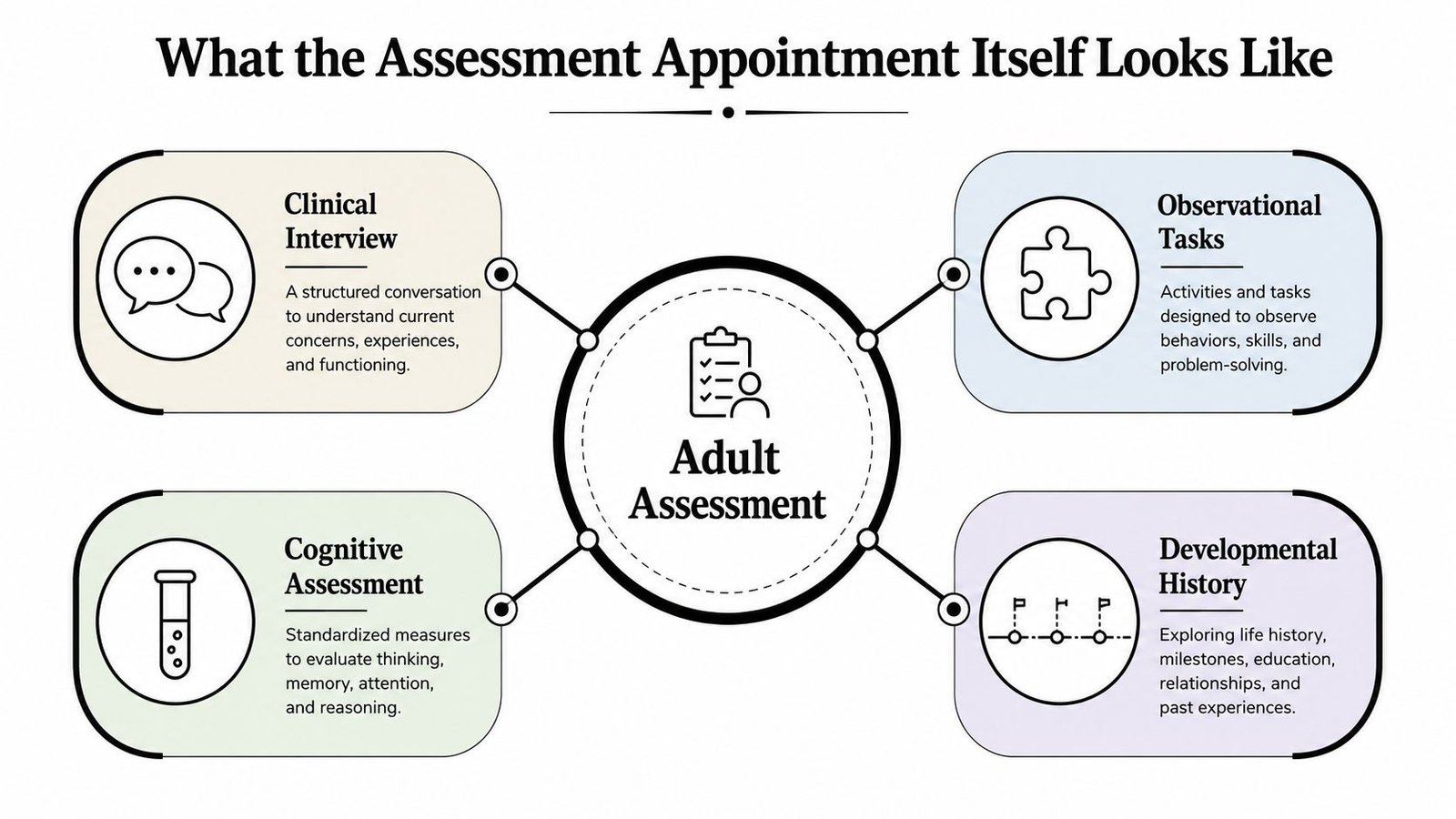
Most adult autism assessments start as a conversation, not a test. The clinician usually begins by asking why you sought help now, what difficulties are showing up in daily life, and what your childhood was like, because autism is developmental and the assessment has to establish lifelong traits, not just current stress.
The clinical interview
Expect questions about friendships, work, routines, sensory issues, communication style, and how you cope when things change. A clinician may also ask about sleep, mood, physical health, and stress, because those can shape how autistic traits look in real life.
From your side, this part can feel surprisingly ordinary at first, then unexpectedly detailed. That's normal. Clinicians are not looking for perfect answers. They're trying to hear the pattern across many small examples.
Informant input and childhood history
A childhood informant matters even when you're an adult. The assessor is trying to understand what was present early, what was always there, and what appeared later because of anxiety, burnout, or other pressures. The NHS says assessment can include input from someone who knew you as a child, someone who knows you now, and GP reports about other health problems (NHS autism assessments).
If you're doing the process privately, pre-assessment forms often take on more weight, because the clinician needs enough developmental detail before the appointment begins. A useful supporting resource is this distraction-free workflow quiz, especially if you're trying to organise forms, records, and appointment prep without getting pulled into half a dozen tabs.
Observation and structured tools
Observation is not the clinician “catching you out.” It's them watching how you speak, how you handle back-and-forth conversation, whether you rely on scripts or patterns, and how you respond to changes in the flow of discussion. In UK practice, structured tools such as ADI-R, ADOS-2, DISCO, or 3di are often used to standardise the history-taking and observation process, and if ADHD is also being queried, tools such as DIVA may come into the conversation as well (NHS England framework).
A strong assessment often feels slower than people expect, because the clinician is checking consistency across your story, not just collecting answers.
If you're wondering how a structured appointment compares with other kinds of focused work, a consultant-led service may use a similarly disciplined intake for autism, ADHD, and broader mental health screening. For example, Insight Diagnostics Global provides adult assessments across autism, ADHD, and co-occurring mental health concerns, with booking, reporting, and follow-up arranged as a single service rather than a loose set of appointments.
How Clinicians Apply DSM-5 Criteria and Rule Out Alternatives
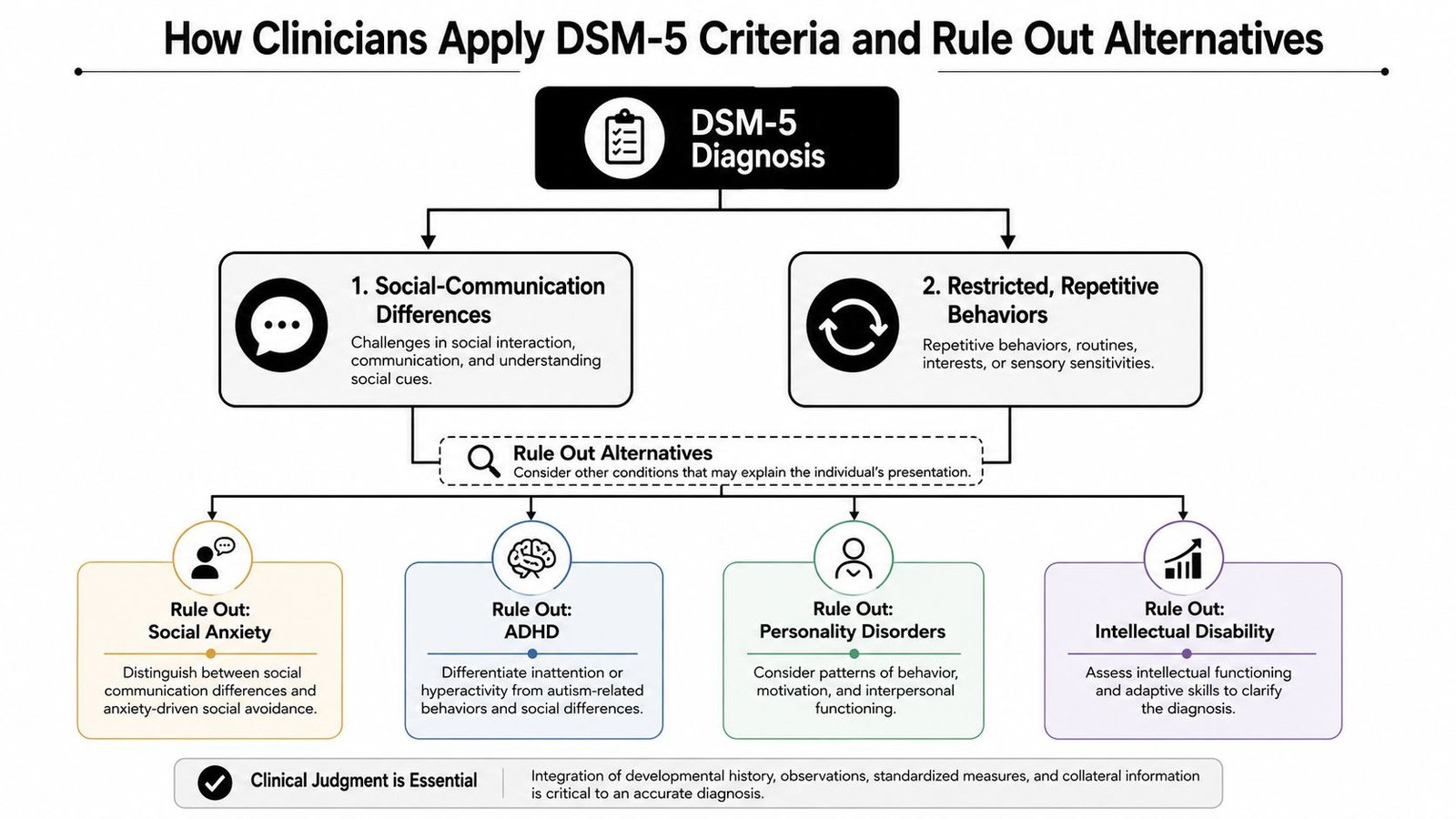
A clinician is not making a diagnosis from one trait, one form, or one stressful week. They are looking for a pattern that has been there across time, with persistent social-communication differences and restricted or repetitive behaviours showing up in development, day-to-day functioning, and the accounts of people who know you well (review literature).
What counts as diagnostic evidence
The process works like matching a long-running pattern to a framework. If social communication has always taken more effort, if routines have felt more regulating than they seem to for other people, and if sensory differences have been present for years, those details carry weight. If the difficulties started only after severe anxiety, burnout, or another major change, the clinician has to look more carefully at timing, context, and cause.
Clinicians also look at how autism traits show up across life, not just in one appointment. Childhood information, relationships, education or work functioning, sensory differences, and strengths all help build the picture. That wider view matters because an autism assessment should produce a profile of how someone functions, not only a label.
Why rule-outs matter
Adults often worry that bringing up anxiety, ADHD, trauma, or low mood will blur the outcome. In practice, those details usually help. Good assessors want to know whether those conditions are present, because they can resemble autism in adulthood and they can also exist alongside it. The task is to separate lifelong neurodevelopmental differences from patterns that came later, while keeping both in view.
Masking is a common point of confusion. It means someone has spent years covering difficulties, rehearsing social scripts, copying other people's behaviour, or pushing hard to appear fine. From the outside, that can make communication look more typical than the internal effort really is.
Clinical reality: anxiety can hide autism, autism can intensify anxiety, and the assessment has to sort out both without assuming one rules out the other.
For a more detailed explanation of how UK clinicians apply the framework, see this overview of ASD diagnosis criteria in the UK. The practical point is straightforward. A good assessment should explain why the evidence fits autism, why another explanation does not fit better, and what strengths and support needs come with that conclusion.
NHS, Right to Choose, and Private Pathways Side by Side
For many adults, the question isn't whether to be assessed. It's which route will get them seen in a way that fits their life, budget, and need for detail. The three main pathways, NHS, Right to Choose, and private, can all lead to a diagnosis, but they do not feel the same from the patient's side.
| Pathway | Typical wait | Typical cost | Report turnaround | Best for |
|---|---|---|---|---|
| NHS | Often long and service-dependent | Usually no direct charge at point of use | Varies by service | People who can wait and prefer NHS continuity |
| Right to Choose | Often shorter than standard NHS access where eligible | Usually NHS-funded if accepted under the route | Varies by provider | Eligible patients wanting an NHS contract route with more choice |
| Private | Usually the fastest route | Paid directly, with transparent package pricing in some clinics | Can be quicker and more predictable | Adults who need speed, flexibility, or a broader mental health picture |
Insight Diagnostics Global says assessments are usually scheduled within seven working days and reports are completed within five working days after that, with transparent package pricing for adult ASD, ADHD, and co-occurring mental health assessments (Insight Diagnostics Global).
How the routes differ in practice
The NHS route tends to suit people who can tolerate uncertainty and want care inside a public service system. Right to Choose is attractive when eligibility applies and you want NHS-funded care with more control over provider choice. Private assessments suit people who need speed, who are balancing autism and ADHD questions together, or who want a service that can also review anxiety, mood, and related concerns in one place.
That last point matters. Some adults don't just need a diagnostic label. They need a clinician to make sense of overlapping symptoms, especially when burnout, attention problems, and anxiety are all in the mix. A consultant-led private pathway can be easier to structure around those needs because the intake, interview, report, and follow-up are coordinated.
For readers comparing routes in more detail, the guide on Right to Choose and autism assessment options is useful because it sits the options alongside one another in plain language.
Choosing the route that fits
If you need a diagnosis mainly for personal clarity and you can wait, NHS may be enough. If you need faster clarity for work, study, or family planning, private often becomes more practical. If you're eligible and want an NHS-funded alternative with more control over where you're seen, Right to Choose can be the middle ground.
A Realistic Timeline From Referral to Report
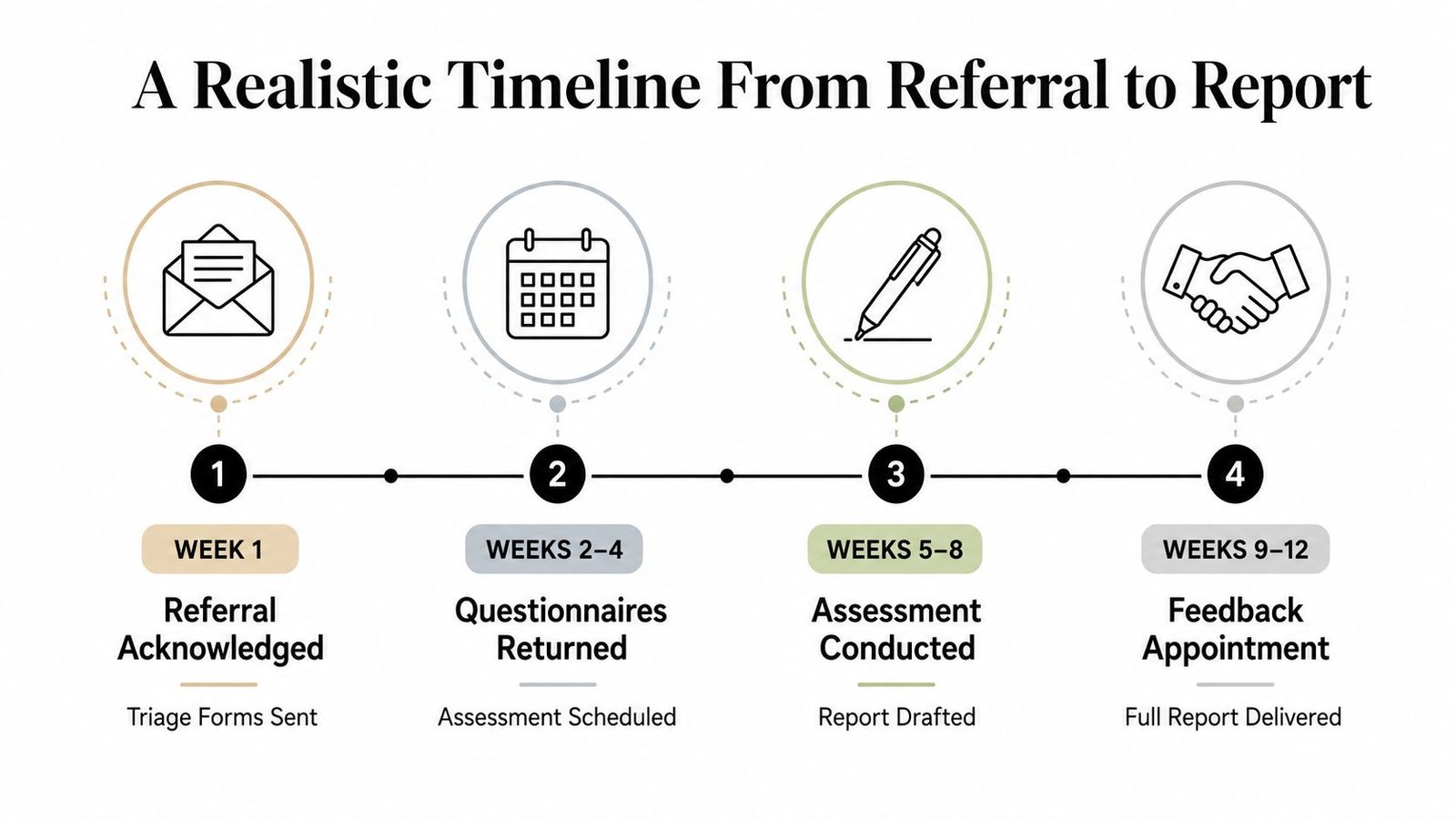
A realistic pathway often starts with the least dramatic part, paperwork. Week one can be the referral, acknowledgement, and a triage form landing in your inbox. If you've already spent months waiting for the first acknowledgement, that small email can feel like movement at last.
What usually happens first
The next couple of weeks are often about questionnaires, informant forms, and GP records. Delays tend to begin here, because one form goes missing, an informant is hard to pin down, or records take longer to arrive than anyone hoped. The assessment itself usually cannot happen properly until the service has enough background material.
Practical rule: return forms quickly, ask your GP to chase records if needed, and tell your informant exactly what the assessor is looking for.
What the day feels like
On the assessment day itself, many adults describe a strange mix of relief and exposure. Relief, because someone is finally taking the question seriously. Exposure, because you may be asked to talk through years of coping strategies, missed cues, and social exhaustion in one sitting.
After the appointment, the clinician or team usually needs time to review the evidence, write the report, and prepare feedback. In a full pathway, that can mean a written summary, a feedback appointment, and recommendations that sit alongside the diagnostic decision rather than afterthoughts.
How private timing changes the experience
Private pathways often compress the same shape into a much shorter span. That doesn't change the clinical logic, but it does change the emotional experience. You spend less time living in uncertainty, and more time moving toward a plan. For many adults, that difference is what makes the private option feel workable even before the first appointment begins.
How to Prepare for the Appointment
Preparation doesn't need to be obsessive. It needs to be relevant. The best documents are the ones that help the clinician see how you were as a child, how you function now, and what patterns have been present long enough to matter clinically.
What to gather
Bring school reports if you still have them, old care notes if they exist, and any previous mental health or GP records that mention longstanding social, attention, or sensory difficulties. If you've already written examples of situations that felt confusing, overwhelming, or socially costly, those are useful too. You don't need to bring every email, screenshot, or journal entry you've ever saved.
If someone is helping you complete background details, a structured prompt can make a big difference. This resource on health history forms for caregivers can help families think through what information is worth collecting rather than guessing in the moment.
How to brief your informant
Tell the person helping you that the clinician will want examples, not opinions. “They were shy” is less useful than “they avoided birthday parties, lined up toys for hours, and struggled with noisy places from an early age.” The same applies to adults who are being assessed now, detail beats labels.
Sensory and practical adjustments
Ask for what helps. That may include written questions, breaks, lower lighting, or a quieter room. If you're likely to get fatigued, say so early. Fatigue affects clarity, and clarity affects the quality of the assessment.
For adults preparing questionnaires, the adult autism questionnaire guide can help you think about the kind of examples clinicians usually need before the appointment.
A well-prepared assessment isn't about performing certainty. It's about making your actual pattern easier to see.
After the Report, What Support and Outcomes Look Like
The report matters because it should do more than name a condition. A good one sets out the evidence, the strengths you showed, the areas where support would help, and the recommendations that follow from those findings. It should also record whether other conditions were identified, because that often changes the next step as much as the diagnosis itself.
What the outcome can look like
If autism is confirmed, the report should explain how the evidence met the criteria and which support needs were identified. If the clinician thinks autism is unlikely, a careful assessment still explains what was considered and why a different explanation fit better. If the picture is mixed, you may be advised to look at ADHD, anxiety, mood symptoms, or other mental health concerns.
That broader approach is one reason adults often want a consultant-led service that can assess autism and ADHD together. The overlap can be real, and the next step is often a careful review of how those traits affect work, study, relationships, and energy management.
What happens next in practical terms
Feedback usually comes first, then the written report, then whatever support fits your situation. That may mean workplace adjustments, university evidence, or a clearer explanation you can finally use with family. The report can also support post-diagnostic services, especially when the same clinic offers ongoing review or related mental health care.
For a fuller picture of what people often do after getting the result, this guide to what happens after autism diagnosis is a useful companion. It covers the part many people worry about after diagnosis, what they are meant to do with the result.
A diagnosis does not remove every difficulty. It does give those difficulties a map, and that is often the first real shift.
If you want an assessment that includes autism alongside ADHD and broader mental health review, Insight Diagnostics Global offers consultant-led adult assessments with structured triage, written reports, and follow-up options. Visit Insight Diagnostics Global to see how their autism, ADHD, and psychological assessment pathway works in practice.