

You open a tab, type “quiz for ADD in adults”, and start answering questions that feel uncomfortably familiar. Do you lose track of tasks? Forget what someone just said? Start ten things and finish two? By the end, the result says you may have ADHD, and your stomach drops a little.
For many adults in the UK, that moment is both a relief and a worry. Relief, because there may be a reason daily life has felt harder than it looks for other people. Worry, because online quizzes can sound more definite than they really are.
A quiz can be useful. It can help you notice patterns, put words to long-standing struggles, and decide whether it's worth seeking help. But it isn't the same as an assessment, and it shouldn't leave you alone with a vague result and no idea what to do next.
Do I Have ADHD Understanding the First Question
A lot of adults ask this question after years of blaming themselves.
Maybe you've always been described as bright but inconsistent. You can focus intently on something urgent or interesting, yet routine tasks seem to scatter in every direction. Bills, emails, laundry, deadlines, returning calls. None of it is impossible, but all of it seems to take more effort than it should.
Other people don't always see the full picture. They may notice missed appointments or a cluttered workspace, but not the mental strain behind trying to stay organised. Some adults also arrive at this question after seeing ADHD discussed online and recognising themselves for the first time.
That's one reason a quiz for ADD in adults has become such a common starting point. It feels private, immediate, and less intimidating than contacting a GP or specialist. You can answer questions in your own time and begin making sense of patterns that may have been present since childhood.
Still, the first question isn't really “Do I have ADHD?” It's often something more personal.
“Are these struggles just my personality, or is there a reason they keep happening?”
That's a fair question. It deserves more than a yes-or-no internet result.
A useful way to begin is by noticing the broader pattern. ADHD in adults usually isn't just about being distracted now and then. It tends to involve repeated difficulties with attention, organisation, impulse control, restlessness, and follow-through across parts of life such as work, study, relationships, and home.
If you're unsure what counts as a sign and what doesn't, this guide to adult ADHD signs can help you compare everyday experiences with common symptom patterns in a practical way.
Why this question can feel emotional
Many adults carry years of self-criticism before they ever consider ADHD.
- At work: You may meet deadlines only by relying on pressure and last-minute effort.
- At home: Simple routines may keep collapsing, even when you care a great deal about keeping life manageable.
- In relationships: Forgetfulness or inconsistency may have been mistaken for lack of effort.
- In your own mind: You may swing between self-doubt and the hope that there's finally an explanation.
That mix of hope and uncertainty is exactly why it helps to understand what a quiz can do, and what it can't.
What Is an Adult ADHD Screening Quiz
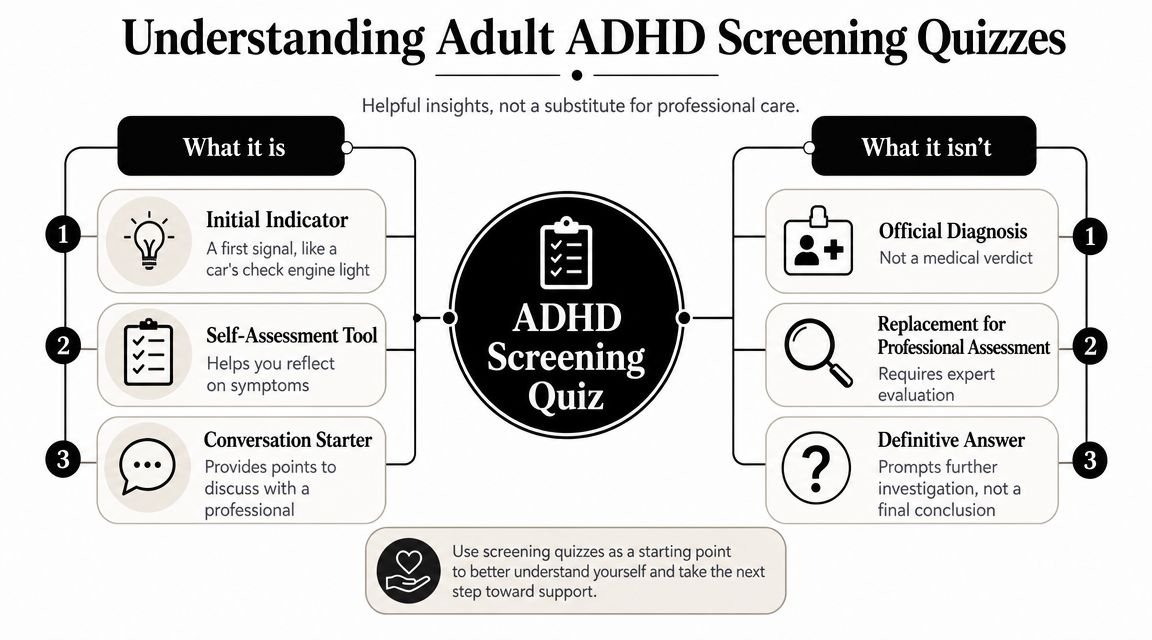
An adult ADHD quiz is best thought of as a screening tool.
It's a bit like a smoke alarm. If it goes off, it tells you something needs checking. It doesn't tell you exactly what caused the smoke, how serious the problem is, or what the full solution should be.
What these quizzes are based on
Many online tools borrow the style of recognised screeners such as the Adult ADHD Self-Report Scale, often called the ASRS. In UK practice, tools like this are used as a first filter, not as a diagnosis. NICE-linked guidance makes clear that a quiz result is meant to show whether further clinical review may be warranted, and these tools help triage adults whose symptoms may have gone unrecognised since childhood, as discussed in this review of adult ADHD assessment in the UK.
That matters because a well-designed screener can still be helpful. It gives structure to what may have felt like a vague problem. It can also make it easier to explain your concerns when you speak to a clinician.
What a screening quiz actually does
Most quizzes ask about patterns such as:
- Attention: Losing focus, drifting during conversations, forgetting details.
- Organisation: Struggling to plan, prioritise, or complete multi-step tasks.
- Restlessness: Feeling internally “on the go” even when sitting still.
- Impulsivity: Speaking too quickly, interrupting, acting before thinking things through.
A positive result doesn't mean, “You have ADHD.” It means, “Your answers are similar to people who may benefit from a proper assessment.”
Practical rule: Treat a quiz result as a prompt for the next conversation, not the final answer.
Why people still find them useful
Used properly, a quiz can help in three ways:
- It turns vague frustration into clearer observations.
- It gives you language to describe what's been happening.
- It helps you decide whether to pursue formal assessment.
That's why taking one isn't silly or self-indulgent. It's often a sensible first step. The key is knowing where that first step ends.
Example ADHD Screening Questions and Scoring
Looking at sample questions can make the process feel less mysterious. Most screeners use short, everyday prompts rather than complicated medical language.

Example self-check questions
Try answering these using: Never, Rarely, Sometimes, Often, Very often.
- How often do you put off tasks that require sustained mental effort?
- How often do you lose track of what you were doing halfway through a task?
- How often do you misplace everyday items like keys, your phone, or documents?
- How often do you find it hard to concentrate when someone is speaking directly to you?
- How often do you feel restless or fidgety when you're expected to stay seated?
- How often do you interrupt, finish other people's sentences, or speak before thinking?
- How often do routine tasks pile up because you don't know where to begin?
- How often do you feel mentally overloaded by basic organisation?
These are illustrative examples only. They are not a validated diagnostic test and shouldn't be used to diagnose yourself.
If you want to compare your experiences with a more structured symptom overview, this adult ADHD symptoms checklist can help you organise what you've noticed before you seek professional advice.
A simple educational scoring guide
For learning purposes only, you might use a rough pattern such as this:
- Mostly Never or Rarely: Your answers don't strongly resemble the kind of pattern that often pushes adults to seek ADHD assessment.
- A mixture of Sometimes and Often: There may be some relevant difficulties, but context matters a lot.
- Often or Very often on several items: Your experiences may be consistent with the kinds of difficulties that make a formal ADHD assessment worth considering.
This kind of scoring is only a teaching tool. Real screening tools have their own scoring methods, and even those are still only one layer of the process.
A useful quiz doesn't ask, “Are you a disorganised person?” It asks how often specific patterns show up in ordinary life.
Where readers often get confused
People often assume frequency alone is enough. It isn't.
A clinician will want to know things a quiz can't properly test, such as:
- When it started: Were there signs earlier in life?
- Where it happens: Is it present across settings, not just at work or during stress?
- How much it affects you: Does it create real impairment, not just occasional inconvenience?
- What else might explain it: Could anxiety, burnout, poor sleep, trauma, or another condition fit better?
That's why a quiz can open the door, but it can't tell you what's behind it.
The Important Limits of Online ADHD Quizzes
The biggest weakness of an online quiz is context. It can count symptoms, but it can't interpret them in a careful clinical way.
That sounds like a small problem, but it's the central one. Two people can tick the same boxes for entirely different reasons. One may have ADHD. Another may be exhausted, anxious, traumatised, sleep deprived, autistic, depressed, or struggling with more than one issue at once.
Why a positive result can be misleading
Brief screeners can overestimate ADHD. In two UK population samples, the WHO ASRS v1.1 identified probable ADHD in 26.0% of participants, compared with an expected prevalence of 2.5%, which shows why a positive result needs careful follow-up rather than self-diagnosis, as reported in this UK study on the ASRS in general population samples.
That doesn't mean the quiz is useless. It means the quiz is broad. Broad tools catch many people who may need a closer look, but they also catch many people whose symptoms come from something else.
Symptom overlap is common
ADHD traits overlap with other difficulties in ways that can confuse anyone trying to interpret an online score.
| Overlapping difficulty | How it can look similar to ADHD |
|---|---|
| Anxiety | Racing thoughts, poor concentration, forgetfulness under stress |
| Depression | Low motivation, slowed thinking, missed tasks |
| Sleep problems | Inattention, irritability, mental fog |
| Burnout | Overwhelm, procrastination, reduced focus |
| Autism | Executive function difficulties, sensory overload, social strain |
| Trauma or PTSD | Distractibility, restlessness, emotional reactivity |
A quiz can't reliably sort those apart.
If you've had a strong result on an online screener, it helps to treat it as a reason to look deeper, not as proof. Some people find it useful to start with a broad free ADHD test overview and then write down examples from work, home, and relationships before seeking formal assessment.
What quizzes usually miss
Online tools rarely ask enough about:
- Childhood history
- Functional impairment across settings
- Developmental background
- Other mental health symptoms
- Autistic traits or learning differences
- Whether current stress is distorting the picture
A positive quiz result means “this deserves attention”. It does not mean “this is settled”.
That distinction protects you from two common mistakes. The first is dismissing yourself too quickly. The second is deciding too quickly that ADHD must be the whole answer.
Your Next Steps After Taking a Quiz
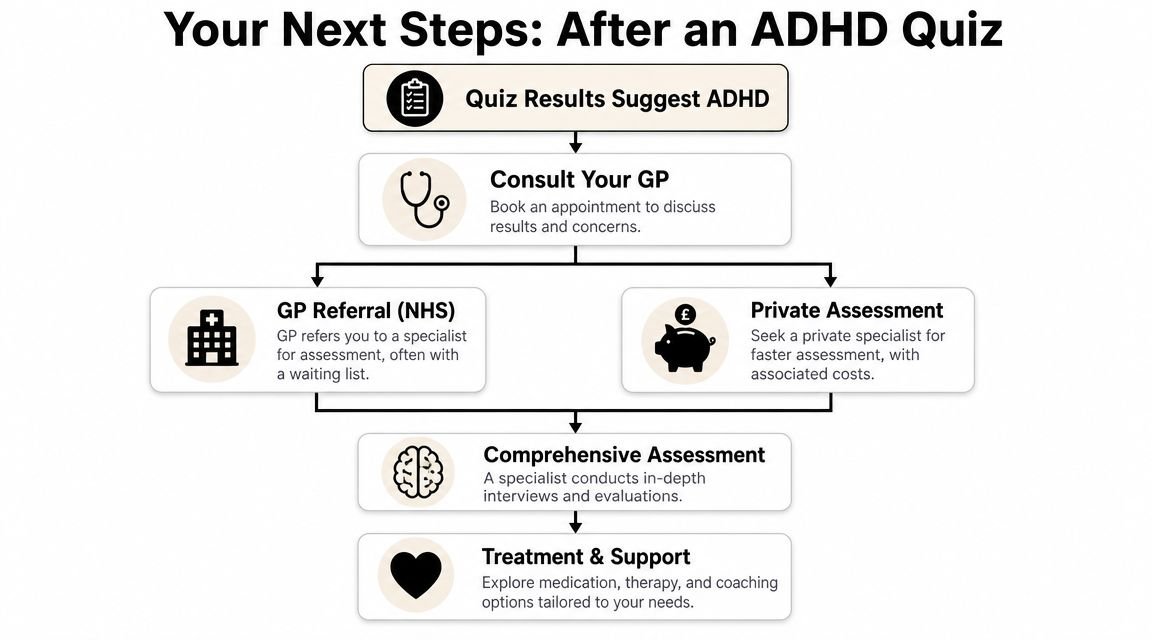
Once a quiz suggests ADHD may be worth investigating, the most useful question is simple. What do I do now in the UK?
The answer depends on how quickly you want to move, how you prefer to access care, and whether your symptoms overlap with autism or other mental health concerns. An ASRS-style screener can be a starting point, but it can't confirm diagnosis. The practical next step is choosing between a GP referral, the Right to Choose pathway, or a private assessment, as outlined in this guidance on adult ADHD access pathways.
Option one through your GP
For many adults, the first formal step is booking a GP appointment.
Bring notes rather than relying on memory. A short list helps: examples of attention problems, organisation issues, impulsivity, how long they've been present, and where they affect you most. If you've taken a quiz for ADD in adults, you can mention the result, but focus more on real-life impact than the score itself.
Your GP may discuss referral options and whether another issue also needs assessment. If anxiety, depression, sleep problems, or autistic traits are part of the picture, say so clearly.
Option two through Right to Choose
Some adults use Right to Choose if they want an NHS-funded route with more flexibility than standard local waiting pathways.
This can be especially relevant if you've been stuck for months trying to decide what to do next. The paperwork and provider choice can feel confusing, so it helps to prepare your notes in a simple timeline.
A surprisingly practical step is improving your day-to-day structure while you wait. If routines regularly collapse, tools for selecting a routine automation solution can help reduce friction around recurring tasks such as medication reminders, admin, and household jobs. That won't answer the diagnostic question, but it can make waiting periods easier to manage.
Option three through a private route
A private assessment may suit you if speed, appointment flexibility, or clinician choice matters most.
This route can also be useful when the picture isn't straightforward. For example, some adults aren't just asking about ADHD. They're also wondering about autism, burnout, trauma, mood problems, or longstanding emotional difficulties. In those situations, a broad psychiatric assessment can be more informative than chasing one label at a time.
Later in the process, some people also find it helpful to hear a clinician talk through ADHD in clear language. This short video may help you think about the next conversation you want to have:
What to prepare before any appointment
You don't need a perfect life history. A few organised notes are enough.
- Write examples: Pick a few situations from work, study, home, and relationships.
- Think developmentally: Were there signs earlier in life, even if no one recognised them then?
- Note overlap: Anxiety, poor sleep, low mood, trauma, or autistic traits can all matter.
- Ask someone you trust: A relative, partner, or old school report may add helpful context.
That preparation often makes the assessment process feel less intimidating and much more grounded.
Why a Clinical Assessment Is Different
A proper ADHD assessment is not just a longer quiz. It's a different kind of process.
NICE recommends a full diagnostic assessment based on a detailed clinical and psychosocial history, not just rating scales. A structured interview is important for diagnostic accuracy and for differentiating ADHD from overlapping conditions such as anxiety, sleep disorders, or autistic traits, because rating scales alone are insufficient, according to this summary of the diagnostic standard for adult ADHD assessment in NICE-aligned guidance.
What clinicians are actually looking for
A specialist assessment usually explores:
- History over time: not just what's happening this month
- Symptoms across settings: work, home, relationships, study
- Level of impairment: where life is getting disrupted
- Developmental clues: often with collateral background if available
- Alternative explanations: whether another condition fits better, or also needs attention
That process is especially important in adults who are high-achieving, burnt out, late-identified, or already receiving help for another mental health issue. Those cases often look simple on a quiz and much more nuanced in real life.
Clinical reality: The goal isn't to “pass” an ADHD test. The goal is to understand what best explains your difficulties.
Online quiz vs clinical assessment
| Feature | Online ADHD Quiz | Insight Diagnostics Clinical Assessment |
|---|---|---|
| Purpose | Flags possible symptoms | Evaluates whether ADHD is the right diagnosis |
| Depth | Brief self-report | Structured psychiatric assessment |
| Context | Limited | Includes psychosocial and developmental history |
| Overlap with other conditions | Poorly handled | Actively explored |
| Accuracy | Screening only | Built around diagnostic decision-making |
| Outcome | Suggestive result | Diagnostic clarity and recommendations |
| Personalisation | Generic | Tailored to your symptoms and functioning |
If you want a clearer picture of what that broader process involves, this explanation of what a psychiatric assessment includes is a helpful place to start.
A clinical assessment offers insight that goes beyond whether ADHD is present. It can also identify when autism, anxiety, depression, sleep disruption, trauma, or personality-related patterns are contributing to the same struggles. That's what makes the outcome more useful in everyday life. You don't just leave with a label. You leave with a clearer map.
If you're ready to move beyond online self-screening, Insight Diagnostics Global offers consultant-led assessments for adults, including ADHD, autism, and broader mental health concerns. Their service is designed to provide structured evaluations, clear reports, and practical treatment recommendations, with online and face-to-face options for adults across the UK.