

You’ve probably landed here after doing what many adults do for months, sometimes years. You’ve read symptom lists late at night, recognised parts of yourself in ADHD or autism descriptions, wondered whether low mood is depression or burnout, and then hit the same wall every time: long waits, unclear pathways, and too much conflicting advice.
That uncertainty can be exhausting. It’s even harder when work is slipping, relationships are strained, or you’ve spent years compensating without understanding why things feel harder for you than they seem to for other people. A good online psychiatric assessment should reduce confusion, not add to it. It should be careful, regulated, and clinically grounded.
For adults in the UK, especially those seeking help with ADHD, autism, broader mental health concerns, and psychological assessment, online psychiatry is now a serious route to diagnosis and treatment. The quality varies. The best services are consultant-led, follow structured methods, and are clear about what they can and can’t do. In neurodevelopmental and personality disorder work, that level of expertise matters. Leading clinicians in this area include Dr Sai Achuthan, whose work reflects the kind of specialist standard patients should look for when choosing an online service.
The Growing Need for Accessible Mental Health Support
Many people start looking for a private psychiatrist online after a familiar experience. They’ve spoken to a GP, been told a referral is possible, and then realised the main challenge is the wait. Others are already on a waiting list but feel they can’t keep functioning in limbo.

That frustration isn’t imagined. During 2024, mental health services in England received a record 5.2 million referrals, representing a 37.9% increase compared to 2019, according to the BMA’s analysis of mental health pressures data. When referral volumes rise at that pace, access becomes the problem even when services are working hard.
Why more adults are looking beyond the standard route
Some people need an answer about attention, focus, impulsivity, sensory overload, or social exhaustion. Others need clarity about anxiety, depression, mood instability, trauma, or longstanding personality difficulties. In practice, these don’t arrive in neat boxes. ADHD may sit alongside anxiety. Autism may be masked by years of adaptation. Burnout may look like depression until someone takes a proper history.
That’s why a private psychiatrist online can be useful when the service is high-quality. It offers a route to specialist assessment without requiring travel, and it can shorten the gap between “I think something is wrong” and “now I understand what’s going on.”
A fast appointment only helps if the assessment itself is careful enough to stand up clinically.
Some patients also benefit from doing early reading before they book. If anxiety is a major part of the picture, Anxiety University is a sensible educational resource because it helps people put language around symptoms before a formal assessment.
What people often need most at the start
Most adults aren’t looking for a label for its own sake. They want one or more of these:
- Clarity: Is this ADHD, autism, depression, anxiety, burnout, a personality pattern, or a mix?
- A treatment plan: Medication, therapy, coaching, workplace adjustments, or further psychological assessment.
- A credible report: Something detailed enough to support discussions with a GP, employer, university, or insurer.
- A calmer process: A setting where they can explain themselves properly instead of squeezing years of difficulty into a brief appointment.
The right online assessment can do that. The wrong one tends to feel rushed, generic, or overly certain too early.
What Is Online Psychiatry and Who Can It Help
Online psychiatry is psychiatric care delivered through a secure video platform by a GMC-registered Consultant Psychiatrist or another appropriately regulated clinician working within a proper service. In practical terms, it means your appointment happens by video rather than in a clinic room, but the core clinical task is the same: history taking, symptom analysis, risk assessment, diagnosis where appropriate, and planning treatment or follow-up.
Who tends to benefit most
A private psychiatrist online is often a good fit for adults who’ve had longstanding questions that were never fully explored. Common examples include the professional who has always struggled with organisation and deadlines, the university student who can’t sustain focus despite trying hard, or the adult who has spent years masking autistic traits and is now burning out.
It can also help people who need differentiation rather than a quick label. A thoughtful psychiatrist won’t assume that low motivation means depression, or that emotional dysregulation automatically means ADHD. Good telepsychiatry is about pattern recognition plus careful questioning.
The demand for neurodevelopmental assessment helps explain why so many adults are exploring this route. NHS England estimates suggest around 1% of the adult population in England may be autistic, and autism referral rates per 100,000 males increased from 162 in January 2022 to 414 in December 2025, a 155% increase, according to the independent review terms of reference published by the UK government.
Situations where online psychiatry is especially useful
- Suspected ADHD or autism in adulthood: Especially if childhood signs were missed or masked.
- Complex mental health symptoms: Anxiety, depression, mood changes, trauma-related symptoms, or possible personality difficulties.
- Need for a second opinion: When previous input has felt incomplete or contradictory.
- Work or study impairment: If concentration, stress tolerance, routines, or social functioning are affecting performance.
Burnout is not always a depressive disorder
One of the most common areas of confusion online is burnout. Chronic work stress can cause exhaustion, dread, sleep disruption, poor concentration, and emotional numbness. Those symptoms can overlap with depression, but they are not automatically the same thing. A proper psychiatric assessment looks at context, duration, pervasiveness, biological symptoms, loss of pleasure, and whether the difficulties are confined mainly to work-related strain or extend across life more broadly.
That distinction matters because the intervention may be different. Some people need medication and formal mental health treatment. Others need occupational changes, psychological support, rest, and a realistic plan for recovery. Families trying to support someone with low mood may also find practical behaviour-focused resources helpful. For example, help a depressed daughter build habits offers useful non-clinical ideas about routine and support.
If you’re seeking an online assessment, go in with a question, not a self-diagnosis. “Please help me understand what this is” is usually the strongest starting point.
Who shouldn’t use it as a first step
Online psychiatry is not a crisis service. If someone is at immediate risk, acutely suicidal, severely psychotic, or unsafe because of intoxication or sudden deterioration, they need urgent in-person help through 999 or NHS 111.
It’s also not ideal when the main need is emergency containment rather than assessment. Telepsychiatry can do a great deal. It can’t replace emergency services.
The Private Assessment Pathway for ADHD and Autism
The best private pathway is organised, paced, and transparent. It shouldn’t feel like a single video call that produces a label out of nowhere. For adult ADHD and autism, a good assessment usually unfolds in stages, each with a clinical purpose.
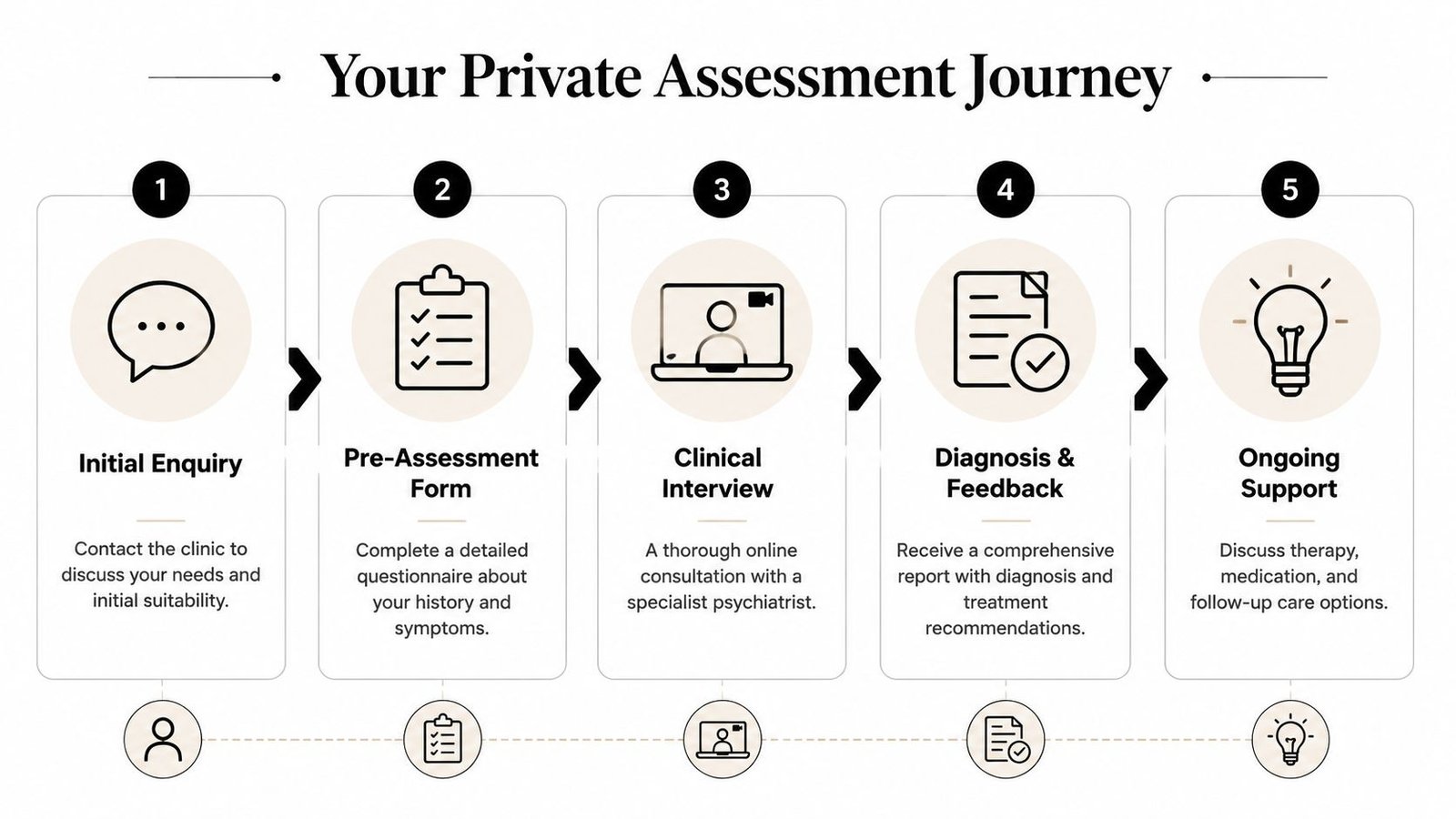
Stage one involves triage, not diagnosis
The first contact is usually administrative and clinical. You describe why you’re seeking help, what diagnosis you suspect if any, and whether there are complicating factors such as trauma, substance use, major mood symptoms, or previous psychiatric treatment.
At this point, a high-quality clinic is deciding whether the referral is suitable for online assessment and which specialist is the right fit, a critical step since ADHD, autism, mental health conditions, and personality disorder presentations can overlap, and matching the patient to the right clinician improves accuracy.
Stage two is paperwork that actually matters
Pre-assessment forms aren’t filler. They do part of the clinical work before the appointment starts. In a careful service, you may be asked about developmental history, physical health, current medication, family history, functioning at work or university, and rating scales relevant to the question being assessed.
For ADHD and autism specifically, live online psychiatric assessments in the UK adhere to NICE guidelines, requiring a structured clinical interview using validated gold-standard tools such as DIVA-5 to meet NHS diagnostic standards, as described by Private ADHD’s overview of online assessment standards.
That’s the key point many patients miss. Speed does not have to mean informality. The tool matters, but so does the clinician using it properly.
Stage three is the clinical interview
This is the part people usually imagine, but it’s only one part of the whole process. A consultant psychiatrist explores childhood and adult symptoms, functioning across settings, relationships, education, work, routines, sleep, emotional regulation, and any co-occurring mental health problems.
For ADHD, the psychiatrist is looking beyond distractibility. They’re assessing persistence of traits, impairment, developmental onset, and whether another condition explains the symptoms better.
For autism, they’re listening for patterns in communication, sensory experience, flexibility, social understanding, masking, burnout, and developmental history. In adults, especially bright or high-masking adults, this requires nuance.
Practical rule: If a service promises a diagnosis with minimal history and no structured interview, that’s a warning sign.
Stage four is feedback and the report
A serious report should explain not just the conclusion but the reasoning. That includes relevant history, symptom patterns, assessment findings, differential diagnosis, and recommendations.
A useful report often covers:
- Diagnostic outcome: Whether criteria were met, not met, or remain uncertain.
- Clinical formulation: How the psychiatrist understands the full picture, including overlap with anxiety, depression, trauma, or personality factors.
- Functional impact: Work, study, relationships, daily organisation, and wellbeing.
- Recommendations: Medication review, therapy, coaching, occupational adjustments, educational support, or further psychological assessment.
If the answer is “you don’t meet criteria,” that can still be valuable. Many patients leave a good assessment with a clearer explanation of burnout, anxiety, trauma, or another issue that had been obscuring the picture.
Stage five is what happens next
For ADHD, follow-up may include medication discussion and titration if clinically appropriate. For autism, the emphasis is usually on psychoeducation, workplace or university adjustments, and support planning rather than medication for autism itself. For broader mental health concerns, the next step may be psychotherapy, medication, further review, or liaison with your GP.
What works well is continuity. The psychiatrist who knows your history can guide next steps with less duplication. What works poorly is a one-off transactional assessment with no route for questions afterward.
Comparing Your Options Private vs NHS vs Right to Choose
Patients usually have three broad pathways in the UK. None is perfect. The sensible choice depends on urgency, cost tolerance, complexity, and whether you’re prepared to wait.
One figure captures the difference in access clearly. Benchmark data shows that NHS Right to Choose pathways for adult ADHD assessments face waits up to 32–40 weeks, while private online services offer initial assessments within 2–3 weeks, reducing time-to-treatment by approximately 90%, according to Psychiatry UK’s Right to Choose comparison information.
UK Psychiatry Pathways Compared Private vs. NHS vs. Right to Choose
| Factor | Private / Self-Funded | NHS Pathway | NHS Right to Choose (RTC) |
|---|---|---|---|
| Speed | Usually the fastest route, often suitable when work, study, or mental health deterioration makes delay hard to manage | Often the slowest, with local variation and more steps before specialist assessment | Faster than many local NHS routes, but still involves waiting |
| Cost | Paid by the patient or sometimes via insurance authorisation | NHS-funded | NHS-funded if eligibility and referral criteria are met |
| Choice of clinician | More direct choice, especially in consultant-led services | Usually limited by local service structure | Some choice of provider within the RTC framework |
| Best for | Urgent clarification, people who want speed and flexibility, or those seeking a second opinion | People who prefer fully NHS-managed care and can tolerate waiting | People who want NHS funding but are willing to navigate forms and waits |
| Main trade-off | Financial cost and the need to choose carefully | Delay and local access constraints | Not instant, and the pathway can still feel bureaucratic |
The private route works best when time matters
If your job is under threat, university deadlines are piling up, or your mental health is worsening while you wait, private assessment can be a rational decision. The point isn’t luxury. It’s access.
That said, private isn’t automatically better. It’s better only when the service is clinically rigorous, transparent about fees, and realistic about complex cases. Some adults with overlapping autism, ADHD, trauma, substance misuse, or significant personality difficulties may need a broader or longer process.
The NHS route suits some patients well
The NHS remains the right fit for many people, especially if cost is the deciding factor and the urgency is lower. It can also be preferable when there’s a strong need for ongoing multidisciplinary input through NHS systems.
The frustration is the unpredictability. Patients are often willing to wait if they understand the timeline. What wears them down is open-ended delay and repeated retelling of their history.
Right to Choose sits between the two
RTC can be a useful middle ground. It allows some patients in England to access an NHS-funded assessment with an independent provider. The common misunderstanding is that RTC means “fast private assessment paid by the NHS.” It doesn’t. It can still involve substantial waiting, referral admin, and provider-specific processes.
A balanced way to think about the options is this:
- Choose private if delay itself is causing harm and you can fund it.
- Choose NHS if affordability is paramount and the wait is manageable.
- Choose RTC if you want NHS funding with more flexibility than the standard local pathway.
The best pathway is the one that gets you to a credible assessment in a timeframe your life can tolerate.
Finding a Credible Online Psychiatrist in the UK
The biggest mistake patients make is judging a service by how polished the website looks. Design matters much less than regulation, clinician credentials, and the way the assessment is done.
Start with regulation and specialist status
A credible online psychiatric service in the UK should be CQC regulated if it is providing regulated activities, and the psychiatrist you see should be on the GMC Specialist Register. Those aren’t branding extras. They are practical safeguards.
CQC regulation means the service is accountable for standards of care, governance, safety, and complaints processes. GMC specialist registration means the doctor has recognised specialist training and is held to professional standards expected of consultant-level practice.
This matters even more now because the independent sector is no longer peripheral. Current NHS data shows that at least 50% of all NHS ADHD assessments and over 33% of all autism assessments in England are conducted by the independent sector, as noted by the Independent Healthcare Providers Network. Independent provision is part of mainstream service delivery. Patients still need to separate high-quality providers from weak ones.
What to check before you book
Don’t just ask “Can they diagnose ADHD or autism?” Ask how they do it.
Look for these signs:
- Consultant-led assessments: You should know who is assessing you and what their expertise is.
- Clear scope: Adult ADHD, autism, mental health, psychological assessment, and personality disorder work should be described precisely.
- Structured method: The service should mention clinical interviews, questionnaires, developmental history, and report writing.
- Transparent pricing: Fees, follow-up costs, and medication titration costs should be easy to find.
- Defined timelines: You should know when the appointment is likely to happen and when to expect the report.
Green flags and red flags
A few practical distinctions help.
| Green flag | Why it matters |
|---|---|
| Specific clinician credentials | You can verify training and specialist status |
| Detailed assessment process | Suggests the clinic values rigour, not volume |
| Discussion of complexity | Reassures you they understand overlap and differential diagnosis |
| Realistic wording | Honest services don’t promise certainty before assessment |
| Red flag | Why it matters |
|---|---|
| Instant diagnosis language | Psychiatry doesn’t work like a quick retail purchase |
| No mention of regulation | Harder to judge accountability |
| Very thin report description | Raises concerns about whether the outcome will be useful |
| No follow-up pathway | Leaves patients stranded after diagnosis |
Expertise matters in complex adult cases
Not all adult ADHD and autism presentations are straightforward. Some are shaped by trauma, chronic anxiety, recurrent depression, personality patterns, or years of masking. In those cases, experience makes a difference. Patients should actively look for consultant psychiatrists with extensive experience in neurodevelopmental and personality disorder assessment, including leading clinicians such as Dr Sai Achuthan.
The more complex your history, the less useful a formulaic assessment becomes.
A strong clinician doesn’t rush to confirm the diagnosis you arrived expecting. They test it carefully.
Preparing for Your First Online Consultation
It’s common to feel at least a bit tense before the first appointment. That’s normal. You may be about to discuss childhood memories, school experiences, work failures, relationships, and things you’ve kept private for years.
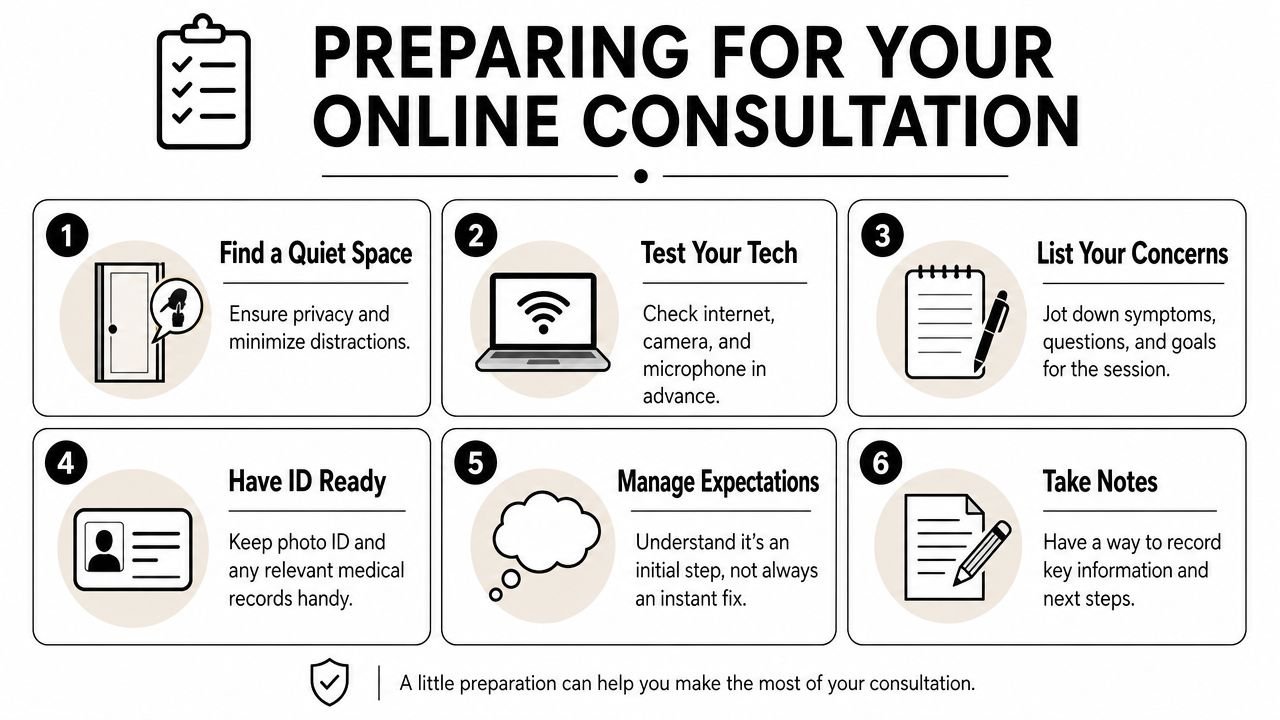
A little preparation makes the session smoother and usually makes patients feel more settled. The aim isn’t to perform well. It’s to give the psychiatrist the best view of your real difficulties.
What to gather before the appointment
The most useful documents are often the least glamorous. Old school reports, previous mental health letters, medication histories, workplace assessments, or university support documents can all add context. If a parent, sibling, or partner knows your long-term patterns well, their observations can sometimes help too.
A simple prep list works well:
- Relevant records: School reports, GP letters, prior diagnoses, therapy summaries.
- Current medication list: Include mental and physical health medication.
- Examples of impairment: Missed deadlines, repeated job strain, sensory overload, relationship patterns, driving issues, financial disorganisation.
- Questions you want answered: Write them down so you don’t lose them in the moment.
Make the setting work for you
Choose a private room where you won’t be overheard. Use headphones if that helps you speak more freely. Check the camera, microphone, and internet connection in advance.
This short video gives a useful sense of how to approach a virtual appointment calmly and practically:
Don’t rehearse a diagnosis
The strongest preparation is not memorising diagnostic criteria. It’s thinking about lived examples. When do things go wrong? What do other people notice? What have you always found disproportionately difficult? What have you had to hide or compensate for?
Some prompts that help are:
- At work or university: Where do you get stuck?
- In daily life: What tasks look simple for others but repeatedly derail you?
- Socially: What feels effortful, confusing, or draining?
- Emotionally: What happens when you’re overloaded, criticised, or under pressure?
Bring examples, not polished conclusions. A psychiatrist can do more with “I miss deadlines even when I care” than with “I definitely have executive dysfunction.”
Also expect that one appointment may start the process rather than finish it. That isn’t a sign something has gone wrong. It usually means the clinician is being thorough.
Frequently Asked Questions About Online Psychiatry
What if I don’t receive a diagnosis
That can still be a useful outcome. A careful assessment may show that ADHD or autism criteria aren’t met, but that anxiety, depression, trauma, burnout, or personality patterns are more relevant. Good psychiatry reduces uncertainty even when it doesn’t confirm the diagnosis you expected.
Is an online diagnosis taken seriously
Usually, yes, if the assessment was completed by a properly qualified clinician within a regulated service and documented in a robust report. Acceptance can still depend on the organisation reviewing it and the purpose involved, but detailed consultant-led reports tend to carry far more weight than brief, generic summaries.
Can a psychiatrist really tell the difference between burnout and depression online
Often, yes, if the interview is detailed enough. The psychiatrist looks at timing, context, biological symptoms, pervasive low mood, enjoyment, sleep, guilt, self-worth, and whether the pattern is tied mainly to work stress or extends across settings. That distinction is one reason a proper psychiatric interview matters more than a checklist.
Can I get ADHD medication through an online service
Sometimes, yes, if ADHD is diagnosed and medication is clinically appropriate. That usually involves physical health screening, a prescribing discussion, titration, and monitoring. Not everyone is suitable for medication, and not every service offers ongoing prescribing, so it’s worth checking before you book.
Is online psychiatry suitable for autism assessment in adults
Yes, it can be, when the service uses structured interviews, developmental history, and clinicians experienced in adult autism presentation. Online format by itself doesn’t reduce quality. Weak assessment design does.
What if I have both neurodevelopmental and mental health concerns
That’s common. Many adults seek assessment because their difficulties don’t fit one simple category. A good service should be able to hold both possibilities in mind. ADHD, autism, anxiety, depression, trauma, and personality factors can overlap. The task is to understand the whole pattern, not force everything into a single label.
When should I avoid booking a private psychiatrist online
Don’t use it as your first step in an emergency. If you’re in immediate danger, feel unable to stay safe, or you’re experiencing a severe crisis, contact 999 or NHS 111 for urgent support.
If you’re looking for a consultant-led, regulated service for adult ADHD, autism, mental health, and psychological assessment, Insight Diagnostics Global offers online and face-to-face care for adults aged 18 and over. The service is CQC regulated, uses psychiatrists on the GMC Specialist Register, provides clear assessment pathways, and offers follow-up support including ADHD medication titration and ongoing monitoring.