

You’ve probably already done the thing many adults do in private. You started searching late at night, read a few lists of traits, took an adult autism questionnaire, and then sat with the same uneasy thought, “Does this explain my whole life, or am I overthinking it?” That mix of relief, doubt, and hope is common, and it’s exactly why these tests can feel so compelling.
Some people land here after years of feeling different but never finding a name for it. Others have ADHD, anxiety, depression, or burnout in the mix, and the overlap makes everything harder to sort out. If you want a calm, practical way to understand what an online questionnaire can and can’t tell you, it helps to start with the bigger picture, not just the score. A useful companion resource is Watch GP Triage’s AI platform, which sits in the wider conversation about how people are first guided through healthcare decisions, and this guide on recognising autism in adults gives a clear starting point if you’re comparing traits against lived experience.
The Search for Answers Understanding Adult Autism
A common story goes like this. An adult has always found small talk exhausting, needs a lot of recovery time after social events, or has spent years copying other people’s social behaviour just to get through the day. Then one evening they search for an adult autism questionnaire, hoping the answer will finally click into place.
That search makes sense. A questionnaire can feel safer than asking for help because it’s private, quick, and it seems to offer a number that might explain years of confusion. It can also feel validating when the questions match your daily life in a way few people ever have.
But the value of that search is usually not the score itself. It’s the moment it helps you notice a pattern, not a verdict. An online test can open the door to self-understanding, yet it can’t see your childhood, your coping strategies, your mental health history, or the way you may have learned to hide traits over time.
Practical rule: treat the questionnaire as a prompt for reflection, not a final answer about who you are.
That’s why so many adults feel both seen and stuck after taking one. If you’re in that place now, you’re not doing anything wrong. You’re just at the point where a self-test has raised a serious question, and the next sensible step is a professional conversation rather than a conclusion drawn from a few clicks.
What Are Adult Autism Questionnaires Really For
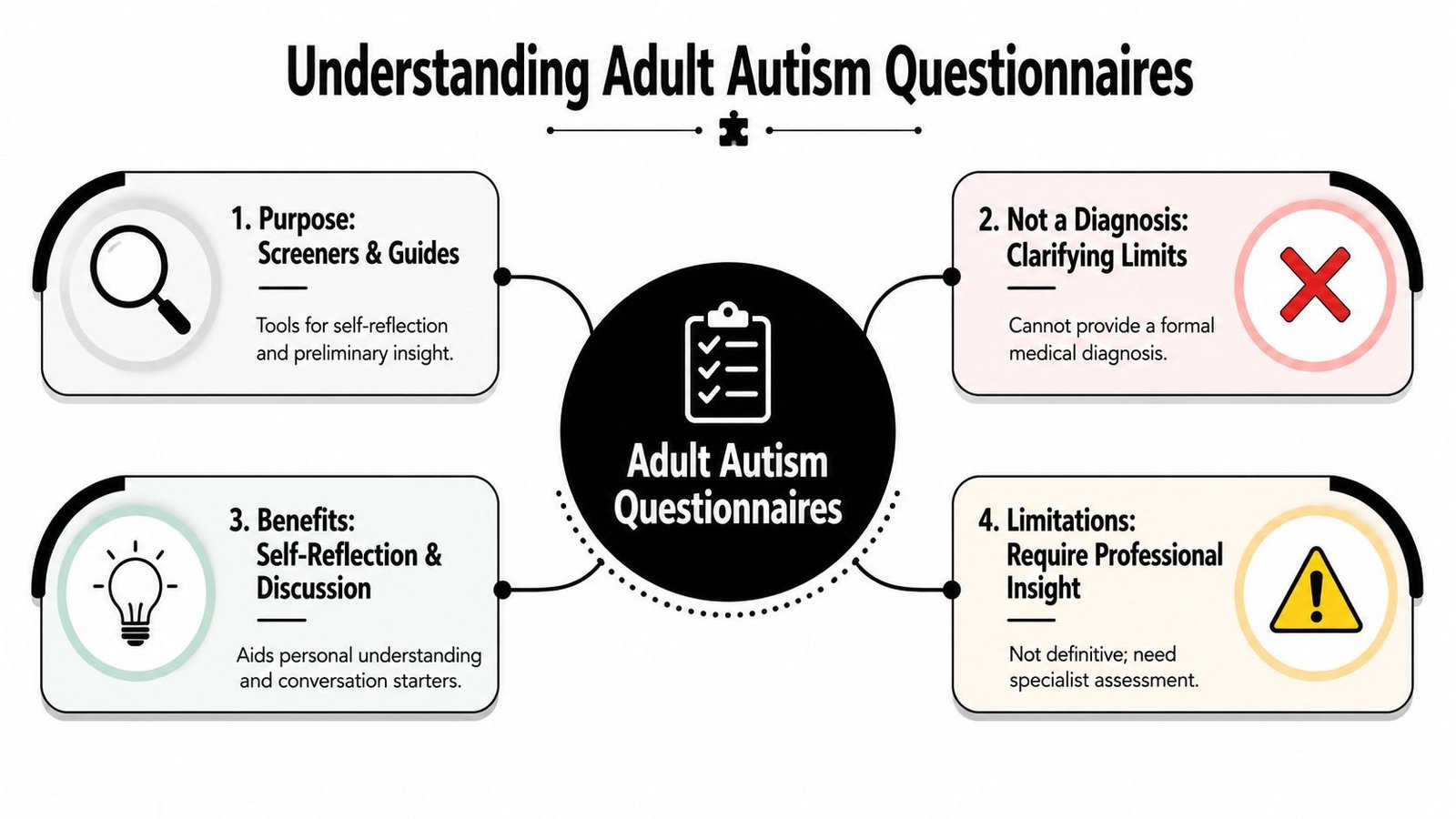
An adult autism questionnaire is best understood as a screening tool, not a diagnosis. It helps show whether autistic traits may be present often enough, strongly enough, or consistently enough to justify a fuller clinician assessment.
A home blood pressure cuff is a useful comparison. It can point to a possible concern, but it cannot replace a cardiologist’s examination, medical history, and judgement. The same applies here. A questionnaire can flag a pattern, but it cannot establish autism on its own.
The Autism-Spectrum Quotient (AQ) is a good example. It was published in 2001 by Simon Baron-Cohen and colleagues at the Autism Research Centre in Cambridge, UK, and the adult version contains 50 questions aimed at autistic traits in adults of average intelligence, defined in the questionnaire materials as IQ 80+ (Autism-Spectrum Quotient overview). In UK practice, the AQ is one of the tools specialist teams may consider, alongside other measures, but it still sits inside a broader assessment pathway.
How clinicians use a questionnaire result
In real practice, the questionnaire helps answer a narrow question, not the whole one. Does this person need a fuller autism assessment? That is the useful function.
The AQ-10 is especially relevant in UK adult pathways because NICE guidance uses it as an early screen to decide whether someone should be considered for full assessment. The broader AQ covers areas such as social skill, attention switching, attention to detail, communication, and imagination, which makes it useful for reflection, but not for diagnosis by itself. If you want a plain-language walkthrough of that kind of self-check, our do I have autism quiz guide explains how online screening tools fit into the wider process. The same principle applies to other questionnaires used in screening and self-review, including the tools outlined in UK autism assessment tools.
A questionnaire can tell you that your concerns deserve attention. It cannot tell you why those concerns exist, or whether autism is the best explanation.
A Closer Look at Common Autism Questionnaires
People often hear a few names repeated, then assume they all do the same job. They don’t. Some tools are brief triage screens, some are broader self-report measures, and some are meant to capture masking that a standard questionnaire can miss.
The AQ-10 is a short screen. In UK adult services, it’s used early because it’s quick and practical. The key point is that it helps decide whether a referral should be considered, not whether autism is confirmed.
The AQ-50 is the fuller version of the same family of tools. It still functions as a self-report measure, but it gives a more detailed snapshot of autistic traits across several areas. That’s useful for reflection and for starting a conversation with a clinician, especially when someone wants to explain patterns that have shown up for years. This AQ-50 overview is a useful companion if you’re trying to understand what the longer version is measuring.
The RAADS-R is different again. It’s an 80-item adult questionnaire designed to assist diagnosis, but it can still struggle in adult mental health populations because anxiety, depression, and other conditions can blur the picture (adult questionnaire performance in mental health settings). That matters because many adults looking for answers are already dealing with overlapping concerns.
Why masking changes the picture
Some adults, especially women and people with long histories of coping by imitation, may score lower than their lived experience suggests. That’s one reason standard screens can miss people who camouflage traits well. A camouflaging measure such as the CAT-Q can add context because it focuses on masking rather than core autistic traits alone.
A questionnaire can reveal patterns, but it can’t see the effort someone puts into looking “fine”.
For UK adults, that distinction matters. A person may read the questions, think, “That’s me, but only on bad days,” and still come away with a score that doesn’t reflect their daily strain. That’s where the questionnaire becomes a starting point for discussion, not a gatekeeper to truth.
Why a Questionnaire Score Is Not a Diagnosis
A score can help you start the conversation, and still leave the main question unanswered. That is the part many people miss when they search for an adult autism questionnaire hoping for a simple yes-or-no result.
The strongest UK evidence shows why caution is needed. In a national specialist diagnostic clinic study of adults referred for suspected ASD, the AQ10 had high sensitivity of 0.77 but low specificity of 0.29, and nearly two-thirds of people below the cutoff of 6 were later found to be false negatives (study on AQ10 limits in adult referral practice). In plain English, the questionnaire caught many possible cases, but it also missed a lot of adults who were later diagnosed, and it produced many false positives too. That is why a score can be a prompt for action, while still falling short of diagnosis.
The same caution shows up in broader research. A systematic review found that structured questionnaires perform better in people who already have a confirmed diagnosis, but their ability to separate autism from mental health conditions drops in referral settings (systematic review of adult autism diagnostic measures). Another evaluation of structured adult Asperger questionnaires found good sensitivity but poor specificity, so false positives can happen when other psychiatric symptoms look similar (structured questionnaire evaluation). That means the numbers can shift in the wrong direction for adults who are already dealing with anxiety, depression, ADHD, or other overlapping concerns.
False positives and false negatives
False positives often happen when anxiety, depression, or social fear makes a person look more autistic on paper than they really are. False negatives happen when someone has learnt to mask, compensate, rehearse, or suppress visible traits so effectively that the questionnaire misses the underlying picture.
That is why a low score does not automatically invalidate your experience. If your daily life still feels hard in ways that fit autism, the questionnaire may be under-reading you. For many adults, especially those who have spent years camouflaging, the issue is not whether the traits exist, but whether a short form can see past the coping strategies.
A score also cannot check the details that diagnostic assessment relies on, such as whether the pattern has been present since childhood and whether it affects relationships, work, study, or recovery after social effort. Those are the kinds of questions that a clinician weighs against the person’s full history, not just their answers on a screen. The difference between screening and diagnosis is similar to the difference between a smoke alarm and a fire investigation, one can alert you, the other has to establish what is really happening.
Clinical truth: the closer a questionnaire gets to real-world adult complexity, the more it needs human interpretation.
If you are trying to reconcile a score with your lived experience, the question is not “Did I pass?” It is “Does this tool capture my actual pattern well enough to guide the next step?” Very often, the answer is only partly. For that reason, the next step is usually a proper assessment against UK ASD diagnosis criteria, where the full picture matters more than a single result.
Interpreting Your Results and Planning Your Next Step
A questionnaire result only becomes useful when you use it to organise your thoughts. If the score is high, that’s a reason to speak with a GP or a specialist service. If the score is low but you still have strong concerns, the next step is still a professional conversation, because masked autism and overlapping mental health conditions can distort the result.
Think in patterns rather than points. Did you recognise yourself in the social, communication, sensory, or routine-related questions? Have these traits been present for as long as you can remember? Do they affect work, relationships, study, or recovery after social effort? Those details matter far more than a single number.
How to prepare for a conversation
Write down examples from different parts of life, not just recent weeks. A clinician will usually need to know what was true in childhood, what is still true now, and what coping strategies you’ve built to get by.
- Daily examples: note situations where you feel overloaded, shut down, or need recovery time.
- Developmental history: think about early social differences, routines, interests, or sensory patterns.
- Overlap with ADHD or anxiety: record what feels shared, because those conditions can complicate the picture.
- Masking habits: describe what you do to appear “normal”, because that context can be very important.
A questionnaire can help you organise that information, but it shouldn’t be the final filter. If your results don’t fit your lived reality, bring that discrepancy into the appointment. Clinicians need the mismatch, not just the score.
Navigating the Pathways to a Formal Assessment in the UK
Once the question is serious enough, the next decision is route, not guesswork. In the UK, adults usually move towards assessment through the NHS, Right to Choose, or a private assessment.
The NHS route usually starts with a GP consultation, then referral to local specialist services if the clinician thinks assessment is appropriate. It’s free at the point of use, but waiting can be slow. Right to Choose can be a helpful option for some patients in England because it allows referral to an approved provider, which may reduce delays depending on the service and local arrangements. Private assessment is the most direct route for many adults because you contact a provider yourself, but you pay for the service.
Comparing the routes
The right route depends on what you need most. If cost is the main barrier, the NHS is often the first place to start. If waiting has already become a major problem, people sometimes look at Right to Choose or private care sooner.
The practical difference is not just speed. It’s also how much flexibility you want, how much detail you need in your report, and whether you want direct access to a specialist team. That’s why it helps to read balanced discussion about NHS and private care, such as The Lagom Clinic’s view on UK healthcare, alongside your own priorities.
For a private pathway, some clinics now offer structured online assessments for adults, which can be helpful if travel, work, or burnout make in-person appointments difficult. Insight Diagnostics Global is one provider offering adult autism assessments alongside ADHD and other mental health evaluations, so adults can discuss overlapping concerns in one setting. Their site also includes video guidance on the assessment journey, which can make the process feel less opaque.
How Specialist Assessment Provides Definitive Answers
A specialist assessment goes beyond a checklist. It looks at the whole person, including developmental history, current functioning, mental health, and the way traits show up across different settings.
At a consultant-led service, the process usually includes structured clinical interviews, review of history, discussion of masking, and use of more than one assessment tool. That matters because a single self-report form can’t capture the full picture, especially where autism overlaps with ADHD, anxiety, depression, or longstanding burnout. A skilled clinician is looking for consistency over time, not just a pattern on paper.
Insight Diagnostics Global provides this kind of adult assessment within a consultant-led model, with clinicians such as Dr Sai Achuthan overseeing neurodevelopmental and mental health evaluations. The value of that approach is clarity. You get a written diagnostic report, explanation of the findings, and recommendations that can help with next steps, whether that means support, adjustments, or further treatment planning.
A questionnaire can start the conversation, but it can’t settle it. A proper assessment can. If you’ve been circling the same questions for months or years, book a formal review with a clinician who understands autism, ADHD, and co-occurring mental health concerns, and visit Insight Diagnostics Global to take the next step towards a clear, professional answer.