

You may be reading this with a positive pregnancy test in one hand and your ADHD prescription in the other. Or perhaps you're trying to conceive, and a simple question keeps circling in your mind: should I stay on my medication, reduce it, switch it, or stop it?
That question can feel far heavier than it sounds. ADHD symptoms don't politely pause for pregnancy. People still need to remember appointments, eat regularly, drive safely, manage work, keep up with paperwork, and cope with the emotional load of a major life change. For some, medication is the support that keeps daily life steady. For others, the idea of taking any medicine in pregnancy feels immediately alarming.
This is where careful, plain-English guidance matters. ADHD medication and pregnancy isn't a yes-or-no topic. It's a balancing exercise. You and your clinicians are weighing symptom control for the parent against known risks, possible risks, and areas where the evidence is still incomplete.
Introduction and Article Scope
A familiar scenario goes like this. Someone has been doing well on methylphenidate or lisdexamfetamine, finds out they're pregnant, then searches online and gets flooded with conflicting advice. One page says stop immediately. Another says the risks are low. A third mixes American drug names, breastfeeding advice, and forum stories until nothing feels clear.
That confusion is understandable. Pregnancy decisions are rarely made in a calm, tidy moment. They often happen while someone is nauseous, tired, worried, and trying to function at work or care for other children. If ADHD is part of the picture, planning can feel even harder because executive function is already under strain.
This article takes a UK-focused approach to ADHD medication and pregnancy, with attention to ADHD, autism, and mental health alongside psychological assessment. It also reflects the kind of consultant-led thinking associated with specialist neurodevelopmental and personality disorder practice, including the work of Dr Sai Achuthan and teams with extensive experience in adult mental health assessment.
Pregnancy planning with ADHD works best when the decision is not "medicine or no medicine" in the abstract, but "what helps this specific person stay safe and functional?"
You'll find a step-by-step explanation of what common ADHD medicines do, how to think about miscarriage risk versus birth defect risk, what often gets missed about untreated ADHD, and how UK care pathways usually work across NHS and private services. A key part of the discussion is an often-overlooked issue in the UK: the evidence gap around lisdexamfetamine, which is increasingly used but still not well isolated in pregnancy data.
The aim isn't to tell you what to do. It's to help you ask better questions, avoid abrupt decisions, and have a more grounded discussion with your GP, ADHD prescriber, midwife, obstetric team, and perinatal mental health services where needed.
Understanding ADHD Medication Safety and Pharmacology
ADHD medication decisions in pregnancy often become confusing because several different questions get mixed together at once. How a medicine works is one question. Whether it crosses the placenta is another. Whether research links it with miscarriage, birth defects, growth concerns, or neonatal effects is another again. Keeping those questions separate helps people make calmer, clearer decisions with their clinicians.
ADHD medicines mainly act on brain systems involved in attention, motivation, alertness, and impulse control. In everyday terms, they help the brain sort signals and hold a task in view long enough to act on it.
How the main medicines differ
Methylphenidate is a stimulant. It increases the availability of dopamine and noradrenaline in ways that can improve focus and reduce impulsivity.
Lisdexamfetamine is also a stimulant, but it starts as an inactive precursor. The body converts it into dexamfetamine after it is absorbed. That slower conversion can matter for how the drug is experienced day to day, but pregnancy safety still needs to be judged from pregnancy data, not from how tidy the mechanism sounds.
Atomoxetine is a non-stimulant. It works mainly through noradrenaline pathways and is often discussed separately from stimulants for that reason.
A practical comparison helps here. These medicines are less like installing a new system and more like adjusting the signal strength on one already in place. In pregnancy, clinicians then have to ask a second set of questions. How much of that adjusted signal reaches the placenta, the fetus, and later, breast milk?
Researchers study placental transfer and breast milk exposure because medicines do not stay in one sealed compartment. Exposure also does not equal harm. It means the decision usually depends on the specific drug, the dose, the stage of pregnancy, how much the medication helps, and how good the evidence is for that exact medicine.
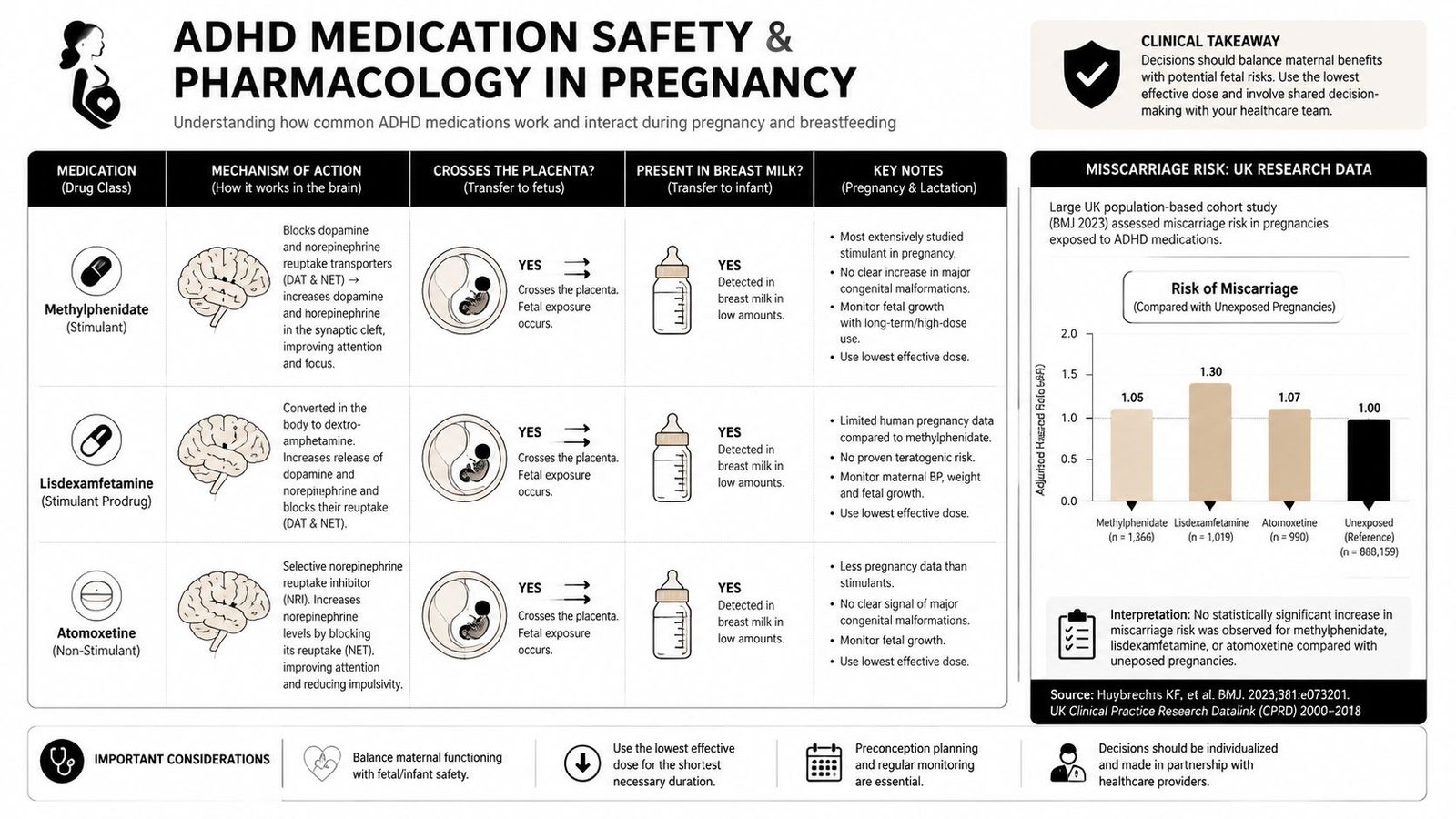
What UK miscarriage data shows
One of the most discussed UK findings comes from a study published in The British Journal of Psychiatry. It reported that any ADHD medication use during pregnancy was associated with a 60% increased risk of miscarriage, with an adjusted odds ratio of 1.60 (95% CI 1.41 to 1.83).
The same study reported different adjusted odds ratios by medication:
| Medication | Adjusted OR (95% CI) |
|---|---|
| Methylphenidate | 1.55 (1.35 to 1.79) |
| Lisdexamfetamine | 1.81 (1.06 to 3.10) |
| Atomoxetine | 2.34 (1.41 to 3.89) |
It also described a dose-related pattern, with miscarriage odds rising from 1.14 (95% CI 0.91 to 1.42) in the lowest exposure tertile to 2.11 (95% CI 1.71 to 2.60) in the highest exposure tertile.
Those figures need careful reading. An association in prescribing data does not prove that the medication itself caused every miscarriage. Prescription records may not perfectly match what was taken, and people prescribed ADHD medication can differ from unmedicated people in ways that also affect pregnancy outcomes.
Where readers often get confused
Miscarriage risk and major congenital malformation risk are not the same outcome. They should be read as separate boxes on the same checklist. A signal in one box does not automatically mean there will be a signal in the other.
Another common point of confusion is pharmacology versus evidence. A drug can make sense on paper, but pregnancy decisions depend on observed outcome data, not just on receptor activity or release profile. That matters in UK practice, where patients may be told that medicines in the same stimulant family are probably similar, even when the safety evidence for the specific drug is thinner than people realise.
For people comparing practical treatment options as well as pregnancy concerns, Insight also has a broader guide to medication for ADHD. If side effects are complicating the discussion, this resource on navigating ADHD medication side effects may help separate expected tolerability issues from symptoms that need medical review.
The UK-specific lisdexamfetamine gap
This is the part many UK readers do not get told clearly enough. Lisdexamfetamine is widely prescribed, but pregnancy evidence for lisdexamfetamine itself is still limited and often pooled into broader amphetamine groupings.
That creates a real clinical gap. It is a bit like being given safety information for a vehicle class when what you need is the record for the exact model you drive every day. The class data is still useful, but it does not answer every practical question.
For UK patients, that gap can shape care in both NHS and private settings. A private ADHD prescriber may know the medicine well from an adult ADHD perspective, while antenatal teams and GPs may look for pregnancy-specific evidence and feel less confident if the drug has not been studied separately in enough detail. That mismatch can leave patients stuck between services unless someone pulls the information together and explains the uncertainty plainly.
The fairest summary is simple. Lisdexamfetamine is not proven to be uniquely unsafe. The problem is that the evidence base is still incomplete, and UK prescribing practice has moved faster than pregnancy-specific research. Honest counselling should say that out loud.
Risks of Untreated ADHD During Pregnancy and Breastfeeding
Some people stop medication as soon as they see a positive test. That can feel like the safest move. But "untreated" doesn't mean "risk-free".
ADHD can affect the ordinary tasks pregnancy depends on. Booking antenatal visits, remembering folic acid, eating consistently, keeping track of scans, answering messages from the midwife, and noticing symptoms that need review all rely on attention, organisation, and follow-through. When those skills drop suddenly, the whole routine can wobble.
A common real-world pattern looks like this. Someone stops medication quickly, then becomes more forgetful, more overwhelmed, and more emotionally reactive. They miss one appointment because they wrote down the wrong date. They delay a blood test because the booking system feels impossible. They sleep badly, anxiety rises, and meals become irregular because planning and food preparation feel like too much.
Functional problems can become health problems
Untreated ADHD doesn't stay neatly inside the label of "poor concentration". It can spill into:
- Prenatal care adherence. Missed appointments, delayed blood pressure checks, or trouble following treatment plans.
- Nutrition and hydration. Skipped meals, erratic eating, and forgetting fluids.
- Stress and mood. More frustration, guilt, panic, and a sense of failing at pregnancy before it has properly started.
- Postnatal adjustment. Sleep deprivation and infant care can intensify executive function strain.
Breastfeeding can be affected too. Not because ADHD makes bonding impossible, but because feeding plans, latch support, waking schedules, and self-care all require sustained attention when the parent is already tired and recovering.
Practical rule: If stopping medication causes a sharp drop in daily functioning, that change itself deserves clinical attention. It isn't a minor side issue.
For adults trying to understand how symptom burden affects work, relationships, and self-management, this overview of treating adults with ADHD is a helpful companion.
Why this matters in decision-making
Pregnancy care often focuses on what a medicine might do. That's important, but it's only half the picture. Clinicians also need to ask what happens if support is removed.
For one person, stopping medication may be manageable with extra structure and family help. For another, it may lead to unsafe driving, severe disorganisation, worsening anxiety, or an inability to keep up with antenatal care. Those differences are why blanket advice rarely works well in ADHD medication and pregnancy decisions.
Preconception Counselling and Shared Decision-Making
The best pregnancy medication decisions usually happen before conception, not in a rush after it. That doesn't mean every pregnancy is planned. It means that if someone of childbearing potential is prescribed stimulant treatment, contraception and pregnancy planning should already be part of routine care.
UK guidance from the British Association of Psychopharmacology and NHS perinatal mental health services recommends routine discussion of effective contraception for women on stimulant ADHD medications and explicit preconception planning in ongoing ADHD care, as summarised in this UK-focused clinical discussion of ADHD and pregnancy medication decisions.
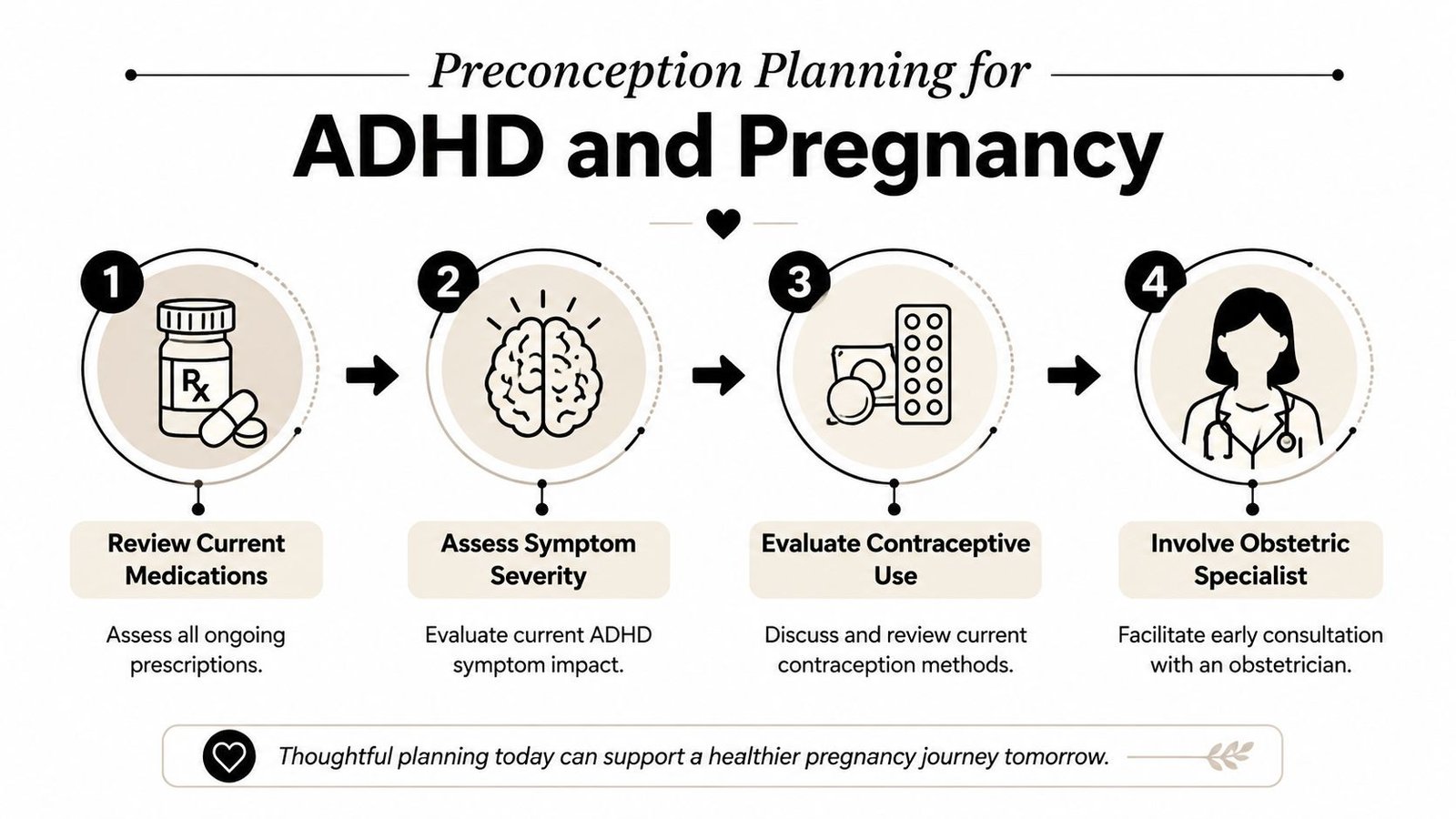
A practical four-step framework
Review the current medication list
Check every prescribed medicine, not just ADHD treatment. Include antidepressants, sleep medicines, supplements, and anything taken irregularly.Assess symptom severity in real life
Ask what happens on a difficult day without treatment. Can the person work safely, drive safely, manage bills, eat properly, and attend appointments?Discuss contraception and pregnancy intentions directly
This shouldn't be a vague "let us know if you plan a baby". It needs a specific discussion about current contraception, future plans, and what to do if pregnancy happens unexpectedly.Involve maternity and mental health teams early
High-quality decisions often need more than one clinician. GP, psychiatrist, obstetric services, and perinatal mental health input may all be relevant.
A visual summary can help anchor those conversations:
Questions worth asking before conception
Some questions are more useful than "Is it safe?"
- What symptoms return when medication is reduced?
- How severe is the functional impairment without it?
- Is this person stable enough to try a lower dose, or would that likely fail?
- Would a switch create more instability than benefit?
- What is the plan for the first trimester, when decisions often feel most urgent?
- What is the feeding plan after birth, and how might that affect medication choices?
Preconception support also includes basics that can be forgotten when attention is fixed on prescriptions. This guide to understanding prenatal vitamin options is a practical example of the wider preparation that often needs reviewing.
For readers who are unsure who can diagnose, prescribe, and co-ordinate treatment, this explainer on a psychologist that can prescribe medication helps clarify roles within mental health care.
Shared decision-making isn't a form to sign. It's a process of matching evidence to the person's actual level of impairment, supports, values, and pregnancy plans.
Management Options During Pregnancy
Once pregnancy is confirmed, the right plan depends on symptom burden, previous medication response, past relapses when stopping, and the person's support system. There isn't one standard pathway that fits everyone.
Systematic reviews aligned to UK practice suggest that continuing psychostimulants may slightly raise NICU admission risk by up to 9.84% but carry very low congenital malformation risk, including 0.03% for cardiovascular malformation, supporting continuation for moderate-to-severe functional impairment, according to this systematic review aligned to UK clinical practice.
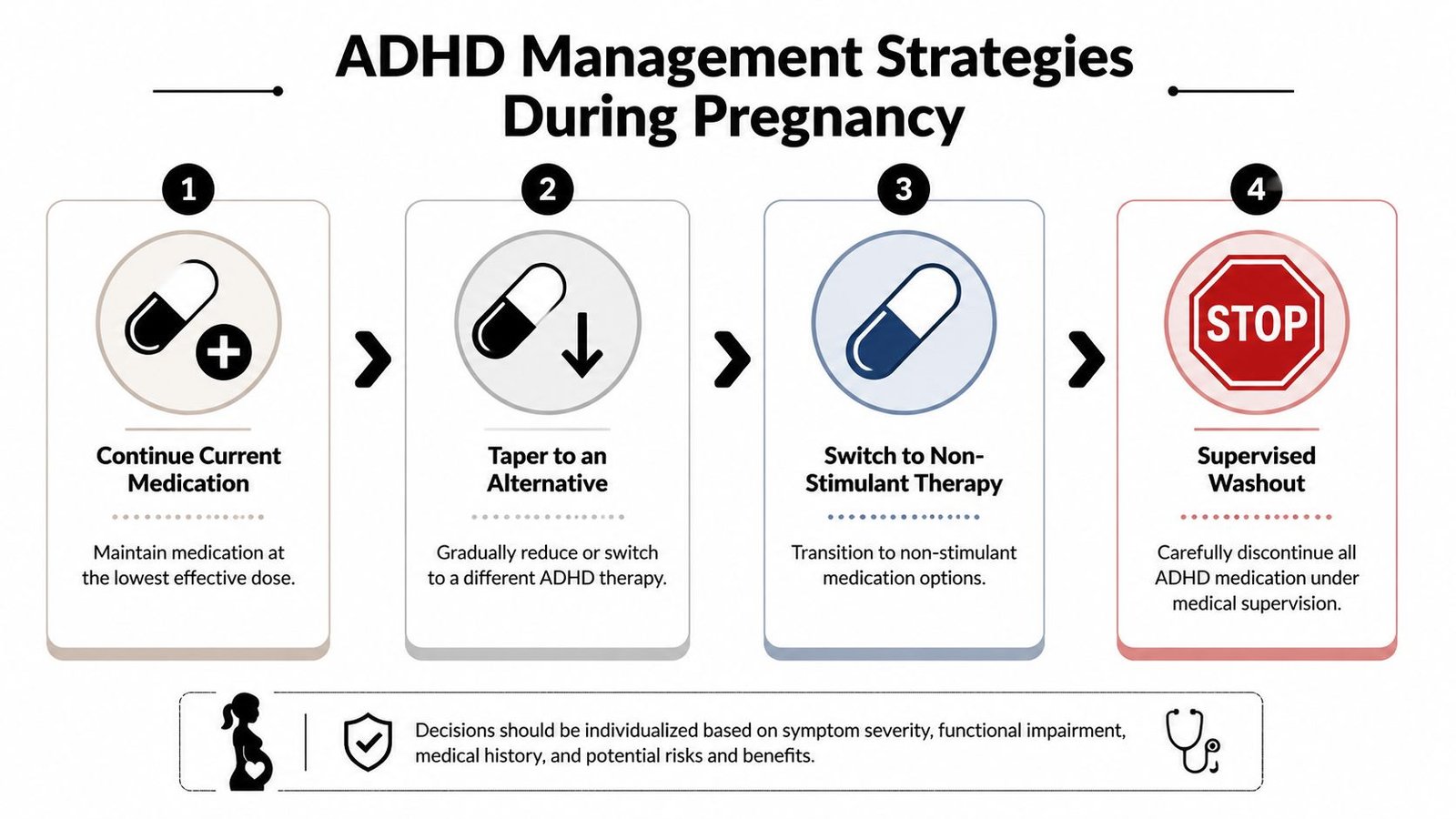
Option one continues treatment with tighter review
This route is usually considered when ADHD symptoms are moderate to severe, daily functioning drops clearly without medication, and the risks of stopping may outweigh the known and unknown medication risks.
The main principle is simple. Use the lowest therapeutic dose that still keeps the person functioning. In practice, that means clinicians often review whether the current regimen is the minimum effective one rather than the historic one that happened to work before pregnancy.
Breastfeeding discussions often start here too. If the antenatal plan is "continue", clinicians should already be planning how to review maternal wellbeing, infant feeding goals, and whether medication timing needs adjustment after birth.
Option two tapers or switches carefully
Some patients don't want to stop abruptly, but they also don't feel comfortable staying on the same treatment throughout pregnancy. A taper or switch can make sense when the current medicine causes side effects, when the person is on a higher-than-needed regimen, or when there is a strong preference to reduce stimulant exposure.
This needs supervision. Sudden discontinuation can produce a rebound of disorganisation, low mood, irritability, and poor self-care right when pregnancy symptoms may already be intense.
A taper works best when the team watches for practical warning signs, such as:
- Missed appointments instead of asking whether concentration feels worse.
- Sleep disruption that starts to affect mood and daily safety.
- Eating problems such as forgetting meals or relying on convenience food because planning has collapsed.
- Relationship strain caused by increased impulsivity or emotional reactivity.
Option three uses non-stimulant treatment in selected cases
Some people ask whether switching to a non-stimulant makes pregnancy automatically safer. The answer isn't that straightforward. Different medicines have different evidence profiles, and "non-stimulant" isn't a synonym for "no concern".
The details matter here. A switch is sometimes reasonable, but only if the likely benefits outweigh the instability caused by changing a treatment that previously worked. The question isn't whether a medicine sounds gentler. It's whether the person will stay well enough on it.
For readers looking beyond prescriptions, this guide to ADHD alternatives to medication can help frame behavioural supports, coaching strategies, routines, and environmental changes that may become more important during pregnancy.
Option four is a supervised washout
A washout means stopping medication with planned monitoring, rather than running out of tablets and hoping for the best. This can be appropriate when symptoms are mild, when the person strongly prefers to avoid medication, or when side effects or obstetric concerns make continuation unsuitable.
A supervised washout still needs structure. Useful supports can include:
- Written appointment systems with reminders in more than one place.
- Practical home support for meals, transport, and daily admin.
- Work adjustments if concentration is likely to dip.
- Rapid review points if anxiety, depression, or loss of function appears.
Some patients do well off medication in pregnancy. They tend to do best when stopping is planned, supported, and monitored, not abrupt and isolated.
How to choose between the pathways
A simple way to think about it is to match the plan to the level of impairment.
| Situation | Usual direction of travel |
|---|---|
| Symptoms are mild and routines hold without medication | Consider supervised reduction or washout |
| Symptoms are moderate and daily life becomes shaky off medication | Consider continuing at the lowest effective dose or cautious taper |
| Symptoms are severe and previous stopping led to significant dysfunction | Continuation with specialist review is often the most realistic option |
| Medication side effects or patient preference are the main issue | Consider taper, switch, or added non-drug supports |
Sleep often becomes a hidden part of this decision. If medication changes worsen insomnia, overall functioning can unravel quickly. This overview of safe options for insomnia during pregnancy may be useful as part of a wider discussion with your maternity team.
Monitoring Pregnancy Outcomes and Multidisciplinary Coordination
A pregnancy plan is only as good as the monitoring behind it. Once a decision is made, the next step is making sure the right people know about it and the right checks happen at the right time.
In UK prescribing data, ADHD medication is used in 1.49 per 1,000 pregnancies, and pooled studies found no significant increase in major congenital malformations but a modest rise in NICU admissions with an odds ratio of 1.5 (95% CI 1.3 to 1.7), according to this review of prescribing prevalence and pregnancy outcomes.
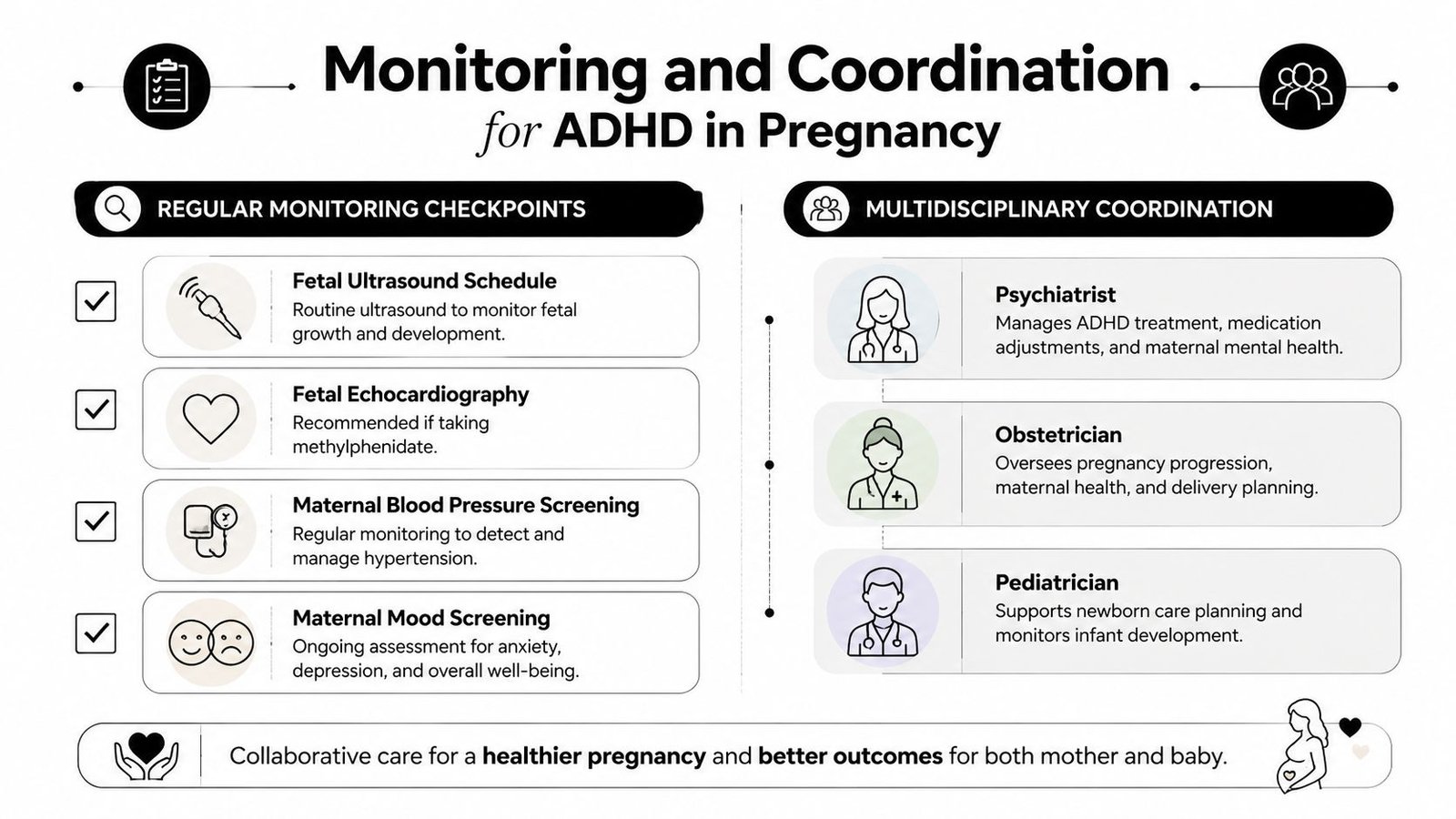
What should be monitored
Monitoring works best when it covers both pregnancy outcomes and maternal functioning.
A practical checklist often includes:
- Fetal ultrasound planning to follow routine obstetric care and any added scans the maternity team recommends.
- Blood pressure checks because stimulant use and pregnancy both make blood pressure relevant.
- Mood screening to pick up anxiety, depression, or escalating distress.
- ADHD symptom review in concrete terms, such as attendance, daily organisation, driving safety, and work function.
Some teams also ask patients to track a few ordinary markers in a notebook or phone. Examples include whether meals are being skipped, whether medication timing has changed, whether sleep is fragmented, and whether antenatal tasks are being completed. These aren't formal trial measures. They're useful signals for clinical review.
Who needs to be in the loop
The most effective plans usually involve clear communication between several people:
- The prescriber, who reviews medication choice and dose.
- The GP, who often sees the wider picture and co-ordinates referrals.
- The midwife and obstetric team, who track pregnancy progress.
- Perinatal mental health services, where available, if symptoms are complex or risk is rising.
- The pharmacist, who can flag formulation or dispensing issues.
A common problem isn't lack of care. It's fragmented care. One clinician assumes another has explained the plan. Another assumes the medicine was stopped already. The patient gets different advice from different services and loses confidence in all of it.
Good co-ordination means one written plan, shared with the clinicians involved, so the patient doesn't have to carry the whole system in their head.
When a plan should be adjusted
Monitoring should lead to action, not just record-keeping. A plan may need changing if the patient becomes significantly less functional, starts missing maternity care, develops concerning side effects, or feels unable to cope with the current balance of symptoms and treatment.
That adjustment might mean reducing dose, reinstating support, speeding up psychiatric review, or involving obstetrics earlier. In other words, monitoring is the steering wheel, not just the dashboard.
Navigating UK Clinical Guidelines and Urgent Care Pathways
UK guidance can sound scattered because it sits across teratology services, psychiatric prescribing guidance, NHS perinatal services, and local maternity teams. The practical message is more straightforward than it first appears.
For methylphenidate, the UK Teratology Information Service advises fetal echocardiography for first-trimester exposure because of a modest association with cardiac malformations, while overall teratogenicity remains low, as reflected in this UK perinatal mental health prescribing guidance document.
What the main UK recommendations amount to
- Preconception discussion should be routine for people taking stimulant ADHD medication.
- Medication decisions should be individualised, not automatic.
- Methylphenidate in the first trimester may prompt fetal echocardiography.
- Lowest effective dose is the usual principle when treatment continues.
- Obstetric and perinatal mental health input should be sought when the case is complex.
When to seek urgent help
Medication decisions can usually wait for an organised review. Some symptoms can't.
Contact urgent services if there is:
- Severe mental health deterioration, such as intense agitation, loss of reality testing, or thoughts of self-harm.
- Possible preeclampsia symptoms, including severe headache, visual disturbance, sudden swelling, or upper abdominal pain.
- Markedly raised blood pressure concerns raised by your maternity team.
- Heavy bleeding, severe pain, or sudden pregnancy symptoms that worry you.
If it's urgent but not immediately life-threatening, use NHS 111. If there is immediate danger to life or safety, call 999.
Private assessment can sometimes help when someone needs a faster medication review or a more detailed neurodevelopmental assessment alongside pregnancy planning, but it doesn't replace emergency care. Urgent obstetric or psychiatric red flags still belong with NHS urgent pathways first.
Conclusion and Next Steps
Pregnancy planning with ADHD medication is less like following a fixed rule and more like adjusting the controls on something sensitive. The aim is to keep symptoms managed well enough for daily life and safety, while keeping fetal exposure as low as reasonably possible. In UK practice, that decision is often straightforward for some medicines and much less clear for others.
One gap matters more than many people realise. UK clinicians have limited pregnancy safety data for lisdexamfetamine, so decisions about continuing or changing it often rely on careful case-by-case judgement rather than a simple evidence-based answer. That uncertainty does not mean the medicine is unsafe. It means the discussion needs to be more deliberate, more clearly recorded, and more closely coordinated between ADHD prescribers, the GP, and maternity teams.
Your next step should be practical. Ask for a medication review if you are trying to conceive, have just found out you are pregnant, or feel your current plan is no longer working. If your care is split between NHS and private services, make sure each team has the same medication list, the same pregnancy timeline, and the same agreed plan for dose changes, monitoring, and who to contact if symptoms worsen.
A good final plan should be simple enough to use on a stressful day. What am I taking now. What is staying the same. What might change. Who is leading the prescribing decision. When is the next review.
If you want specialist support with adult ADHD, autism, and wider mental health assessment, Insight Diagnostics Global offers consultant-led online and face-to-face care for adults, including thorough assessments, ADHD medication titration, and ongoing monitoring. The service is CQC regulated, with psychiatrists on the GMC Specialist Register, and can support private, self-funded, and some insured patients seeking faster clarification and treatment planning. For urgent mental health or pregnancy emergencies, use NHS 111 or call 999.