

You may be reading this after another exhausting week of trying to work out why ordinary life seems to require so much effort. You manage at work, you get through conversations, you keep up appearances, but it often feels as though you're following rules that everyone else somehow absorbed naturally. By the end of the day, you're depleted. Some adults describe it as burnout. Others say they've always felt out of step, but never had language for it.
In clinic, that pattern is common. Adults come for an autism assessment because they're struggling with social uncertainty, sensory overload, rigid routines that help them cope, or the sheer fatigue of constant self-monitoring. Many have already been treated for anxiety, depression, ADHD, or stress. Sometimes those diagnoses are accurate and still don't explain the whole picture. Sometimes autism has been sitting underneath for years.
For adults in the UK, this is no longer unusual territory. More people are seeking clarity later in life, especially when old stereotypes never seemed to fit. A careful assessment can help separate autism from lookalike problems, identify overlaps with ADHD and mental health difficulties, and give you a more useful explanation than “you're just overthinking everything”.
Is It Autism An Introduction for Adults
A typical adult referral doesn't start with “I think I'm autistic”. It often starts with, “I'm exhausted all the time”, or, “I can function, but it costs me far too much”. Someone may be successful in a professional role and still dread meetings because reading the room never feels automatic. Another person may cope well in structured settings but fall apart when plans change, noise builds, or social expectations become vague.
That's one reason adult autism can be missed for years. It doesn't always look like the childhood stereotype people still carry in their heads. Many adults have learnt scripts for conversation, copied social behaviour, or shaped their lives around predictable routines without realising why those strategies feel so necessary.
The shift in recognition is substantial. The rate of autism diagnosis among UK adults aged 26 to 34 increased by 450% between 2011 and 2022, as reported in JAMA Network Open. That doesn't mean autism suddenly appeared in adulthood. It means more adults who were previously overlooked are now being identified.
When the question starts to make sense
For some, the trigger is a child's assessment. A parent recognises the same traits in themselves. For others, it's workplace strain, repeated relationship misunderstandings, university pressure, or a sense that every transition takes more effort than it should.
Many adults don't need convincing that they're struggling. They need a framework that finally explains why.
An autism diagnosis for adults isn't about forcing every personality difference into a medical label. It's about working out whether there's a consistent neurodevelopmental pattern that has shaped communication, sensory experience, routines, coping, and mental health across the lifespan.
What a good assessment offers
A proper assessment should do more than answer yes or no. It should help you understand:
- Whether autism is the best explanation for your lifelong pattern of traits
- Whether ADHD is also present, because overlap is common in clinical practice
- Whether anxiety, depression, trauma, or burnout are contributing to what you're experiencing now
- What support makes sense next, rather than leaving you with a label and no plan
That clarity matters. Even when autism is ruled out, people usually benefit from finally understanding what is driving their difficulties.
Recognising Autistic Traits in Adulthood
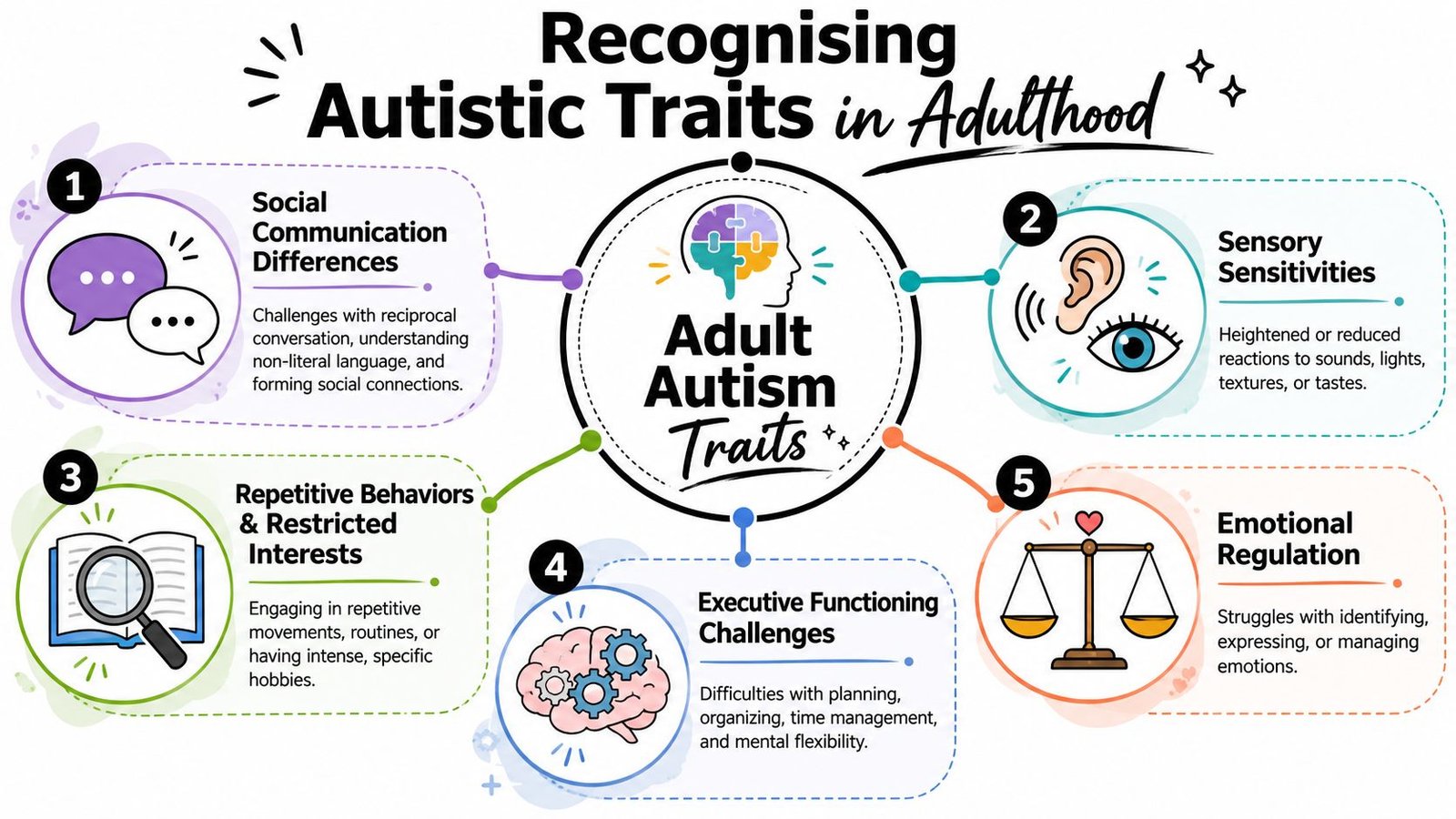
Adult autism is usually easier to recognise when you stop looking for clichés and start looking at patterns. The question isn't whether someone appears quiet, clever, awkward, or intense. The question is whether there is a long-standing neurodevelopmental profile affecting social communication, sensory processing, flexibility, and daily functioning.
What it often looks like in adults
Some adults speak fluently and hold responsible jobs, yet still struggle with reciprocal conversation. They may miss implied meanings, need extra processing time, or rely on rehearsed responses. Others describe lifelong confusion in friendships, difficulty knowing when to join in, or a strong preference for one-to-one interaction because groups feel chaotic.
Sensory issues are another major clue. This may involve noise, lighting, texture, smell, crowded spaces, or the cumulative strain of environments other people seem to filter out automatically. Adult life can hide this because people build workarounds. They choose quiet times, wear the same fabrics, avoid certain venues, or keep daily life tightly organised.
Common themes include:
- Social communication differences that show up as literal interpretation, uncertainty with nuance, or difficulty tracking fast-moving group interaction
- Restricted interests or routines that provide structure, relief, or a reliable focus
- Executive functioning strain, which can look like procrastination, shutdown, or difficulty switching tasks
- Emotional regulation difficulties, especially after sensory or social overload
For a fuller practical overview of common adult signs, see how to recognise autism in adults.
Why masking complicates the picture
Many adults don't present in an obvious way because they've spent years compensating. Masking means consciously or unconsciously suppressing autistic traits to appear socially typical. In the UK, masking affects up to 68% of adult women and 42% of men seeking an ASD diagnosis, contributing to a 29% average delay in diagnosis for women.
That matters clinically. Someone may make eye contact, use humour, or seem socially competent in brief appointments and still be autistic. A key question is what that performance costs, how deliberate it is, and what happens when the person is tired, stressed, or outside familiar routines.
Clinical reality: the better someone has become at masking, the more important it is to ask about effort, recovery time, and lifelong patterns rather than judging from appearance alone.
Autism, ADHD, anxiety, and burnout
This is where experienced assessment matters. Autism can overlap with ADHD, and both can sit alongside anxiety or depression. Burnout further muddies the picture. A person may report exhaustion, poor concentration, irritability, and withdrawal. That could reflect work stress. It could reflect ADHD. It could reflect autistic burnout. It may be a combination.
A useful distinction is pattern and context. Professional burnout usually centres on sustained overload from external demands. Autistic burnout often includes a sharper loss of coping after prolonged masking, sensory strain, and social effort. It tends to feel less like “I need a holiday” and more like “the systems I use to function have stopped working”.
What doesn't work is self-diagnosing solely from online checklists. What does work is a structured specialist assessment that asks how these experiences developed over time and whether they fit autism better than the alternatives.
The Formal Diagnostic Process Explained
A formal autism diagnosis for adults should feel structured, not mysterious. In a CQC-regulated clinic, the process is designed to answer a precise question: do your lifelong traits meet recognised diagnostic criteria, and if so, what else needs to be considered alongside them, including ADHD, anxiety, depression, or personality-related difficulties?

Who should diagnose adult autism
In the UK, adults should look for a clinician with specific expertise in neurodevelopmental assessment. Consultant Psychiatrists on the GMC Specialist Register are particularly well placed to diagnose autism when there is overlap with ADHD, mood disorder, trauma, or complex mental health history. That distinction matters because the challenge is often not spotting autistic traits in isolation. It's deciding whether autism is the primary explanation once the full picture is considered.
At clinics such as Insight Diagnostics, consultant-led assessments are often chosen when adults want an integrated view of autism, ADHD, and mental health alongside psychological assessment, particularly when the referral question is not straightforward. Dr Sai Achuthan's work in neurodevelopmental and personality disorder assessment reflects the kind of expertise many adults need when symptoms cut across categories.
What the core tools actually do
The ADOS-2 is the NICE-recommended gold-standard tool for UK adult assessments. It has a diagnostic accuracy of 85 to 90% when combined with a clinical interview and reduces misdiagnosis rates by 34% compared with unstructured methods. In practical terms, it gives the clinician a standardised way to observe social communication, reciprocity, and behavioural style, rather than relying only on a conversational impression.
The ADI-R serves a different purpose. It focuses on developmental history and helps establish whether the pattern began early in life, which is central to diagnosis. Adults often expect the process to be based only on present-day difficulties, but autism is a developmental condition. The history matters.
If you want a clearer overview of the framework clinicians apply, this guide to diagnostic criteria for autism in the UK is a useful starting point.
What usually happens in practice
A robust assessment commonly includes:
- Screening questionnaires such as the AQ-10, used to identify whether fuller assessment is warranted
- Detailed clinical interview covering social development, routines, sensory experiences, coping style, education, work, and relationships
- Standardised observation using ADOS-2 where clinically appropriate
- Collateral history from a parent, sibling, partner, or school records if available
- Differential diagnosis, especially where ADHD, anxiety, depression, trauma, or personality difficulties may overlap
A short explanation from a clinician can make the process feel more concrete:
A high-quality assessment doesn't rush to confirm autism. It tests that possibility properly and rules out weaker explanations.
What tends to go wrong in poor assessments
The common failures are predictable. The clinician relies too heavily on surface presentation. They don't ask enough about childhood history. They ignore masking. They treat anxiety as the whole story. Or they assess autism without considering ADHD and broader mental health.
That's why structured methods, specialist training, and regulatory standards matter. They don't make the process mechanical. They make it safer and more accurate.
Navigating Your Assessment Options in the UK
Once you've decided to pursue an autism diagnosis for adults, the next question is practical. Which route fits your situation best: the standard NHS pathway, NHS Right to Choose, or private assessment?
The answer depends on three things. How quickly you need clarity. Whether you need flexibility around provider choice. And whether cost certainty matters more than speed.
The three main routes
The standard NHS route usually begins with a GP referral to your local adult autism service. That can be appropriate if you're happy to stay within local pathways and can tolerate a potentially long wait.
NHS Right to Choose gives eligible patients in England more control. It allows you to ask your GP to refer you to a provider of your choice for NHS-funded assessment, provided that provider accepts Right to Choose referrals and meets the relevant requirements. For many adults, this is the middle path between waiting locally and self-funding.
Private assessment offers the most control over timing and appointment format, but you pay directly unless your insurer agrees cover in advance.
For a practical overview of the referral route many adults ask about, this guide to NHS Right to Choose explains the process clearly.
UK Autism Assessment Pathways Compared
| Feature | Standard NHS | NHS Right to Choose | Private (Self-Funded) |
|---|---|---|---|
| Funding | NHS-funded | NHS-funded | Paid by the patient unless insurance authorises cover |
| Choice of provider | Usually limited to local service | Broader choice of eligible provider | Patient chooses provider directly |
| Speed | Often slower | Often used to avoid long local waits | Usually the most flexible for appointment timing |
| Upfront cost | No direct fee to patient | No direct fee to patient | Direct payment required unless covered |
| Best suited to | Patients who prefer local NHS care | Patients wanting NHS funding with more choice | Patients prioritising speed, scheduling, or provider preference |
The financial trade-offs
Cost uncertainty stops many adults from moving forward. A full CQC-registered private autism assessment in the UK typically ranges from £1,200 to £2,500, and a 2025 survey found that 45% of UK adults delay seeking assessment due to uncertainty over these costs and the pre-authorisation process for insurers such as Vitality or Aviva.
That hesitation is understandable. Two clinics can both advertise “autism assessment” while offering very different levels of detail, clinician seniority, and post-diagnostic support. Some provide a narrow diagnostic opinion. Others provide a fuller report with recommendations for work, education, and mental health care. Price often reflects scope.
Insurance and pre-authorisation
If you have private health insurance, don't assume autism assessment is automatically covered. Policies vary, and insurers often require pre-authorisation before booking. In practice, patients commonly get stuck on a few points:
- Policy wording about neurodevelopmental conditions versus general psychiatric assessment
- Named clinician approval, especially if the insurer wants consultant-level oversight
- Report requirements, where the insurer wants a clear outline of what the assessment includes
- Timing delays, which can be frustrating if you expected private care to be immediate
Paying privately can be straightforward. Using insurance often isn't. Clarify cover before you book, not after.
If your priority is affordability under NHS funding, Right to Choose may be the strongest option. If your priority is control and speed, private assessment may fit better. If your situation is clinically complex, focus less on route and more on whether the provider can assess autism, ADHD, and co-occurring mental health properly.
How to Prepare for Your Assessment
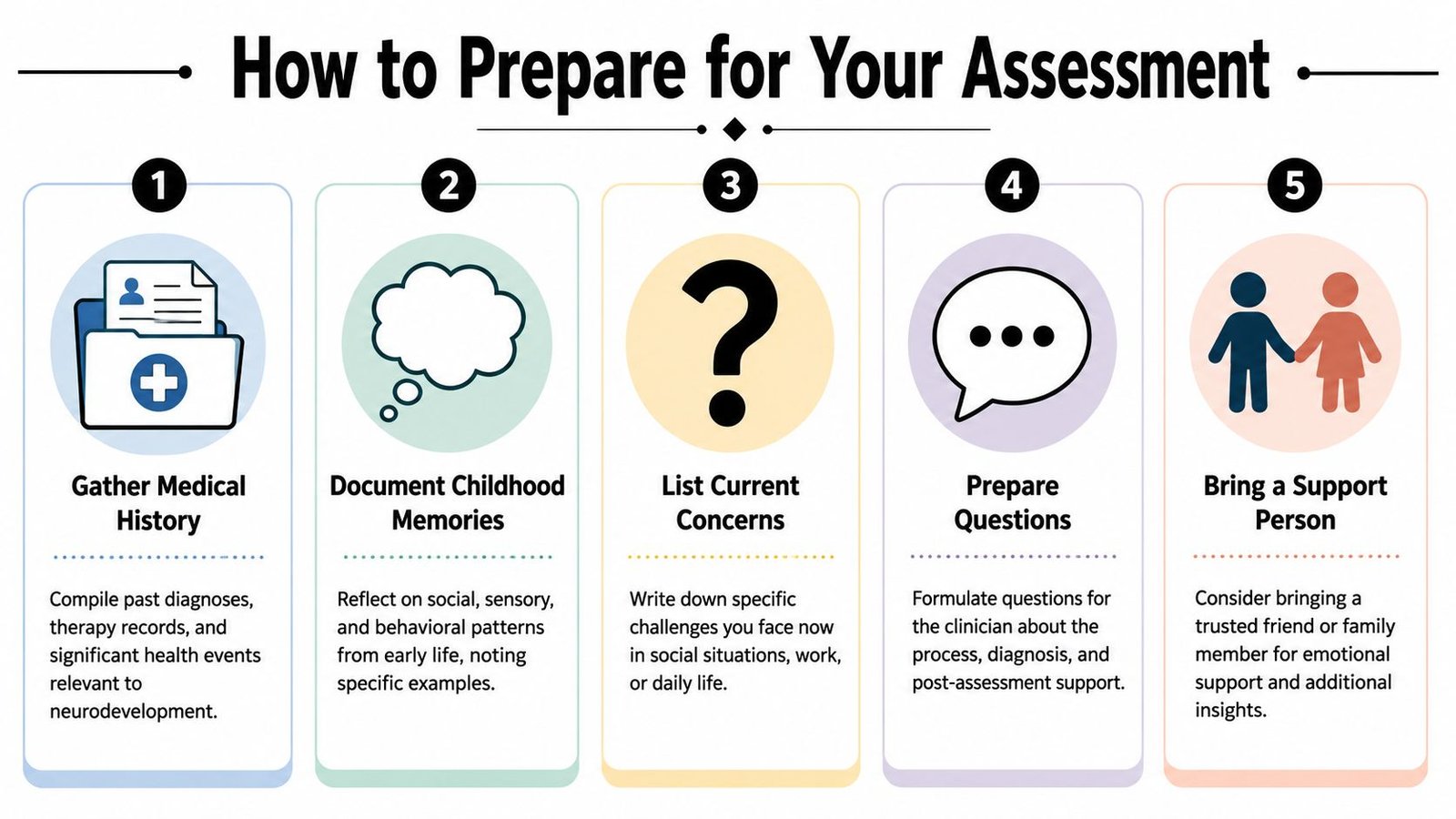
Preparation improves accuracy. It also reduces the pressure of trying to explain your whole life on the spot. Many adults arrive worried they'll forget important examples, minimise their difficulties, or come across “too well” to be understood properly.
That concern is justified. A 2025 audit of 1,200 UK adult ASD cases found that 63% of adults couldn't recall early developmental symptoms without external validation from parents or school reports, which is one reason preparation matters so much.
Gather evidence before the appointment
Don't try to remember everything from memory alone. Pull together anything that helps build a developmental picture.
Useful material may include:
- School reports that mention social difficulties, rigidity, anxiety, underperformance despite ability, or “daydreaming”
- Family observations from a parent, sibling, or someone who knew you well as a child
- Past mental health records if you've previously been treated for anxiety, depression, ADHD, or burnout
- A brief timeline of major struggles at school, university, work, or in relationships
Write examples, not just labels
Saying “I struggle socially” is less helpful than giving examples. The same is true for sensory issues or routines. Before the assessment, note down specific situations that capture the pattern.
You might list:
- Conversation examples such as difficulty knowing when to speak, interpreting statements precisely, or replaying interactions afterwards.
- Sensory examples like fluorescent lights, crowded transport, certain fabrics, food textures, or noise in open-plan offices.
- Change and routine problems, including distress when plans shift or the need to do tasks in a set order.
- Burnout patterns where prolonged social or work demands led to shutdown, withdrawal, or loss of functioning.
Bring the raw material of your life, not a polished performance. Messy detail often helps more than a neat summary.
Prepare yourself, not just your paperwork
A good assessment isn't an exam you can fail by saying the wrong thing. You don't need to present as “autistic enough”. You do need to answer sincerely, even when the truthful answer feels contradictory. Many autistic adults can socialise. Many can work. Many can appear confident. The issue is whether the underlying pattern and cost fit autism.
It can help to:
- Bring a support person if that makes you feel steadier
- Tell the clinician if you mask or tend to downplay problems
- Make a list of questions about the process, report, and next steps
- Rest beforehand if possible, especially if long conversations are tiring
Preparation doesn't distort the assessment. It gives the clinician a better chance of seeing the complete picture.
Understanding Your Diagnostic Report
When the report arrives, many adults read the conclusion first and skim the rest. That's understandable, but it's rarely the most useful way to approach it. A good report should function as a clinical map, not just a verdict.
What the report should contain
At minimum, you should expect a clear diagnostic outcome, a summary of the assessment methods used, and a reasoned explanation of how the clinician reached their conclusion. If autism is diagnosed, the report should connect your history and presentation to recognised criteria in plain language. If autism is not diagnosed, the report should explain what better accounts for your difficulties.
Most detailed reports also include standardised findings where relevant, such as ADOS-2 observations, plus a narrative account of social communication, sensory profile, routines, developmental history, and current functioning.
Why the recommendations matter most
The final pages often have the greatest practical value. Here, the report should translate clinical findings into action. That may include workplace adjustments, educational support, psychological therapy approaches, ADHD follow-up, or strategies for managing sensory strain and burnout.
For many adults, the report also becomes an advocacy document. It may help in conversations with employers, universities, GPs, or other clinicians. If you'd like to see how mental health reports are typically structured and used, this overview of a mental health assessment PDF gives a useful sense of what a clear report should do.
What to look for as a patient
Read the report with three questions in mind:
- Does it sound like me? The narrative should reflect your lived experience, not just generic phrases.
- Does it explain the reasoning? You should be able to see why the clinician concluded autism, ruled it out, or identified overlap.
- Can I use it? A report has real value when it points towards support, adjustments, and next steps.
If any part feels unclear, ask for clarification. A diagnostic report should increase understanding, not create a fresh layer of confusion.
Life After Diagnosis Your Next Steps
Most adults don't feel only one thing after diagnosis. Relief and grief often sit together. Relief because something finally makes sense. Grief because the explanation may have arrived later than it should have.
Give yourself time. You don't need to rebuild your identity in a weekend. Start by noticing what the diagnosis changes practically. It may help you ask for clearer communication, adjust your workload, rethink sensory demands, or pursue support for overlapping ADHD, anxiety, or depression with a more accurate formulation.
Useful next steps often include:
- Reviewing workplace or university adjustments based on your actual needs
- Connecting with autistic adults who understand late identification
- Following up on ADHD or mental health treatment if the assessment identified overlap
- Looking for local support, including options such as structured support in Southampton when day-to-day scaffolding would help
An autism diagnosis for adults isn't an endpoint. It's a better starting point. With the right formulation, people usually stop trying to force themselves through unsuitable systems and begin building lives that fit how they function.
If you're considering an adult assessment and want a consultant-led service that looks carefully at autism, ADHD, and broader mental health, Insight Diagnostics Global offers online and face-to-face assessments for adults with clear triage, structured reports, and follow-up options.