

You’re in the worst part of the process. The GP has already taken you seriously, the referral has gone in, and now the silence starts. Days turn into weeks, weeks into months, and because nobody has explained the pathway properly, it can feel as if your case has vanished into a black hole.
That silence is exactly where people get trapped. They assume there is one queue, one wait, one answer. There isn’t. There’s the wait to be triaged, the wait to be seen, and then the silent wait for treatment to begin. If you’re looking at an NHS psychiatrist waiting list for ADHD, autism, anxiety, depression, or a broader mental health assessment, you need to know which wait you’re in, because the right move depends on that.
This GP-focused guide on getting a mental health assessment is useful if you’re still at the referral stage and want to understand how to avoid being bounced around. But the bigger point is this, you’re not dealing with one problem. You’re dealing with a system with named stages, and each stage has different rights, different delays, and different escape routes.
The Referral That Started Your Wait
Your GP suspects ADHD after months of you saying the same thing in different ways. Or maybe it’s autism, burnout, panic, low mood, or a mess of symptoms that doesn’t fit neatly into one box. The referral goes off, you leave with a little hope, and then nothing happens. No appointment. No update. Just a growing sense that the system has swallowed your file.
That feeling is common because the referral itself gets mistaken for progress. It isn’t progress, it’s the start of the queue. If you’re waiting for an NHS psychiatrist assessment, the referral usually moves into a community mental health pathway first, not straight to a consultant psychiatrist, and that distinction matters because the first contact may not even be with a psychiatrist at all.
Practical rule: if nobody has told you who is holding the referral, ask. You need the name of the service, not just “the NHS”.
The other trap is emotional. Once the GP has acted, people often go quiet because they think they should be patient. That’s the wrong instinct. Patience without information just turns into drift, and drift is where waits become longer than they need to be.
If you want the pathway to make sense, treat it as a sequence of decisions, not a single delay. You need to know where the referral sits, who is triaging it, and what happens after first contact. You also need to know when a private route makes sense, because for some people waiting is reasonable, and for others it’s the wrong move.
How the NHS Psychiatrist Pathway Actually Works
The five stages you need to recognise
The adult NHS pathway usually runs in a set order. First comes the GP referral, then triage, then first contact, then a fuller assessment, and finally treatment or onward referral. The wait can build at any of those steps, but it usually builds most at triage and between first contact and actual treatment.
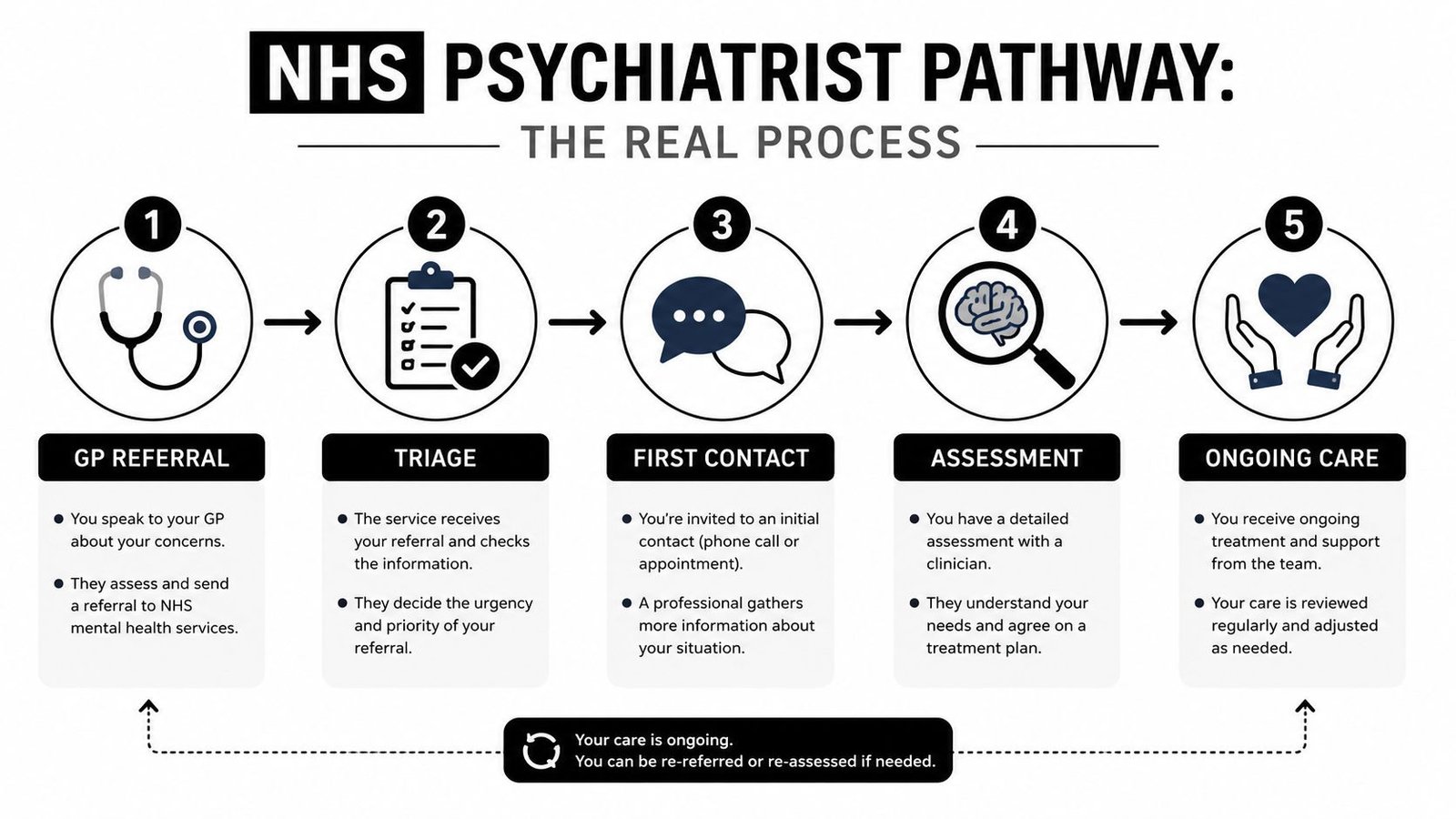
Triage is often done by a clinician, not a psychiatrist. That’s normal, but it catches people off guard because they think the referral means a doctor is already reviewing them. In reality, the service is deciding where you fit, whether you should be seen, and how urgently.
First contact can also mislead people. It may be a screening call, a questionnaire, or a brief conversation designed to gather facts, not a full psychiatric assessment. A lot of frustration comes from assuming that “I’ve been contacted” means “I’ve been assessed”. It usually doesn’t.
Where the delays really sit
The biggest delays usually sit in community mental health services, because they are the gatekeepers for many adult psychiatric assessments. NHS England says only some mental health services have formal access standards, and the King’s Fund notes that waits between assessment and actual treatment are often poorly captured, even though the adult community mental health median wait to second contact is 47 days and 10% have waited at least 238 days (King’s Fund).
For people seeking help for ADHD or autism, the route is often separate and more specialised. That matters because neurodevelopmental pathways don’t always behave like general adult mental health services. They can be clinically better defined, but they can also be slow and patchy.
A useful mental model is this. Seeing someone is not the same as starting treatment, and a call from the service isn’t the end of the queue. It’s just one marker in it.
The language that helps you ask better questions
If you need to chase, use the system’s own words. Ask whether you’re waiting for triage, first contact, assessment, or ongoing care. If the service mentions RTT, remember that it means the referral-to-treatment clock, and the clock doesn’t stop just because the wait is uncomfortable.
For people who want the NHS route explained in a more practical way, this guide to NHS Right to Choose in mental health is worth reading alongside your referral status. It won’t make the NHS faster, but it will make the pathway less mysterious.
What the Numbers Show in 2026
The backlog is not one number
Walk into any NHS mental health service and you quickly see why “the NHS waiting list” is a blunt phrase. In community mental health services, nearly 1.7 million people in England were waiting by the end of December 2024, up from 1.3 million in March 2024, and 48,000 people were waiting more than two years at that point (Independent). NHS England data cited for April 2025 still showed 10,198 adults waiting more than two years for community mental health treatment to start.
This is what the phrase NHS psychiatrist waiting list means. For many people, the delay is weeks. For a smaller but clinically important group, it runs into months or years. Both sit inside the same system.
A long wait is not a personal failing. It usually means the service is under more pressure than it can comfortably absorb.
Talking Therapies is not the whole picture
The NHS Talking Therapies programme performs better than many secondary-care mental health routes. In January 2024, 92.1% of completed referrals accessed services within 6 weeks (NHS Alliance). In February 2025, 90.8% of referrals accessed services within 6 weeks, against the NHS standard that 75% should be seen within 6 weeks and 95% within 18 weeks (NHS Digital).
That tells you something practical. Anxiety and depression in a high-volume, protocol-led service can move relatively quickly. Complex psychiatric assessment often cannot. Those are different pathways, with different pressures and different queues.
The long tail is the warning sign
Rethink Mental Illness analysis found 16,522 people waiting more than 18 months for mental health treatment in February 2025, compared with 2,059 for elective physical health treatment, and the longest mental health waits were about 658 days (NHS Alliance). NHS Providers also reported a median wait of 44 days for adults and older adults receiving a second contact with services in Nov 2024 to Jan 2025, with 124,600 people receiving that second contact in the same period, up 2.8% from the prior quarter (NHS Providers).
The pattern is clear. Some parts of the system are coping reasonably. Others are not. If your wait is stretching into months, that is the backlog behaving exactly as it does.
A private route can be the sensible move when you need an answer faster than the NHS queue can deliver it. If you want to compare that against the NHS path, a private psychiatrist online assessment is often the cleanest starting point for understanding speed, cost, and what you get back.
Your Three Routes and How to Compare Them
There are three meaningful options if you’re stuck on the NHS psychiatrist waiting list. Standard NHS referral. Right to Choose under the NHS. Or a self-funded private psychiatric assessment. People waste months because they compare only NHS versus private, when the choice is more specific than that.
| Route | Typical wait | Cost to patient | Eligibility | Report outcome |
|---|---|---|---|---|
| NHS standard | Often weeks to months, sometimes much longer depending on the local service | Free at the point of use | Anyone accepted by the local NHS pathway | Assessment and treatment are usually handled within the local service |
| NHS Right to Choose | Often shorter if you use a commissioned provider with capacity | Free at the point of use | England only, and only for appropriate commissioned providers and conditions | Usually a specialist report that can support diagnosis and next steps |
| Private psychiatric assessment | Can be much faster if you pay directly | You pay privately | Self-funding, or insurance where authorised | A consultant-led report, often used for diagnosis, treatment planning, or shared care discussions |
A private route makes sense when the delay itself is the harm. That’s especially true if you need an answer for work, study, parenting, safety, or medication planning. It also makes sense if you’ve already been waiting a long time and the NHS pathway isn’t moving.
By contrast, Right to Choose is the underused middle route. It’s still NHS-funded, so it doesn’t cost you at the point of use, which is why it’s often the first thing I’d look at for ADHD and autism assessments in England.
If you’re comparing private services, this overview of online private psychiatrist assessment gives you a better sense of what a consultant-led route looks like when you need speed and clarity.
Using Right to Choose Step by Step
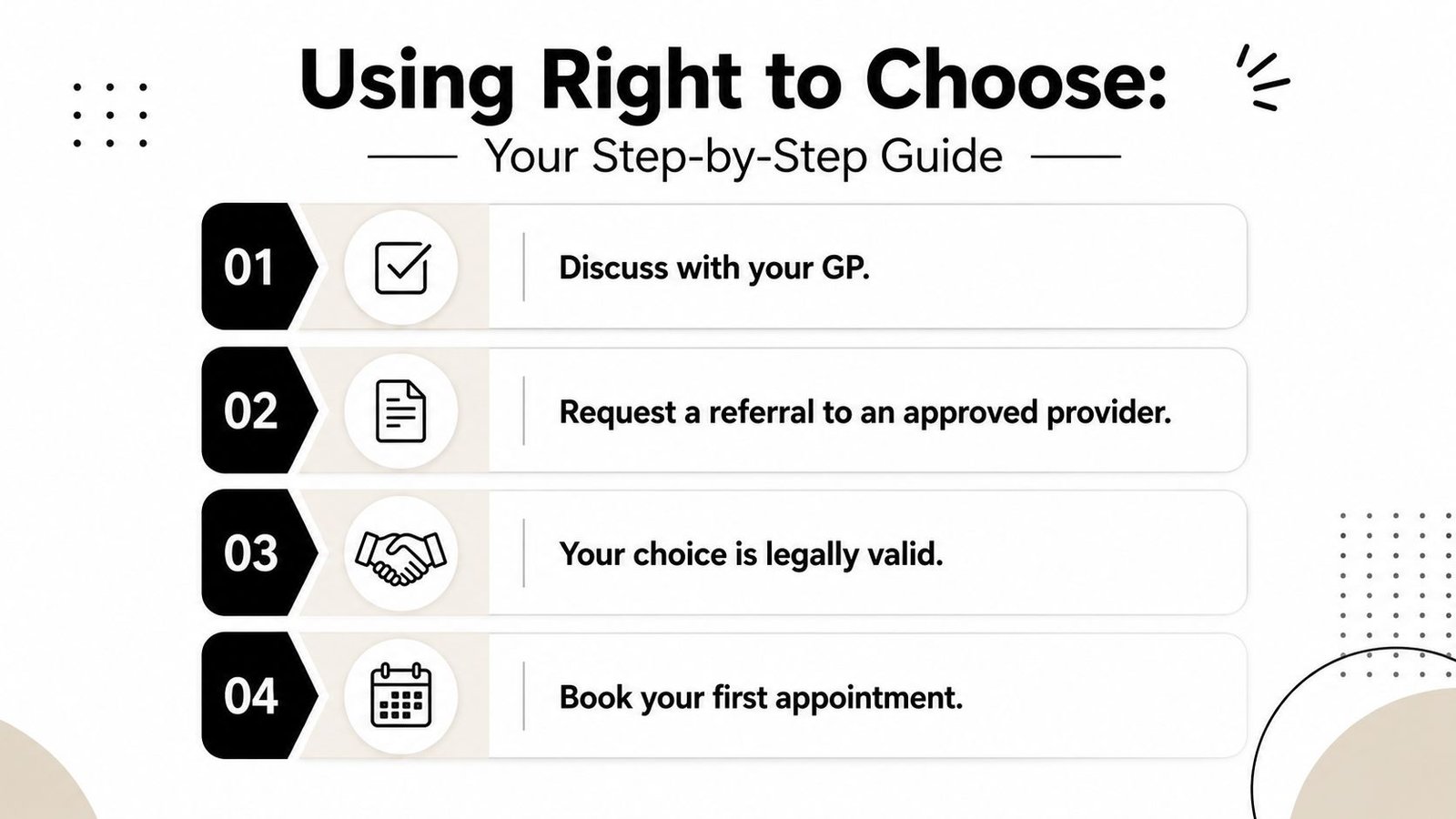
Right to Choose is an NHS England policy, but in plain English it means this, you can ask for an appropriate NHS-funded provider that your ICB commissions, if your GP agrees the referral is clinically suitable. That matters because it turns a vague complaint about waiting into an actual request.
- Pick a provider before the appointment. For ADHD and autism, choose someone who clearly offers the assessment you need and accepts NHS-funded Right to Choose referrals in England.
- Take the provider’s referral form to your GP. Don’t expect the practice to work it out for you. Bring the paperwork, the service name, and a short note about why that route is appropriate.
- Ask for an NHS-funded Right to Choose referral. Use those exact words. It keeps the conversation precise and reduces the chance of the request being filed as a general query.
- Escalate calmly if the answer is no. Ask for the practice manager, then the ICB route if needed. You can also ask another GP in the same practice to review the request.
The limits matter too. Right to Choose doesn’t cover everything, and the GP still has clinical discretion. The provider must also be one that the NHS can commission for your area and your condition. So no, it’s not a magic override. But it is a real lever, and many people still don’t use it properly.
For a fuller walk-through of where it fits in mental health care, this guide to Right to Choose and waiting times is a decent companion read if you’re deciding whether to stay in the NHS system or move faster.
Who Waits Longest and How to Push Back
The system doesn’t delay everyone equally
NHS England’s July 2025 data said people in the poorest communities and those from Asian or Asian British backgrounds are more likely to wait over 18 weeks (NHS England). That matters because waiting isn’t neutral. It interacts with advocacy, access to digital systems, language confidence, transport, and whether someone has the energy to keep phoning.
Rethink Mental Illness also reported that 80% of respondents said their mental health deteriorated while waiting, and the longest adult community mental health waits in that analysis were 727 days (NHS Alliance). That is not a minor administrative issue. It changes risk, family life, and the likelihood of crisis presentations.
What to ask for if you think you’re being deprioritised
If your referral has gone cold, ask the service or your ICB for a waiting-time breakdown. Ask whether your referral is still active, whether you’ve been triaged, and whether there’s a clinical reason you’ve been placed lower. If the first triage feels dismissive, ask for a second clinical opinion within the NHS.
Keep the tone firm and boring. State the symptoms, the impact on work or parenting, any deterioration, and any risk issues. You’re not trying to be dramatic. You’re trying to make the case legible.
Write like a clinician reading 40 other referrals that morning. Clear, factual, and short beats emotional clutter every time.
Use PALS if you need help navigating the local system, and document every contact. Dates, names, what was said, and what was promised. That paper trail is often what gets movement.
Parents should take the child and adolescent picture seriously too. As of November 2025, there were 550,610 children and young people on mental health waiting lists in England, with 30% (165,887) waiting more than two years and 53% (289,722) waiting more than one year (Royal College of Psychiatrists). If a child is being left too long, that needs escalation, not polite resignation.
Staying Well While You Wait
Keep the next appointment clinically useful
A one-page symptom diary is more useful than pages of anxious notes. Write down the current symptoms, when they happen, what worsens them, what helps, and how they affect daily life. For ADHD assessments, add sleep, caffeine, stimulant use, and any periods where focus changed sharply. That makes the eventual consultation sharper and less dependent on memory.
If anxiety or depression is a major part of the picture, use NHS Talking Therapies in parallel where appropriate. It doesn’t replace a psychiatric assessment, but it can reduce the pressure while you wait. If the GP thinks interim medication or monitoring is needed, ask directly. Don’t assume that “waiting for assessment” means “doing nothing”.
For urgent situations, use the crisis routes, not the queue. 111 is the urgent NHS contact point for mental health support, 999 is for emergencies, and Samaritans or Shout can provide in-the-moment support when you’re struggling to hold the line. Insight Diagnostics Global is not a crisis service, and neither is any routine outpatient clinic.
If you’re waiting alongside a difficult home situation, it can help to use a short, structured support plan. A practical example of how people organise interim counselling while they wait is the Penticton counselling guide from Interactive Counselling, which is a useful reminder that short-term support should be active, not passive.
Don’t let the wait distort the assessment
People often try to “prove” symptoms by pushing themselves into collapse. Don’t do that. The goal is accurate assessment, not theatrical suffering. Keep your notes factual, stay in touch with your GP if symptoms escalate, and make sure someone close to you knows what warning signs mean you need urgent help.
This is the part people skip, then regret. A waiting list is not a holding pen. It’s a period where you either preserve enough stability to be properly assessed, or you slide until the eventual appointment can’t tell the true story.
Your Next Move This Week
If your symptoms are urgent, use 111, your local crisis team, or 999 if you’re in immediate danger. If you can wait a few weeks but not a few months, ask your GP for a Right to Choose referral and take the provider details with you. If you need an answer inside a fortnight and you can self-fund, a regulated, consultant-led private assessment is the route that matches the urgency.
That’s the decision tree. Don’t let anyone turn it back into vague reassurance. If you’re an adult looking for a structured psychiatric assessment for ADHD, autism, anxiety, depression, or a broader mental health review, Insight Diagnostics Global provides consultant-led assessments for adults aged 18 and over, with online and face-to-face options and a clinical report you can use in the NHS, workplace, or personal care planning.
Visit Insight Diagnostics Global if you want a clear next step from a consultant-led service rather than another month of guessing what the queue is doing.