

You can be sitting in a GP waiting room with a printout on your phone, a letter from your employer, and the same message you’ve heard for months, maybe years, that the NHS list is long and you just need to wait. Then someone mentions the Right to Choose, and suddenly the whole conversation changes. Not because the system gets easy, but because you realise there’s a lawful referral route that can move you away from the default queue if your GP uses it correctly.
That’s the part often overlooked. The Right to Choose is not a magic pass to any clinic you fancy, and it doesn’t remove clinical judgement from the GP. It does give eligible patients in England a real say in where an NHS referral goes, which matters enormously when you’re dealing with ADHD, autism, anxiety, depression, burnout, or overlapping concerns that all need proper assessment, not a rushed checkbox exercise.
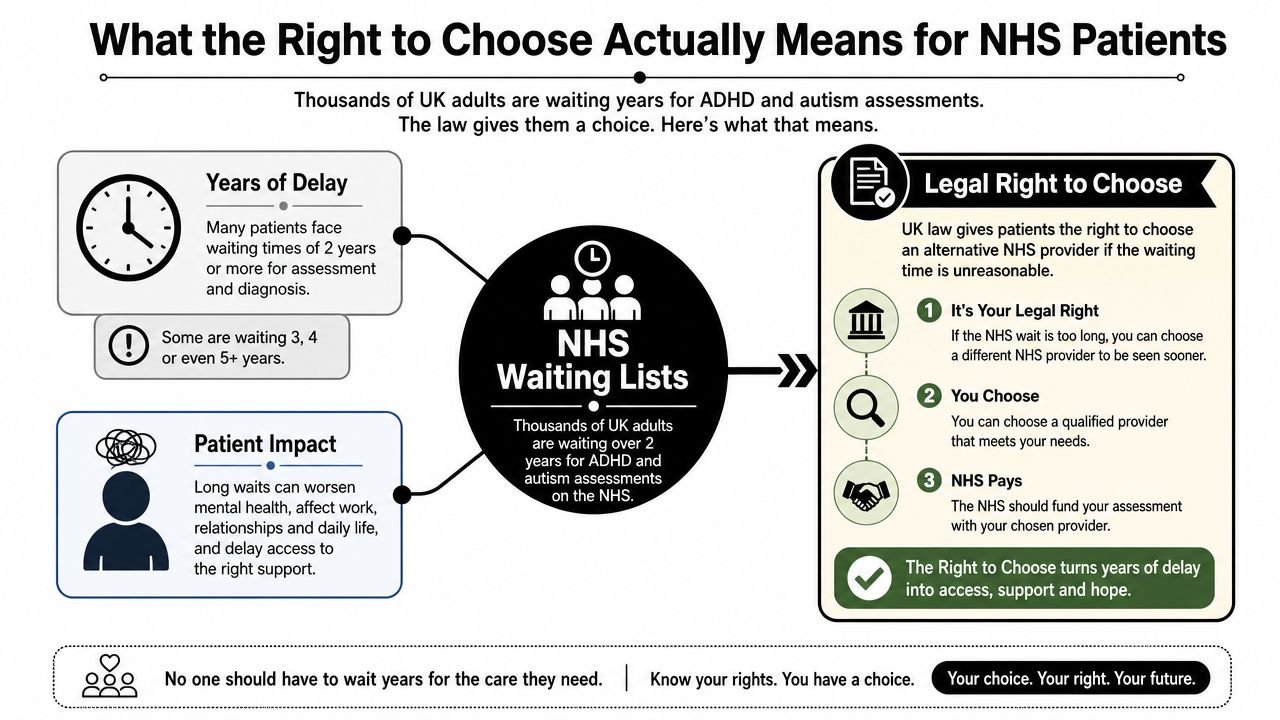
What the Right to Choose Actually Means for NHS Patients
A lot of people first hear about the Right to Choose when they’ve already done the hard part, they’ve accepted that they need help, they’ve booked the GP appointment, and they’ve been told to join yet another queue. Then a friend says, “You can choose the NHS provider.” That statement is broadly true, but only if you understand what the route does and does not cover.
In England, Right to Choose is a legally recognised pathway that allows a GP referral to go to an NHS-commissioned provider rather than the default local service, but it is not available in Scotland, Wales, or Northern Ireland. The practical effect is simple. The referral gets routed differently, the provider’s queue changes, and that can materially affect how long you wait for ADHD or other outpatient mental health assessment, provided the chosen service is contracted for that work and the referral meets the provider’s criteria. ADHD UK’s explanation of Right to Choose sets out that basic structure clearly.
Practical rule: if the provider can’t legally receive the referral for that specific service, your choice stops at the commissioning boundary.
The distinction that matters most is this, the patient chooses the provider, the GP still decides whether the referral is clinically appropriate. That separation is often where the process becomes frustrating, because patients assume “choice” means total control. It doesn’t. It means choice at the point of referral, inside a commissioned NHS framework, not a blanket entitlement to any clinician on earth.
For adults trying to compare pathways, it helps to think in terms of routing rather than slogans. The right to choose is about who receives the referral, not about bypassing every rule in the NHS. If you want a broader perspective on how referral criteria compare with practical registration hurdles in another regulated profession, the guidance on meeting AHPRA registration requirements is a useful example of how systems often look permissive on paper but still depend on strict process checks in practice.
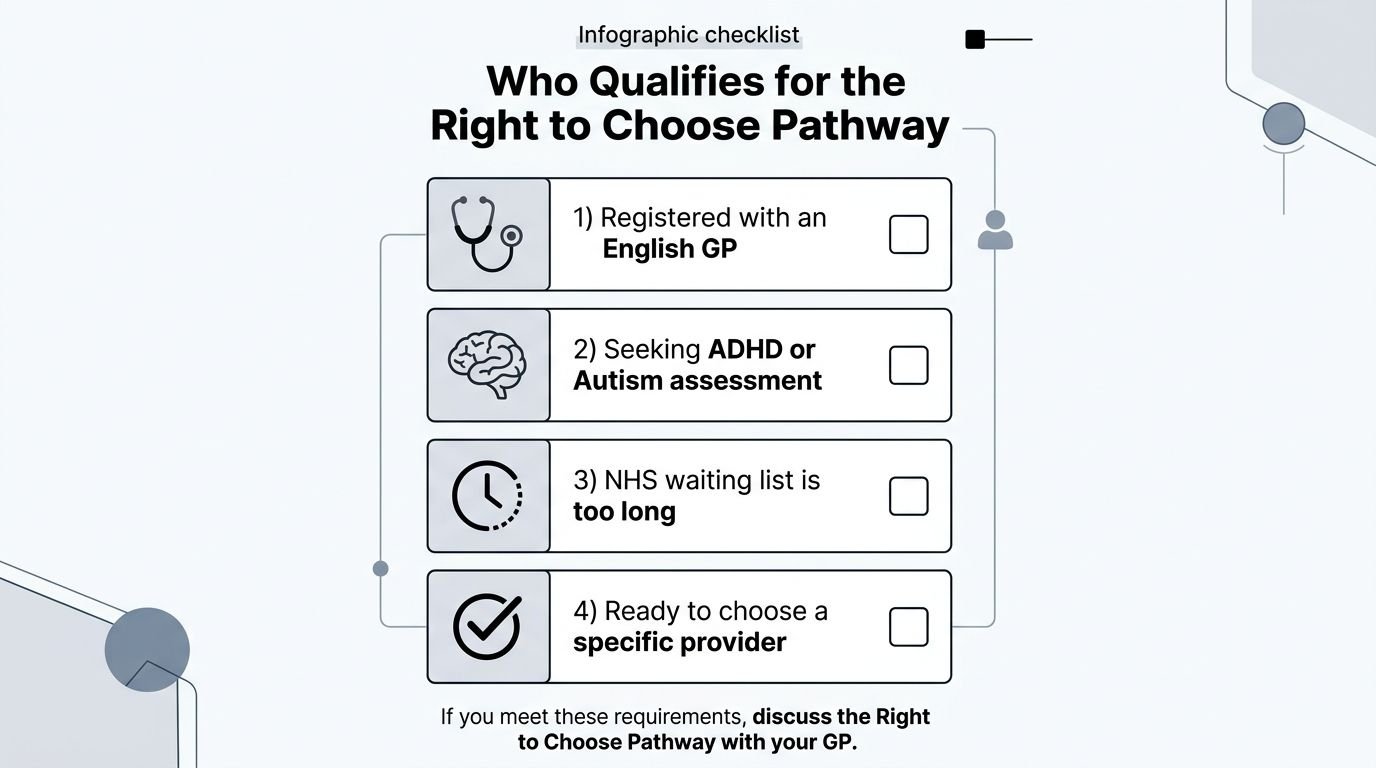
Who Qualifies for the Right to Choose Pathway
If you want the short answer, start with three questions. Are you registered with an English GP, are you seeking an elective outpatient assessment rather than emergency care, and does the provider hold the right NHS commissioning contract for the service you need? If the answer to any of those is no, the pathway gets tighter fast.
The service itself matters. For NHS mental health referrals, the patient-facing mechanism is provider selection at referral time, not a general entitlement to every service in the country. The provider must be commissioned for the relevant service, and it must be consultant-led or mental-health-professional-led. That’s why some names you see online are fine for one pathway but not another.
The basic checklist
- English GP registration. The route works through an English NHS referral, not a UK-wide free choice system.
- Elective referral. This is for planned assessment, not urgent or emergency care.
- Correct commissioned service. The provider must hold the NHS contract for the exact assessment you need.
- Clinical appropriateness. Your GP still has to judge that the referral makes sense clinically.
- Provider fit. The provider has to be set up to receive that specific type of referral, not just any referral.
That last point catches people out. A provider can be perfectly legitimate and still be the wrong fit if the contract doesn’t cover your pathway, or if the referral form and triage rules don’t line up with the service you need. That is why some patients think they “qualify” and then hit a wall at admin stage.
The other misconception is geographic. The route is not a nationwide entitlement across all four nations. It’s an English NHS mechanism with commissioning rules attached. If you live outside England, you need to look at your local system instead of assuming the same rules apply.
How to Ask Your GP for a Right to Choose Referral
Go in with one clear ask. Don’t frame it as “I want this clinic because it looks faster.” Frame it as, “I’m asking for an NHS referral through Right to Choose to a provider that can assess adults for ADHD or autism under the commissioned pathway.” That wording keeps the conversation clinical, which is where it needs to stay.
Bring a written summary. Include your symptoms, when they started, how they affect work, study, relationships, sleep, and day-to-day functioning, and any relevant childhood history if you have it. If you’ve got old school reports, a parent’s observations, previous mental health letters, or any documentation showing long-standing difficulties, bring that too. A good GP can work with uncertainty, but a thin appointment with no evidence makes it easier for the request to drift.
What to say if the GP pushes back
If the GP says they only refer locally, ask them to confirm whether they can make an NHS referral to a commissioned provider chosen under Right to Choose. If they say they don’t know the process, stay calm and ask them to check the referral pathway rather than shutting the request down. If they say the provider name must not be written on the form, point out that the referral needs to identify the chosen provider clearly so it can be routed correctly, especially where Integrated Care Board processes differ.
That variation matters. Referral forms are not uniform across England, and different ICBs can have different administrative expectations. Some GPs know the route well, others have never used it properly, and a few will try to keep you in the usual local funnel because it’s familiar. Don’t let “we don’t normally do that” become the end of the discussion.
If you want a practical example of how referral paperwork is usually presented in an ADHD context, the overview at Insight Diagnostics’ ADHD referral form guide is worth reading before your appointment so you know what a clean referral pathway looks like.
Ask for the referral, ask for the provider name to be recorded, and ask for the next step in writing. Confusion thrives when nobody pins the process down.
What a Proper ADHD and Autism Assessment Should Include
A proper assessment is not a quick online quiz followed by a headline diagnosis. For adult ADHD, NICE requires a full clinical and psychosocial assessment, evidence that symptoms began in childhood and continued across settings, and observation of behaviour where possible. Rating scales can support the process, but they can’t make the diagnosis on their own. NICE also says the assessment should look at coexisting conditions such as anxiety, depression, autistic spectrum disorder, and personality disorder.
For autism, NHS England’s adult diagnostic guidance points in the same direction. Assessment should use developmental history, direct observation, and a diagnosis made by a clinician with appropriate training and competence. It should not rely on a single tool, and it should consider whether the person’s difficulties were present in childhood and affect more than one setting. Where needed, a multidisciplinary approach should be used, with attention to differential diagnoses and coexisting conditions, including ADHD and mental health conditions.
What that means in practice
A serious assessment usually has three layers:
- Clinical history. How symptoms show up now, and how long they’ve been there.
- Developmental context. What was happening in childhood, school, home life, and early relationships.
- Overlap screening. Whether anxiety, depression, autism, or other conditions are masking or complicating the picture.
For common mental health screening, NICE’s practical threshold is simple. Clinicians can start with the PHQ-2 and GAD-2, then move to longer measures if each score is 3 or more. That doesn’t diagnose anything on its own, but it does tell you whether someone is taking the overlap seriously instead of treating your symptoms as a single-label problem.
The best providers don’t rush this. They document how difficulties affect daily functioning, they explain differential diagnosis, and they tell you what happens next if the answer points to medication, therapy, workplace adjustments, or further assessment. If you leave an appointment with no discussion of coexisting conditions and no clarity on next steps, that’s not a proper evaluation.
If you want a broader breakdown of how these appointments are structured, the guide to types of mental health assessments is a useful companion because it shows how ADHD, autism, anxiety, and mood screening fit together in a real diagnostic process.
Comparing Right to Choose with Private and Insurance-Funded Routes
The right route depends on what you need after the diagnosis, not just how fast you want the first appointment. Right to Choose can be the best answer if you want NHS-funded assessment and the possibility of smoother onward NHS links. A self-funded private route can be faster, but it can also leave you managing more of the follow-up friction yourself. Insurance-funded routes sit somewhere in the middle, because authorisation rules and policy limits can shape what’s covered.
| Criteria | Right to Choose | Self-Funded Private | Insurance-Funded |
|---|---|---|---|
| Speed | Often better than the local NHS queue, depending on provider capacity | Usually fastest to book | Depends on authorisation and policy terms |
| Upfront cost | NHS-funded if the referral is accepted | You pay directly | Usually requires policy approval |
| NHS prescribing follow-through | More likely to remain within NHS structures, though not guaranteed | Can be harder if local shared care is resisted | Can still require NHS handoff arrangements |
| Shared care viability | Can still break down after diagnosis | Often more fragile | Depends on the insurer and local NHS cooperation |
| Assessment flexibility | Bound by commissioning rules | More flexible | Bound by cover and pre-authorisation |
The trap is thinking the quickest appointment is automatically the best outcome. It isn’t. If you need medication titration, workplace adjustments, or university support later, a diagnosis that never turns into stable follow-up is a weak result. That’s the hidden cost people don’t budget for.
So my view is simple. Choose Right to Choose when the route is available and the provider can deliver a proper assessment with a sensible post-diagnostic handoff. Choose private care if speed matters more and you’re prepared for more follow-up management. Choose insurance-funded care only after you’ve checked what the policy covers, because approval friction can erase the convenience you thought you were buying.
For more detail on how cover and authorisation work in practice, the guide on private mental health insurance is a good reality check before you commit to a route.
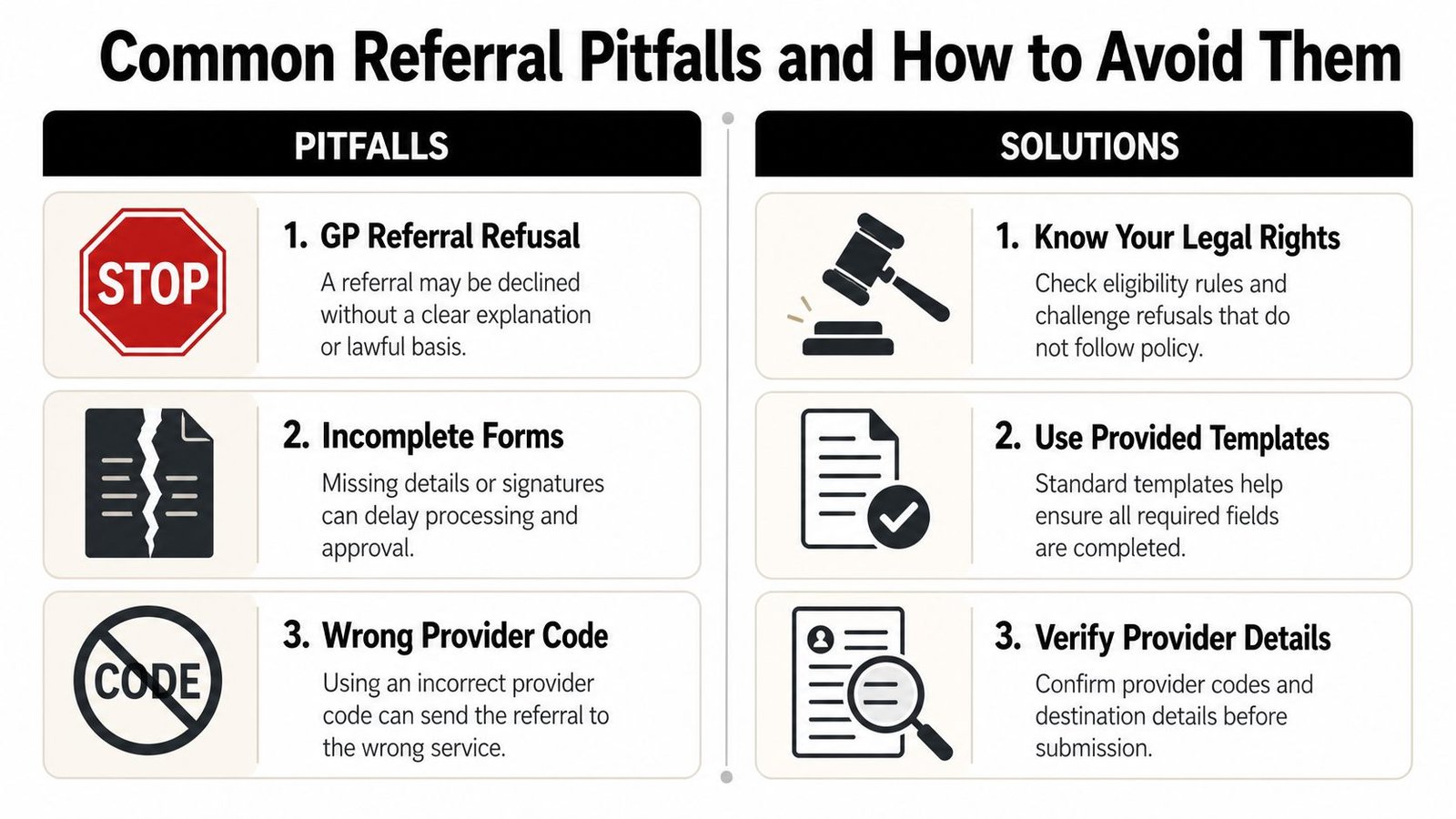
Common Referral Pitfalls and How to Avoid Them
The biggest mistake is assuming a GP saying “yes” means the referral is safe. It doesn’t. In real life, referrals stall because the practice uses the wrong form, the provider code is wrong, the commissioning contract doesn’t match the service requested, or the GP believes they can only use the usual local pathway.
The failures I see most often
- GP referral refusal. The practice says it can’t refer outside its normal route.
- Incomplete forms. The referral goes out without the provider name, service type, or required clinical details.
- Wrong provider code. Admin sends it to the wrong service, and the referral bounces.
What works when things stall
- Know the route. A referral can be made to a commissioned provider if the clinical and contractual criteria fit.
- Use a template. A clean referral summary reduces admin excuses.
- Verify details. Check the exact provider name, service, and form requirements before the appointment ends.
Regional variation makes this worse. Different Integrated Care Boards can handle referral admin differently, and that means two patients with the same request can meet two very different delays. Once the referral is sent, don’t assume silence means success. Follow it up.
There’s also a post-diagnosis bottleneck that too many guides ignore. You can get a diagnosis and still have problems with shared care for medication titration or ongoing prescribing. That’s where the system often stops being about access and starts being about continuity. If your pathway to diagnosis doesn’t lead to a workable treatment plan, the win is partial at best.
If you want a useful example of the broader healthcare workforce context around referral systems and career pathways, Access Courses Online’s healthcare career guidance is a sensible read for people who like understanding how clinical and administrative systems fit together.
How to Choose the Right Assessment Provider
A referral can look perfect on paper and still fall apart if the provider is the wrong fit. Start with regulation, clinician credentials, and aftercare. A provider should be CQC-regulated and staffed by psychiatrists on the GMC Specialist Register if you want confidence that the assessment is being handled at consultant level. That baseline matters more than polished branding or a promise of quick appointments.
Check what the service does, not what its homepage claims. If you need ADHD and autism assessment alongside broader psychological screening, you want a team that understands the overlap, not one that treats each condition as a separate checkbox. Adults often present with symptoms that cross neurodevelopmental and mood domains, and a provider should be able to handle that properly. For a practical way to check clinician background, use a psychiatrist finder that lists specialist credentials clearly.
What to check before you book
- Who is doing the assessment. Consultant psychiatrists with neurodevelopmental experience are a strong sign.
- What the report includes. You want clear diagnostic reasoning and personalised recommendations.
- How treatment is handled. Medication titration and monitoring should be discussed plainly if ADHD is on the table.
- How follow-up works. Ask how they support shared care, onward letters, and next steps.
- How transparent the process is. Defined timelines beat vague promises every time.
The best providers are specific about what happens after diagnosis. They do not stop at a label and leave you to sort out the rest. They explain whether medication titration is available, whether ongoing monitoring is part of the service, and what the report will contain so your GP, university, or employer gets something usable rather than a generic summary.
I would also trust a provider more when it is direct about timelines and report turnaround. Insight Diagnostics Global, for example, states that assessments are usually scheduled within seven working days and reports are completed within five working days thereafter, and that kind of clarity is exactly what patients need when the system has already wasted months of their life. The point is not speed for its own sake, it is speed that still leads to a clinically serious report.
Your Action Plan for Starting the Assessment Journey
Start this week, not “when things calm down.” First, write a one-page summary of your symptoms, childhood clues, work or study problems, and any mental health overlap. Second, choose the type of assessment you need, ADHD, autism, or both, and note whether you’re aiming for NHS-funded referral, private care, or insurance-funded care.
Then book the GP appointment and ask directly for a Right to Choose referral if you’re eligible in England. Bring your summary, any old reports, and the exact provider name if you’ve already chosen one. After the appointment, ask when the referral will be sent and how you’ll know it’s gone through.
If the referral stalls, don’t wait passively. Follow up with the practice, ask for the referral status in writing, and check whether the provider details were entered correctly. If the diagnosis comes through but shared care collapses later, keep every document, because continuity problems are usually administrative, not clinical.
The goal is simple. Get the referral moving, get the assessment done properly, and protect the handoff that comes after diagnosis. That’s how you stop the system from turning your need for help into another long wait.
Insight Diagnostics Global provides consultant-led ADHD, autism, and broader mental health assessments for adults who want clarity without being bounced around the system. If you’re ready to move from confusion to a proper plan, visit Insight Diagnostics Global and see how a structured assessment can help you take the next step with confidence.