

If you're reading this while sitting on a waiting list, chasing a GP appointment, or trying to work out whether your concentration problems, sensory overload, burnout, or lifelong social difficulty might be ADHD or autism, you're not alone. For many adults in England, the hardest part isn't deciding to ask for help. It's figuring out how to get assessed without being lost in a system that often feels slow, fragmented, and unclear.
NHS Right to Choose mental health becomes practical rather than theoretical. Used properly, it can help adults access a consultant-led assessment pathway for ADHD, autism, and wider mental health concerns through an NHS-funded referral. Used badly, it can lead to bounced referrals, confused conversations with GPs, and long delays because the rules weren't followed closely enough.
The difference is usually in the details. You need to know what the right covers, where it stops, how to ask for it clearly, and how to choose a provider that runs a proper clinical process rather than just offering a fast appointment.
What Is NHS Right to Choose for Mental Health
You book a GP appointment ready to ask for an ADHD or autism assessment, and the answer sounds fixed before the conversation has even started. Join the local waiting list. Wait your turn. Consider going private if you can afford it. For many adults in England, that is not the full picture.
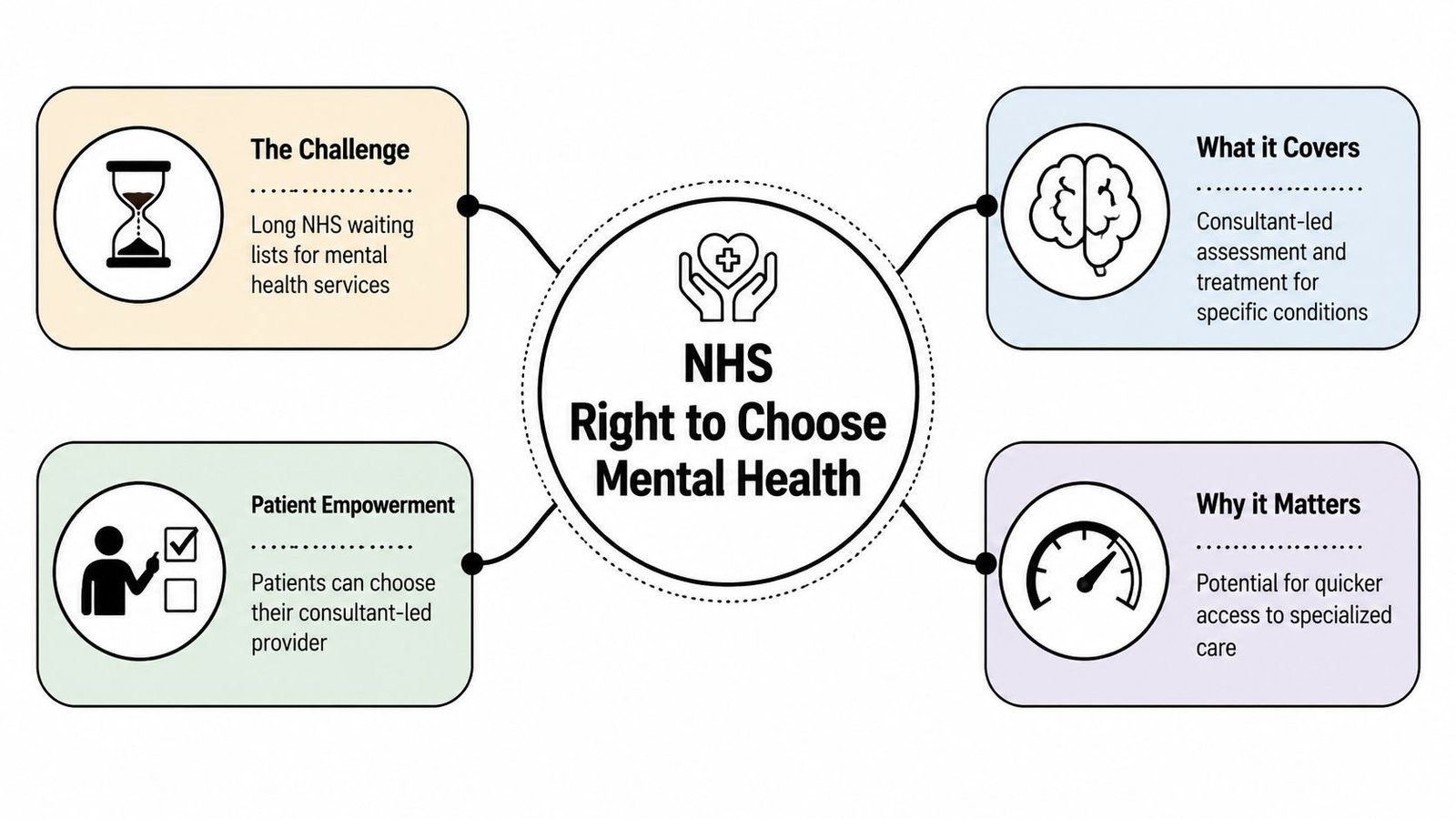
NHS Right to Choose for mental health gives eligible patients in England a legal route to choose their first outpatient mental health provider for planned care, including the clinical team responsible for that care where the rules are met. In practice, this means a GP referral does not always have to go only to the default local service. For adults seeking ADHD or autism assessment, that can open access to an NHS-funded consultant-led provider outside the usual local pathway. The key point is simple. This is a patient choice framework with legal force, not a favour a practice grants informally.
What the right actually means
For mental health, Right to Choose usually applies when a GP is making a planned referral for a first outpatient appointment. If the provider is commissioned appropriately for that service, you may ask to be referred there instead of accepting the standard local option.
That is where many referrals go wrong. A clinic being quick, well reviewed, or private does not make it available under Right to Choose. The provider must be consultant-led and set up under the right NHS contractual arrangements for the service you need.
For adult ADHD and autism, this distinction is practical, not academic. If you ask your GP for a named provider that clearly accepts Right to Choose referrals, you are giving them something they can act on. If you ask vaguely for "somewhere faster," the request is much easier to dismiss or misroute.
What it does not cover
The right has clear limits. It does not apply to urgent or crisis care, inpatient treatment, or certain settings and service types outside the outpatient choice framework.
That catches people out. A patient may have a valid concern, clear symptoms, and a supportive GP, but still hit problems if the referral route sits outside first outpatient elective care. This is one reason I advise people to prepare carefully before the GP appointment, especially if they are requesting an adult ADHD or autism assessment through a specialist provider.
Practical rule: Right to Choose works best when you are asking your GP for a planned first outpatient assessment with a provider that openly accepts NHS Right to Choose referrals.
Why patients use it
Adults usually use this route for one reason. Time matters. Delayed assessment can affect work, study, relationships, driving confidence, daily organisation, and mental health.
There is also a quality issue. The goal is not only a faster appointment. The goal is a proper assessment pathway with consultant oversight, clear diagnostic process, and usable follow-up information for your GP. If you are comparing providers, reviewing a guide to mental health assessment options near you can help you ask better questions before the referral is sent.
While you are waiting, structured self-monitoring can also help you describe symptoms more clearly at assessment. Some people find practical resources such as mental health tools for anxiety useful for tracking triggers, patterns, and day-to-day impact. That kind of record often makes the GP conversation more focused and gives the assessing clinician a clearer starting point.
Are You Eligible for an ADHD or Autism Assessment
For adults, the most common use of this pathway is a referral for a neurodevelopmental assessment. In this scenario, the rules become more specific and more useful.
The key point is straightforward. Right to Choose is explicitly available for adult autism and ADHD diagnostic assessments in England, provided the chosen provider operates under an NHS Standard Contract and meets service specifications, as set out in NHS information on patient choice for neurodevelopmental assessments.
The people most likely to qualify
You are usually in the strongest position to request this route if the following apply:
- You are an adult in England. The pathway discussed here relates to adult ADHD and autism assessments in England.
- You are registered with a GP in England. The referral needs to come through the NHS route that supports this choice framework.
- You need a planned assessment. This is elective care, not emergency or crisis intervention.
- You are seeking a first outpatient appointment for that issue. This is one of the most important legal boundaries.
If you're still trying to work out whether your symptoms fit either condition, a screening-oriented resource such as do I have autism or ADHD can help you prepare for a more focused discussion with your GP.
Situations that often lead to problems
People lose time when they hear that they can “choose any provider”, then discover that their case doesn't fit the pathway cleanly.
Common sticking points include:
| Situation | Why it may be difficult |
|---|---|
| Self-referral | Right to Choose works through a GP referral, not a self-booked request |
| Urgent deterioration | Urgent and crisis care sit outside this pathway |
| Already under secondary care for the same issue | The “first outpatient appointment” requirement may no longer apply cleanly |
| Wrong provider type | The provider must be operating under the right NHS contractual framework |
A lot of frustration comes from trying to use the right for the wrong stage of care. If the route isn't clinically appropriate, the referral can stall before it ever reaches the provider.
ADHD and autism are covered, but not every pathway is
This is an important distinction. The assessment types are covered. The way your local area routes referrals can still affect access.
For example, some areas centrally triage autism referrals before assessment. That doesn't remove the existence of the pathway, but it can affect how your GP has to submit the referral and what paperwork needs to accompany it. In practice, the patient who comes prepared with a named provider, a clear reason for referral, and concise symptom history tends to move through the system more smoothly than the patient who asks for “an autism test”.
How to Request Your Right to Choose A Step-by-Step Guide
This section provides essential practical information. The law matters, but the referral only happens if your GP has the right information and the request is presented properly.
In England, NHS Right to Choose is a statutory patient-choice pathway that applies when a GP makes a clinically appropriate elective referral for a first outpatient appointment. Patients can choose any clinically appropriate provider holding an NHS contract, and commissioners are responsible for upholding that choice, according to NCL guidance on choice in mental health care.
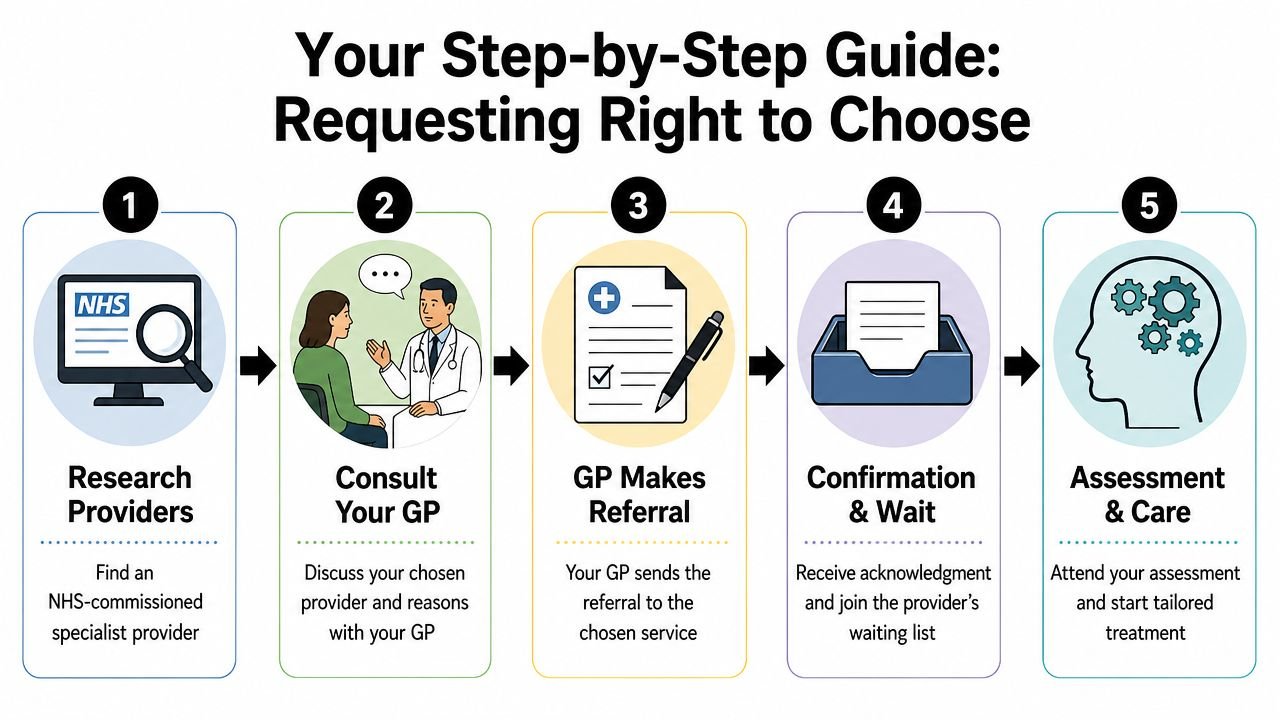
Step 1 Choose the provider before you see the GP
Don't go into the appointment with only a general idea. Go in with a specific provider in mind and check whether that service is appropriate for the assessment you need.
Look for:
- An NHS-contracted service model. If the provider isn't operating within the right NHS framework for the referral, your request may fail.
- Adult ADHD or autism expertise. Adult presentations can be subtle, masked, or complicated by anxiety, trauma, depression, personality difficulties, or burnout.
- A consultant-led pathway. This matters when symptoms overlap and the history is complex.
- A clear diagnostic process. You want to know how history taking, questionnaires, interviews, collateral information, and reporting are handled.
Step 2 Prepare a short clinical summary
Your GP doesn't need your entire life story in the first minute. They do need enough to understand why referral is appropriate.
Write down:
- The main symptoms causing concern.
- How long they have been present.
- Where they affect you most. Work, study, relationships, daily functioning.
- Why you think ADHD or autism should be considered.
- The name of the provider you are asking to be referred to.
Keep this to one page if you can. If you ramble, the request becomes harder to process.
Step 3 Ask clearly and directly in the appointment
You don't need to be confrontational. You do need to be precise.
You can say:
I would like to request an NHS Right to Choose referral for an adult ADHD assessment or adult autism assessment. I understand this applies to a clinically appropriate first outpatient referral, and I would like my GP referral to be sent to my chosen NHS-contracted provider.
If your symptoms include broader mental health concerns, it also helps to mention that the assessment may need to consider overlap with anxiety, mood symptoms, trauma, or personality factors. That signals that you're asking for a proper specialist evaluation, not only a label.
Step 4 Take a template letter with you
A written request reduces confusion. You can adapt this:
Dear GP,
I am requesting a referral under NHS Right to Choose for a first outpatient assessment relating to suspected adult ADHD / suspected adult autism.My symptoms are affecting my daily functioning, including [brief examples]. I am requesting referral to [provider name], which offers the relevant assessment pathway under NHS contractual arrangements.
I understand that NHS Right to Choose applies where a GP makes a clinically appropriate elective referral for a first outpatient appointment to a clinically appropriate provider holding an NHS contract.
I would be grateful if you could consider this referral and advise me if any further information is needed.
Yours sincerely,
[Name]
[NHS number if known]
Step 5 Follow up properly
After the appointment, don't assume everything is moving. Ask what will happen next.
Useful questions include:
- Has the referral been sent yet
- Was it sent through the correct referral route
- Do you need anything else from me
- If not sent, what is the clinical reason
If you need a practical overview of how specialist assessments are usually arranged, how to get a mental health assessment is a helpful companion resource.
Bring the provider details, your symptom summary, and your request in writing. That turns a vague discussion into a referral decision.
Choosing Your Consultant-Led Assessment Provider
Not all assessment services are built the same way. Some are thorough, consultant-led, and clinically careful. Others look simple on the surface but leave gaps around differential diagnosis, risk, or follow-up.

What to check before agreeing to any assessment
A good adult ADHD or autism assessment service should answer several questions clearly.
| Checkpoint | Why it matters |
|---|---|
| Is it CQC regulated | Regulation is a basic safeguard around service standards |
| Are clinicians on the GMC Specialist Register where relevant | Adult diagnostic complexity often needs specialist psychiatric judgement |
| Is the model consultant-led | Senior oversight matters when symptoms overlap with other mental health conditions |
| Is there a clear report and treatment plan | A diagnosis is only useful if the outcome is actionable |
| Can they explain follow-up options | Especially important for ADHD where medication review or titration may be relevant |
Why specialist depth matters
Adult neurodevelopmental assessment isn't just a checklist exercise. People often present with mixed pictures. Someone may have untreated ADHD plus anxiety. Another person may have autistic traits, trauma history, depression, and longstanding interpersonal difficulties. A shallow process can miss the true pattern.
That is why consultant psychiatrists with experience across neurodevelopmental conditions and personality disorder presentations, including clinicians such as Dr Sai Achuthan, are valuable in a diagnostic pathway. The point isn't prestige. It's clinical judgement.
One provider in this space is Insight Diagnostics Global's psychiatric assessment service, which offers consultant-led assessments for adults, including ADHD, autism, and wider mental health presentations. The practical value of that kind of model is that it can assess beyond a single symptom cluster and produce a structured report with recommendations.
Practical trade-offs patients often overlook
Speed matters, but speed alone isn't enough. A fast appointment with a weak assessment can create more problems later, especially if your GP or another clinician needs a thorough report.
Pay attention to:
- Communication quality. Do they explain the pathway in plain English?
- Report structure. Will the report set out history, findings, diagnostic reasoning, and recommendations?
- Medication pathway where relevant. For ADHD, ask what happens after diagnosis.
- Insurance and payment clarity. Some patients use self-pay, others use insurer authorisation. For clinicians trying to understand the administrative side of insurance participation, resources on how therapists get paid as a mental health professional are useful background reading because they show how funding arrangements shape access.
The best provider for you isn't simply the one with the shortest queue. It's the one that can assess your presentation properly and communicate the outcome in a way the rest of the system can use.
What Happens After Your GP Makes the Referral
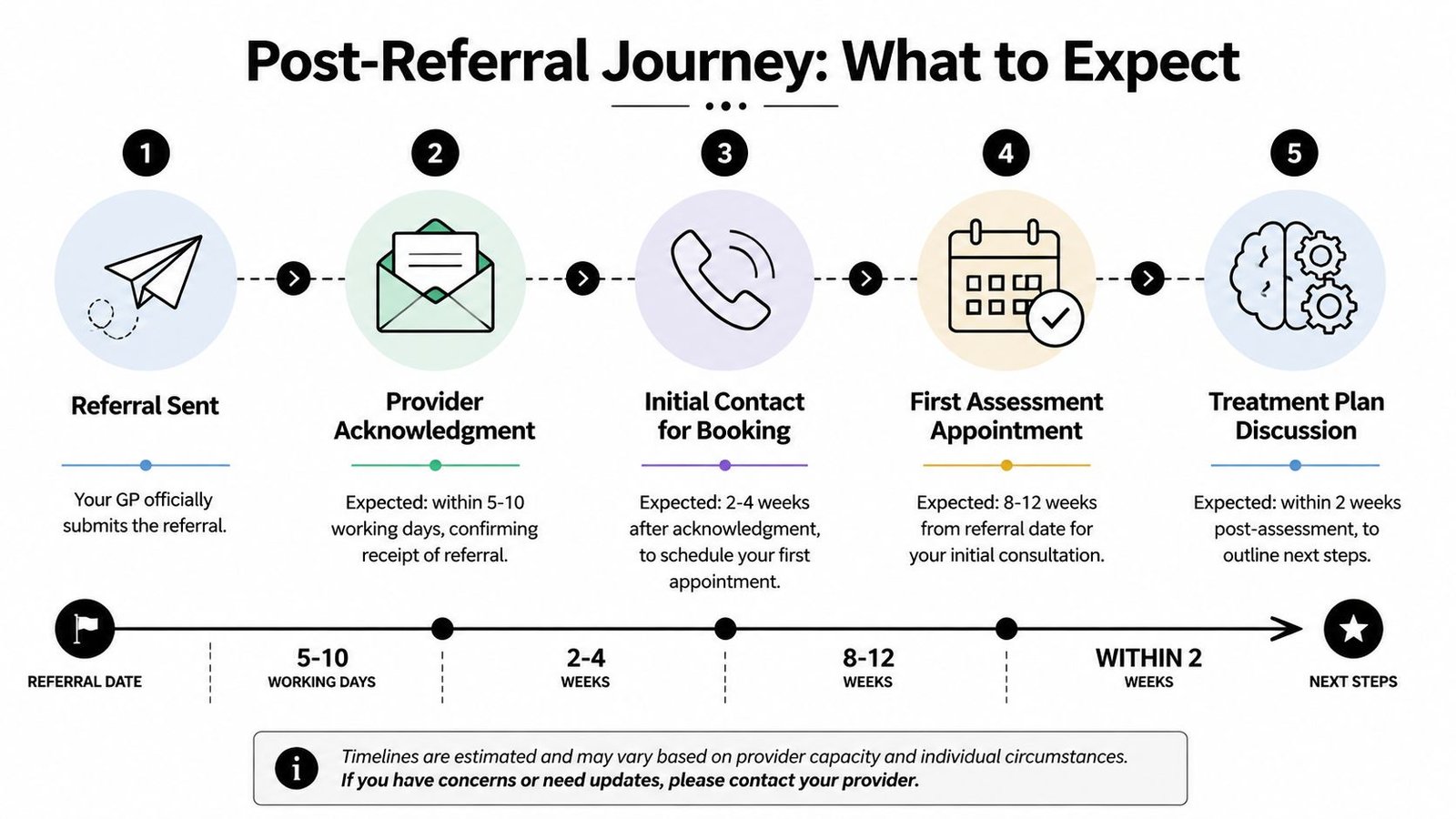
A common pattern follows. You ask your GP to send the referral, feel relieved for a day or two, then hear nothing and start wondering whether it has gone anywhere at all.
That silence is normal, but it should not be treated as progress.
People waiting for mental health support often report worsening symptoms while they wait, including serious deterioration and crisis, as reported in the BMA mental health pressures analysis. For adults seeking ADHD or autism assessment through Right to Choose, the practical goal after referral is simple: confirm the referral was sent, confirm the provider received it, and deal with problems early.
What usually happens next
After your GP sends the referral, the provider reviews it against its service criteria. For ADHD and autism referrals, that often means checking the referral letter, basic clinical history, and whether the referral is suitable for a first outpatient appointment under Right to Choose.
If the referral is accepted, you may receive forms to complete. These can include screening questionnaires, developmental history forms, or requests for informant evidence from a parent, partner, or someone who knew you well. This part matters more than patients sometimes expect. Delays often happen because forms sit unfinished or because the provider is waiting for missing background information.
Once that stage is complete, you join that provider's waiting list and wait for an assessment slot. Some providers keep patients updated well. Others are much quieter, so it helps to check what their communication process looks like from the start.
Where referrals commonly get delayed
In practice, I see two recurring problems.
The first is a referral that never reached the provider in a usable form. The GP may have agreed to refer, but the letter may not have been sent yet, may have gone to the wrong address, or may be missing enough detail that the provider rejects it. For ADHD and autism referrals, this is one reason template letters and a clearly named provider help. They reduce avoidable back-and-forth.
The second is administrative pushback from local systems. Patients are sometimes told that a local area prefers its own pathway or does not usually refer to a particular provider. That does not answer the actual question, which is whether your referral is clinically appropriate and whether the provider can accept Right to Choose referrals for your assessment.
Ask for specifics.
If a referral is rejected, ask the provider or GP surgery for the exact reason in writing. "Not accepted" is not enough. You need to know whether the issue is missing information, service criteria, pathway eligibility, or something else. Each problem has a different fix.
What to do while you wait
Keep a short record with four items: the date you saw the GP, the date the referral was sent, the provider name, and any reply you have received. This saves time if you need to chase the referral later.
If you have heard nothing after a reasonable period, contact the GP surgery and ask whether the referral was sent and on what date. Then contact the provider and ask whether it has been received and whether any further information is needed. That one-two check picks up a lot of silent admin failures.
If your symptoms get worse while waiting, go back to your GP. Right to Choose can help you access planned assessment. It does not replace urgent mental health support, risk review, or treatment for deterioration while you are on the list.
Common Questions About the Right to Choose Pathway
You ask for an adult ADHD or autism assessment, your GP agrees in principle, and then the questions start. Can they say no. Does being under another team change things. Will a diagnosis lead to treatment. This is usually where people get stuck, not at the policy level, but in the practical details.
Can my GP refuse to refer me
A GP can decide that a referral is not clinically appropriate. They should still explain why.
Ask for the reason in clear terms. Is the concern about referral threshold, the provider's suitability, missing information, or whether Right to Choose applies in your case. Those are separate problems. They need separate fixes.
A vague answer such as "we do not do that here" is not enough to act on. A specific answer gives you something you can address.
Can I self-refer under Right to Choose
No. Right to Choose starts with an NHS referral, usually from your GP.
You can still contact a provider before the appointment to check whether they accept adult ADHD or autism referrals, what documents they need, and whether they are consultant-led. That groundwork can save time, but it does not replace the referral itself.
I'm already under a mental health team. Can I still use it
Sometimes, but this is one of the more complicated situations.
If you are already in secondary care for the same condition, the standard Right to Choose route may not apply in the way people expect. In practice, that often means your GP and current team need to be clear about what is already being managed, what assessment is still needed, and whether an external provider can accept the referral.
This is worth checking early. It is much easier to sort out before the referral is sent than after it is rejected.
Does it cover urgent help
No. Right to Choose is for planned assessment and treatment pathways, not crisis care.
If you are at immediate risk, or your mental health has deteriorated sharply, use urgent NHS support through your GP, NHS 111, local crisis services, or emergency services if needed.
Does Right to Choose guarantee medication or long-term treatment
No. An assessment and a treatment pathway are linked, but they are not the same service.
This matters a lot for ADHD. Some providers assess and diagnose, but medication titration, follow-up reviews, and shared care with your GP may sit on a separate pathway. Ask those questions before choosing a provider, especially if your main concern is not only getting clarity but also accessing treatment after diagnosis.
For autism, the trade-off is often different. The assessment may answer a long-standing question and support workplace or education adjustments, but it does not usually lead to medication in the same way an ADHD pathway might.
I'm a university student. Can I still use it
Often yes, if you are registered with a GP in England and your referral meets the pathway rules.
The practical issue is usually GP registration. Some students are registered near university but expect their home GP to manage the referral, or the other way round. Check which surgery currently holds your registration before you request anything.
What if my GP says my area doesn't allow it
Ask them to be precise.
They may be referring to a local preference for using the area's usual service. That is different from saying Right to Choose does not apply to your case. Ask whether the problem is legal eligibility, service criteria, funding approval, or local process. Once you know which one it is, you can respond properly.
What tends to help
A structured request gives your GP something they can act on. For adult ADHD and autism referrals, the strongest requests usually include:
- the assessment you are requesting
- the full name of the consultant-led provider
- a short summary of current symptoms and functional impact
- any provider forms or referral information the surgery needs
- a written request you can leave with the GP or send after the appointment
Template letters help. They reduce ambiguity, keep the referral focused, and make it easier for the surgery to send the right information first time.
If you're ready to move from questions to action, Insight Diagnostics Global offers consultant-led adult assessments for ADHD, autism, and broader mental health concerns, with online and face-to-face appointments, written reports, and follow-up pathways where appropriate.